Wednesday, March 21, 2007

Wir setzen uns mit Tränen nieder


Now is the Lord brought to his rest.
My Jesus, now good night!
The toil is o'er which all our sins have laid on him.
My Jesus, now good night!
O thou, most blessed body,

See how I weep with grief and sorrow for thee,
That thee my fall to such distress hath brought!
My Jesus, now good night!
Have all my life
For thy great passion countless thanks,
That thou my spirit's health such worth did pay.
My Jesus, now good night!

We lay ourselves with weeping prostrate
And cry to thee within the tomb:
Rest thou gently, gently rest!
Rest, O ye exhausted members!
This your tomb and this tombstone
Shall for ev'ry anguished conscience
Be a pillow of soft comfort
And the spirit's place of rest.
Most content, slumber here the eyes in rest.

- J.S. Bach, St. Matthew Passion

Monday, March 19, 2007

Arma Christi

Christ was born to die.

From the very first moment we are schooled in the Catholic religion, we have always been taught that Jesus, the Son of God, was destined to die. We are bombarded with the many verses from the Old Testament, which pre-figure His miraculous birth; His rejection by His own people; His agony and suffering; His being despised, mocked, beaten and ridiculed by the bloodthirsty crowd. His was a story marked by the greatest of sorrows. Contrary to popular opinion at the time, Jesus was not the divine warrior-Messiah, born of kings and ruler of the powers of the world that the Jewish populace expected Him to be. Rather, He was the complete opposite: a commoner, having been born in a filthy manger with beasts for companions. His birth was not met with jubilation; we know for a fact that He was the main reason why Herod ordered the slaughter of the Israeli firstborn. Our Lord was born in a time of tribulation and distress, baptized by fire and adversity, no glorious warlord but a peasant carpenter.

When the Child grew up, He took his place among the men of His society. Like any Jew, He would have been circumcised; He would have visited the Temple as well, and that He did, even wandering away from His earthly, foster parents. Much of what we know about Him during these days is shrouded in secrecy; but we do know from Scripture that He grew up in wisdom and grace, and was found favorable to the LORD. When He had finally reached manhood, the Boy took up His father Joseph's trade. He must have been quite an excellent carpenter; one would expect nothing less from the Son of God Himself. Like us, He too cried, felt sorrow, fell ill and got impatient; but unlike us, the Boy never sinned.

He was probably very close to His Mother, as well. She it was who nursed Him, fed Him, clothed Him and served Him with her whole being. She loved Him as well, and He loved her. His father, too, would have been proud. He was a noble man, whose justice, purity, patience and humility knew no equal. Sadly, he never got to see Jesus grow into maturity. Somewhere in those hidden years, Joseph died. And perhaps he it was who held the singular greatest comfort a man can have, for he died in the loving arms of God Himself, and with him grieved the Virgin Mary, whose tears were a more soothing balm than anything we mortals can produce.

As the Boy grew older, His life began to take its first steps in the redemption of the human race. From the moment He came to the river Jordan to be baptized by His cousin John, when the Spirit of God descended upon Him, He knew there was to be no turning back. For the next three years of His life, He practiced His public ministry, ministering to the apathetic, the zealous, the sinner, the saint, the wounded, the healed, the virtuous and the vicious. All of them came to Him. They listened to His words, and marveled at His wisdom.

The Pharisees eventually came to hear of this 'wonder worker'. These men, a 'brood of vipers' and a pack of 'whitewashed sepulchres' as He called them, were filled with envy and rage at His growing popularity. They resented how the crowds came to believe that He was the long-awaited Messias, and how they held Him in greater esteem than themselves. Their blood boiled at the thought of Him who dared to minister to Samaritans, their people's sworn enemy, and they vented their collective rage at this 'charlatan' who dared to call Himself God, Who had the gall to upbraid them of their errors, and who sacrilegiously vowed to destroy the Temple-- and rebuild it in three days' time.

They soon heard the news that He was coming to Jerusalem. And came the fateful day did. When He entered the Holy City, He was greeted with almost universal acclaim by its people. They beheld Him, a figure in white, Who rode a donkey as a sign of His humility. The prophecies of old were suddenly being fulfilled. Here is come the Saviour-- the Messias-- Who would deliver Jerusalem from her enemies, and Who would reign in glory as its rightful king and lord.

One of the first things He did upon entering the City was to cleanse the Temple of the myriad plagues that threatened it. Like a prophet of old, He seized arms and began to beat the merchants and simoniacs who dared to profane the House of God with their gluttonous trade. 'It is written, My house shall be called a house pf prayer!' And with that, the wicked men flew away from Him, melting like wax in the presence of the ardent fire that was now before them.

Eventually, the Pharisees caught up with Him. In a mock trial in a mock court, in the middle of the night where hidden things came to vivid life, they accused Him of blasphemy, sorcery, sacrilege and a myriad other accusations. The same people who had greeted Him five days earlier, who laid palm branches and shouted 'Hosanna! Hosanna to the Son of David!' and who rightfully claimed Him as their king, now came up to Him with the most venomous of calumnies. They accused Him of sedition, of being a puppet and slave of the Babylonian Beast (Rome), and of being a liar. The same people who had welcomed Him with loving arms now sought to wrap those same arms around His neck.

The furor eventually came to the attention of the Roman authorities. In one of the greatest tragedies in human history, Pilate, who knew that Jesus had done no wrong, gave in to the bloodlust of the crowd. And the Pharisees incited the crowd to have Him crucified. 'Crucify Him!', they said. In the face of all these, after having endured a monstrous flogging which ripped flesh from His bones and left Him a mass of scarred, bloodied and broken pulp, He maintained an almost uncanny silence. See how He forgives--and loves us-- even to the point of death!

They load the Cross on His bruised and broken shoulders. It is heavy and big, even for a healthy and strong man. But He still carries it with love and devotion. Although He has practically been reduced into literally a bundle of sinew and bleeding orifices, and even though the weight of sin was crushing Him into oblivion, He knows that it is His duty to fulfill it. He knows there can be no escape now. And He knows that He cannot back down now.

Golgotha. The place of skulls. It is a cruel site, a barren and desolate patch of land atop a ragged hill. Here is the site of His death. He arrives soon enough, and the sight of that dry patch of land was almost a relief to Him. The Roman soldiers, exceedingly cruel even in their own day, strip Him of His garments. The crown of thorns they had forced onto His head cause blood to pour down His face. His body is half-alive and half-dead, but more dead than alive. They push Him onto the cross, and they nail His hands and feet. The nails they use are no mere ordinary nails-- on the contrary, they are more akin to spikes. The cruel iron nails dug onto His flesh and pierced His bones. He is now a wailing piece of meat, yet even in this condition, He ha the gall to forgive them. 'Father, forgive them, they know not what they do.'

His mother arrives soon, and she is devastated at the sight of her son. She beheld Him now, literally a bloody, gore-dripping mass of broken and beaten flesh, cruelly nailed to an even crueler cross; condemned like a common criminal, yet debased and humiliated lower than dung itself. Her tears stream down her face, and it is as if a sword had pierced her own heart.

Then, after more than three hours hanging in that awful beam, He expires. He surrenders His soul to God, His Father. 'Tetelestai-- It is accomplished!' He pauses one more time. And with a heavy heart, He says 'Father, into Thy hands I commend my spirit'. And with these words, He breathes His last. The sky darkens. The earth trembles. The world is plunged in darkness.

Yet, in that dead hour, He has achieved His greatest victory. By His death, He has forever won for us the price of eternal life; we who have crucified, mocked, flogged and humiliated Him-- we who lacked the courage to speak out against the terrible injustice being levied against this Man-- have been bought with the blood of God Himself. We have been ransomed from the pain of everlasting fire.

The nails, the wood of the cross, the flagella, the crown of thorns, the ladder, the sponge, the spear. All these call to mind the darkest hour of the human race. But in that blackest of hours, the light of Christ shone forth, forever dispelling the darkness. By His death, we are free. He has laid waste to the strongholds of the Enemy and He has put the Wicked One's works to destruction. He has plundered the armouries of darkness and has broken the iron bars of its gates. By His death, He has conquered Death itself. And by rising from destruction, He has given us new life.

Saturday, March 17, 2007

Auto da Fe

When I was growing up, I was always told to be prim, proper and decorous at all times. In truth, my childhood was rather Puritan in character. Instead of horsing around with the kids at the neighborhood, I would read Grimm's Fairy Tales and Aesop's Fables non-stop, since learning, after all, is a nobler endeavor. I learned about architecture, music and art through my aunts-- I had six whom I always saw-- and they would always tell me how rock music incites the mind to worldly things, how smoking can be a precursor to 'the fire that quencheth not', how cleanliness IS Godliness. They would also tell me about the Bible; I particularly liked the Old Testament and its stories, which to me seemed exceedingly rich and bursting with excitement.

It was in my seventh year when I lost my 'innocence'. One night, as my brother and I were playing with our Power Rangers action figures ( he had an eight inch Ivan Ooze, while I sicced the (MY) mighty Dragonzord at him), one of my aunts came up to us. Like any concerned relative, she advised us to be careful, and not be overly violent. Then, as we were taking a break, she brought out a rather thick volume from her bag; it was a book, bound in black. It wasn't the biggest book, nor was it probably the most interesting. But it carried with an omen of doom.

'Have I got a story for you two. I'm going to tell you about the end of the world.'

That night, I couldn't sleep. I could still see in my mind's eye that vision of the world-- the same earth that Captain Planet just saved from evil industrialists that morning-- shrouded in a sea of fire. It was utterly dark; pitch black was an understatement. I could hear the wails of torment of the damned, their bones being crushed by the massing darkness, the cries of their lamentation lingering like shreds if cloud in that inescapable realm. I could smell the foul mixture of blood and filth, and my skin crawled at the thought if having devils-- murderers, charlatans, ingrates, the proud, the arrogant, the damned-- as my eternal companions.

Later on, I was to find out that the book in question was Bellarmine's perennial classic, 'Hell And Its Torments'. Why an Evangelical was reading it to me would later puzzle me-- and it still does, mind you-- but all of that wasn't important for me. What mattered for me then was how to save my soul, and to avoid such a horrible fate.

For the next few years, I lived in the shadow and fear of this memory. It was in 2002 when I first started to read more into Catholicism. It was during this time that I first came across Sedevacantism: I still remember reading, and being shocked and scandalized, at the supposed '101 Heresies of John Paul II'. I was intrigued when I heard stories about Paul VI's corpse exuding a foul stench during that pontiff's wake, and how John XXIII's body supposedly faced downward (Hell) when his coffin was opened. I lived in an almost millenarianist paranoia, thinking that the end of the world was literally waiting around the corner. I kept thinking about my fate, of whether He would count me among the blessed, or if He would turn His face away from me, and condemn me to everlasting fire.

Ironically, it was also this time that my Evangelical relatives told me about how the Catholic system was a deluded mess, and that it was a synthesis of abomination, with its 'Mariolatry', 'bread-worshipping', and its 'necromancy' (obviously referring to the veneration of saints). In particular, they pointed out to me how the Mass 'killed' Jesus again and again, and that it mocked Him by making a ridicule of His sacrifice (a wafer can never save my from my sins, they said); as well, they called the Pope the anti-Christ, and that this pope (then JPII) would be the final one; Christ, they said, was coming soon to render glory to the just and vengeance to the wicked. Amen.

A couple of months later, I found Catholic Answers. That site provided a blow-by-blow counter-attack to even the most vicious Protestant punditry. It analyzed the Church not just from a Biblical perspective, but also through historical, cultural and sociological methods. The myth of Sola Scriptura was forever crushed, in my eyes. Without that doctrine, everything else in Protestantism falls. Then, in that same year, I came across Traditional Catholic Apologetics (http://www.catholicapologetics.net/). To me, that site contained the most detailed and the strongest attacks on the errors of Protestantism. I particularly liked that site's sections on the Protestant Bibles-- that, for me, ultimately sealed the deal.

That was somewhere in late 2003/early 2004. During this time, I became more confident in my resolve. I started hanging around in the Yahoo! Chatrooms and debated the Prots, often through vicious and violent means (I called many of them worthy of death). I was practically a militant; I felt like Christ when He drove the moneychangers and simoniacs out of the Temple, or when He called the Pharisees 'a brood of vipers'. It was like a mad sugar rush, only it made me angry. Very angry.

Then, in the middle of 2004, I became re-acquainted with the Sedevacantist movement. I came to believe that the Novus Ordo Missae was possibly tainted with the odour of heresy some months before; but my frequent visits to Traditio and Novus Ordo Watch bolstered this conviction to a soaring degree. Eventually, I ended up being a Sedevacantist (though only for a short time). I was convinced that JPII was a pertinacious heretic, and that the Council and its popes were irredeemably and hopelessly damned for their destruction of Catholicism. I was a fanatic and proud of it. If your mantilla wasn't long enough, you are a Jezebel; if your knees buckled at your genuflection, that was a sign of weakness, perhaps even homosexuality. And if you dared so much as smile or laugh or turn your head during Mass, you are disrespecting God, and are deserving of a punch to the face, a kick in the spine and a hammerfist to the head.

I was in a perpetual state of tension, and I prided myself on that achievement, if it can be called that. I congratulated myself for reading as much papal (pre-conciliar) encyclicals as I can, and I flaunted the fact that I knew Latin, however rudimentary, to everyone claiming to be a good Catholic-- and when they gasped in amazement, I would smirk, give him or her a condescending look, and proudly say 'Everyone knew Latin before that f-----g Council introduced heresy into the lifeblood of the Church'. I liked being called a 'Triumphalist'-- to me, it was the surest sign of holiness and love for the Church. I was a 'son of thunder' and I thundered across the plains of heresy, schism, weakness and lukewarmness with the zeal and conviction of the martyrs.

But my conviction peaked. It had reached a maximum point, and the only place left to go was downward. Somewhere in 2005 or 2006, I just lost it. I came back to sinning. It seemed as if I would ultimately be consigned to hell, and that I would forever share in the company of the wicked and the damned.
In early May of 2006, around the time I started this blog, I visited San Agustin church in Manila. This venerable stone shrine, run by the Augustinians, was a perpetual 'sermon in stone', having survived several earthquakes and natural disasters in the past. It was a masterpiece of the Spanish Plateresque: inside, the mighty vaults of the ceiling declared the glory of God with its magnificent trompe l'oeil, and the fourteen side altars, all singularly glorious, were awash with the grace and wisdom of the ages. As you walk down the nave, your gaze is drawn to the imposing main altar: a vision of such grandeur and beauty that it moves you to tears. In the central niche was housed an image of the Apostle Paul, sword in hand, gazing from his 'throne', a look of compassion in his face. Two candles burned perpetually beside him. The silver altar fittings gleamed with faint light in that rainy day.

St. Paul, of course, is the greatest apologia for Catholicism. This man, who was single-handedly responsible for the destruction of many ancient Christians, who traveled to Damascus, who encountered Christ on that fateful road, and who would ultimately become one of the pillars of the very Faith he sought to vanquish by fire or force; this man who sinned and was forgiven, who killed and 'died in Christ'; I saw this man, looking at me from his niche, with eyes full of vigor and compassion. The expression on his eyes put to shame every Catechism, encyclical, exhortation, dissertation or spiritual writing I've read to that point.

I did not cry, but I looked at that loving gaze for what seemed hours. I felt like Pilate, and I wanted to scream with him: 'Quid est veritas?'

Moments later, my concentration was broken, as a group of women, clad in white, their heavy mantillas shrouding their heads, marched to the front pews and took their seats, some two rows ahead of me. They were a motley crew of eleven: some were rich, some were poor. I concluded that one of them was a teacher, another a mid-level executive, some housewives, and some widows. A number of them spoke in hushed tones. I heard some mild laughter. One pulled out her antique mother-of-pearl rosary with the flourish of a conductor brandishing his baton. Two or three intoned the 'Salve Regina', their voices frail, while another said the Golden Arrow ('May the most holy name of God...'). For me, that scene was the visual equivalent of St. Paul's metanoia-- and how fitting this would happen in this noble and venerable church dedicated to the very saint!

The women eventually finished their devotions. Then, I saw the ministers vesting the altar for Mass. The lights were turned on, the candles lit. Soon, more and more trooped to the church, and took their seats under the church's great ceiling. I saw several tourists pose for pictures near the altar, while a cute American five year old boy descended from the pulpit. I soon left, as I still had business to attend to.

It was then that I realized how much I've fooled myself. I prided myself in my vast knowledge, and took this as a sign of my personal holiness. I lived under the shadow of a lie.

That experience in the church was more powerful than any theological construct I've read. Like Paul, we too have sinned: and like Paul, we can still find redemption. Often this comes to us in our darkest hours, when God has seemingly abandoned us to whims of this world. By blood, sweat and tears, we try our best to make amends for our myriad faults. We beg Him to grant us the grace to face the challenges ahead. But this is not the affair of the mind, but of the heart. Redemption is after all, a unitive thing. We cannot redeem the 'mind' alone, or for that matter, merely the 'heart'.

The Christian life is inherently a life filled with contradictions. But it is the only path worth taking, because it is the only path that makes the prize so much sweeter. That is the beauty of our Faith: more than anything, its idea of 'perfection' stems from the basic acknowledgment of our inherent weakness. I am reminded of a story Sir Anthony Hopkins once told. As the story goes, the actor once asked a Jesuit priest regarding the shortest and most effective prayer he knew. The Jesuit paused for a moment, looked hims straight in the eye, and said: 'Fuck it, it's in God's hands'.

The women in that church viewed their whole lives as an auto da fe: an act of faith. They sin and pray and hate and forgive: but behind their human weaknesses lies a conviction, tempered with fire and harder than steel, that there is a God out there Who loves them. And it is a God who became man, Who suffered as man, Who now lives and reigns in glory undimmed for all eternity.

The Jews expected a divine man to deliver them from tyranny and oppression. Ours is a human God, Who, by entering our world and suffering with us and for us, has forever delivered us from sin and death. We have only to realize this fact. After all, it is by our own choices that we are rewarded or punished in the life to come.

Tuesday, March 13, 2007

Authentic Yet Exotic

Like many in Mexico, Tzintzuntzan is a Catholic city. The name literally means 'place of the hummingbirds', and it holds the distinction of being the capital city of the Tarascan region. In Pre-Columbian times, Tzintzuntzan covered only a measly seven square kilometers, a far cry from the 165 square kilometer city that it is today. Tzintzuntzan is also famed for its weaving; in fact, baskets are one of its main exports. As well, it is significant to note the presence of many steppe pyramids, many of whose stones were hewn to provide suitable building materials for the first Catholic chapels in that region. It is a quaint, rural spot, largely untouched by the hustle and bustle of the Twentieth and Twenty First centuries.


Holy Week, as observed in this quaint little Tarascan outpost, follows the general pattern of exuberance and solemnity particular to countries which have been colonized or influenced by Madre Espana. On Palm Sunday (or Good Friday? I forgot), a detail of ten or so crimson hooded men enter the church, presumably to herald the arrival of the King of kings. Also central to the celebration of Holy Week are the various parades that speak of the pageantry of bygone days, when the world was still innocent. On Good Friday, seven, ancient crosses, entrusted to the same families for hundreds of years, are brought out of storage. They are paraded several times that day, with the greatest of pomp and most solemn of ceremonies. When the procession is finished, the crosses are taken to the town church, where they are displayed for veneration in the church's entrance. And, as is customary to many Mexican villages, the Passion play is performed. It is interesting to note that as recently as thirty to thirty five years ago, penitents still had themselves crucified, as is still practiced here in the Philippines.

To many of us, such scenes are reminiscent more of superstition than faith, of exaggerated machismo rather than true contrition. We are appalled by the sight of blood, by the gore-dripping depictions of the Christ, even by the solemnity in which all of these things happen. We are scandalized by the un-orthodox depictions of His suffering; we frown, for example, at a bow-legged Christ, hanging from a cross by the palms of His hands, which by now are reduced to no more than a mere bundle of sinew. For us, these are the vestiges of an age of mysticism, an age that has been replaced-- conquered-- by an age of reason.

However, exotic as it may seem, such scenes used to be the norm.

I remember my grandfather telling me stories about his youth. He was born in 1922, a mere 24 years after Las Islas Filipinas became independent of Spain, and when the American Occupation began. My grandfather, being a Nationalist, was incensed at the Church in those days. He would tell me, for example, how we would give food to the wandering Aglipayan ‘priests’ while hiding the rest from the Catholic ones. He contemplated joining the Masons, but even they were too ambiguous and anti-religious for him.

Some years later, he met my grandmother. Her mother was a very devout Catholic, although her father was a Mason. On Sundays, she and her mother would both sneak off from the house to attend Mass while her father slept. She recalled gutting an old screen door to use the mesh as a veil, because any sign of the ‘Spanish religion’ was dealt with accordingly. My grandmother grew up to be a very religious person. And by the grace of God, her father left that horrid group and was reconciled into the Church in the 1940s.

It was my grandmother who taught my grandfather to pray. When they were still newlyweds, she would also act as a catechism teacher to him, and together they would pray the rosary, go to Mass, visit the major shrines of the Virgin, attend the evening Benediction and read Scripture daily. It was a simple life, a life characterized by vigorous piety and a genuine, deep-rooted love.

In those days, penance was a very strict affair. There were none of the penances we are so accustomed to these days. In the early part of the Twentieth Century, a typical penance for missing Sunday Mass would have the penitent kneel on a handful of rock salt for half an hour straight. It was an excruciating affair: I tried it once out of sheer curiosity, and needless to say, that was the reddest I’d ever seen my knees. The salt dug onto my flesh, scratching the delicate covering and leaving gaping pock marks for the rest of the day. Another penance, usually for sins of the flesh, would be to crawl to the altar on one’s elbows and knees. This was very interesting for me; in my grandfather’s case, he would make sure to visit an important Marian shrine to do his penance. One such famous shrine is that of Nuestra Senor de la Paz y Buen Viaje, located in Antipolo.

The trek to this place alone was already penance enough. Antipolo was nestled on top of a hill, some 1 to 1.5 hours away from Manila. Traditionally, devotees would walk all the way to shrine barefoot, as a sign of penitence and humility. This arduous journey usually left its mark in the many blisters that dot the devotee’s feet. The whole trek was so exhausting (this was around 30 kilometers at least, if I'm not mistaken), that may devotees sang this song along the way:


Tayo na sa Antipolo
At doon, maligo tayo
Sa batis na kung tawagin
Ay Hinulugang Taktak


* Translation: “Let us forth to Antipolo/and there let us bathe/in the river called/Hinulugang Taktak)

The ordeal doesn’t end here, however.

When the shrine’s glimmering roof is first glimpsed, penitents immediately drop to their knees. From there, they crawl to the Shrine, heads bowed, hands clasped at the chest. Pious old women bring out their heavy lace mantillas and cover their heads, while men take off their hats, if they have any. A group on a pilgrimage might sing a Marian song, like ‘Salve Regina’ or ‘Ave Maris Stella’. The rosary is also usually prayed. Remember that this is no small group: a typical day at the Antipolo Shrine, even on weekdays, draws up to several thousand devotees.

To enter the shrine church is everyone’s dreams. When one first enters the shrine, his eyes are immediately drawn to the gilded silver retablo. In the central niche, beneath a solid silver baldaquin, rests the image of Nuestra Senora de la Paz y Buen Viaje. She is no more than three feet tall, but her devotes throng in the thousands. One might even argue that it is not an exceptionally carved image of that it looks almost too provincial; but then again, this is not the main concern. These man and women have come to Mary’s shrine to honor her with praise. The devotees usually bring flowers with them, whether it be a single red rose or a bouquet of the most exquisite kinds available, and lay them at her feet, the devotion of a child to his mother.

My grandfather, sorry for his sins and those of his past life, crawled on his hands and knees. It seemed like an eternity to crawl all the way to the altar. His head was bowed down, his eyes contemplated the floor. He dare not look at her whom he has shunned, ignored and rejected. But from the corner of his eyes, tears well. They are the tears of hope and joy.

Most of us, sadly, don’t have such stories to tell. Such is the unfortunate fruit of the dreaded 60s affair. What we formerly held as being the norm is now viewed, almost like a specimen in a museum, as something strange and exotic. Our traditions are no longer part of the cultural mentality, but reduced to a severed limb, a nude on display for the fascination of an unknown age.

The problem with many traditionalists is that we often forget that we are not the whole of tradition. This was the main reason I became alienated to so many self-proclaimed “rad trads”. Beneath all their pretenses of being traditional lies the fact that they view the soul of tradition as being theirs for the taking. In short, what is considered ‘traditional’ may, in fact, just be someone else’s opinion of what is. For what it’s worth, being a ‘rad trad’ is really nothing but taking tradition into our own hands and owning it—the very antithesis of what tradition is all about.

We look at such devotions as being remnants of a superstitious age. But these criticisms come not only from the hated liberals—they also come from conservatives and traditionalists. Sometimes I wonder what the point of being a traditionalist is when these people (including myself) cannot even agree on what traditional means. Is it merely the Mass? Is it merely devotions, processions, parades and badly-garbed statuary? Common sense tells us no. For me, this is our ultimate tragedy as Catholics—the loss of our culture. It is sad when holiness is measured by how long a woman’s chapel veil is, or how much of a dialectic philosopher one is. Gone are the piety of old that did things with the heart and the mind, which has now been replaced by a thoroughly intellectualist spirituality. It is sad when such pious customs as crawling to the altar, walking barefoot for the Stations of the Cross, or offering flowers to Our Lady are relegated to the dusty museum halls of the past.

It is a sad thing when we start to lose that gift our fathers in faith have tried to hard to procure for us, by sweat and blood and toil.

Sunday, March 11, 2007

What Difference A Council Makes

Over at The Hallowed Ground, you can find pictures of a Solemn Papal Mass of canonization celebrated by Pope Paul VI in the years before that horrid 1960s affair reared its ugly head. Among others, there is a picture of the Holy Father drinking the Precious Blood through a golden fistula, something which that unfortunate Council did away with. The new sancti being glorified in this Mass are St. Charles Lwanga and companions, missionaries from Africa who have sprinkled that land with their blood as a powerful witness to the grace and love of Christ. I will say no more and let the gorgeous pictures speak for themselves.

Click the following link to read the whole post. The rest of the blog should also not be missed, as its impressive photo collections can attest to.

Friday, March 09, 2007

Some Thoughts on Tradition

This post will yet again be brief, but it is my hope that I can at least communicate something coherent and in the end profound to the reader (if any, lol).

Tradition, as I've said in my previous posts, is the essence of the Church. The word itself hails from the Latin 'traditio' which means something which has been handed down. Tradition is more than just the sum of all the gestures we do during the Mass; in tradition, we see the entire history of the Church, from Her infancy to the present day. A genuflection, for instance, is more than a mere act of politeness; it also symbolizes our affirmation of the doctrine of the Real Presence, as well as the fulfillment of the Biblical command that 'at the name of Jesus, every knee shall bend'. In the numberless gestures that we Catholics make-- whether the triple cross during the Gospel, or bowing the head at the mention of the Holy Name, or kissing a St. Michael medal in times of trouble and affliction, we see a part of the truth of the Church. Tradition, then, is almost a 'sacrament'. It binds and has bound Catholics throughout the centuries, and still does so, albeit on a less obvious level (no doubt due to our own fault). Tradition both sanctifies us and has, in turn, been sanctified, canonized, by the actions of many saints in the past.

Tradition is history. It helps us to reconnect with our past, without actually dwelling on it. The beauty of Tradition is that it is by nature 'sacred'. It has been hallowed, as it were, by its usage by men and women greater than ourselves, and has given strength and succor even to the destitute. Tradition, then, connects the rich to the poor, the mighty to the fallen, the sinner to the saint. Tradition tells us, rather, reminds us, of that one truth we have seemingly forgotten: that the Church is a living, breathing entity, much like an extended family. Oftentimes we are confined to the notion that the Church is this unshakable monolith with the Pope and his curia at the very top. Tradition reminds us that the simple and ignorant are just as much a part of the Church as the learned. Tradition, then, serves as an equalizer. It is our common inheritance, that precious piece of memory from the past.

Lastly, Tradition is perhaps the most visible, tangible proof of the communion of saints. In the Creed, we profess our belief in the doctrine of the communion of saints, that most comforting doctrine by which we affirm the capability and efficacy of the saints' intercession for us in Heaven. By repeating the hallowed and hallowing gestures of our faith, like the above mentioned genuflections, we are doing exactly what Francis Xavier would have done all those years ago. By weeping over the Santo Entierro, we are imbibing the simple spirituality of Francis of Assissi. By venerating Our Lady of Victories, we are paying tribute to Pius V. Tradition, then, is a continuous process that should, theoretically, grow more profound with every passing generation.

This is the disaster of Vatican II. It has destroyed these 'family customs' and substituted 'new', 'fresh' and 'experimental' ways and approaches to do things which we have always done in the past. Instead of Tradition evolving into something more glorious, this Council has done much to circumvent the wisdom of the past with its arrogant innovations. Gone is the sense of Tradition being a common property; in this 'Spirit of Vatican II' age, tradition is virtually rendered meaningless, and it is left to the individual to make his own sense of it. We have thus effectively estranged ourselves from each other.

Tradition is not sacred because it is untouchable. A true sense of tradition knows that it is continually evolving, whether through accretion, amalgamation or otherwise. The Church-- the human element, that is-- is beautiful not because it is perfect, but precisely because it is human. It is a Church that knows how to love, how to cry, how to mourn, how to rejoice, how to be angry, what have you. The same is true for any family. While we might occasionally pick fights amongst ourselves, these only help to make us understand how much we love each other. I believe St. John Chrysostom said something to the effect that Adam and Eve's banishment from Paradise was the only way they could see how much God loved them. Vatican II, in its dream to reflect a fabled 'Golden Age' of the Church, has forgotten that there is no such age. There have always been heresies and schisms and grave scandals in the past. To try and think otherwise would be the height of foolishness.

This is the ultimate irony of it all. Vatican II was actually more idealistic (in the wrong sense) than what it tried to portray itself. In its dream of achieving perfection in this earthly life, it has steered the Church clear away from the path of the supernatural and into the world of the mundane. Tradition is our sole refuge in reconnecting with our past. It is the one thing that connects us all, the living, the dying and the dead. That the Council destroyed this notion of connection is indeed lamentable.

Wednesday, March 07, 2007

Recommended Reads


I thought I'd try something else for a change. Here are some I books I've been reading lately, and I encourage you all to check them out. Heh, maybe this can be a weekly thing or something. Oprah's Book Club, move over. Haha.

1) The Name of the Rose, by Umberto Eco

Erudite, ebullient, witty, incredibly sarcastic-- Eco has created a hodge podge consisting of parts of medieval philosophy, history, aesthetics, metaphysics, you name it, this book has it. It is a classic detective story set in the exciting time of the Middle Ages. This is truly a master work. Eco peppers the narrative with the odd Latin phrases every now and then (some of which are really funny, btw) but the reader never gets sidetracked. More than a simple fiction story, 'The Name of the Rose' is also a philosophical treatise, delivered with devastating wit and introspectiveness as only this quirky Italian fellow can deliver.

2) 1453: The Holy War for Constantinople and the Clash of Islam and the West, by Roger Crowley

This account of the Fourth Crusade, as well as the final demise of that most glorious Christian city, proves to be a hauntingly fun read. Crowley, though an amateur historian, delivers the goods with a peerless panache for detail. One note of caution, though: he seems to be too sympathetic to the Infidels at times. But aside from that, it's one of the most entertaining books on the subject I've ever read.

3) A Very Short Introduction to History, by John Arnold

Another history book. Arnold's style is readable and flows smoothly, though somewhat clumsy at times. At some 130-150 odd pages, it is a surprisingly quick read, though this is done without compromising clarity and attention to detail. Chapter 6 was particularly entertaining; you'll know what I mean when you read it.

I'll promise to return to my regular brain-wracking in a few days' time. I'm sorry if this post was extremely short, and probably useless in the long run, but hey, it's alrady crunch time. Right now, the stress is REALLY piling up on me. Oh well.

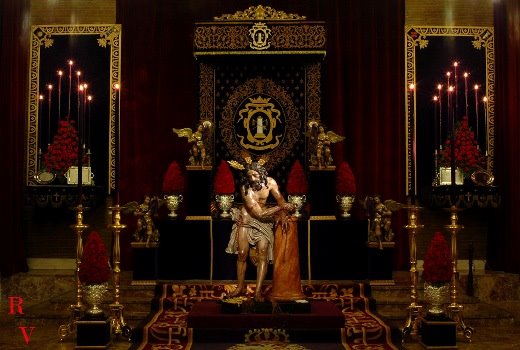
BTW: Most of the pictures I use in my posts come from this wonderful website: Fotos Cofrades Blog. Interesting place, especially if you're interested in Spanish processional statues, of which this blog has an enchidrion of pictures.

Tuesday, March 06, 2007

15 Secret Tortures of Jesus Christ


This devotion scared the hell out of me when I first heard about it. Also, if you recall Mel Gibson's movie, I think some of the scenes depicted in this devotion made their way to 'The Passion of the Christ'. In any case, I think this is an oft-forgotten part of our Catholic culture, and here I am posting about it so it can get some more exposure. I'll be quiet now and let the prayer speak for itself.

THE 15 SECRET TORTURES OF OUR LORD JESUS CHRIST
____________________________________________________________________________________

Revealed to the pious, God-loving Sister Mary Magdalen of Sancta Clara Order, Franciscan, who lived, died and was beatified in Rome. Jesus fulfilled the wish of this Sister, who desired to ardently know something about the secret sufferings which He endured the night before His death.

This devotion is approved and recommended by His Holiness Clement XII, 1730-1740)

____________________________________________________________________________________


1. They fastened My feet with a rope and dragged Me over the stepping stones of the staircase, down into a filthy, nauseating cellar.

2. They took off My clothing and stung My body with iron joints.

3. They attached a rope around My body and pulled Me on the ground from end to end.

4. They hanged Me on a wooden piece with a slip knot until I slipped out and fell down. Overwhelmed by this torture, I wept bloody tears.

5. They tied Me to a post and pierced My body with various arms.

6. They struck Me with stones and burnt Me with blazing embers and torches.

7. They pierced Me with awls; sharp spears tore My skin, flesh and arteries out of My body.

8. They tied Me to a post and made Me stand barefoot on an incandescent metal sheet.

9. They crowned Me with an iron crown and wrapped My eyes with the dirtiest possible rags.

10. They made Me sit on a chair covered with sharp pointed nails, causing deep wounds in My body.

11. They poured on My wounds liquid lead and resin and, after this torture, they pressed Me on the nailed chair so that the nails went deeper and deeper into My flesh.

12. For shame and affliction, they drove needles into the holes of My uprooted beard. They tied my hands behind My back and led Me walking out of prison with strikes and blows.

13. They threw Me upon a cross and attached Me so tightly that I could hardly breathe anymore.

14. They threw at My head as I lay on the earth, and they stepped on Me, hurting My breast. Then, taking a thorn from My crown, they drove it into My tongue.

15. They poured into My mouth the most immodest excretions, as they uttered the most infamous expressions about Me.

____________________________________________________________________

Then, Jesus added,

"My daughter, I desire that you let everybody know the Fifteen Secret Tortures in order that everyone of them be honored."
"Anyone who daily offers Me, with love, one of these sufferings and says with fervor the following prayer, will be rewarded with eternal glory on the day of judgement."

~ P R A Y E R ~

My Lord and My God, it is my unchangable will to honor you in these Fifteen Secret Torments when You shed Your Precious Blood; as many times as there are grains of sand around the seas, as fruit in the orchards, as leaves on the trees, as flowers in the gardens, as stars in the sky, as angels in Heaven, as creatures on earth. So many thousands of times may you be glorified, praised and honored, O Most love-worthy Lord Jesus Christ - Your Holiest Heart, Your Precious Blood, Your Divine Sacrifice for mankind, the Holiest Sacrament of the altar, the Most Holy Virgin Mary, the nine glorious choirs of Angels and the Blessed Phalanx of the Saints, from myself and everyone, now and forever, and in the eternal ages.

In like manner, I desire, my dear Jesus, to give You thanksgiving, to serve you, to repair and atone for all my ignominies, and to offer You my soul and body as Your possession forever. Likewise, I regret all my sins and beg Your pardon, O my Lord and my God. And I offer You all the merits of Jesus Christ to repair everything, to obtain a happy dying-hour and the deliverance of the souls from Purgatory. This prayer I desire to renew at each hour until my death, O lovable Jesus. Sweet Savior, fortify my resolution and permit not that neither wretched men nor Satan destroy it. AMEN.

Source: http://www.thesacredheart.com/secret.htm


A God Cosmic Yet Personal


In my youth, I have often wondered about God. When I was around five years old, my Evangelical aunts would always tell me stories from the Bible. I still remember the story of King Joash and how he was saved from certain death through Jehoida's intercession, and his subsequent fall from grace. I recall leaving coded messages to my cousins that said 'Mene, mene, tekel upharsin' and I still laugh when Balaam's ass talked back to him and left him literally hanging by a hair (clumps of it, rather) from a tree. I believed all these stories to be true, and I still do. They filled my childhood with joy and laughter and tears, especially the New Testament (specifically, the accounts of the Passion). When I entered my double digits, twelve or thirteen most likely, I began to be more skeptical. Perhaps it was the secularized environment, and then there was also the fact that I had this ridiculous reputation in school as some sort of a "pseudo-intellectual." But that's not really the point of the post.

Going back, in second grade, I read this short story called 'When God Was All Alone'. I remember there was an illustration of a bearded God the Father with a shiny triangle behind his head, and a huge scepter on one hand. His feet rested on lumps of cloud, as is commonly seen in Hispanic religious iconography. In my fourth and fifth grades, I came to love science, especially biology. I loved science so much that, at one point in my life, I decided I wanted to become a paleontologist. I would be the first to find a viable tissue sample of T. rex, and then, using my amazing intelligence, I would clone it, and I would have the best pet in the whole world.

It's ironic that my two favorite subjects-- Religion and Natural Science-- seem perpetually at odds with each other in this day and age. On one hand, you have religion: a way of life, a system of belief, a community of believers and its doctrines. I grew up with religion and had always thought of it as something indispensable. On the other, we have science, a systematized way of gathering knowledge through empirical, tangible means. Religion was based on faith, which is arguably something non-quantifiable, while science rested on the veracity of its assumptions as proven through a battery of tests, in order that the most plausible answer is arrived at. Okay...

I was in my sophomore year of high school when I first had doubts. I knew in my heart of hearts that there was a God. But then, how do I know which 'version' to follow? Why not Zeus? or Odin? or Kali? In fact, why should I confine myself to a personal God, when the universe-- its vastness, incomprehensibility, immensity and chaos-- all seem to point to a cosmic God? I relished the fact that I was an 'independent thinker'; I liked to think of myself then as a rebel. Cheesy, I know, but high school often brings out strange things from many people. How could I honestly reconcile what I see and feel with my senses, the visible and tangible, to my inner conviction?

Religion and science, for all their alleged differences, are actually very similar to each other. Both are concerned with finding the 'Truth'. In religion, in order to determine what is wrong from right, you propose something, and if that proves insufficient, knock it down. The same is true with science. Theories are theories because they are good propositions; but they are not laws (meaning pertaining to all states of matter) because there may yet be a possibility of it being knocked down, or replaced by a more credible theory. But science is not the I Ching. It is but a tool we use to arrive to our generalizations.

I believe that it was Duns Scotus who, in referring to whether the Immaculate Conception of the Blessed Virgin was viable, argued as follows: 'If He can do it, why not?' (Latin version goes potuit, decuit, ergo fecit) To those unfamiliar with theology, this basically translates as such: 'Well you can't prove He didn't do it, so why are you so against it?'

As I've said many times before, Christianity is a religion of paradox. We believe in an eternal, uncreated God, and we believe that this same God took flesh in the womb of a Virgin, and was made man. We believe this Man to be just like us, able to experience pain, joy, and sorrow, but unable to sin. We believe that this God sustains the universe into being by His will-- yet we also believe that this God is governed by prayer. We believe in a God Whose ways are far, far above our own, yet we believe that this God is Justice or Love Itself.

If I remember correctly, St. Thomas Aquinas wrote in his monumental Summa that angels are simply beyond human comprehension. Since they are pure spirits, they do not need and are not constrained by physical limitations. An angel can be at any point in the universe just by willing it; at the thought of it, they are immediately there. An angel's power is of a magnitude that makes all nuclear weapons detonated at the same time look like a dusty lizard fart in comparison. And just as an angel is so far above humans, such is also the case with the succeeding choirs of angels. From the archangels up to the seraphim, each ascending choir is infinitely greater than that which preceded it. If that ain't DBZ-style godmodding enough for you then I don't know what is.

In physics, I learned that just 10kg of matter, converted into pure energy, is enough to pulverize the earth ( Or was it split it in two? Please confirm this). Both science and religion make bold claims, each one as audacious as the other has to throw. Why, then are we so stuck with the perception that science is an inherently infallible, impeccable thing? I don't think even Bl. Pius IX would have approved of the latter.

In the end, science and religion are not far so from each other. Both are essentially based on the principle that something must have come from something, though what or Who that something or Someone is both still contend. As for me, I've never looked at either as being the be-all-end-all. After all, it was a Catholic monk who discovered heredity, a Catholic priest who proposed the Copernican model and yes, a Jesuit who first thought up of the Big Bang. Why there is such disparity between the two, I think, is a question that is more deserving of an answer than which of the two is right (because they both are).

Monday, March 05, 2007

Dust and Ashes


"Wherefore I abhor myself, and do penance in dust and ashes."
-Job 42:6

A Lenten reflection.

Have you ever seen a full moon? I live in an area which allows me to get a good vantage point of it. I always admired how it would illuminate the clouds that surround it from behind, highlighting its wisps like a poor man's aurora borealis. Sometimes, when there are no clouds, I look, enraptured, at the fullness of its glory. Often, I would stare out my window just to get a good look at it. The softness of the moonlight is almost poetic and brings to life many things hidden in the day. There are just some things that you can only see at night.

Lately, I've found my view of the moon being obstructed by this tree. It hadn't been there that long, perhaps only three years. but slowly and surely, it began to cover the moon. I hated how the tree's leaves would cover up the moon. I hated how its rugged trunk stuck like some stripper's gonorrhea-ridden pole in my yard. And I hated how bats would sometimes spend the night in it. I hate bats.

It so happened that a few months later, around January, the tree began to lose its leaves. Slowly, the green that frolicked like tongues of fire on its withered branches began to fall, leaving the tree looking like a xenomorph husk. I hated the way its gnarled branches stretched like bony fingers to an unseen target. It looked like something straight out of a bad horror movie.

I awoke the next day feeling groggy from the previous night's calculus test (I hate math the most, though). I went to the garden as usual. It was a few minutes before dawn. The tree was still there, but it did not look as gnarled and creepy as before. Then, in the blink of an eye, I saw it. A red and yellow shape fluttered out of nowhere and landed on a bony twig. It was a bird. I had never seen its kind before-- they were just so rare. I don't know what species it was, but it was one of the most beautiful birds I had ever seen. It perched there for two minutes which could very well have been eternity. It left in the same flutter of color in which it had arrived.

Then, the sun came up. It shone with a golden light that bathed the whole landscape with a fiery glow. Its beams shone forth and stabbed through the garden like a saber of light. The beams hit the tree, scattering and refracting the light in a sea of directions. It was truly a beautiful sight to behold.

Just what in the bloody blue hell does this have to do with Lent?

A lot, actually.

There is no more poetic, more glorious and more emotional time in the Christian calendar than the drama of Lent. Though a season of penance, we often forget that Lent is also the ultimate celebration of the love of God. It is during these dark hours when the Son of Man felt the weight of sin crushing down on Him; it is during Lent that we commemorate the ultimate act of sacrifice and the final victory of the God-Man over the forces of hell.

J.R.R. Tolkien coined the word 'eucatastrophe' to refer to seemingly hopeless circumstances which ultimately have a glorious conclusion. Christ's Passion-- His murder at the hands of His own people, His being rejected by His own followers, His helplessness and meekness before the maddening crowd-- these are considered to be man's darkest hour in the Christian religion. Yet three days later, these events were forever overturned by the Resurrection, the greatest miracle in Christianity. More than a mere assertion of His prophecy of rising again after three days, the Resurrection of Christ cemented Christianity as something credible and incredible at the same time. As St. Paul says, had the Resurrection not happened, then Christians would be the most miserable of all men, the sorriest lot that ever did walk the face of the earth.

Lent is a celebration of this drama of salvation. Those forty days of mourning and penance, aside from atoning for our sins, are the ultimate expression of hope and faith. We believe that at the end of all the hardships, beatitude and glory await us. Sometimes, you only have to look at things from a different perspective. That awful tree that blocked my view of the moon only helped to make the sun shine all the clearer.

Tu eris sacerdos in aeternum


Martin Scorcese once said that one of the main reasons he wanted to become a priest when he was younger was that, along with the mafiosi, they were the most powerful and ubiquitous figures in his Italian neighborhood. Growing up, we all had a certain person we looked up to. In traditionally Catholic communities, the priest and whatever he said held sway. In an Anglo-Saxon environment, it could be the local philanthropist. In seedy, seemingly godless neighborhoods, the thug reigned unchallenged. But in all cases, the presence of an authoritative figure defined the community.

I grew up in a very 'Spirit of Vatican II' environment. My idea of the priest's role in the community was that of a presider, perhaps an elder, whose merits and virtues made him the sole person acceptable of being God's representative. When Mass ended, my parents would tell me to go to the priest, kiss his hand, and wait for his blessing, but that was it. I knew from an early age that only he could say the Mass, but I never really grasped the rationale behind this. I just accepted it at face value. Oh, and they told really corny jokes, too.

Of course, this was a far cry from the priests of my grandparents' and even my parents' days. In the Fifties and Sixties, priests were cast form a very different mold. Most of the priests then were still Spaniards, who still delivered sermons in Spanish. They were perpetually garbed in flowing black cassocks; their faces conveyed a serene sense of joy, but never lost their gravitas. I remember the stories my parents would tell me about how Fr. Spaniard or so and so would rise early in the morning and start sweeping the sanctuary in preparation for his Mass. They would also organize meetings with the different parish organizations, mumble their Masses, perhaps prepare for a debate with the local Arian-- er, Iglesia ni Cristo chapters, give the self-proclaimed hermit a much-needed bath in the Asperges ceremony, and say the Divine Office.

At the start of the harvest season, the farmers would bring their seeds to him so that he can bless them, and effect a bountiful reaping. The common folk flocked to him whenever the local Freemasons would mock the Church, and he, in turn, would damn them to hell in his pulpit. He was the virtual ruler of the community whom even the town's local government could not match in authority and influence.

The priesthood is the very essence of masculinity. He did his job-- not because he asked or volunteered for it-- but because he was the only one who could. He was the champion of the masses as well as the confessor to the nobility. He rebuked the superstitions of the wayward and praised and extolled the apparitions of the Virgin. He was despised by a few and loved by many, many more. At the end of the day, after hearing the vomit-inducing confessions of his flock (this actually happens, you know), performing his duties to God, and possibly winning new souls into His good graces, only then can he take care of his own salvation. He knows that he has much to answer for; if he was too strict in the confessional, he has to own up to this before God. If he confuses zeal for the salvation of souls with spiteful 'uncharitability', he must also account for it before God.

In this day and age, the idea of a celibate man dressing up in richly-embroidered silks and brocades and performing a couple of arcane gestures in front of a kitschy looking screen with images of a gore-dripping Christ and an extravagantly attired Mother of God may seem laughable, perhaps even a tad 'homosexual' to some. But then so do 'faith communities', butch-y women in red blazers pretending to be men, 'kumbaya' and a bevy of other things too horrible to mention. The Mass is not some fashion statement, anyway. He came there to do a job that only he can do; our business is not in the altar but in the pews.

Much like Rambo, with his Oscar-winning lines, or Zorro, with his pencil-thin moustache and weird choice of name (the fox?!?!?!), the priest's role is not to serve himself, but his people. He is their champion, their refuge, their very own Godfather. Perhaps that was why Roman Catholicism was so successful back then: the priest actually did his business. He asserted his authority and did the best he could, in his limited means, to provide for his parishioners' needs. He was hero and servant at the same time; truly, Our Lord could not have been more proud.

Sunday, March 04, 2007

Sola Scriptura


EPISTOLA MARTYRI PETRI AD SOFIAM NOBILE
(Mater semper dignus est)

A love story.

From the letters of Peter, the boy:

"My dearest Sofia,

It has been a long time since we have corrsponded. From the time we first met seven years ago, I knew I had to be with you. I cannot possibly live without you. It sounds horribly cliched, but know that my feelings are true. When we first met at the public square, do you remember how the man looked? His eyes were filled with sorrow. He looked at you, as he did me. In that space between seconds, our eyes met.

It is ironic, really. Just twelve days before that day, I had a chance to talk to the man. He was so full of compassion and goodness. It haunts me how those men could could so easily mock and and blame him for a crime he didn't commit. It was the height of travesty, as you and I both know. I have done many things-- much of which I am not proud off-- and I felt as if he took them all away. In his moment of agony, I found life anew.

I love you with all of my being. Don't you find it strange-- even supernatural-- how we both found love and redemption in that man's last hour? To this day, the look on his eyes still haunt me. But it is a look that, despite the suffering he endures, imparts peace to me.

They are sending me away. This will probably be the last time we will be able to talk for a very long time. Know that I love you, and that I long to be with you again.

Peter"

From the letters of Sofia, the girl:

"My love,

It grieves me how I cannot be with you in your hour of need. I am stuck here. I know that I know no fear, but I am rendered weak and helpless by circumstances beyond my control. My heart longs for you, and I find that I cannot rest until I know you are safe. Dearest Peter, I love you with a love that burns. It kills me how we are so cruelly set apart by the vicissitudes of fate.

I remember the man and how he looked at both of us. I remember, too, the jeering of the crowd, their bloodthirsty calls for violence. I remember how they breathed fire at him for every word of kindness, every trace of forgiveness he had for them. I felt it, too. I felt his gaze. I could feel him staring at me with loving and forgiving eyes, despite the barbarity of those around him.

How I wish I had been able to talk to him. He haunts me still, as he does you. There is something in me, something ineffable, that he has done. It is as if he has given me all the strength in the world.

It is a cruel fate to be haunted by this dead man! Know that I am with you always. Mt heart goes out to you in your hour of desperation. I will be the gentle breeze, the warm rays of the sun, the laughter of a child that will keep you company in your arduous journey. I love you.

Sofia"

From the letters of an unnamed man:

"Distinguished colleagues:

In my incessant search for meaning, I, in my twilight years, have finally deciphered the meaning of these letters. They are the accounts of two lovers who were involved in a brutal murder some XXX years ago. In fact, they seem to be the earliest extant copies of erotic poems. Note, in the first letter, the epistle of the so-called 'Peter' how he longs to be with her again, presumably to consummate their love. It is a language of carnal power. It expresses the intense longing both of them have for each other. It is a tour de force of human sexuality as viewed in these times.

In the second letter, the one of 'Sofia', we read of her desperation and longing for his presence. In one line, in particular, we read of her love as 'a love that burns'. This is an obvious allusion to the orgasm. Again, we read of the ineffable being set off in her by the man. Sofia is perhaps one of the most important women in history: her letter clearly shows that she is a woman in control. The ineffable here could be taken as a reference to masturbation. She is a liberated woman, who comforts her man, instead of the other way around.

These are only my preliminary findings. I am terribly excited to know more. I will be keeping in touch as much as I can.

Dr. **************."

STAT ROSA PRISTINA NOMINE, NOMINA NUDA TENEMUS.

(Finis)

On Crucifixes


I had a rather unhealthy fear of crucifixes as a child.

Growing up in the Philippines, one of the very few predominantly Catholic nations in Asia, I was naturally exposed to and reared in a Catholic environment. Seeing that we were once a former colony of Spain, an unabashedly Hispanic Catholicism-- with its multitude of flowers, candles, grotesquely bloody images and exuberance-- took root. In particular, as I have mentioned in my previous post, I took delight in looking at badly-carved, folksy-looking santos, clothed in their excessively-embroidered brocade mantles, bedecked in their 'baroque bling': gold encrusted crowns, aureoles, 'resplendors', and a host of other unnameable miscellany.

However, I always cringed at the sight of crucifixes. I was haunted by the image of a Man hanging from his palms ( it's always the palms ) from a cruel-looking cross. His arms and legs were blackened by bruises and by the constant flow of blood. His wounds gaped at you and exposed raw muscle and even bone in some cases. A crown of thorns, shoved onto His head, pierced His skull and caused even more blood to weep down His face. His entire body was blackened by a bevy of beatings, and wept from a thousand ( according to lore, the wounds numbered some 6,666 all in all ) orifices. It was a sight that made or broke one's faith.

It did not help that, when I was nine years old, I dreamt that I was alone in an abandoned church, with nothing and no one save a crucifix as my companion. In my dream, I remembered looking at that crucifix, and it, in turn, looked back at me. Like some surreal re-telling of St. Gregory's Mass, the Corpus went down from the cross, and slowly came toward me. I panicked, and ran as fast I could, but everywhere I went, the bloody Corpus always managed to catch up.

Why do we love to see Him suffer? Why are we Catholics hopelessly fixated on this image of a dying Man, His bones sticking out and His blood oozing in obscene amounts? Why is something so revoltingly shocking the most common fixture of our Faith?


This is the ultimate paradox of Catholicism. It has never been a 'sanitized' religion. Case in point: the peace ceremony in the Old Rite involved a pious image being passed around to the congregation, who then take turns kissing it. Have you ever wondered how much bacteria is in there? Or what if Ol' Toothless took a whole minute kissing it? It's a bit unsettling to think of, especially in this day and age. But that is how it was done for centuries. Tradition is not so much as an endless reverting to how we think it was always done; rather, it is humbling ourselves and submitting to the way it has always been.

This is the main difference between Anglo-Catholics and Roman Catholics. Whereas the Anglos might have a superior appreciation of the aesthetics of liturgy, have better taste in music and are much more reverent, there is almost nothing behind it. It is a religion based on theory, and there is no sense of fallback whatsoever. Catholics have come into criticism for being distracted at Mass; we go to our favorite shrines to light a candle during the sermon, we scold our children for being too noisy at the Credo, and even crossing oneself looks like an exercise at, oh say, removing a stray booger from one's face.

The beauty of Catholicism is that it is a very human thing. Unlike Protestantism, we Catholics understand that to be perfect does not have to mean giving up being a human. Perfection is not some overnight infusion of grace; it is a process that has its ups and downs which may take years before we can achieve. Sometimes, the greatest sinners turn out to be the greatest saints: St. Augustine's story is familiar to us all, as well as St. Dismas'. It was St. Josemaria Escriva in point 675 of his book 'The Way' who said:

"It's true that he was a sinner. But don't pass so final a judgment on him. Have pity in your heart, and don't forget that he may yet be an Augustine, while you remain just another mediocrity."


It is no secret that we have had many heresiarchs for priests and bishops and that we've had scoundrels for popes. It is precisely because we have had so many sinners in the fold that Catholicism comes off as an objectively real thing. The Church is not some abstraction based on paper; it is the screaming multitude of men and women, saints and sinners, priests and laymen. It is very much a visible thing.

And we are all under the banner of the crucifix. That bloody, beaten, bruised Corpus is a powerful reminder of the love of God for us. I once read a quote that went something like this: 'Sucking your stomach in at the weighing scale-- that is the ultimate self-delusion'. The Crucifix is the visual symbol of the Christian life. It is a life that faces up to the challenges ahead with the knowledge that we will ultimately get something beautiful and profound in the end.

Saturday, March 03, 2007

The Church of the Gutters


There is no bigger festivity in the whole of Manila than the feast of the Black Nazarene. Held for the last four hundred years on January 9th, the feast draws literally hundreds of thousands of participants-- men mostly-- to the venerable Quiapo church. These men, mostly from the lower classes, come in droves, usually armed with a white, woolen towel, a miniature replica of the Nazarene, and are almost universally clothed in Maroon. The highlight of this feast is the procession. At around noon, the gilded carriage of the Black Nazarene is processed out of the church, where it is greeted by a sea of shouts from the thronging crowd. The men wave their towels in the air, while shouting salutations at the image of Christ. This image of Christ carrying His Cross is famed throughout the country as the sole, miraculous survivor of a fire that ravaged a ship en route to Manila from Mexico, and is said to bring fortune, health and blessings to those who venerate it.

Upon the carriage, dozens of men crowd around the statue. They are the 'official guardians' of the image, and are in charge of wiping the Nazarene's face with the towels thrown at them, and subsequently returning these to their owners. Looking at the scene, one would think it were a pagan festival, Jaganatha Puri transported to Manila via some strange coincidence of fate. But pagan festival it is not; it is one of the last vestiges of a simple, unadulterated faith that has been largely supplanted by an unhealthy rationalism. It is Catholicism in its rawest form.

As a child, I remember being fascinated by my visits to more venerable churches of Manila. I marveled at the multitude of life size santos, dressed in their heavily embroidered tablecloths and blond wigs made from abaca. I stared in wonder at altars and retables shrouded in a sea of silver and gold and cried at the sight of a bloody Spanish crucifix, complete with gaping wounds and torrents of blood gushing from them, the arms and legs of the Corpus almost black. I stared in amazement at the numberless women, heavily mantilla-ed up to their backs as they crawled their way towards the altar, and wondered how long they could hold their arms in a 'cross' position while they prayed the Sorrowful Mysteries. Catholicism has never been a middle-class religion. As the title of this post suggests, it is in the gutters where Catholicism has largely been cultivated.


Many conservative and traditionalist Catholics today are sadly disdainful of these practices. It strikes me as strange how many traditionalists are able to memorize as many encyclicals as possible, genuflect until their knees pop, and discern an approved litany from another, but are unable to even pray the Stations of the Cross properly, for example. Many pride themselves in their ability to recite Newman or Belloc or Chesterton at the drop of a hat, but have never seen a Pieta Prayer Booklet before or read about the Fifteen Hidden Tortures. They pray only the approved novenas but are reluctant or disdainful of touching, say, a plastic St. Joseph statue and wiping it with their hankies or kissing its feet. They go to all three masses of All Souls' Day but gawk at the notion of keeping an overnight vigil at the cemetery.

Gone are the simple piety and trust that characterized the faith of our grandfathers. Instead, it has been supplanted by a rationalized paper religion, a Catholicism of the mind but thoroughly lacking in heart.

Catholicism was able to maintain its sanity throughout its troubled history precisely by treating its holy days as holidays. For instance, it is the only religion that honors St. Benedict, that most austere of saints, with the gaudiness and flamboyance of the Spanish Baroque. It is the only religion where 'the servant of the servants of God' wears a gold-encrusted triple crown and is (rather, used to be) carried on a portable throne supported on the backs of twelve men. I recall reading some time ago how John Henry Cardinal Newman once visited a Catholic church in Rome. It was like being in another world for him: people knelt and bowed at the altar, thronged around statues of saints, worshipped bones and other dismembered paraphernalia of dead men. In particular, he noticed how an elderly woman took the prayer booklet of another who had just entered the confessional. Yet through it all, there was a sense of something 'objective' being done. For the first time, he thought, he had seen real worship manifested in the simple piety of these people ( read more about this in I.T. Ker's "Catholic Revival in English Literature 1845-1961: Newman, Hopkins, Belloc, Chestertone, Greene, Waugh").

Catholicism is very much a human religion; it is a religion of the mind as well as the heart. Among the ranks of its saints, one may find superb intellectuals like the Angelic Doctor, Thomas Aquinas, seemingly irredeemable sinners such as Augustine, alleged "hippies" like Francis of Assisi and a host of other personalities. There seems to be a notion that all Catholics are expected to be these perfectly-mannered, insufferably polite, basically very middle-class group of characters. Nothing could be further from the truth. Majority of the world's Catholics subsist on pitiable salaries that go into the feeding and rearing of their children. But that is not what this post is about.

I find it ironic how many conservatives and traditionalists see cultural Catholicism as some sort of disease or malady that is irreconcilable with the proper practice of Faith. It is ironic in that these cultural practices are sometimes the only vestiges left of the old soul of the Church as practiced in the days of our grandfathers. Processions, plastic statues, embroidered tablecloths, all of these were fixtures of the Catholicism of old. Why, then, do we disdain them so much? Perhaps this is the greatest tragedy of Vatican II: how the practice of Catholicism has been reduced to nothing more than having valid sacraments and fulfilling obligation for the sake of fulfilling it.

Make no mistake: valid sacraments are integral to Catholicism. But aside from that, the Church today is seemingly devoid of the character it once possessed. In the attempt to 'go back to the basics', we have spurned the practices of our elders; we have robbed Catholicism of its character. By concentrating purely on a sacramental and didactic model of the Church, Catholicism becomes a mere collection of articles to which we either assent to or not.

Prior to the Reformation, the term 'devout Catholic' was a redundant, perhaps even non applicable term. In the book "The Church: A Pictorial History" (1961), a typical scene in Catholic England was laid out. The account describes how the English, for example, would all recite the "Pater Noster" in the town square at a certain time, and how everyday the churches were packed with worshippers. Their Faith was simple; it was the devotion of a child to his father, the tenderness of a mother to her child. It was not an intellectualized abstraction, but the effusion of love from a dedicated son or daughter. It is sad how these scenes are virtually consigned to the dust bins of memory. Indeed, I wonder what would have become of England had the Reformation not happened; it is saddening to think that this once most Catholic country is now removed of the traces of religion, Catholic or otherwise.

There is something haunting, and the same time comforting, at doing something that has been done for hundreds of years prior to you by people who have already long gone. In praying the Stations of the Cross, I sometimes wonder if a Dominic or a Francis Xavier's knees hurt as much as mine did, or if an Ignatius or an Augustine had an irrational fear of ghosts while keeping vigil in a cemetery. I sometimes if the priests of yesterday actually mumbled their Masses, or if they just spoke really bad and accented Latin as in some cases today. The clasping of hands, the beating of the chest, the double and single genuflections are haunting reminders that this is how it was always done. It is the entire history of the Church, distilled and refined into one action. This is Tradition; it is knowing that somehow, someone, somewhere at one time or another, can walk into a church and worship as he always has. And although you may never laugh with them, talk with them, kiss them or be with them, it is a most comforting thought to have.

Thursday, December 14, 2006

Adversus hostem aeterna auctoritas esto

Thus goes the old Roman adage- "To the enemy no quarter."

In many ways this is especially true today. We live in an age where mercy and clemency are vanishing in place of vengeance and over-the-top political correctness. Nowadays, if someone happens to slip up, the crowd goes into a frenzy worthy of the mob. This is especially evident in the Philippines as shown in all the brouhaha spent on the Cha-cha/Con-con/Con-ass issue(s).

Don't get me wrong. I'm entirely against them, too. Not only does the issue seek to circumvent the constitution entirely, but it is also a mere facade for politicians to extened their reign of terror in Congress or the Senate.

However, I'm also of the opinion that the militants and other various groups opposed to it have crossed the line.

Last Tuesday, 12 December, at exactly 2pm, a massive rally organized by the pseudo-Communists ( I call them this because majority of them wear red all the time ) marched along Commonwealth avenue, obviously to air their views as regards to the Dance of Death ( economic, political, cultural, you decide. ). They carried banners, placards, streamers and other paraphernalia that scremaed variations of 'No to Cha-cha', 'No to Con-con', 'Oust gloria now', 'Lechon-in si De Venecia' and other colorful slogans, such that can only be found here in Glorious Philippines. The rallyists were convened at the door of St. Peter's Church ( the drama! ), with some of their members still platooned in front of Diliman Preparatory High School. As you can imagine, this caused SEVERE traffic that was to last up until 6.30 in the evening. And I don't mean 'severe' in the ordinary, day-to-day sense. This was pressure-boiling, vein-busting, heat-stroke inducing bacchanalia at its finest.

It's moments like these that make me want to be a wannabe Fascist. I'm all for free speech, but please, don't make your business my business. And not helping to clear this mess ( but in fact, even contributing to it ) is the CBCP, which, in my opinion, has degenerated into nothing more than a political mouthpiece for bleeding-heart liberals. Case in point: my very own bishop, the Most Reverend Antonio Tobias, of the Diocese of Novaliches, is one of the most vocal critics of the Arroyo government.

I'm not exonerating the government as well. But really, you would think the Filipino people would have learned by now that bickering solves nothing and leads only to further division. Former President Cory Aquino, ironically enough, is also an ardent anti-Arroyo activist; recall that her reign was besiged by many destabilization attempts, and expect her most of all to know what the repercussions of such actions are.

So what exactly are my political beliefs?

For starters, I'm not so keen on a democarcy. There, I said it. Afterall, 'democracy' is but one letter away from being demoncracy, the rule of demons. I believe that an enlightened dictatorship or even a monarchy would be best. However, seeing as how that's nearly impossible to accomplish in this day and age of extrme political correctness, a system patterned after the Singapore government would be acceptable. In Singapore, they believe in the efficacy of corporal punishment, even for cases that are not that 'extreme'. One might recall that in Singapore, public caning is stil very much a common thing. By God, sodomy is a capital offense there: what's more to want? Remember, a state without teeth is rendered weak and helpless.

Going back to the rally, don't you think that the four hour period spent shouting slogans and calling for an end to Con-con ( haha, another thing, it seems the rallyists forgot that it was already trashed-- THE DAY BEFORE )by the militants could have been better used by acutally going to work? Instead of concentrating on abstractions an overwhelming majority of the rallyists don't even understand, they couyld have used the period instead by working, earning a living, and PROVIDING FOR THEIR FAMILIES. And I'm really serious. Most of the rallyists were from the disenfranchised sector, which we give the politically incorrect term of 'squatters'. I don't want to sound like a total elitist, but it is true when I say that they don't even understand what Cha-cha/Con-con/Con-ass is all about; I'm thinking they're just finding something, anything to vent their anger at. It's sad, I know, when a sector of society is generalised; but such is the sad truth here.

I love my country. But with all these Judases and Caiphases that populate all sectors of the society, maybe even including myself, I cannot blame anyone who decides to leave the country for greener pastures abroad. I can only hope that, someday, the Filipino people will realize just what freedom is.