Sunday, December 09, 2007

The Slavery of Liberation


There's hardly a question that liberation theology has been one of the most controversial theologies to have arisen in the wake of the Second Vatican Council. Vilified by some, and yet vindicated equally by others, I think both sides can agree that the controversy generated by this world view stems from the fact that it is a theology greatly unhappy and discontented with the way things are-- so much so, that it is willing to provoke the change itself, regardless of means, and sometimes even of its consequences.

Influential theologians (you have to admit it) like Jesuit Fathers Jon Sobrino and Ernesto Cardenal, among others, speak of the so-called 'preferential option for the poor' almost as if it were prayer. On the converse side, its opponents speak of it like the plague. What is the average Catholic to think then of liberation theology? Should he shun it and avoid all contact with it, or should he embrace it, in order to be on 'the right side'? And for that matter, who is on the right side?

I don't subscribe to liberation theology, but let me offer a few points in the semester that I was acquainted with it. First: yes, it is true, the primary lens with which these theologians see liberation is Marxist-- that is, liberation from primarily sociological and economic malcontents. Second: liberation theology and its theologians seem to envision a world that is the 'Kingdom of God'; however, what is ironic is that this kingdom is one without a King, in the sense that they see a classless, absolutely-equal utopia as the icon of the heavenly kingdom. Apocalyptic would be a suitable word here. Corollary here would be the obligation binding on all the faithful to work for this utopia, even if it means a revolution (insert what context you may, here).

At least, that is their party line, political ideology. In retrospect, I guess I can see why liberation theology is becoming increasingly popular in the Third World. Latin America is home to a cornucopia of Catholic nations, but paradoxically, not all of these nations necessarily have Catholic societies. A socialist nation could literally be next door to a totalitarian state-- both are just not feasible options for me. Here in the Philippines, the gap between rich and poor is rapidly becoming more and more unbridgeable. I have been to streets where literally one end could lead to an upper crust suburban environment, while the other end is home to families poor as dirt, living in squalor and squatting by the streets as the SUVs of their suburban co-streeters gaily ride down the road. I have seen entire families, sometimes with up to ten members, eking out a living and barely surviving in makeshift shanty towns under bridges and garbage dumps. These are sights to wrench the soul of even the most hardened among us-- I've lived here all my life, yet I still cannot fathom the extent of the poverty of these people.

For all my bourgeoisie, I sometimes have to remind myself that I am but a part of a minority in this country which is increasingly suffering from the stratifications of language, wealth, and education. The only reason I can write, speak, and think in English like this is because my parents were hardworking enough to send me to the right places; the only reason I am not part of them is because I was lucky enough to escape. But in a population of at least 90 million, where only a handful can afford a semblance of 'life' (as used in the Western context), one simply cannot remain locked in his environment.

We can blame the government, our politicians, and even ourselves all we want, but that does not change the fact that we have too often neglected our charity to our fellow man. There seems to be a disturbing trend among many Catholics today to make an idol out of poverty-- we admire the poor for their simple faith, but the great irony is that there is absolutely nothing simple about this faith. This is a faith born out of many sleepless nights of hunger, of rummaging through waste bins and trying to find even the smallest scraps of junk food to last a family of ten for the next week; this is a very visceral faith. And let us not kid ourselves: we who grew up living in comfort would probably lose the faith sooner than touch a discarded piece of fruit covered in germs and all that 'good' stuff.

This is why I can never fully give my support to these liberation theologians, because the poor at least know one thing: poverty is a curse. Poverty is hell on earth. Imposed poverty can in no way ever be a blessing, because to do so would be practically the same as acknowledging a god that does not know how to love. But we have learned men in their polo shirts and Gucci loafers strutting around town proclaiming the good news of being penniless. It is indeed a great irony that even poverty is fast becoming a luxury of the rich, and that this egalitarianism is the sole oligarchy of a few.

However, this is not to say that sociological and economic liberation are entirely wrong. This would be swinging form one extremism to another, and as we know, this is precisely the rhythm in which heresy is born. There are Catholics out there who live as if one only needed the sacraments to enter heaven-- of course, from a theological perspective, this is true. But there is a marked difference between a true, proper sacramental life and a legalistic, juridical understanding of it (i.e., reducing the sacraments to transactions). There is a reason why there are clergy and laymen in the Church-- have we forgotten that our place is in the world, and not the altar? Many traditionalists today sadly believe that locking themselves in church would be the answer to all of life's problems; yet, from the lives of the saints, we know that demons are present even at Mass. I think it was Padre Pio who said that the church building is crowded with all the powers of Hell during Mass, only being vanquished at the Consecration.

Perhaps one of the greatest deficiencies in religious praxis today is the divorce between the mind and heart. To be properly called religious, one must shun all the things of this world and live as if time and life had not changed since five or so decades ago; let us make no mistake here-- this is nostalgia, plain and simple. At best, it could be a genuine desire to return to the simplicity of bygone days, but this will never completely solve all of our problems, mainly since the one pervading quality of life-- that is, its ability to lapse into sinfulness-- has not changed since the days of our distant ancestors. Similarly, while there is great virtue in living a life of service, it must always be grounded in Truth, and that is Jesus Christ. What makes joining the Red Cross so different from Christianity, then?

I think it's a great shame that things that were formerly expected of every good Christian now have to be lumped together under specific, but ultimately chaotic, theologies. How did it come about that love for fellow man got filed under liberal modernism? And how did it come about that sticking to the rules got filed under blind obedience? One has to wonder if we honestly believe in religion at all, given this mindset; for what it's worth, we are becoming more and more like dilettantes. Here, the paradox: the Christian must achieve absolute selflessness through maximum self-consciousness. The problem with liberation theology is that it imposes selflessness, not so much through honest assessment, but through imposition as well. And, as anyone can see, there has to be something to do the imposition. In that sense, it is really a luxury.

Christ said, ‘The poor you will have with you always’. What are you going to do about it?

Saturday, December 08, 2007

Weird Emails

I don't know why, but I've been receiving strange emails from three individuals named 'God', 'Satan', and 'Teh Raptorzzz' for the past three days. The subject of the emails is almost always a variation or a play on a quote from Scripture (and really bad ones, too); for instance, the other day, one email's subject read: 'REPENT!!! The TYNE is at hand!!! WOOSH!'. Yes, the 'WOOSH!' part is real. The emails themselves are all blank, but contain a link to some site (I can't reproduce it here, since A) I have no idea what it is, and B) I have no control as to its content).

Has anyone else been troubled by similar occurrences? It's really getting quite annoying-- my Gmail, Yahoo and MSN accounts have all received these emails. Ah well. Time to get a new email address, mine's already getting old, anyway.

Friday, December 07, 2007

Prayers Requested

Please say a prayer for the repose of the soul of Jose Roberto 'Joey' Carlos, a freshman here at the university. He died in a car accident over the weekend. He was only 18. I never knew Joey; in fact I can probably say with all certainty that I would never have heard of him had it not been for this accident. But we went to the same school; he was my fellow student, and it pains me whenever something bad happens to a member of my community. I don't know what he looks like, but we probably passed each other more than once when moving from one classroom to another. I don't know how he sounds like, but I probably heard his laughter-- so full of mirth and life-- in passing the cafeteria. I don't know the guy, but I feel like I've lost someone I know.

He is to be interred tomorrow, the feast of the Immaculate Conception. Again, I urge you all to pray for his eternal repose, especially at this time which is so near Christmas. Please also offer your prayers for his parents, that they may have the strength to weather this tragic loss.

Wednesday, December 05, 2007

St. James the Great


OK, I lied. This is the last short post. Sorry, I just couldn't let the day pass without posting this.

Above, a picture of the posh St. James the Great parish church's high altar in swanky Alabang, one of the wealthiest districts in Manila. The particular suburb in which this church is located is home to some of the oldest, most venerable families of the country. It is a veritable playground of the Spanish mestizeria, the relatively few of them still remaining in the country. What's interesting is that this church was built only within the last decade, having been completed, to the best of my memory, in 1995, blessed by no less than Jaime Cardinal Sin himself. I estimate this retablo to be at the very least 25 to 30 feet high. It is certainly one of the most beautiful built in recent memory.

The usus antiquor was celebrated here on November 14. What a sight it must have been to see the ancient rite celebrated on such a slice of heaven as this.

Tuesday, December 04, 2007

Jesuitry

This will be the last short post in a long while, I promise :D .

So I was talking to my mate Kyle today. Back in high school he had a rather nasty reputation as a playboy slash bad/inattentive student, as well as a bit of the more naughty kids in class (he just didn't like listening to the lectures and amused himself with childish pranks). We didn't go to the same high school; he studied under the Jesuits, and although he wasn't the most religious person out there, Kyle still had the fear of God instilled in him. He was the type of person who would suddenly grow tense whenever the topic of Hell or death would be brought up, though he did not like to admit it. Anyway, Kyle came down with a very bad case of the flu last week. It was one of the worst illnesses he had ever gotten, which caused him to miss five school days.

In an effort to alleviate his fears, he contacted a Jesuit priest to give him anointing of the sick. Unfortunately, he was one of those students who preferred cutting classes and causing trouble more than listening and taking down notes, a fact which this Jesuit priest (who came from a socialite family) apparently never forgot. At his house, he surprised the priest by suddenly asking for the last rites (he apparently tricked the Jesuit, proferring another reason for his visit). Then the surprise came.

The Jesuit, clearly annoyed, suddenly blurted out, 'Tangina mo naman pala, eh', which in English is loosely translated as 'Your b*tch of a mother'. Said Jesuit relayed this without batting an eyelash, in crisp and accented Tagalog. Not knowing what to do, Kyle just laughed, and rather loudly at that, which the Jesuit clearly enjoyed. After giving him last rites, the Jesuit departed, but not without giving my friend a solid smack on the back first.

Ah, Jesuits. Sometimes I don't know if I should still be shocked by their antics. And worse, I don't know whether to laugh or cry at the incident.

Monday, December 03, 2007

Thank God for Nick Names

I was talking to a friend of mine earlier. This friend hails from a very old, very hidden family of Spanish descent. Unlike other mestizos, though, he was what we would call in modern parlance 'jologs', a term which has come to mean kitschy or down to earth or in bad taste or cheap (all of these things and yet none of them-- it's hard to explain. I think nouveau riche isn't accurate at all, but it somehow connotes a misplaced ability to prioritize... or something). The conversation gradually drifted into the subject of names, but somehow he didn't like talking about it.

'What's wrong? Don't you like your name?'

'I do. I have enough saints in my name that they're probably fighting in heaven as to who should be my patron.'

'But don't you think it's good to have many patrons?'

'Sometimes I think I'd rather have just a few'.

'So just what the hell is your whole name?'

'Jose Miguel Alessandro Sebastian Carlo Maria de Aranzazu Felipe Francisco Javier Alfonso Martin Ignacio del Santisima Trinidad, Alzogaray y Acuna.'

'Oh.'

His nickname: Zazu, after the Virgin of Aranzazu.

Wednesday, November 28, 2007

San Martin de Porres


Can I sing you, Brother Martin,
saint whose hands know work, like mine?
Would that we could sit together,
tell our cuentos, sip some wine.

Soon I'll close the church till morning.
Please guide me walking home alone.
Not a safe place for a woman.
Justice this old world postpones.

Speaking to our sweeping rhythms,
let us plot for those in need.
Can't you scare these stubborn faithful,
with your powers intercede?

Bread you gave to those in hunger,
kindness to the child alone,
held the trembling hand that suffered,
kindness from a man disowned.

Is it true when you were sweeping,
cats and dogs would come to chat,
telepathically you'd answer,
query disbelieving rats?

Brother Broom, with just a handshake,
you could cure a soul in pain.
Oh, I wish that you could touch me,
make these old joints fresh again.

Would that you had time to teach me
bilocation, such a trick,
not that I deserve the honor
and pleading seems impolitic.

You liked flying and liked gardens,
so practice aerial delights.
Come see roses, tulips, daisies.
Can't I whet your appetite?

Ay, that I had seen the shining,
from your oratorio,
in your habit, man so prayerful,
that your very self would glow.

How we come, the dark-skinned faithful,
comforted to see you here,
able to confide our sorrows
to a black man's willing ear.

Your corrido I must finish
for priests frown at such casual songs,
frowning is their special talent,
but still, protect them all night long.

Help me listen to my garden,
cease wrinkled judgments based on skin,
our colored sacks like bulbs or seeds
that hold our fragrant selves within.


From the excellent book, 'Aunt Carmen's Book of Practical Saints', by Pat Mora. This was an instant favorite of mine-- get this book as soon as possible! It is well worth the read.


Sunday, November 25, 2007

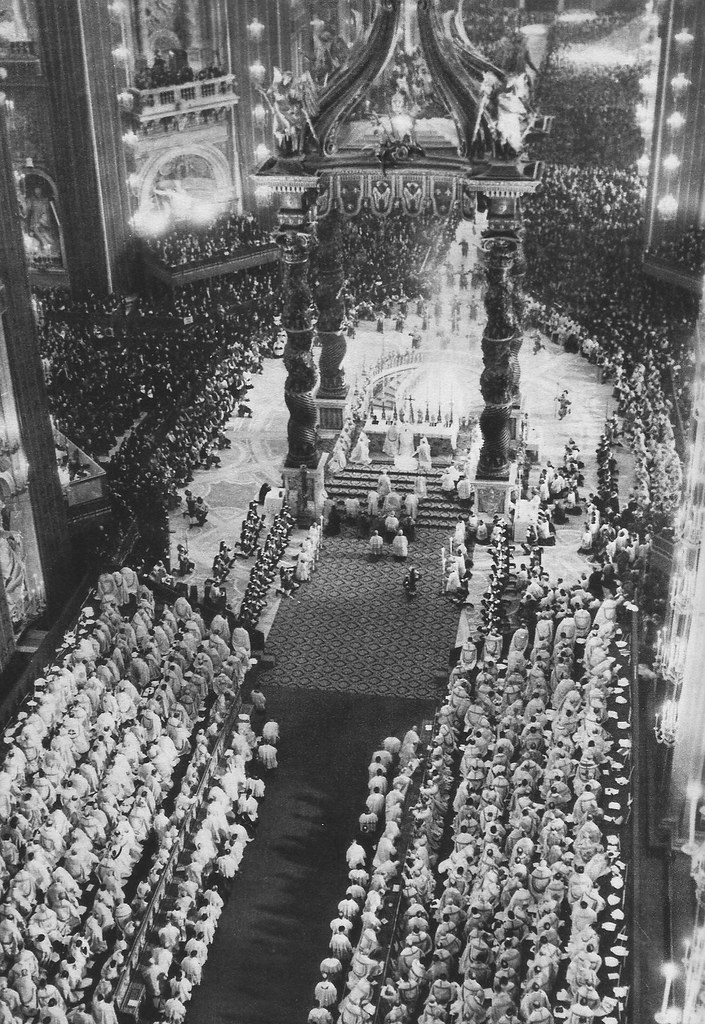
Papal Mass of the Proclamation of the Assumption


I really like this picture. There are certain truths that only images can capture-- words can only do so much, and are limited to the scope of truthfulness they possess. The icon, the image, however, reveals this truth as it has always been. If we want to know what it means to be Catholic, the life of the Church-- Her ceremonies, liturgies, and mystery-- should be our starting point. From Msgr. Pierre Pfister, the French canon at the Lateran Basilica:

"On this morning of the extraordinary All Saints' Day of 1950, it was quite impossible to move in the crowd of more than half a million. The majority chose to watch the rite of the definition of the dogma outside the basilica. Those who filled the interior were able to hear the Pope's voice through loud-speakers, and, in this setting, as thrilling as it was awe-inspiring, they could watch his processional entry and the Mass in which the new text was followed for the first time. It is the supreme moment of the Consecration. All are kneeling, and the Noble and Swiss Guards are giving a military salute."

Friday, November 23, 2007

Come apart into a desert place, and rest a little


Sometimes we can be too restless, even in the practice of religion, that we end up not doing anything at all. We are too busy theologizing, arguing, apologizing, party lining, bitching, whining and even thinking about too much that there can be a real danger of adapting--nay, conforming-- our religious lives to our secular lives. Of course, ultimately, one has only one life to live, and it is understandable when these two spheres occasionally collide with each other.

The problem I see with this is that religion basically becomes a hobby. We argue it, fight for it, debate it, bitch about it, but hardly practice it. I guess, with the arrival of the internet, this tendency has been more especially pronounced than before. Nowadays it is so easy to come across religious polemics, both pro and against it, that I sometimes have to wonder if being religious today is just another fad. We have many Catholics who know the minutiae of papal ceremonial, for example, but can't stand a simple roadside shrine Mass. We have so-called traditionalists who seem to exist for the sole purpose of criticizing everything that the Pope says or does, and we have even worse progressives who think they are the only people in the Church who constitute a valid voice, and who are seemingly more concerned with the cosmetic facets of the Mystical Body (actually, I think both sides are guilty of this) than its preservation.

There is a very real danger here of arrogating the Church-- and ultimate Its Head, Jesus Himself-- exclusively to oneself. Somehow, there seems to be a growing, if cryptic, trend that is slowly equating religiosity with being a busy-body. Nowadays, to be a 'true' Catholic, one must have a certain set of politics and ideal world view, all wrapped up and packaged with a shiny, red bow; or you can just as easily swing to the other side, and claim that being a 'true' Catholic means an almost exclusive devotion to issues of social justice and diversity and acceptance. Both speak of the arrogance of our age; we are all too busy of thinking of ourselves as the evolutionary apex of Catholicism that we too often forgot our own humanity-- and consequently, that we, too, are sinners.

For all it's worth, the picture above is, quite simply, sublime. In prayer, in bended knees and folded hands, the world rests; a fragile world, resting on fragile hands, taking in the whispered breaths and voiceless sighs of equally fragile men and women. Prayer gives peace to the soul. Prayer reveals the sweet face of Christ. If there is anything we need to pay more attention to, it is prayer-- and to learn how to pray, we must first shut up.

Thursday, November 22, 2007

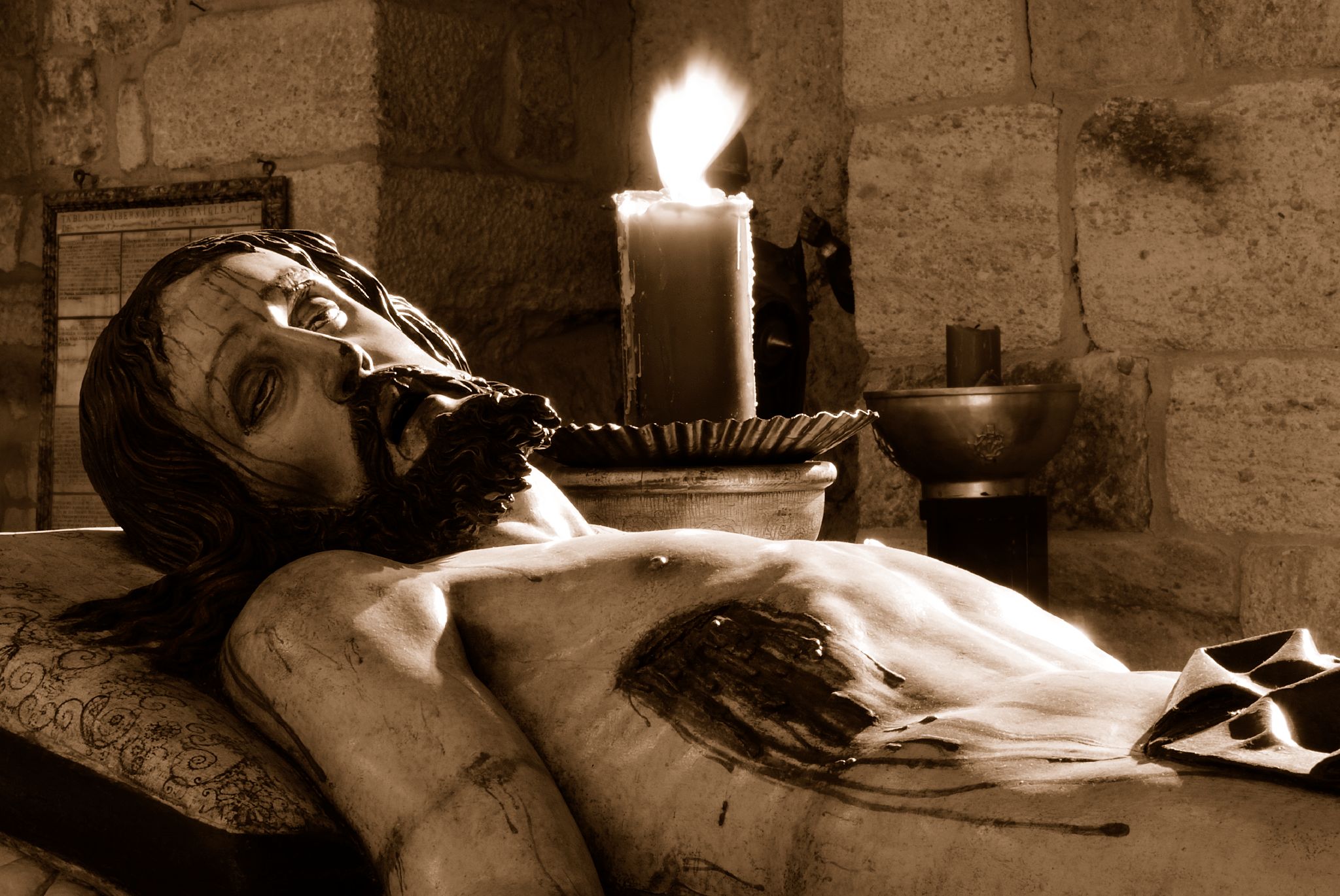
Cristo Yacente


From the taller of the sculptor Gregorio Fernandez, a fine example of 16th century Spanish Baroque. This image is kept in the church of Santa Maria de la Nueva in Valladolid.

Monday, November 19, 2007

Prayers for My Grandmother

Today, 19th November, marks the third death anniversary of my paternal grandmother (1923-2004). She was a devout Catholic in life, and prayed the holy rosary morning, noon, and night, and read Scripture at every moment she can. In life she was a brilliant teacher, having founded a Catholic school in their neck of the woods, which remains, to this day, a bright light in their area. Your prayers would be especially appreciated-- of the holy souls in purgatory, it is written that they shall plead for us before the Divine Tribunal in the hour of despair. It is a good and wholesome thing to pray for the dead.

Friday, November 16, 2007

On Love and Devotion


European visitors to the Philippines in the twilight of the Spanish colonization often noted the exotic, often 'excessive' devotion of the native people to the saints-- they bowed and knelt before statues, wiping its face, hand, feet, and sides with handkerchiefs in broad, sweeping motions, and often placed wreaths and garlands of flowers upon the saint's image. The devotion to the Santo Entierro-- the dead Christ-- often reached feverish heights in some places, such that pulling the ropes of the image's carriage was often seen as a fountain of innumerable graces. Even today, many processions still retain a certain awe to inspire even the most brazen of non-believers. I've blogged enough about the Black Nazarene, the Lord of Quiapo, whose procession every January 9th attracts, in some cases, up to a million people, rich and poor alike. They go about their panatas solemnly and yet at the same time with a sense of merriment that could only be called medieval.

The educated Spaniards and their mestizo illustrado counterparts called this show of excessive piety 'una devocion horrorosa', decrying the superstitious facade of many of these celebrations. Looking at the image above, the children are grasping the arms and hands of the Lord; some are taking pictures, some are blessing themselves, some are content just to be able to witness the scene. Christianity is a religion, first and foremost, of a Person; a Person can love, can be angry, can be merciful, is. Logically, of course, a Person can be the recipient of love and devotion, because only another Person is able to comprehend and return these things. You can't have a devotion to a Book, however lovely and beautiful it is, because it does not understand things like love, beauty, and truth. At best, they are just repositories of it.

Those people above have had their lives shaped by the face of Christ, that sweet, melancholy face fraught with all the bitterness and hatred of the world, and yet still manages to be a refuge to even the most desperate. They kiss and wipe and touch His cheek every Good Friday and kiss and wipe and touch His cheek as a newborn babe on Christmas day. These are people who grew up with the haunting image of the God-Man's face etched in the deepest recesses of their hearts and guts. As someone wise once said, the Bible is perhaps the most beautiful book in all of creation-- it is God's personal love letter to us-- but remains a letter nevertheless. To love another person necessarily transcends the boundaries of the spoken and the written, its communication distilled to its purest in the silences and sighs that span the space between seconds, and cover the whole of eternity. To love is its own reward, and there could be no more greater one than it.

At the end of the day, whom would you rather trust: the one who knows the love letter by heart, or the one who has actually loved? These are things that we have largely forgotten, and desperately need to remember.

Tuesday, November 13, 2007

Bastards!!!

Blast hits Philippine congress, 1 killed.

This occurred roughly five to ten minutes away from where I live. At around 8pm this evening, Manila time, there was a loud, booming sound that jolted me from my dinner. I didn't pay much attention to it. It was only after half an hour that I found out about the terrible news. I drive through this area every day; there is a public school just in front of the House of Congress, which, up until last year, had classes all the way till ten in the evening to accommodate its large number of students. To think what might have happened had the school continued that policy. To think I was planning on going out tonight.

They are reporting that a Muslim congressman is the latest to die in the explosion; the first casualty was a driver for one of the congressmen. Please pray for the souls of the injured and the departed. Please pray that whoever son of a bitch did this will fall.

Monday, November 12, 2007

Towards a Catholic Democracy


For you are all the children of God by faith, in Christ Jesus. For as many of you as have been baptized in Christ, have put on Christ. There is neither Jew nor Greek: there is neither bond nor free: there is neither male nor female. For you are all one in Christ Jesus.

-Galatians 3:28

The following post deals with a very messy topic: politics.I am not an expert on political science, but government is a subject that has always intrigued me. It has taken me a lot of days to write this, partly because I am so very busy, and partly because I haven't had the right 'moment' to start it.

Some of my readers may recall a certain post which I blogged way back in December of last year, wherein I expressed my main gripes with democracy. It shouldn't be too hard too find, as it is the only post for that month. Back then, I was still very much a self-confessed 'radical traditionalist'; my concerns were still very much political, and most of the time I wanted to turn this blog into a little corner where all my rants and gripes could be expressed. The only thing that stopped me from doing so was that I didn't really like controversy.

Today, I am a very different person-- I am a lot more sober and realistic in dealing with things, and I am a lot more 'level-headed', compared to my overly-impassioned self eleven months ago (not that this is entirely bad, mind you). Part of this change involves my own political views, which have, interestingly enough, been more 'leftist', in that what some of us might call 'Catholofascism' started to lose its appeal to me. Perhaps it is because I am currently in the university that this has happened; perhaps this change is due to myself alone, the external factors helping only slightly. Needless to say, I have beens saying a lot of things lately which would have made my blood pressure climb through the roof just over a year ago. What a difference a year makes!

To tell the truth, I am still sort of suspicious of democracy, at least the version of it that we are all familiar with. I stand by my earlier convictions that it is a system which can be heavily prone to abuse, from both far-leftists and far-rightists. It is a thing of incredible, indelible irony, indeed, that many governments could justify their totalitarianism under the guise of the people's will; it has been so abused that democracy has practically been stripped of any political significance. Be that as it may, I have begun to rethink my earlier position, namely, that democracy is an inherently flawed, and evil political system.

The seeds of this process began some moons ago, when my parents, out of the blue, began to reminisce on the Martial Law days of the Philippines from the 1970s to the mid-1980s. Adding to the growing bonfire was the spate of high-profile murders of journalists and leftists, which reached a feverish peak in May of this year, when the senatorial elections took place. I guess what really prodded me to be suspicious of far-rightists was the pregnant silence of the Philippine government on the matter of these killings. It was the kind of silence that one would expect from a cabal, or an anti-clerical entity like the Freemasons. I won't go into details here, but I seem to have lost much of my trust in the government.

Romanticism can be a very dangerous thing: what the freedom fighter is to one group could very well be an anarcho-terrorist extraordinaire for another. An excess of the romantic spirit could just as well be dangerous as a deplorable lack of it. It all comes full circle, as the adage goes. That is why legislation can be a very dangerous thing: it reduces problems into a set of propositions, and by the might of a majority, proclaims it as gospel truth. In fact, I think the gravest problem of democracy is its ability to provide too many answers for a single question.

But then again, to say that democracy is in itself an inherently evil thing would be just as wrong as saying that it is God's best gift to mankind after silly string. As is well known to all, democracy comes to us form the Greeks, a term which means 'the rule of the people'. Going back to the Greeks, we have Plato and his student Aristotle, both intellectual titans of the ancient world. Plato, of course, is more idealistic and poetic, while Aristotle's though focuses on the pragmatic and the scientific. To cut a long story short, Aristotle disagreed with his master's positions. Plato mentions in his Politeia that there are roughly three types of government: tyranny, oligarchy, and democracy. Aristotle differs from his master in that he classes these different systems in a somewhat hierarchical manner: first, monarchy, then the aristocracy, and lastly, polity. He cites these three systems for their pragmatism and efficiency.

Given the intelligence of the Greeks, one would expect the kind of liberal socialistic-democracy we have today to be the same rule of law as back then. But, as it turns out, this is not the case. Aristotle still endorsed slavery and reserved education to the ruling class; Plato believed in a totalianarian absolutism, where all power rested in the reigning, 'enlightened' monarch. This democracy, then, is just as elitist as the aristocracy. Mob rule would be a more fitting term.

The arrival of Christianity brought about an unprecedented change in European civilization, a very radical one, indeed. We see how it was necessary for the arrival of the Christian religion to develop democracy as we know it today: without Galatians 3:28, Europe could still very well be composed of barbarians, reavers and slavers. Without that verse, we would not have the concept of human rights, fair trial, dignity, freedom or a transcendent happiness. The concept of a People of God was not yet established; but with its establishment came the sense of entitlement we have today. Thus we can demand our rights to free speech and a fair trial because of the radical notions of Christianity, which liberated entire peoples from slavery to the pagan gods. We can shout for our dignity at the behest of others because Christianity taught that all peoples were equal in the eyes of God: kings and bandits alike were of the same substance, and would one day be subject to the same judgment. But whither each shall go, remains to be seen.

Would we really want to live in a world without free speech or thought? Would we really want to live in a world where a commoner can never question the infallible words of a monarch? Would we really want to worship in a Church where the word of a corrupt bishop are heard as the voice of God? None of us would like to do so. The danger in idealizing monarchy as an infallible ideal is that we run the risk of associating God with a certain politics, effectively confining Him under the limits of a few zip codes. This is in marked contrast to what the Church has always taught about God: that He is everywhere, being confined by neither time nor space. He is not a provincial, back water deity, but the God of the Nations, the Lord of Hosts.

The problem with today's praxis of democracy is the overwhelming lack of responsibility on our part. Consequently, legislation loses all its meaning and morphs into a whimpering paper tiger, which can be freely challenged at anytime. We patent laws and statutes which have no meaning at all other than to serve as witnesses to our own decadence and sin. In due course, we arrive at the democracy envisioned, or at least taught, by Aristotle: a veritable anarchy, where the rule of the mob is law. We thus arrive at the old elitisms and cease to progress.

The danger of assuming that God has certain politics is that we eventually make that god contingent to our own politics; it is a god that ceases to exist outside the confines of Republican or Democratic territory. This god, then, is an elitist god, that hogs all power unto itself. We lose the light, and are slaves to the darkness once more.


"Their gods were sadder than the sea,
Gods of a wandering will,
Who cried for blood like beasts at night
Sadly, from hill to hill."

-Chesterton

Wednesday, November 07, 2007

All in the Family

I have the weirdest family on earth.

I just came from a family reunion, the first one we've attended in seven years. I got to meet many interesting people, and even some faces that I've never seen before. Also, several of my cousins who have migrated to other countries in the past came home, making it an even more festive occasion. There was Manual, who used to bully us before-- now a full-fledged queen. There was also Robert, formally the biggest goody two shoes on the planet, who apparently became an anarchist-activist in his eight years in California.

I also learned some things about some family members, some of whom I never even knew I had. I'll list some of these points one by one.

- My father's great, great grandfather was a Spanish friar by the name of Don Severino. Since almost everyone referred to him as 'padre', his last name seemed to have been lost to the ages. Don Severino sired a set of twins, one boy and one girl, who would start our family.

- The boy twin became moderately successful, making a modest fortune in sugar. He would probably be upper middle class by today's standards. Lolo Paco, as everone called him, eventually had ten children, five boys and five girls. Three of the boys would become priests, honoring their grandfather: one became increasingly nationalistic, another went to Rome, the other was supposed to have been a mystic.

- The two other boys went on to become professionals: one, Pico, became a lawyer, but apparently became bankrupt. The other fellow is more interesting: Javier would go on to have ten children of his own, but not before undergoing several 'vocations'.

- Javier tried to enter the seminary, but was too wrapped up in worldly affairs that he soon left. Then, he became a Freemason; he married a local beauty whom he forbade to go to Mass on Sundays. She disobeyed him, however, and would sneak off at the crack of dawn on Sundays with a cut of fishing net for a veil, since her husband was a very sound sleeper.

- Over time, Javier left the Freemasons and became a very devout Catholic. From his eighteen children would arise my grandfather, who shared his father's early liberalisitic ideals. In fact, he himself admitted to an aversion to almost all things Catholic early in life. Then, he met my grandmother. Even up to her death in 2004, she always had a rosary at hand and read fifteen to thirty minutes of Scripture at a time; she was the one who taught my grandfather to pray, and brought him back to the Faith.

I'll post more on this subject soon. Right now though I have to finish an essay for one of my classes, an evil, diabolical, fifty page tome on the virtues of democracy. As you can see, I'm going to need all the prayers I can get for this one, LOL.

Monday, November 05, 2007

The American Dream


The following post has been simmering on my mind for a long time now. I just felt the need to put this down on paper, as it were, and give voice to something which has gripped my attention lately.

Everyone always told me that America was the land of dreams when I was growing up. In America, they said, success was just waiting around the corner; it was seen by many as Paradise on earth, a utopian society where all your wishes come true. I was around four years of age, possibly younger, when I first heard of America; the common folk described it with an almost mythic air, speaking of the 'white man' and his exploits. It is safe to say that I had a very otherworldly conception of Americans, and Caucasians in general.

My parents say that the first time I had been to the United States was when I was a mere two years old; to some extent, I can still recall some vague details, as if veiled by mist, but as to the length of our stay or the details of it, I do not. Apparently there was a very important family gathering, and we just had to attend (this nearly bankrupted us, given our limited resources then). I vaguely recall Aunt Tessie handing me my first dinosaur book, and being enticed by the snow; these, at least, were the clearest memories.

In the Third World, when one says 'Western', the automatic association one has with this term is American. Nothing says Westernization better than Mc Donald's, or Burger King, or The O.C., or pizza; here in the Philippines, where society is very Westernized, speaking with an American accent or having even the slightest strain of Caucasian blood seems to automatically predispose one to greener pastures-- seen by many as a remnant of colonial mentality amongst the peoples of this country. America is not so much just a country, but an almost mythological force of nature.

My first trip to the United States that I recall was in the spring of 2000, when my parents were at the peak of their careers. Of course, spring in the United States is summer here in Manila; and for an even more special treat, dad decided we would stay with our relatives for almost the entirety of our two-and-a-half month long summer vacation. He announced this in January; by March, I was dying to leave the country. For me, this was a chance to put something of a face behind the American phenomenon which had been spoken of so reverently by the people.

I distinctly remember waking up at 2am in the morning of 6 May 2000, and our flight was at 4am; this was before 9/11, so the airport rules were not as strict as they are today. I brought along a bevy of my 'lucky charms': unopened packets of Mc Donald's ketchup, a lithium battery, a novelization of the American Godzilla movie (I lost it in the plane), a notebook, some pens, and even two stuffed animals, just so I can say that my things have left the country. Call it ambitious, even pretentious; I wanted so desperately to bring everything with me and yet feel like I had nothing at all.

That was the longest flight I had taken then-- 16 hours of travel from Tokyo to Newark, and I desperately wanted to eat (I didn't even consider touching the airline 'food') and
do my ablutions'. When we landed, finally, I could barely contain myself: wow! It's a white guy! I want his hair!I want his abs! I want his girlfriend! I want his skin color! Though this was not the first time I had encountered a non-Asian (our old neighborhood had a lovely German family at the end of the street whose child I was acquainted with), it was a different sensation altogether to visit them in their own lands. I distinctively remember thinking to myself: fuck Manila! fuck Quezon city! fuck our house! fuck our lands in the province! This is where I want to live! This is where I want to get rich!

I was naive, of course. From Newark, we took a plane to Orlando, where we were met by my dad's cousin, Tito (uncle) Edward. Now, he had three children, the youngest being Annie, who was about the same age as I was; we immediately got along very well, and I even showed her some tricks for her Pokemon game. Needless to say, we had a grand time: we spent eight days all in all just touring Disney World, two days for each of the parks. After that, we proceeded to New York, where we met with Aunt Grace, my paternal grandfather's sister. Aunt Grace worked as the head nurse of a retirement home, and was loved by all; she was also a very devout Catholic, leading us on an excursion to the National Shrine of the Divine Mercy in Massachusetts, and even touring us in St. Patrick's Cathedral (if I remember well, this was a few weeks after the death of John Cardinal O'Connor).

In California, I met a whole lot of relatives I had never heard of, let alone seen, before. I was able to meet Tia Corazon, my dad's aunt through marriage, who welcomed us with open arms. She was a feisty character who never ran out of stories; like Aunt Grace, she also worked at a retirement home, both as its accountant and chief nurse. Her husband, my grand uncle Isauro (but everyone called him 'Doc') was a pediatrician. He apparently liked to samba. I was able to visit their beautiful home in Coronado, San Diego; I even met their neighbors. One of them interested me very much, an old veteran who fought in the Philippines during World War II, and was a survivor of the Bataan Death March.

The rest of those almost-three-months lasted very quickly; almost to the end of our vacation, we returned to New York to visit some sights we had not yet been to. I was enthralled when we visited the Museum of Natural History; after years and years of waiting, I was finally staring at real, honest-to-goodness bones of a T. rex. We also spent an entire day, nearly ten hours long, just rummaging through FAO Schwarz and the Toys R'Us rumored to be owned by none other than Imelda Marcos herself. And in a chilling turn of events, we decided to postpone our trip to the World Trade Center; next time, said dad. Little did I know that the next time anyone of us would see the WTC, it would be reduced to a massive pile of smoke and debris.

We were walking along Fifth Avenue when I spotted a homeless woman to one corner, seemingly talking to herself. She was clearly begging for alms, but the people around her--some less than six inches away from her-- acted as if she were a blank wall. The lady started to raise her voice, in the vain hope that someone would listen to her. My sister, then only six years old, walked toward the lady, and handed her a half-eaten cheeseburger. 'God bless you', she said, almost as if she were choking back tears of joy. This was surely a strange sight, I thought; wasn't America the land of dreams? Then why are there still homeless people here? I couldn't let my mind wander off from that train of thought.

Later that evening, in Aunt Grace's home, there was a family reunion of sorts; both Tia Cora and Isauro were there. But this was no ordinary family meeting; else, why was Tia Cora sobbing? The story she told us would remain with me to this day. In the retirement home where she worked, Tia Cora was in charge of taking care of an elderly man named Rudy. Now, Rudy had been suffering from a disease, Alzheimer's if I recall correctly, for the better part of the last few years. He checked himself in only three years prior, and immediately took a liking to Tia Cora. My grand aunt was a patient, jovial woman; she would always remind Rudy to take his medications, as well as tell him stories about the Philippines, her children, and her opinions on politics and religions (Rudy was apparently an atheist who was still open to religion).

Rudy died that day; Tia Cora was on leave when he breathed his last, so she had to read about it via email. As one of the few people Rudy trusted, she had the phone numbers of his closest relatives who should be able to collect his remains in the occasion of his death. One number was for a man named Jack, and it was listed first, so she called that number first. 'Hello?' a somewhat gruff voice answered. Tia Cora introduced herself as Rudy's friend and nurse; the man Jack replied that he was Rudy's son. Seemingly relieved, she told him about his father's death. A brief silence passes, and Jack replies 'So?' in a detached manner. 'Why should I care?' Since he was the closest relation to Rudy, my grand aunt wondered as to what the retirement home should do with the body, or when Jack would like to claim it. His answer shocked us all who listened to the story.

'Do I look like I give a damn? I don't care what you do to him.'

At that point, Tia Cora did not know whether to cry out in rage or sadness. Has it really all come down to this? A man just died whose own son did not even care about hearing, let alone digesting the news. It was like a shower of cold water dousing a beautiful, pristine dream.

At that point it seemed that I, too, had been woken from a delusion to face reality. Would I really be risking it all to live in America-- and become just another commodity as easily disposable as fast food? Would I be willing to trade my life here in Manila, uncomfortable and fraught with woe and endless litanies of other outside factors, for the good life-- but albeit one that is as cheap and substantial as plastic? I am not anti-American-- God knows how much I secretly want to have it all and remain true to myself. But in the end, one has to wonder, if the good life is really worth having at all.

In the United States, I felt like a king, sitting in a Greyhound bus, and an emperor dining on a cheeseburger (which, in all honesty, tasted like onions sauteed in onions) in an Amtrak train. I want to be a patriot fighting for a cause in a foreign land, a native adventurer, a foreign nationalist, and a litany of other oxymorons too numerous to list down. In truth, if there is anything I 'envy' about most Americans is how they can diss their country all they want and yet remain in a comfortable position. I don't have that luxury: diss the government here and you are either a subverter or a political enemy. Thus we look to this earthly paradise as a means of escape from the woes and problems here. Who can honestly blame them, though? We are only human, and it is only human to dream and to want a better life for oneself.

When I returned to the Philippines, I was hailed as a conquering hero by my classmates. Tommy wanted to hear every detail of my trip; Julius said that I had the best bragging rights in the whole class; Ryan said that I was the coolest kid and school; Marc, that I should be the most popular, on account of the fact that I had a Pokedex with me (this was at the height of the popularity of Pokemon). All this praise for a cheap piece of plastic which had probably been made in China, anyway.

I'll admit that there is still a part of me that just wants to forget it all and start a new life in another country, and maybe even find success along the way. I'd want nothing more than to live a life of consummate ease and well--being. But if there is anything I have learned regarding this matter, it is that problems never really go away. At best, they can be nice problems to have-- but problems nevertheless. I have seen the West, and it is exactly like the Far East, only on a grander scale. I have seen what it can do to people-- how they can be reduced to mere commodities on par with plastic. And while it would certainly be very nice to live as Americans, it is an entirely different matter to actually be them.

Just what is it about America that entices people so much? What is it about Americans that provokes reactions from the most welcoming to the most hostile? Perhaps we are all just a bit off our rockers; certainly, it would be a bit of a stretch to say that nothing good has ever come out of that country. Maybe when we begin to see the real United States of America-- and not the mythical, grossly California-ized pipe dream of both its detractors and supporters-- will we know just how lucky we are. The simple truth is that the United States of America is, like the rest of the world, just a country, albeit one that is exceedingly rich.

The American Dream is a beautiful dream, but like all dreams, it belongs to the subconscious. I'm not saying it is an evil thing to dream-- only that it must always be tempered by reality. We will find that their concerns are just as human as our own.

As for Europe, that is for another story.

Sunday, November 04, 2007

Veni, Coronaberis


I am always amazed at the consistency and intensity of Catholic devotion to the Blessed Virgin. Whether one is reading something from the Middle Ages, the Renaissance, or the Enlightenment, the devotion to the Virgin has always maintained a raw and unchanging character. The following prayer which I will be posting is taken from the Pasyon, a narrative of the life and death of Our Lord in verse, which is chanted during Maundy Thursday to Good Friday. Traditionally, it lasts for over 24 hours, with the unspoken rule being that it must end at 3pm of Good Friday, when Our Lord died on the Cross. I promise to provide a translation soon.

At ikaw Birheng Maria
Ina't hari ng awa ka
bukod sa tanang sampaga,
di matuyo't di malanta
dikit mong kaaya-aya.

Ikaw rin po't siya lamang
Sedes Serpientine ang ngalan;
luklukan ng karunungan
at kaban kang sinusian
ng Diyos sa kalangitan.

Toreng walang pangalawa
ni David, bunying Propeta
bahay na ganitong sinadya,
pinamahayang talaga
ng ikalawang Persona.

Ikaw rin Birheng Mahal
bituin sa karagatan
mapag-aliw sa may lumbay,
kuta ng makasalanan
matibay sa katibayan.

Reynang walang kahulilip
ng sanlangitan angheles
pinupuring walang patid,
ng Tronos, Dominaciones,
Virtudes at Potestades.

Emperatris na mataas
ng Patriarkas, Propetas
Birheng walang makatulad,
bukod sa babaing lahat
ng nag-iwi sa Mesias.

Yayang ikaw ay di iba
batis ng Misericordia
binabalungan tuwi na,
ng awa't mahal na grasya
ng bunying tatlong persona.

Kami po ay uod lamang
sa lupa ay gumagapang
lipos ng dilang kasamaan,
Birhen, kundi mo tulungan
anong aming kapakanan?

Real Religion

I found this today via the NLM Blog.


This is Catholicism. This is the faith of novenas, processions, the religion of blood, sweat and tears, weeping icons and mind-bending miracles; the superstition of Protestantism and the scandal of the unbelievers. The video speaks volumes for itself.

Wednesday, October 31, 2007

Sensus Plenior


In the Philippines, October is the month of candies and frivolities, and November is the month of ghosts, witches and demons. It is on the first of November that tales of lost souls and hell-bound men are told; it is during the first week of the eleventh month that hell and spirits and death in general are discussed in the media, from radio to television to what have you. My early recollections of November revolve, primarily, on visits to the cemeteries with the whole family, spying on deserted, haunted mausoleums, and hearing stories to chill the blood of any child.

One of the most vivid of these memories involved myself listening to the arguments of some of my relatives a decade or so past. My great aunt Luisa attends Charismatic Catholic services; she waves her handkerchief in the air to receive God's blessings, and was a firm believer in the importance of emotions in the proper worship of God. Still, she was a cradle Catholic, having been born in the 1920s when the echoes of the Council were still undreamt, and the holy traditions still mattered. Her brother, my grandfather, died in 1987, a strict, if uncatechised, Catholic; however most of my aunts, and even my grandmother, left the Church to be 'born again' in the late 80s to the early 90s. Naturally, visits to the grave would have presented an obstacle to them.

I remember great aunt Luisa telling my grandmother how, some weeks before All Saints' Day, she was walking in her house to get something from the basement when a sudden gush of wind blew in, and whipped about her neck. She described the feeling as nothing short of chilling; she went over the list of her dead relatives, and suddenly remembered her brother Peregrino, my grandfather. She told my grandmother how it all made sense to her; I listened intently, wondering if this was supposed to be a ghost story. To remedy the situation, great aunt Luisa said a silent prayer for Peregrino, even offering a plate of food on the window sill to sate him on the way back to Purgatory.

All that time my grandmother stood, mesmerized by the story. I was scared; my siblings were scared, my cousins, some of them at least, did not care, not having been raised with such stories in the first place (they were evangelicals, remember). Nowadays, most of us would probably agree with my cousins and shrug this story off as superstitious drivel concocted by dreary minds in order to find some sense of resolution about the death of a loved one. Even when I was hearing that story, a part of me was 'convinced' that it was nothing but a story, a mountain of a mole hill, perhaps.

Many Catholics, especially my elders, would probably tell me I'm wrong; in the olden days, it would probably even have involved a smack to the face, or a lash of the belt. Today, of course, I wold be told wrong for believing the story-- such is the paradigm of modern belief that rationalization and its prerequisites have practically filtered into the way be perceive and believe. Sociologically, rationalization involves three very important things: efficiency, calculability, and predictability. Faith has become efficient: its praxis is restrained to doing X,Y,Z, such that any sense of doubt is cast as something to be ostracized and shunned. Faith is calculable-- we know what it offers, and we are free to 'shop' around if we like. This is best represented by what I like to call 'parochial exaltations' where parishes are based on its clique and culture rather than a proper geographical location.

Faith is predictable-- this is perhaps one of the most grievous blows dealt to the notion of belief. A predictable faith is a faith where mystery and wonder have all but disappeared; it is a faith that is too concerned with the world, a faith that operates on a very human level of understanding. It is disturbing to consider that we have basically all become magisteria to ourselves: we immediately know, for instance, when an apparition of the Virgin is legitimate or not just by basing the circumstances of a particular case to those of past cases. That we can speak of such an earth-shattering thing like the apparition of the Blessed Virgin in such casual, even medical terms is very disturbing to me.

Such is the irony of belief today that it is the one who can quash as many 'hoaxes' and debunk so many supposed apparitions and miracles who is considered the believer, and the one who actually believes in the reality of things, who speak of them in whispers and firm conviction, who is considered the heathen unbeliever. Our faith is in theology, not in the saints, the Virgin, or God.

This is why Catholicism never was, or never will be, a 'Bible religion'. There is of course no doubt as to the veracity and truth of Scriptures; but to have it as the sole, proximate and immediate basis for faith seems, to me, the wrong road to take. The attitude displayed by many today is that if it is not in the Bible, it must follow that it is dispensable, and even some Catholics are beginning to buy into this ruse. The smoking gun is of course the fact that it is the 'superstitious' faith of the simple, and their assent to the incredible, that made Scripture possible in the first place. At the bottom of the Old and New Testaments lies a common thread that binds them both, and that is the notion of a loving God. This loving God, Who loved the world so much, was not a god Who preferred to deal in abstractions. This loving God became a thing of flesh and blood, and performed miracles.

It is not so much the reading of Scriptures that makes one have faith; rather, it is only through the eyes of Faith that Scripture begins to make sense. Else, it is but a book, and all books have a different interpretation to the individual who reads it. Catholicism is a religion of whispered prayers and pilgrimages to dusty, roadside shrines; of talking statues and living blood, severed heads and miraculous weapons. These are very real, very physical things, as the anima sola is a real thing (though often portrayed metaphorically). Humility is a virtue we forget too much in our praxis of faith; perhaps that is why we can't acknowledge the existence of wandering spirits and possessed trees, because we only believe what we see with our own eyes-- eyes that see only the physical and the tangible.

I recall something that great aunt Luisa told my grandmother: Peregrino is here. She told this with such clarity and firm conviction, in barely whispered tones, to my Born Again grandmother. Surely, I thought, she must think all of this nonsense. I soon swallowed my words, when I saw her talking to the winds. But it was not really the wind that my grandmother was talking to, but Peregrino himself. That is Faith. That is how we believe.

Thursday, October 25, 2007

The Vagabond


One of the most disturbing trends I see in the traditionalist Roman Catholic movement is an incredible distrust of modernity. I can understand where this fear comes from, and there is little doubt that the world in which we live in today is thoroughly godless and an exultation of decadence, luxury, and an overbearing sense of the self. Any Catholic should be rightly fearful and cautious of such environments, not only because they can be detrimental to one's faith, but it can also be incredibly dehumanizing as well.

But there too is to be found error in outright antiquarianism. To live as if the fruits of modernity were completely that of the Devil, or to see it as a negation of all that is good and worthy is, to me, more worthy of the Manichaeans than the Church. I think a sizable majority of those who consider themselves traditional can be prone to this, as I myself have been, and in some cases, still am. To negate this negation, we run the gamut from fierce apologias as to why modernity is inherently evil, to establishing nigh-utopian communities. I think this kind of thinking is very dangerous, in that it supposes Tradition, or even a certain epoch in time, as an impregnable bastion to the thralls of Hell.

This attitude is crystallized and manifested at its best in the various Sedevacantist movements that have sprung up within the last few decades or so. Like the tactics of many revolutionary groups (such as the New People's Army here in the Philippines), the arguments of these bodies are based purely on negating the positions of another; it is an endless flow of anathema after anathema, that one has to wonder, just what do these people stand for. What would become of their arguments, and their bodies as a whole, when the situation is 'normalized'? Would the Brothers Dimond, for example, cease acting like a terminal madhouse case once the Tridentine Mass is exclusively celebrated once again, or would they clamor still for the return of the American 1940s?

At best, it can perhaps be said that the animating ethos behind most of the 'radical traditionalist' factions is one that is primary psychological. To be a 'good' Catholic means being gloomy, downcast, grim, unsmiling, utterly prim, with no time for ribaldry or any kind of fun at all, and wearing three-piece suits in a quaint cottage with a nice piece of farmland managed with the fewest bits of technology; for women, it's wearing a frumpy dress made out of tablecloth and being utterly submissive to their husbands. Assuming that X,Y,Z are done, then it follows that there is world peace, peace on earth, and an endless litany of other utopian ideals.

Let's not stop there. If we really want to be traditional, let's just get rid of our modern hospitals. Sick children? Bah! They should learn to take it like men. I also think that our Catholic women are not dressed conservatively enough; I mean, just look at those Muslim women! Those burqas sure are elegant. And while we're at it, let's get rid of such modern 'conveniences' (instruments of the Devil, really) like the internet, television, cars and whatnot.

The majority of Catholics in the past never had any Missals, and just sat and knelt at the prescribed times in the Mass. My grandmother, for example, prayed a decade of the rosary at the Gospel, said a novena during the homily, lit a candle during the offertory, and left the church immediately after receiving Holy Communion. They toiled at the farm all day long, without the benefit of any modern tools, which led to her having callos on her feet, and a perpetual back ache for my grandfather. In fact, surprisingly, many Catholics were more exuberant and attentive in extra-liturgical ceremonies, like processions and various Filipino traditions like the pabasa, and the pasiyam. The simplest answer is, of course, the language: Latin, which was treated as a language of incantations and incredible power, but just that and nothing more.

I'm not saying that we should get rid of Latin and completely destroy our Catholic heritage; but what I am saying is that we need to be more sober in dealing with others who are not of a traditionalist bent. The only reason we can say that the Second Vatican Council was a disaster is because we have seen its fruits and know better; our liturgies are in disarray and our praxis of faith is sloppy. But for all our pining and whining, are we really losing sight of the big picture? Again, we need to ask ourselves this question: are we really more Catholic than the rest by the mere virtue of our support for the old ways? Or is it really a Manichaean paranoia that drives us to seek shelter in the past?

I attend the Tridentine Mass because it is perhaps the most beautiful thing I've seen this side of the world. I attend it because it is the same Mass that an army of saints knelt before, the same ceremony that brought wonder into the eyes of many a child. But to politicize it is perhaps one of the gravest mistakes we can commit. To see the Tridentine Mass, or indeed any of the traditional sacraments (as if the sacraments we have are decidedly and completely different from those 45 years ago) as agents, tools, of furthering a political end is to me an act of gross scandal.

I thank the Holy Father for giving us Summorum Ponitificum and 'freeing' the Tridentine Mass from the immobility brought about by the politicizing of the Second Vatican Council. At the end of the day, though, it is the countless millions who attended Mass in the 'halcyon' days before the Council, who knew its rhythms even before speech flowed from their mouths, who never knew a drop of Latin nor owned a hand Missal, that I thank: the nameless who silently wished for Mass in the vernacular, but kept silent out of obedience and love for that Rite.

We stand on the shoulders of giants-- but this is something we have forgotten. And so I pay my respects to those who have long since died, who wished to see the Mass of their youth restored to the altars. And I pray for myself, that my arrogance would be quashed and silenced, and that I may cease to be a vagabond, wandering and shouting and cursing at the graves of those 'foolish' enough to have abandoned the Old Rite. In the immortal words of Robi 'Draco' Rosa:

Rodando por el mundo camino, camino
Pregunto a la Quimera el enigma del destino
Nómada loco, noctámbulo y soñador
Un vagabundo
trono sin rey
Un vagabundo
Templo sin dios
Un vagabundo.

Tuesday, October 23, 2007

Cheese

I'll admit it: I am a big Spongebob Squarepants fan.


I really like this episode, it's probably the cheesiest song I've heard on TV for a very long time. I thought it might provide a few chuckles-- or even tears of joy-- to my readers. More serious posts as October ends, right now I want to enjoy as much as I can, hehehe.

Friday, October 19, 2007

Funkatronic Dreams


I've never been on crack, but I seem to have had the strangest, most vivid dreams lately.

Take last night, for example. In that dream, I was supposed to be a Roman Emperor. Somehow, I had the urge to summon the other 'co-emperors' (who were incidentally, my high school classmates)to the Flavian Amphitheatre, there to decide whose cuisine reigns supreme... er, who the Really Truthy True Emperor is. Strangely, instead of duking it out ourselves, we were given access to giant monsters to do it for us.

My beast looked like a cross between the latest incarnation of Godzilla and Z-Ton, the space dinosaur who spewed trillion degree fireballs, who was the original Ultraman's final enemy. This fat guy in my class clapped his hands, and from the ground came up a vaguely humanoid shape, with a rubber chicken for a head.

The referee of the fight was almost universally referred to by the voice in my head (in the classic narrator accent) as 'Whatina' reporter Maria Teresa Guadalupe Aranzazu del Santissimo Nombre de Jesus 'Cheche' O'Flannagan, who was wearing one of those black garbage bags. She was watching the 'fight' atop a curious-looking platform which reminded one of a flying saucer.

So the fight started; my beast, whom I called 'Dunbar', spat fireball after fireball at the rubber-headed chicken beast. Then, all of a sudden, there was a darkness in the sky, and a comet fell to the earth, whence came forth a grisly looking hand, attached by duct tape to a weird mishmash of fluff that gave the impression of innards and offal, as rendered by bad special effects. The hand 'spoke' in sign language, introducing itself as The Thingy.

For some reason, King Crimson's 'In The Court of the Crimson King' began playing in the background, followed by a Rush song whose title escapes me now. Then, a mariachi band composed of dwarf monsters dressed lime Oompa Loompas began swaying to some 60s beat. I don't think I've ever seen such huge asses, hahaha.

Again, this is one strange dream. The next moment, I found myself, no longer dressed in imperial robes, but in neon-pink pimp robes, complete with a staff cut from a single, gigantic diamond. Somehow, my name became 'Sweet Buttah O'Reilly'. Then a stewardess dressed in a bunny outfit leaped and bounded into the ring, and began singing and swaying to the tune of that Abba monstrosity, 'Dancing Queen'.

Finally, a strange sound began to ring in the air. It sounded like a screaming banshee, which seemed to cause an earthquake in the ring, where fell the party animals. It was my alarm clock.

I wonder what my dreams would be like if I had actually taken drugs? I imagine it would be strange, indeed.

Tuesday, October 16, 2007

San Ignacio Church

A picture of the old, and much-lamented San Ignacio church in Intramuros, Manila.


The church was run by the Jesuits and was the toast of high society, in the less than sixty years it existed. Though not a physically imposing building (it was notably small, only 80' by 40' if I recall correctly), it was nevertheless decorated with the best artwork-- the famed sculptor and santero Isabel Tampingco worked on San Ignacio's ceiling, as well as carved many statues for the church, including the Immaculate Conception and the image of St. Ignatius in the main altar.

San Ignacio was destroyed in World War II, a victim of Allied attacks. By the time it was destroyed, Mass had not been said on its altars for well over three years-- the building, which had been decorated with various hardwoods, took several days to burn. Its ruins remain even to this day, a silent, brooding sentinel of a bygone age.

Wednesday, October 10, 2007

Teacher from Hell


Teacher from Hell.

That's what my mates and I used to call our fifth grade English teacher, Hector. When the principal introduced us to the new teachers that year, Hector's reputation preceded him; he was described as a 'walking encyclopedia', a 'drill sergeant', and many other epithets of fear. True enough, when he first came to our classroom, he ordered us to occupy only one fourth of our seats, and have our backs straight as possible; he immediately gave us a ton of homework, and his first words to us were 'I'm not here to be your friend.'

Now, from what I remember, Hector came from a well-off family of lawyers and justices in beautiful Iloilo City, which rivaled Manila in prominence at the end of the Spanish colonial period. Hector studied with the Jesuits in grade school and high school, joined the Opus Dei, went to Harvard, and came back to the Philippines after several years of study. He was the first teacher I'd ever seen who drove a Mercedes Benz to work, and he talked with a perfect Hahvahd accent, with the slightest tinge of a Hispanic flavor to it.

Most of what we knew about Hector came from hearsay. Back then, to us, he was the most awesome teacher we had, while at the same time being the very epitome of Hell. Just a few days into the school year, he already required a notebook to be submitted at the end of the year, containing at least two new words we learned per day, including weekends. The penalty for so much as failure to note one entry was unknown, but we didn't stick around to find out what it was.

He was also the first teacher to deviate from the approved curriculum; he made up his own, and required us to read C.S. Lewis' 'Chronicles of Narnia' instead; for the first quarter, it was 'The Lion, the Witch, and the Wardrobe', 'Prince Caspian' for the next, and 'Voyage of the Dawn Treader' for the last two. Failure to bring one's book meant being excluded from the lectures for a whole week. Indeed, Hector was so strict in this regard, that some parents even complained against him.

Hector had a lot of quirks. He hated clicky pens, calling them unmanly. One time, a friend of mine who would later on become valedictorian, used a clicky pen for a major test. Hector lost no time in approaching him, and snapped the clicky pen like a twig between his fingers. He also did not mince words; in the Philippines, the Spanish puneta as well as puta are considered exceptionally taboo; he broke this taboo by explaining to us their proper meaning. When he would encourage us, he told us anecdotes from World War II, telling stories of Joseph Goebbels 'the sinister head of the Propagandaministerium'; I don't know why.

He was also our religion teacher as well-- and if he was strict in English class, he was doubly strict in religion. He spoke casually of the sufferings Our Lord suffered on the Cross, citing ancient Roman sources on the severity of this ignominious execution. One time, during a lecture about the Virgin Mary, an Adventist seat mate of mine cracked, 'Advocate? What do you mean, like the Devil's Advocate?' (the discussion was about Mary being our intercessor before God). Hector fumed, his face turning red; he let out a large scream and swept our jugs, which were resting atop a low shelf to one side of the room, hurling them at Chuck, my Adventist seatmate (who was incidentally our biggest bully). 'ANATHEMA SIT! GET THE 4%^&* OUT OF MY CLASSROOM!' That was the first time I saw Chuck cower in fear. I think he even cried, if I remember correctly.

He was very strict when it came to essays in both subjects; spelling 'ecumenical' wrong, for example, landed one a point's deduction. When someone asked him, 'Sir, can I come inside the room?', he would glower fiercely and say, 'You may not', and slam the door shut. He refused to let the student in until he learned proper grammar. Luckily, I was never one of those students.

There was also a legend, that he picked a fight once with another English teacher in the faculty room, apparently appalled at his grammar or something, who would incidentally go on to teach us in the sixth grade. When we were noisy (and it was rare), he would either make us line outside the room or, more frequently, have us run laps in the quadrangle, or carry our chairs above our heads for forty minutes while he delivered his lectures. The thing that struck fear most of all into us, though, was when he picked up a piece of chalk, and calmly rubbed his forefinger and thumb, and completely pulverized it. Without even breaking a sweat. Without even straining a muscle.

He would have been our Spanish teacher as well, but time did not permit, so we had to settle for another one, who he would probably have called 'a clown' to his face. But that probably would not have been a good idea, since he would have asked us to write essays at least five pages in length (for a Grade 5 student, that's Hell) entirely in Spanish. Besides, I wouldn't want to get a tongue lashing from him like that other student did, whom he called a maricon and a pajero in front of the whole class (the other section).

Looking back, that year under Hector was one of the most memorable things in my mind. Eight years have hardly dulled his memory, and today we still speak of him in a reverent air, afraid that he might pounce at us from a hidden, shadowy corner. Hector was simply awesome; I doubt I'll ever meet another teacher like him again. I would not write the way I do today without his criticisms, and I probably would not know what 'diphenychloroarzine' or 'succinylsulfathiazone' is had he not required those two new words everyday; I must have bled our three volume dictionary set looking for the rarest, most difficult words I could find, but still he knew most of what I put in that notebook.

Please pray for Hector. He was diagnosed with prostate cancer last year, and it is apparently not progressing. He has a beautiful daughter, a lovely wife, and so much to lose-- and still to give-- at this early stage in his life.

In the words of his favorite greeting to us: 'Morituri te salutant!'

Tuesday, October 09, 2007

Do Mothra's Priestesses Sing in Tagalog?


I was watching one of my all-time favorite movies this morning, 'Mosura tai Gojira' (1964), or 'Mothra against Godzilla'. If you're a fan of Japanese monster movies, and in particular Toho's Godzilla series, you will no doubt have heard of this movie, as it is a classic amongst fans. Many cite the Mosu-Goji suit (aka, the rubber Godzilla suit) to be among the most evil looking of the lot, with its slithering, serpent-like quality and soulless eyes.

The plot is simple enough to follow: a freak storm uncovers a gigantic egg buried underneath layers of soil in a distant island, which then washes onto a Japanese shoreline. It is then bought by the Maritomo Company, which intends to put it on display. Meanwhile, ace reporter Sakai and his oviparous girlfriend Junko, who try to wrest the giant egg from the evil industrialists, are surprised by the appearance of the Shobijin: twin fairy priestess barely a foot tall.

The Shobijin claim that the giant egg is Mothra's, and that if it isn't returned soon, they shall have to face the moth goddess's wrath. But suddenly, Godzilla arises after years of slumber, and he's madder than ever! The radioactive dinosaur, hungry for breakfast, heads for the giant egg; while in a last ditch attempt to save the people of Japan, Sakai, Junko and Professor Miura head to a desolate and seemingly God-forsaken island to beg Mothra's assistance in the oncoming fight.

I won't spoil the rest, but let it be known that this movie ranks among the best in the Showa Eiga Godzilla movies, or those movies produced in the years 1954 to 1975. This was the first Godzilla film from the Showa era that I had seen, and it easily remains one of my favorites.

I was a bit surprised, though, when the Shobijin began singing in a language eerily similar to my own, Tagalog. I know that Mothra's island (called Infant Island in the movie) is supposedly near Indonesia, but I didn't realize I would also hear my tongue in that movie. True enough, I did a quick search on the internet and came up with this.

The Sacred Fountain

Verse 1:
Na intindihan mo ba
Na intindihan mo ba
Mairoun doan
Maganda baron
Punta ka lang dito
Ka lang dito
Harika tu marupo
Harika tu marupo

Verse 2:
Na intindihan mo ba
Na intindihan mo ba
Mairoun doan
Maganda baron
Punta ka lang dito
Ka lang dito
Harika tu marupo
Harika tu marupo
Ru, ru, ru, ru, ru, ru

The song 'The Sacred Fountain' is sung when the Shobijin implore Mothra's help. Granted, it's a very crude form of Tagalog; but here is my translation anyway:

Do you understand?
Do you understand?
(Mairoun doan)
Is it beautiful there?
Hasten to us
To us
Come now (no idea what 'tu marupo' is)
Ru, ru, ru, ru, ru, ru

The words in parentheses are either wrongly transliterated, or they may be in another language. I feel like such a geek now. Hahaha.

Sunday, October 07, 2007

All Things Seen and Unseen


One story that has always intrigued me is an anecdote from the life of the late bishop of San Fernando, Pampanga, His Excellency Cesar Ma. Guerrero. The story goes that the good bishop, en route to an important function in the city, suddenly felt a massive migraine in the car. He ordered the driver to stop the car, and going to a nearby tree, began exorcising it. The bishop claimed that the tree was a habitation of demons; it was cursed, and therefore had to be rid of the evil surrounding it.

For many of us who have grown up in a cosmopolitan environment, things such as these elicit scoffs of ridicule and derision. For atheists and non-believers in general, this is proof of the immense superstition that Christianity really is. In another time, and perhaps another place, such an event would be viewed with eyes full of wonder; indeed, stories like these are the same stories our grandfathers would perhaps tell us on a cold, stormy night.

I am Catholic, but I have to admit, I am not really good at the 'legal' aspects that being Catholic entails. Of course, I have encountered the writings of saints on doctors on doctrinal subjects in the past, but for the most part, I tend to be bored by them. I am much more fond of sensational anecdotes like walking statues, miraculous crucifixes being found inside trees, dancing images of the saints, and visions from God than doctrinal wrangling. I am not saying these are any less important, but only that they are not the whole of Christian truth.

The picture above depicts a nun in prayer behind a cloister. Near the edges of the frame, one could clearly see visitors, one touching the grills with one hand and simultaneously blessing herself with the other, another with her head bowed in reverence, and another either leaving or approaching the grills. These are ordinary women, with very ordinary problems. If I were to hazard a guess, I would say that they are probably very poorly catechized. But what is perhaps the most powerful sight in this picture is that of the nun herself, rapt in prayer-- to her visitors, she is seen in a special light, elevated from the mortal coil by her being 'touched' by God.

For me, one of the biggest failures of Vatican II was that it tried to explain everything about the Faith. Ironically, much of the nouvelle theologie it espoused advocated a return to the notion of God as Mystery, away from the prevalent and 'dry' Neo-Thomism of earlier decades; Rahner's theology is notable for being a very vocal proponent of this notion. The results, however, are very familiar to us: bad liturgy, bad music, basically bad everything, so that the notion of Mystery itself is stripped to nothingness.

As discussed in the previous post, 'belief' today is practically meaningless, more an expression of doubt than an acknowledgment of truth. Today, only those with a doctorate in theology seem to have a shot of going to heaven-- never mind the fact that a good portion of our saints in the past were themselves poorly catechized. One wonders what some radical traditionalists today would think of St. Jean Marie Vianney, who failed Latin countless times.

In saying more, we wind up saying less; but in silence, profundity and depth speak for themselves. Why do we pray for the dead? Because the pains of hell, we are told, are inconceivable for any intellect, save God's, to fathom. It may be perhaps that one of our biggest problems today as Catholics is that we don't really 'believe'; while many of us are solidly orthodox, praxis seems to be at an all-time low. Of course, this is not really surprising, as the tendency for many conservatives and traditionalists nowadays is to reduce Catholicism into a prayer book, with red ink for rubrics, and bold text for emphases.

Perhaps the modern Catholic's obsession with the fundamentals of Faith is symptomatic of our fears and anxieties? I think the difference between the guilt trips of modern day traditionalists and Catholics who grew up pre-Vatican II lies in the object of that fear. Admittedly, when I was a much more rabid 'rad-trad', I was allayed by fears of the Church being wrong, of having spent my life living a lie.

The few pre-Vatican II Catholics I know spoke to me of the fear of being forgotten, so much so that they may yet spend the remaining time from their deaths to the Final Judgment in purgatory. They spoke with certainty, with a glint in their eyes, of the unspeakable. It should rightly send a shiver up our spines.

Thursday, October 04, 2007

I Believe


"Quicumque
vult salvus esse, ante omnia opus est, ut teneat catholicam fidem: Quam nisi quisque integram inviolatamque servaverit, absque dubio in aeternum peribit."

-The Athanasian Creed

"I believe". These words have haunted the imaginations of Christians for centuries. In the days of the infancy of the Church, a Christian could literally get killed for saying these words; and, just as it was before, saying 'I believe' today marks one for persecution of the world. The Christian who is not afraid to say that he believes in Something greater than what the eyes can see, what the ears can hear, and what hands can touch, is either branded a lunatic or a fanatic.

But what exactly do we mean when we say 'I believe'? The Latin word credo has a very interesting etymology. Many have theorized that the verb credere is formed by a compound of the words cor, cordis (heart) and do (entrust); taken together, credo is properly translated as 'I keep to my heart'. The foundation of Christian belief, then, is primarily trust in God.

The German end Old English also share some similarities: the German belieben, for example, is strikingly close to the English believe. It is interesting to note that, whereas the context of the German is in preference and allegiance, 'belief' today in the English language has come to mean s mere affirmation of doubt; to believe someone, then, is almost necessarily an inferior way of knowing the truth. To believe has simply come to mean 'What you say is incredulous, but I will still listen to it, on account of the fact that I cannot offer a suitable alternative to yours-- that is, for the time being'.

How did this come about? Many of us will no doubt blame certain historical epochs for this loss; the Reformation, the Enlightenment, the Industrial Age and the Age of Commercialism immediately spring to mind. Then there is also the arrival of science, that sole arbiter of empiricism, whose has shattered the concept of religion, and consequently God, for many the world over. To a point, it is true; the Church's greatest enemy has always been apathy, and one has to wonder, what place is there left for religion in the world? We live in a society where material possessions are the pinnacle of human existence; in such a world, traditions simply have no place. Even Faith itself seems to have bee influenced by the secular to a certain degree.

A cursory glance at apologetics will reveal a mindset of self-preservation, especially in the First World, where the practice of religion is rapidly declining. I cannot blame people for thinking this way-- and as any person will tell you, Christianity itself is the greatest apocalyptic movement to have ever existed on earth. Admittedly, there are also times when we must face the 'dark side' of our history if we ever want to see where we are headed. But then, what next? It is not enough to merely believe that God exists-- one must believe in Him.

I was struck at the difference between the kind of traditional Catholicism practiced by today's reverts, perhaps even myself included. Tradition is basically packaged as a set of philosophical musings-- of legalese and endless quodlibets after piles and piles of 'yes' and 'nos'-- the kind of doctrine that would hold a geeky lawyer's attention for hours at a time. But the gutter Catholicism of the poor is something much more raw; it is a religion of pilgrimages on knees, prostration before the Blessed Mother, bargaining with saints, and kissing the polychromed cheeks of the Holy Child, that in the rays of the sun, it would seem as if He were really sweating amidst the pulsing, throbbing multitudes gathered before His effigy. This is the Catholicism inherited from ignorant, uncatechized elders, the Church closest to the leper colony who clung to Our Lord with their disease-ridden hands.

That poor mother of ten in the streets, upon learning of a cancerous growth, would perhaps go to Baclaran on her knees, and in a piously vulgar display of devotion, would crawl to the Virgin of Perpetual Help; the hunted murderer would flee to the Lord of Quiapo and vow to pull the ropes of His carroza for fifteen years straight if He would but give him peace of mind. These are very much physical acts, veneration at its most profound. At the core of belief lies the conviction that the Other loves us for who we are; and we respond to this love, tentatively, perhaps with more than a grain of caution.

Faith, then, is not so much the interior convictions but the actions of the individual. To believe is to love the other for who he is and what he is, the same way that a mother would still find it in her heart to forgive her soon even with all the evil he has committed against her. That we have 'divorced', as it were, this aspect of doing from the concept of belief is perhaps symptomatic that there is something very wrong with us. As I've already mentioned, belief these days is practically worthless; in the same way, the soul is slowly being ripped apart from the self, that it becomes just another byword for thousands of other bywords out there.

In the Philippines, it is a curious thing that majority of people who do extraordinary acts of penitence in Holy Week are usually the berdugos-- the wandering tough guys, macho men who drink and whore any other day of the week-- lining up in columns of up to hundreds at a time, their faces obscured by a blood-stained cloth, their backs scarred from the countless lashings of a whip. For the catechized, it is a spectacle of unimaginable superstition; the fundamentalist Protestant would probably whisper 'Pelagianism' underneath his breath, while the radical traditionalist would probably be invoking canon after canon in condemning the wicked practice.

But for the better part of the last few hundred years, such idioms of piety, complete with wailing and much ululations, constituted the norm for the Church. Perhaps this repulsion stems from the fact that their God is a small god, a god of the philosophers, rather than the personal God of the Christians. At the end of the day, God is neither contained by our limited understanding of Him; we only end up putting Him in the midst of immobilist politics. In my opinion, we have simply become far too smart for our own good, that we are confusing what little germ of faith we may have had in the first place with how we think the Church, and God, ought to be.

It is surprising to me that religion involves very little of creeds and formulae in actuality, but seems, for the most part, more concerned with the here and now of worshiping, adoring, prostrating, praying and devoting. Maybe the surest sign of a secularized church is not so much the apathy of its congregation but rather the excess of their devotion. Yes, it can go either way, but too often the tendency is to ignore an over-wrangling reach of so-called traditionalists into matters solely for the eyes and ears of the Curia. The pious Catholic today is one who has memorized as many encyclicals as possible and who wears three-piece suits to Mass and chuckles with a socialite's glee at the under dressed. The simple pieties of old, of kneeling before the image of a beheaded saint for hours at a time, is relegated to the rubbish bin of ignorance and 'misguided' beliefs.

Thus we hide under the cover of complaining how everything about the Church is in such a state of calamity, because we envy those who, even in the midst of the most banal Novus Ordo 'bastardization', can calmly close his eyes and kneel before the Blessed Sacrament, however irreverently It is treated. We invoke the clause of 'modernists running the Church' because we secretly desire to run the Church, but are afraid of the consequences and responsibilities. We criticize those who persevere in error, not taking into account our own sins. We are a people who have forgotten how to love.

Being a Catholic is definitely not one of the easiest things in life-- the badge carries with it a stigma of being brainwashed followers of an old man with a funny hat who sits in his golden throne in Rome, and it carries with it a 'gutter' culture, at least in the eyes of the 'polished' Christians. But that is ultimately what it means to have faith-- it is to love, to hope, and to do. To believe is to know that the world, for all its temptations and evils, can be overwhelmed and fit into that small pocket of the heart.

It is said, man is the only being capable of lying in the face of the Truth. Not even the highest angels are given this privilege. That we are capable of living a lie and yet acknowledge the Truth is something that puzzles me still.