



I found this gem of a video while browsing on YouTube. In March of this year, the pilgrim relics of St. Therese of Lisieux visited the Philippines, touring the country and 'meeting' her devotees from all across the islands. St. Therese is a special patron of the armed forces of this country (her shrine is in close proximity to the Villamor Air Base), and as one can see in this video, they certainly turned out full force to honor their illustrious and holy helper in heaven. What is interesting is that the police and the army have 'traditionally' been tied with Freemasonry; however one does not see any trace of that at all in the video. It is certainly very moving to see such faith and devotion in action!
Thursday, November 13, 2008

Sunday, November 09, 2008
Santa Rita de Siquijor

The island of Siquijor here in the Philippines has long been surrounded with a mystic air. Called the 'Isla del Fuego'-- the island of fire by the Spaniards, it is whispered that this ancient land is home to countless witches, sorcerers, and a host of other supernatural beings. And it is by no accident that it was christened with such a name, for Siquijor's forests were home to great multitudes of fireflies, whose light bathed the island in an eerie glow.
Siquijor, too, is home to a controversial statue of St. Rita, which is said to be a favorite of the brujas and witch doctors of the islands. Here is a brief summary, from the now defunct My Sari-Sari Store website of photojournalist Sidney Snoeck.
Hidden inside the church of the village of Maria is the frightening statue of Sta. Rita holding a skull and an inverted crucifix. Leave before dark, some people claim she is a ghost...
The statue is out of view and you will not be able to see it without the authorization of the Parish Priest. Nobody, even the Parish Priest, could give me any clues as to the origin of the statue. The documents related to the statue disappeared mysteriously a few years ago.
According to local legend, the skull belongs to the woman’s husband whom she killed for reasons nobody in the island seems to know.
The decision to hide the statue from the public was taken by the bishop to protect the statue from theft and vandalism. The statue was already stolen in the past and was luckily recovered in the province of Bohol. It also seem that faith healers were scraping pieces of the skull to mix it in their magic potions.
According to the Patron-Saints Index, Rita was the daughter of Antonio and Amata Lotti. From her early youth, Rita visited the Augustinian nuns at Cascia, Italy, and showed interest in a religious life. However, when she was twelve, her parents betrothed her to Paolo Mancini, an ill-tempered, abusive individual who worked as town watchman. Disappointed but obedient, Rita married him when she was 18, and was the mother of twin sons.
She put up with Paolo's abuses for eighteen years before he was ambushed and stabbed to death. Her sons swore vengeance on their father's killers, but through Rita's prayers and interventions, they forgave the offenders.
Upon the deaths of her sons, Rita again felt the call to religious life. However, some of the sisters at the Augustinian monastery were relatives of her husband's assassins, and she was denied entry for fear of causing dissension. Asking for the intervention of Saint John the Baptist she managed to be admitted to the monastery at the age of 36.
Rita lived 40 years in the convent, spending her time in prayer and charity.
Rita is well-known as a patron of desperate, seemingly impossible causes and situations. This is because she has been involved in so many stages of life - wife, mother, widow, and nun, she buried her family, helped bring peace to her city, saw her dreams denied and fulfilled - and never lost her faith in God, or her desire to be with Him.
Friday, November 07, 2008
Prayer of St. Francis
I've always liked this song. The local church choir has only sung it once or twice, I think, but it was always a common fixture at the Wednesday Masses at Uni. The composer is Ryan Cayabyab, who is an esteemed figure in the Philippine music industry.
Thursday, November 06, 2008
Hellmouth

"But if the Lord do a new thing, and the earth opening her mouth swallow them down, and all things that belong to them, and they go down alive into hell, you shall know that they have blasphemed the Lord." -- Numbers 16:30
Georgios Klontzas, 'Hellmouth', from the trypticon of the Last Judgment. See the whole of it here. Also, from Wikipedia, some more information about the Hellomouth, and a wonderful collection of images from the Monster Brains blog, where I found the image.
Remember the Final Judgment
Howl, ye inhabitants of the Morter. All the people of Chanaan is hush, all are cut off that were wrapped up in silver. And it shall come to pass at that time, that I will search Jerusalem with lamps, and will visit upon the men that are settled on their lees: that say in their hearts: The Lord will not do good, nor will he do evil. And their strength shall become a booty, and their houses as a desert: and they shall build houses, and shall not dwell in them: and they shall plant vineyards, and shall not drink the wine of them. The great day of the Lord is near, it is near and exceeding swift: the voice of the day of the Lord is bitter, the mighty man shall there meet with tribulation.
That day is a day of wrath, a day of tribulation and distress, a day of calamity and misery, a day of darkness and obscurity, a day of clouds and whirlwinds, A day of the trumpet and alarm against the fenced cities, and against the high bulwarks. And I will distress men, and they shall walk like blind men, because they have sinned against the Lord: and their blood shall be poured out as earth, and their bodies as dung. Neither shall their silver and their gold be able to deliver them in the day of the wrath of the Lord: all the land shall be devoured by the fire of his jealousy, for he shall make even a speedy destruction of all them that dwell in the land.
Sophonias 1: 11 - 18
Weep, weep, weep, America!
Tuesday, November 04, 2008
The Cemetery Visit, Part I

It has been a long time since I last explored the Manila Memorial Park on foot. So when we visited my maternal grandfather, I was giddy with excitement. For me, cemetery visits occasioned not just opportunities to pray for the dead, but to go 'sightseeing' as well. As this cemetery is relatively new compared to others in Manila, and not to mention that it has a significantly middle class 'population', certain sections of the park were reserved for families who had the clout to build mausoleums for their beloved dead.
Entering the Park, one is immediately greeted by the sight of a large, Greco-Roman style mausoleum-- so large that it had its own driveway, and had pine trees surrounding it. A gorgeous tympanum of the Resurrection, done in the Renaissance style, lent a feeling of awe and wonder to the otherwise drab, gray structure. As a child I was incredibly fascinated by this building; I had always wanted to visit it, but never had the courage nor the time to do so. I imagined that, whoever owned the mausoleum, they were probably old-money types who shunned attention from the world. In any case, it was a very beautiful, very solemn structure. I would love to visit it some other time.
Anyway, my grandfather's plot was still a good distance away. To get there you crossed a bridge of sorts, where a man-made lagoon brooded silently. There was a white monument, like a gigantic spade of sorts, that thrust its way up so that whoever crossed the bridge would see it. I thought it was an ugly, brutal thing. Surprisingly, there were already a lot of people in the cemetery, for October. Usually the arrivals peak on October 31st and November 1st; I saw a lot of cars, even a classic Ferrari, gleaming immaculate and red as blood to one corner.
Eventually we arrived at my grandfather's plot. We got there just in time as the cemetery workers (who literally lived 'behind the wall'-- but more on that later) finished laying Lolo's new lapida (gravestone). The old one had long been decrepit, and the brass lettering stolen, so that we only read a ridiculous caricature of his name on our last visits. As for the workers-- Lolo was buried in a far-off, secluded area of the cemetery, which was already close to its boundaries. Behind the cemetery wall, however, was a small squatter 'colony'. It's quite creepy when you think about it, but in this corner of the world, survival is of greater importance than living one's life.
When we got there, the other side of my family was already there (the Protties). They brought a banig with them (i.e., a handwoven mat made for sleeping or outdoor eating), some short stools, paper plates, Doritos, pails of water (for cleaning the tomb), and what have you. My grandmother then surprised me by pulling out some siomai (dumplings) from her bag (!!!). They even came with some soy sauce. Oh, it was a wonderful picnic; the dumplings were simply scrumptious! My cousin then pulls out a deck of Magic cards and begins to duel with my brother; it was then that I decided to do a walking tour of the cemetery.
My aunt and my other cousin decided to tag along with me, and in no time, we were following the winding roads of the cemetery. Our first stop was not a mausoleum, but a 'condominium', which basically means a high wall where niches were arranged, side by side, for the beloved dead. We saw a lot of Basque names in that condominium; there was a Zabaljauregui, a Barranechea, and a Zaldarriaga next to a Fong. Surprisingly, I saw no messages in Euskerra, only in Castellano. Finishing that, we crossed over to a wooded path (see image above). But before that, we passed another condominium marked 'The Sanctuary of Peace'.
The following is going to be embarrassing, but it is true. When I first saw the SoP in 2001/2002, I thought it was where the bathrooms were. I remember yelling loudly for my brother, telling him I found the bathrooms. I even pointed a finger to indicate where it was. Suddenly I realized that my finger was pointing at a woman rather befuddled and amused; she then tells me, 'Hijo, ang 'Sanctuary of Peace' ay kung saan inililibing ang mga batang namatay.' In English: 'Son, this is where they bury those who died in infancy'.
That done, we finally reached the part of the cemetery where the mausoleums were. I was astounded at how large the cemetery was-- there literally rows upon rows of mausoleums! None of them, however, could compare to the size and majesty of the first mausoleum by the cemetery's entrance. A large part of the mausoleums we saw belonged to Chinese families; that was not immediately apparent, though, since many Chinese Filipinos tend to Hispanize their names; for example, often, an Ang becomes an Angeles in the process of 'Filipinization'. On another interesting note, many Chinese surnames in the Philippines are actually the Hispanized names of their forebears. Some examples are Chikiamco (Chi Kiam Co), Yupangco, Lichaytoo, Cojuangco. It was interesting to see, in some mausoleums, statues of Christ being venerated with joss sticks, and trays of sumptuous food for the deceased.
There were also some European-descent families. One mausoleum even had a family crest (Cabarrus), which I thought was pretty cool. Most of them were built in a rather brutal style that seems to defy categorization. I saw one that looked slightly Art Deco, and another with spooky statues of the Angustia and a relief of the Santo Entierro. Of course, I might be hallucinating; it is difficult to remember all the details. We must have walked for at least an hour, passing mausoleum after mausoleum, many silent and brooding, some bursting with life. We passed one of a Chinese family, and they were actually having a barbecue, complete with a grill, outside. I smiled at them, and they smiled back at me. The smell of paper money, incense, and candlewax permeated the air. It was a strangely peaceful thing to be among the dead. For a brief moment, I thought about the Final Judgment, when earth and sea shall give up the dead to bear final witness to the glory, justice, and love of God. It helped that the soon was obscured by a hazy mist, and that many trees were losing their leaves. I did not know what to make of these visuals, but they seemed to speak to one at a deeper level.
It was getting dark, and it was finally time to return to my grandfather. On the way back we decided to take another route, one longer but just as scenic as the one we took on our mausoleum-hunt. The fading sunlight burned golden, bathing everything in a haunted patina. Colors became richer, the wind and sound and heat even conspiring to produce a sense of blessed isolation. Many families were just starting to arrive at this time. Many of them we saw were praying the rosary; one family even had a customized set of black-beaded, silver-crossed rosaries for the occasion. Many were just enjoying the breeze, eating and drinking and toasting the memory of their beloved dead. Two kids nearly knocked me unconscious playing badminton, but I didn't mind. Finally, we were back at my grandfather's grave. The 'grown-ups' had already finished packing by the time we got there.
Sadly,we didn't get to pray for my grandfather together, since that side of my family has been Evangelical for some time now (please pray for them!). I took one last look at Peregrino, lying six feet under, and thought about him-- how he must have looked like, what his voice sounded like, how he was like when angry. Being that he died two years before I was born, I can only guess at these things. I said a brief prayer for Lolo Perry, before I finally boarded the car. It was an afternoon well-spent, I thought. On the way out, we saw more people arriving at the cemetery. Candles, some half-eaten already, while some were still tall and stout, lit the way out of the place.
I have only ever seen one picture of my deceased grandfather-- it was an old portrait, some forty years old already even when I was born. It showed a man with a high forehead, chinky, deep-set eyes, and perfectly combed hair. There was no trace of the difficult childhood he had in that photo; just a normal, everyday, ordinary, simple man. It's funny how death can change a lot of things, and at the same time, humbling. But even today, my image of Peregrino remains static-- he is, to me, forever the immaculately dressed man in that black and white photo I first saw several years ago. It is only now that I realize that I have his eyes.
Friday, October 31, 2008
The Spirit Photographs of William Hope

William Hope (1863 - 1933) was a little known English medium in life, gaining posthumous fame after an album of his 'spirit' photographs was unearthed in a Lancashire antiques shop. Here is the link to the complete set: The Spirit Photographs of William Hope @ the Flickr Commons.
Follows a short biography of Hope, from Flickr, where I found these pictures.
"Born in 1863 in Crewe, Hope started his working life as a carpenter. In about 1905 he became interested in spirit photography after capturing the supposed image of a ghost while photographing a friend.
He went on to found the Crewe Circle – a group of six spirit photographers led by Hope. When Archbishop Thomas Colley joined the group they began to publicise their work.
Following World War I support for the Crewe Circle grew as the grieving relatives of those lost to the war sought a means of contacting their loved ones.
By 1922 Hope had moved to London where he became a professional medium. The work of the Crew Circle was investigated on various occasions.
The most famous of these took place in 1922, when the Society for Psychical Research sent Harry Price to investigate the group.
Price collected evidence that Hope was substituting glass plates bearing ghostly images in order to produce his spirit photographs.
Later the same year Price published his findings, exposing Hope as a fraudster. However, many of Hope’s most ardent supporters spoke out on his behalf, the most famous being Sir Arthur Conan Doyle, and Hope continued to practice, despite his exposure. He died in London on 7 March 1933."
The Evocation of Mephisto
I thought I'd post something scary for Halloween. The following clip is taken from F.W. Murnau's 1926 adaptation of 'Faust'. In this scene, Faust, having found a book of the dark arts, attempts to conjure the demon Mephistopheles whilst in the middle of a crossroad, under a full and leprous moon. Murnau's skill at evoking the dread and power of the supernatural is something to behold. His skill at inducing chills up one's spine is simply legendary, and puts to shame the 'efforts' of so many derivative filmmakers who choose to focus on cheap thrills and loud noises to convey that feeling of dread we all love.
Wednesday, October 29, 2008
Pabasa
The Pabasa is a Filipino Holy Week tradition, wherein the Passion of Our Lord is chanted in verse. The tone of the hymn varies from region to region, but the text is almost universal; forget about your chant workshops and Tallis motets for a little while and enjoy the haunting, guttural warbling that defined the faith of the laity in the Philippines for hundreds of years. This particular pabasa was filmed in Cardona, Rizal.
Friday, October 24, 2008
De profundis
I'm going to the cemetery tomorrow.
Think of it as a pre-All Souls' Day vigil. Here in the Philippines October and November are always very mystical months; there is a great deal of mystery and wonder that envelops them. Locally, November 1 and 2 are known as the 'undas', so-called, because of the waves upon waves of people visiting the dead on these two days. But no ordinary visits, these-- from Mexico, something of the Dia de Los Muertos seems to have been imported to our country. Thus undas in Manila means spending all day-- sometimes up to midnight-- in the cemeteries. There is always drinking, eating, merry-making, gambling (if you're lucky), and an occasional impromptu family reunion, happening right beside your loved ones' tombs.
The cemetery where my grandfather is buried is middle class, more or less. But you will still see people playing music and talking rather loudly, as it has always been. The older ones say, the dead need company; if we do not keep vigil with them for the day, it will come back to haunt us. Thus, prayers are recited-- novenas, rosaries, chaplets, the occasional song, litanies, and supplications. One always has to be wary, though, since many take it upon themselves to dress up as priests, and collect those delicious stole fees for their own benefit.
I am sure it will be an interesting trip. We will be going with some Protestant relatives, and some hardcore, mantilla-wearing, rosary-praying, knee-walking, statue-kissing Catholics. One time a Protestant aunt, observing a Catholic grand aunt lighting a candle for the deceased, took me aside and told me: 'I don't mean to be rude, but lighting a candle won't do anything for your lolo, since he is either in heaven or hell, and nothing will change that.' I replied: 'But the lighting of the candle is not a salvific act, it's merely for remembrance.' She replied to me: 'That's what you think. Our elders always told us that candles have other properties.'
It was then that I realized that I knew nothing at all about these traditions. I kept quiet, mumbling to myself in the head. Then another Protestant relative stepped forward, "Talked" to my grandfather for a bit, and then started to pray an Our Father, a Haily Mary (!!!), and a Glory Be. It is amazing how the cult of the saints, the rhythm of countless rosaries, the urge to visit and converse with the dead, can be so firmly rooted in the human soul, that even a self-confessed Born-Again Evangelical Protestant, would find herself muttering these forgotten, ancient, 'pagan' incantations. De profundis, indeed.
The days are running faster, it is growing darker earlier, and already the air seems to smell of lagrimas (a local flower associated with funerals) and candle wax. Tomorrow I will see all of these things-- if not all, then some. And I will become that naive, little boy I once was, and I will sleep in the bosom of these strange and forgotten rituals. I hope I don't see a ghost.
Sunday, October 19, 2008
The Trinity

This depiction of the Holy Trinity is known in Latin America as the 'Trinidad Trifacial'. This particular example hails from Colombia, and was painted by Gregorio Vasquez de Arce y Ceballos. It is worth mentioning that, officially, this iconographic representation of the Trinity is discouraged by the Church; I recall reading somewhere about an edict that tried to suppress this particular 'icon', as well as one of the Holy Trinity inside the Virgin Mary's womb. I will try to find out more about that soon.
Castrum Doloris

The castrum doloris or castle of woes was an often elaborate, theatrical structure, which shelters the catafalque of a deceased person of immense prestige or nobility. In the Philippines, the use of the castrum doloris persisted up until the end of the Spanish occupation. Seen here is a photo of the castle of woes built for the death of Alfonso XII of Spain, in the old Manila Cathedral.
Friday, October 17, 2008

Tuesday, October 07, 2008
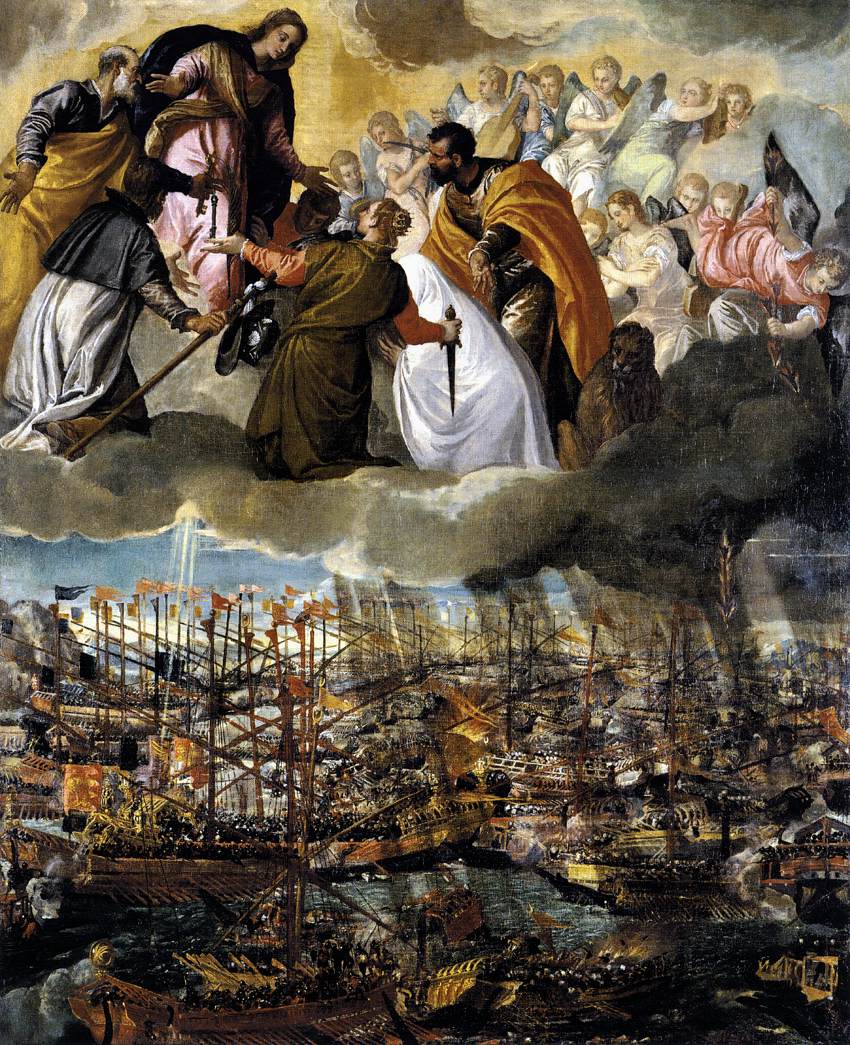
The Battle of Lepanto
Ask most people about the Battle of Lepanto today and you will be met with wither an uneasy smile or ignorance. For most of modern, secular Europe, Lepanto was a bloodthirsty massacre inspired by religious bigotry, a blight upon history whose memory must be forgotten, suppressed, and buried. Yet five hundred and thirty seven years ago, that fateful battle forever fixed the boundaries of the Mediterranean.
Few will probably know that Lepanto was the deciding factor that put a stop to Ottoman expansionism; a loss for the Christian side could have very easily meant the fall of Europe. On one side we have the Christian Holy League, under the aegis of the Spanish Hapsburgs, and sailing with the blessing of the Pope himself; on the other, the Ottoman champions, under the leadership of Ali Pasha. But at stake was more than just military power or economic dominance; indeed, one could probably say that Lepanto was as much a battle for the survival of Europe.
No easy task was this-- the mid 1500's was a time of upheaval in Europe. The convocation of the Holy League itself was fraught by mutual suspicion on the parts of those involved. The neutral Venetians were seen as self-serving and treacherous; Spain was seen as too prudent; and everyone secretly balked at the pope's wish to reclaim the Holy Land. Jealousy and division, and not to mention an almost genetically disposed inferiority complex against the Ottomans (conquerors of Byzantium), plagued the Christian side.
Fast forward to 7 October 1571, to one of the bloodiest days in history. In the span of but four hours, 40,000 people darkened the sea with their blood; fire and flame and smoke were everywhere, as the thunderous din of combat blasted ear drums and shook the marrow of men on both sides. However the day would ultimately go to the Christian side, thanks in part to the heavily armed Venetian galleases and the brilliant leadership of Don Juan of Austria. It was nothing short of a miracle-- the Christian Holy League, which up until a few hours before the conflict were arguing amongst themselves, would crush Ottoman power in a victory nothing short of remarkable-- and dangerously close. The leader of the Ottoman fleet, Ali Pasha, resplendent in his brilliant robes, was said to have been felled by an arquebus shot, after which his head had been decapitated by a Spanish soldier and attached to the tip of a spear. It was said that Don Juan was appalled by this barbarous treatment of what he considered a most worthy opponent.
In Europe, a collective sigh of relief was breathed, with the Venetians rejoicing the most. In Rome, it was said that St. Pius V, while in the middle of prayer, was roused by the vision of the enemy kapudan pasha (admiral), Ali Pasha, falling into the sea. It was a sign of victory, and on a most auspicious day, the Feast of Our Lady of the Rosary. Pius made sure to add another gem to the Virgin's crown, naming her Our Lady of Victories for the Christian victory against the Turk. The victory of Lepanto had put a permanent check on the expansionist dreams of the Ottomans; henceforth, the Mediterranean would be in a stalemate. Divided Europe came dangerously close to being subjected to Islamic dominance, with the Mediterranean serving as the bloody theater of history. Malta alone locked Europe from the Ottomans, and from then it would be a short way to Rome, the center of Christendom. Philip turned his attention west, to the New World, while the sultan Selim had Persia on his mind. In time, both empires' power would be checked, Philip in the disastrous loss of his armada, and Selim and his successors by the unblinking thrust of modernity.
Today tensions have generally cooled off. Lepanto has largely been forgotten, the people it saved shrugging off the old myths and legends, its heroes and champions dubbed fanatics. In 1965, the pope returned the captured sail of the main Ottoman warship, the Sultana, to Istanbul; it was a large, green sail, embroidered with the 99 names of Allah repeated close to thirty thousand times. People have forgotten, too, the French knight for whom the capital of Malta, Valleta, was named: Sir Jean Parisot La Valette, who had previously crushed the vastly superior Ottoman forces in the great siege of Malta. He would later go on in history as one of the order's most illustrious grand masters, defending Birgu to the last man with a steely resolve that would infuriate Suleiman the Magnificent himself.
In 1646, Manila was threatened by the sudden appearance of five Dutch warships, bent on conquering the city. The soldiers, Spanish and Filipino alike, vowed to our Lady of the Rosary to feast her with a lavish procession if she gave them this victory. And sure enough, the Dutch invaders were repelled; but the most remarkable thing was that this was to happen for five times. Today, Our Lady of the Rosary is known in the Philippines as Nuestra Senora de La Naval. She is truly the Queen of Victories, savior of Europe and Asia.
Friday, October 03, 2008
Tuesday, September 30, 2008
Prayers for My Father
Of your charity please say a prayer for the recovery of my father, who was admitted to the hospital tonight after complaining of chest pains. This is the second time this has happened to him; the last one was in December of 2002. Please storm heaven for his quick recovery. Thank you.
Funeral Customs
Whenever someone dies, I always make an interesting discovery. Most of these revolve around various practices and curiosities I often see being done when a loved one dies. These range from such customs as putting an extra chair for the deceased on the dining table, the belief that the deceased's body can and must never be left alone in the funeral parlor, the telling of riddles, or bugtongs as we call them in Filipino, the severing of the clasped rosary, the ninth, thirtieth, and fortieth day commemorations. To be honest, I never quite understood the rationale and piety behind them, but I will try to list as many as I can in this post.
The first custom is holding a banquet in honor of the deceased. Now food is very central to Filipino culture, but during funerals, when there are hundreds of guests to feed (a local belief is that the average person will know 250 people in his lifetime, hence many wealthy families often prepare for this amount), banquets often turn into truly sumptuous events. A place of honor is reserved for the deceased; the chair is left unoccupied, and often has the best servings of food. This could probably be an influence of the Chinese, who often buried food, clothing, and other paraphernalia with their dead.
Another belief holds that the deceased must never, ever, be left alone in the funeral parlor. Local piety holds that the soul of the deceased will get angry if he is not prayed for, and would often haunt its negligent relatives. That is why many Filipinos often 'camp' in the funeral parlor; they sleep, eat, and sometimes even bathe in them (in the bathrooms, of course!) until the day of burial comes. Corollary to this is the belief that someone must stay awake and keep vigil with the deceased for the whole night. To accomplish this, the old-timers would often tell 'bugtongs'. A bugtong is a sentence or question with a hidden meaning, which often functions as a riddle. Here's an example of a bugtong:
Buto't balat
Lumilipad
Loosely translated into English, it is:
Skin and bones
Flying
The answer is, of course, a kite. A bugtong often "fetishizes" mundane things and customs (kaugalian).As far as I know, this practice has been around since Pre-Hispanic times; it survived the Spanish colonization and was given a Christianized facade.
Another interesting funeral custom is the severing of the clasped rosary. Among Filipinos, it is a norm to place a rosary in the deceased's hands as a sign of piety. However, before the body is ultimately buried underground, a relative or loved one of the deceased, usually a female, severs the rosary; it is left in the clasped hands of the deceased, however. This is because they believe that, since the rosary essentially follows a circle, it thus goes round and round, i.e., forever. Thus, it could be seen as a sign that the deceased would have to spend time in purgatory forever (if he is bound for eternal glory, anyway). With the cutting of the rosary, the deceased's loved ones are symbolically freeing him from the fires of purgatory.
I've also seen, in old photographs, how the old-timers used to tie a band of narrow cloth around the deceased person's jaw, thus keeping it tightly shut. I don't have an explanation for this, but I've heard that it keeps the body from being possessed by demons (that is, they prevent them from entering the dead person's mouth). I've not yet heard a good or convincing explanation for this yet, though.
Finally there is the custom of commemorating the ninth, thirtieth, and fortieth days since the death of the loved one. The ninth day, of course, is the culmination of the novena masses for the repose of the soul; it is called the pasiyam, literally 'the ninth'. The thirtieth day commemoration is probably more of a Tagalog practice (I am not really sure), and is mostly held for women. Forty, of course, is a very loaded number in Scripture; there were forty days and nights of rain that flooded the earth, forty days and nights spent fasting in the desert; it is most probable that the fortieth day commemoration is symbolic of the soul's 'calvary' and is perhaps a celebration or reminder that, often life comes through death. It is, above all, a ritual of hope.
It is worth mentioning, too, that women often lead in the prayers; usually, the matriarch of the clan is the prayer leader, if there be no priest present. As is customary, all of these commemorations end in a feast.
Friday, September 26, 2008
St. Peter's Mother

Among the Tagalogs, this story of St. Peter's mother is a very popular folk tale. I remember reading a version of this story way back in second grade, with some of the circumstances altered; still, the essence of the story remained. This version was the one I often heard from my relatives groqing up.
It was said that St. Peter's mother was a very avaricious and greedy woman. One day, when she had lived almost the whole of her life, she summoned St. Peter to her bedside. With a weak but firm voice, she said to St. Peter, 'Entreat you the Lord for me that I be granted many more years to come'. St. Peter, being the obedient son that he was, went to the Lord to seek His help.
So it came to pass that St. Peter saw the Lord one day, after He had just performed a miracle. He flung himself to the Master's feet, and said 'O Lord, You are great and powerful indeed, and no earthly praise is fit to honor You. But my mother is old and sick, and has asked me to spare her life.'
The Lord looked at St. Peter and said, 'When a tree is old its leaves wither and die. But since your mother has asked to be given more years to her life, it shall be done. Plant this seed in your garden, and as long as the tree shall bloom, your mother will live.' St. Peter fell before the Lord and thanked Him. He reached home, when, in his excitement, he forgot to plant the seed in his garden. It remained in his pocket for days, until finally, St. Peter's mother died. The saint was inconsolable, and wept and cursed, but he resigned himself to the will of God.
Nine days after his mother's death, St. Peter had a vision. In that vision, he saw his mother, wrapped in flames, and once again, St. Peter's mother asked her son a favor. 'My son, I am trapped in purgatory, and I am parched beyond relief. Tell the Lord to snatch me away from these unbearable flames'.
Guilt gnawing at his conscience, but at the same time afraid of being rebuked by the Lord for his incompetence, St. Peter debated whether or not to go to the Lord. But in the end, he decided to muster up his courage, and ask the Lord for another favor. So it happened that he chanced upon the Master once more; and again, he flung himself at His feet, and asked 'My Lord, my mother has died because of my incompetence; but now she is in purgatory, and the flames, she says, are unbearable. She asks you to free her from that unspeakable prison!'
The Lord looked at St. Peter and said, 'As I told you, a tree that withers is near death. But since your mother asked for a respite against the pains of purgatory, it shall be granted her. Take you this rope, and when you see her again in your visions, throw the rope to her, and she shall enter Paradise. But be you warned, this is the last favor I will grant your mother.'
That very night, St. Peter's mother appeared to him. 'Mother, the Lord has granted your request! Take the end of this rope and climb up, and you shall enter the gates of paradise!' Overjoyed, St. Peter's mother quickly snatched the rope, and began to climb up in earnest; but just as she was about to escape the mouth of purgatory, she felt a tug on her ankle. Below, she saw a chain of souls, all miserable and yet at the same time hopeful. The soul immediately below her said, 'Take us with you that we too may quench our thirst!' But St. Peter's mother, being greedy and avaricious, tried to shake away the souls clinging to her feet.
And suddenly, in the midst of it all, the rope snapped, and St. Peter's mother fell into the deepest pit of purgatory, eventually landing at the gates of Hell. She alone fell to such a great depth. There she remains to this day, waiting, beyond all mortal rescue, until that Day known to the Lord alone, when heaven and earth shall pass.
Wednesday, September 24, 2008
Dostoevsky on Hell

Fathers and teachers, I ponder, "What is hell?" I maintain that it is the suffering of being unable to love. Once in infinite existence, immeasurable in time and space, a spiritual creature was given on his coming to earth the power of saying, "I am and I love." Once, only once, there was given him a moment of active lifting love, and for that was earthly life given him, and with it times and seasons. And that happy creature rejected the priceless gift, prized it and loved it not, scorned it and remained callous. Such a one, having left the earth, sees Abraham's bosom and talks with Abraham as we are told in the parable of the rich man and Lazarus, and beholds heaven and can go up to the Lord.
But that is just his torment, to rise up to the Lord without ever having loved, to be brought close to those who have loved when he has despised their love. For he sees clearly and says to himself, "Now I have understanding, and though I now thirst to love, there will be nothing great, no sacrifice in my love, for my earthly life is over, and Abraham will not come even with a drop of living water (that is the gift of earthly active life) to cool the fiery thirst of spiritual love which burns in me now, though I despised it on earth; there is no more life for me and will be no more time! Even though I would gladly give my life for others, it can never be, for that life is passed which can be sacrificed for love, and now there is a gulf fixed between that life and this existence."
They talk of hell fire in the material sense. I don't go into that mystery and I shun it. But I think if there were fire in material sense, they would be glad of it, for I imagine that in material agony, their still greater spiritual agony would be forgotten for a moment. Moreover, that spiritual agony cannot be taken from them, for that suffering is not external but within them. And if it could be taken from them, I think it would be bitterer still for the unhappy creatures. For even if the righteous in Paradise forgave them, beholding their torments, and called them up to heaven in their infinite love, they would only multiply their torments, for they would arouse in them still more keenly a flaming thirst for responsive, active and grateful love which is now impossible.
In the timidity of my heart I imagine, however, that the very recognition of this impossibility would serve at last to console them. For accepting the love of the righteous together with the impossibility of repaying it, by this submissiveness and the effect of this humility, they will attain at last, as it were, to a certain semblance of that active love which they scorned in life, to something like its outward expression...
I am sorry, friends and brothers, that I cannot express this clearly. But woe to those who have slain themselves on earth, woe to the suicides! I believe that there can be none more miserable than they. They tell us that it is a sin to pray for them and outwardly the Church, as it were, renounces them, but in my secret heart I believe that we may pray even for them. Love can never be an offence to Christ. For such as those I have prayed inwardly all my life, I confess it, fathers and teachers, and even now I pray for them every day. Oh, there are some who remain proud and fierce even in hell, in spite of their certain knowledge and contemplation of the absolute truth; there are some fearful ones who have given themselves over to Satan and his proud spirit entirely.
For such, hell is voluntary and ever consuming; they are tortured by their own choice. For they have cursed themselves, cursing God and life. They live upon their vindictive pride like a starving man in the desert sucking blood out of his own body. But they are never satisfied, and they refuse forgiveness, they curse God Who calls them. They cannot behold the living God without hatred, and they cry out that the God of life should be annihilated, that God should destroy Himself and His own creation. And they will burn in the fire of their own wrath for ever and yearn for death and annihilation. But they will not attain to death....
- The Brothers Karamazov
Saturday, September 20, 2008
Liturgical Excerpts from 'Ivan the Terrible'
These are incredible. Clips from a 1943 Russian film, 'Ivan the Terrible'. I actually saw these a couple of months back but have only remembered to put them up recently.
And here is Part 2
Subscribe to:
Posts (Atom)