Tuesday, March 06, 2007

A God Cosmic Yet Personal


In my youth, I have often wondered about God. When I was around five years old, my Evangelical aunts would always tell me stories from the Bible. I still remember the story of King Joash and how he was saved from certain death through Jehoida's intercession, and his subsequent fall from grace. I recall leaving coded messages to my cousins that said 'Mene, mene, tekel upharsin' and I still laugh when Balaam's ass talked back to him and left him literally hanging by a hair (clumps of it, rather) from a tree. I believed all these stories to be true, and I still do. They filled my childhood with joy and laughter and tears, especially the New Testament (specifically, the accounts of the Passion). When I entered my double digits, twelve or thirteen most likely, I began to be more skeptical. Perhaps it was the secularized environment, and then there was also the fact that I had this ridiculous reputation in school as some sort of a "pseudo-intellectual." But that's not really the point of the post.

Going back, in second grade, I read this short story called 'When God Was All Alone'. I remember there was an illustration of a bearded God the Father with a shiny triangle behind his head, and a huge scepter on one hand. His feet rested on lumps of cloud, as is commonly seen in Hispanic religious iconography. In my fourth and fifth grades, I came to love science, especially biology. I loved science so much that, at one point in my life, I decided I wanted to become a paleontologist. I would be the first to find a viable tissue sample of T. rex, and then, using my amazing intelligence, I would clone it, and I would have the best pet in the whole world.

It's ironic that my two favorite subjects-- Religion and Natural Science-- seem perpetually at odds with each other in this day and age. On one hand, you have religion: a way of life, a system of belief, a community of believers and its doctrines. I grew up with religion and had always thought of it as something indispensable. On the other, we have science, a systematized way of gathering knowledge through empirical, tangible means. Religion was based on faith, which is arguably something non-quantifiable, while science rested on the veracity of its assumptions as proven through a battery of tests, in order that the most plausible answer is arrived at. Okay...

I was in my sophomore year of high school when I first had doubts. I knew in my heart of hearts that there was a God. But then, how do I know which 'version' to follow? Why not Zeus? or Odin? or Kali? In fact, why should I confine myself to a personal God, when the universe-- its vastness, incomprehensibility, immensity and chaos-- all seem to point to a cosmic God? I relished the fact that I was an 'independent thinker'; I liked to think of myself then as a rebel. Cheesy, I know, but high school often brings out strange things from many people. How could I honestly reconcile what I see and feel with my senses, the visible and tangible, to my inner conviction?

Religion and science, for all their alleged differences, are actually very similar to each other. Both are concerned with finding the 'Truth'. In religion, in order to determine what is wrong from right, you propose something, and if that proves insufficient, knock it down. The same is true with science. Theories are theories because they are good propositions; but they are not laws (meaning pertaining to all states of matter) because there may yet be a possibility of it being knocked down, or replaced by a more credible theory. But science is not the I Ching. It is but a tool we use to arrive to our generalizations.

I believe that it was Duns Scotus who, in referring to whether the Immaculate Conception of the Blessed Virgin was viable, argued as follows: 'If He can do it, why not?' (Latin version goes potuit, decuit, ergo fecit) To those unfamiliar with theology, this basically translates as such: 'Well you can't prove He didn't do it, so why are you so against it?'

As I've said many times before, Christianity is a religion of paradox. We believe in an eternal, uncreated God, and we believe that this same God took flesh in the womb of a Virgin, and was made man. We believe this Man to be just like us, able to experience pain, joy, and sorrow, but unable to sin. We believe that this God sustains the universe into being by His will-- yet we also believe that this God is governed by prayer. We believe in a God Whose ways are far, far above our own, yet we believe that this God is Justice or Love Itself.

If I remember correctly, St. Thomas Aquinas wrote in his monumental Summa that angels are simply beyond human comprehension. Since they are pure spirits, they do not need and are not constrained by physical limitations. An angel can be at any point in the universe just by willing it; at the thought of it, they are immediately there. An angel's power is of a magnitude that makes all nuclear weapons detonated at the same time look like a dusty lizard fart in comparison. And just as an angel is so far above humans, such is also the case with the succeeding choirs of angels. From the archangels up to the seraphim, each ascending choir is infinitely greater than that which preceded it. If that ain't DBZ-style godmodding enough for you then I don't know what is.

In physics, I learned that just 10kg of matter, converted into pure energy, is enough to pulverize the earth ( Or was it split it in two? Please confirm this). Both science and religion make bold claims, each one as audacious as the other has to throw. Why, then are we so stuck with the perception that science is an inherently infallible, impeccable thing? I don't think even Bl. Pius IX would have approved of the latter.

In the end, science and religion are not far so from each other. Both are essentially based on the principle that something must have come from something, though what or Who that something or Someone is both still contend. As for me, I've never looked at either as being the be-all-end-all. After all, it was a Catholic monk who discovered heredity, a Catholic priest who proposed the Copernican model and yes, a Jesuit who first thought up of the Big Bang. Why there is such disparity between the two, I think, is a question that is more deserving of an answer than which of the two is right (because they both are).

Monday, March 05, 2007

Dust and Ashes


"Wherefore I abhor myself, and do penance in dust and ashes."
-Job 42:6

A Lenten reflection.

Have you ever seen a full moon? I live in an area which allows me to get a good vantage point of it. I always admired how it would illuminate the clouds that surround it from behind, highlighting its wisps like a poor man's aurora borealis. Sometimes, when there are no clouds, I look, enraptured, at the fullness of its glory. Often, I would stare out my window just to get a good look at it. The softness of the moonlight is almost poetic and brings to life many things hidden in the day. There are just some things that you can only see at night.

Lately, I've found my view of the moon being obstructed by this tree. It hadn't been there that long, perhaps only three years. but slowly and surely, it began to cover the moon. I hated how the tree's leaves would cover up the moon. I hated how its rugged trunk stuck like some stripper's gonorrhea-ridden pole in my yard. And I hated how bats would sometimes spend the night in it. I hate bats.

It so happened that a few months later, around January, the tree began to lose its leaves. Slowly, the green that frolicked like tongues of fire on its withered branches began to fall, leaving the tree looking like a xenomorph husk. I hated the way its gnarled branches stretched like bony fingers to an unseen target. It looked like something straight out of a bad horror movie.

I awoke the next day feeling groggy from the previous night's calculus test (I hate math the most, though). I went to the garden as usual. It was a few minutes before dawn. The tree was still there, but it did not look as gnarled and creepy as before. Then, in the blink of an eye, I saw it. A red and yellow shape fluttered out of nowhere and landed on a bony twig. It was a bird. I had never seen its kind before-- they were just so rare. I don't know what species it was, but it was one of the most beautiful birds I had ever seen. It perched there for two minutes which could very well have been eternity. It left in the same flutter of color in which it had arrived.

Then, the sun came up. It shone with a golden light that bathed the whole landscape with a fiery glow. Its beams shone forth and stabbed through the garden like a saber of light. The beams hit the tree, scattering and refracting the light in a sea of directions. It was truly a beautiful sight to behold.

Just what in the bloody blue hell does this have to do with Lent?

A lot, actually.

There is no more poetic, more glorious and more emotional time in the Christian calendar than the drama of Lent. Though a season of penance, we often forget that Lent is also the ultimate celebration of the love of God. It is during these dark hours when the Son of Man felt the weight of sin crushing down on Him; it is during Lent that we commemorate the ultimate act of sacrifice and the final victory of the God-Man over the forces of hell.

J.R.R. Tolkien coined the word 'eucatastrophe' to refer to seemingly hopeless circumstances which ultimately have a glorious conclusion. Christ's Passion-- His murder at the hands of His own people, His being rejected by His own followers, His helplessness and meekness before the maddening crowd-- these are considered to be man's darkest hour in the Christian religion. Yet three days later, these events were forever overturned by the Resurrection, the greatest miracle in Christianity. More than a mere assertion of His prophecy of rising again after three days, the Resurrection of Christ cemented Christianity as something credible and incredible at the same time. As St. Paul says, had the Resurrection not happened, then Christians would be the most miserable of all men, the sorriest lot that ever did walk the face of the earth.

Lent is a celebration of this drama of salvation. Those forty days of mourning and penance, aside from atoning for our sins, are the ultimate expression of hope and faith. We believe that at the end of all the hardships, beatitude and glory await us. Sometimes, you only have to look at things from a different perspective. That awful tree that blocked my view of the moon only helped to make the sun shine all the clearer.

Tu eris sacerdos in aeternum


Martin Scorcese once said that one of the main reasons he wanted to become a priest when he was younger was that, along with the mafiosi, they were the most powerful and ubiquitous figures in his Italian neighborhood. Growing up, we all had a certain person we looked up to. In traditionally Catholic communities, the priest and whatever he said held sway. In an Anglo-Saxon environment, it could be the local philanthropist. In seedy, seemingly godless neighborhoods, the thug reigned unchallenged. But in all cases, the presence of an authoritative figure defined the community.

I grew up in a very 'Spirit of Vatican II' environment. My idea of the priest's role in the community was that of a presider, perhaps an elder, whose merits and virtues made him the sole person acceptable of being God's representative. When Mass ended, my parents would tell me to go to the priest, kiss his hand, and wait for his blessing, but that was it. I knew from an early age that only he could say the Mass, but I never really grasped the rationale behind this. I just accepted it at face value. Oh, and they told really corny jokes, too.

Of course, this was a far cry from the priests of my grandparents' and even my parents' days. In the Fifties and Sixties, priests were cast form a very different mold. Most of the priests then were still Spaniards, who still delivered sermons in Spanish. They were perpetually garbed in flowing black cassocks; their faces conveyed a serene sense of joy, but never lost their gravitas. I remember the stories my parents would tell me about how Fr. Spaniard or so and so would rise early in the morning and start sweeping the sanctuary in preparation for his Mass. They would also organize meetings with the different parish organizations, mumble their Masses, perhaps prepare for a debate with the local Arian-- er, Iglesia ni Cristo chapters, give the self-proclaimed hermit a much-needed bath in the Asperges ceremony, and say the Divine Office.

At the start of the harvest season, the farmers would bring their seeds to him so that he can bless them, and effect a bountiful reaping. The common folk flocked to him whenever the local Freemasons would mock the Church, and he, in turn, would damn them to hell in his pulpit. He was the virtual ruler of the community whom even the town's local government could not match in authority and influence.

The priesthood is the very essence of masculinity. He did his job-- not because he asked or volunteered for it-- but because he was the only one who could. He was the champion of the masses as well as the confessor to the nobility. He rebuked the superstitions of the wayward and praised and extolled the apparitions of the Virgin. He was despised by a few and loved by many, many more. At the end of the day, after hearing the vomit-inducing confessions of his flock (this actually happens, you know), performing his duties to God, and possibly winning new souls into His good graces, only then can he take care of his own salvation. He knows that he has much to answer for; if he was too strict in the confessional, he has to own up to this before God. If he confuses zeal for the salvation of souls with spiteful 'uncharitability', he must also account for it before God.

In this day and age, the idea of a celibate man dressing up in richly-embroidered silks and brocades and performing a couple of arcane gestures in front of a kitschy looking screen with images of a gore-dripping Christ and an extravagantly attired Mother of God may seem laughable, perhaps even a tad 'homosexual' to some. But then so do 'faith communities', butch-y women in red blazers pretending to be men, 'kumbaya' and a bevy of other things too horrible to mention. The Mass is not some fashion statement, anyway. He came there to do a job that only he can do; our business is not in the altar but in the pews.

Much like Rambo, with his Oscar-winning lines, or Zorro, with his pencil-thin moustache and weird choice of name (the fox?!?!?!), the priest's role is not to serve himself, but his people. He is their champion, their refuge, their very own Godfather. Perhaps that was why Roman Catholicism was so successful back then: the priest actually did his business. He asserted his authority and did the best he could, in his limited means, to provide for his parishioners' needs. He was hero and servant at the same time; truly, Our Lord could not have been more proud.

Sunday, March 04, 2007

Sola Scriptura


EPISTOLA MARTYRI PETRI AD SOFIAM NOBILE
(Mater semper dignus est)

A love story.

From the letters of Peter, the boy:

"My dearest Sofia,

It has been a long time since we have corrsponded. From the time we first met seven years ago, I knew I had to be with you. I cannot possibly live without you. It sounds horribly cliched, but know that my feelings are true. When we first met at the public square, do you remember how the man looked? His eyes were filled with sorrow. He looked at you, as he did me. In that space between seconds, our eyes met.

It is ironic, really. Just twelve days before that day, I had a chance to talk to the man. He was so full of compassion and goodness. It haunts me how those men could could so easily mock and and blame him for a crime he didn't commit. It was the height of travesty, as you and I both know. I have done many things-- much of which I am not proud off-- and I felt as if he took them all away. In his moment of agony, I found life anew.

I love you with all of my being. Don't you find it strange-- even supernatural-- how we both found love and redemption in that man's last hour? To this day, the look on his eyes still haunt me. But it is a look that, despite the suffering he endures, imparts peace to me.

They are sending me away. This will probably be the last time we will be able to talk for a very long time. Know that I love you, and that I long to be with you again.

Peter"

From the letters of Sofia, the girl:

"My love,

It grieves me how I cannot be with you in your hour of need. I am stuck here. I know that I know no fear, but I am rendered weak and helpless by circumstances beyond my control. My heart longs for you, and I find that I cannot rest until I know you are safe. Dearest Peter, I love you with a love that burns. It kills me how we are so cruelly set apart by the vicissitudes of fate.

I remember the man and how he looked at both of us. I remember, too, the jeering of the crowd, their bloodthirsty calls for violence. I remember how they breathed fire at him for every word of kindness, every trace of forgiveness he had for them. I felt it, too. I felt his gaze. I could feel him staring at me with loving and forgiving eyes, despite the barbarity of those around him.

How I wish I had been able to talk to him. He haunts me still, as he does you. There is something in me, something ineffable, that he has done. It is as if he has given me all the strength in the world.

It is a cruel fate to be haunted by this dead man! Know that I am with you always. Mt heart goes out to you in your hour of desperation. I will be the gentle breeze, the warm rays of the sun, the laughter of a child that will keep you company in your arduous journey. I love you.

Sofia"

From the letters of an unnamed man:

"Distinguished colleagues:

In my incessant search for meaning, I, in my twilight years, have finally deciphered the meaning of these letters. They are the accounts of two lovers who were involved in a brutal murder some XXX years ago. In fact, they seem to be the earliest extant copies of erotic poems. Note, in the first letter, the epistle of the so-called 'Peter' how he longs to be with her again, presumably to consummate their love. It is a language of carnal power. It expresses the intense longing both of them have for each other. It is a tour de force of human sexuality as viewed in these times.

In the second letter, the one of 'Sofia', we read of her desperation and longing for his presence. In one line, in particular, we read of her love as 'a love that burns'. This is an obvious allusion to the orgasm. Again, we read of the ineffable being set off in her by the man. Sofia is perhaps one of the most important women in history: her letter clearly shows that she is a woman in control. The ineffable here could be taken as a reference to masturbation. She is a liberated woman, who comforts her man, instead of the other way around.

These are only my preliminary findings. I am terribly excited to know more. I will be keeping in touch as much as I can.

Dr. **************."

STAT ROSA PRISTINA NOMINE, NOMINA NUDA TENEMUS.

(Finis)

On Crucifixes


I had a rather unhealthy fear of crucifixes as a child.

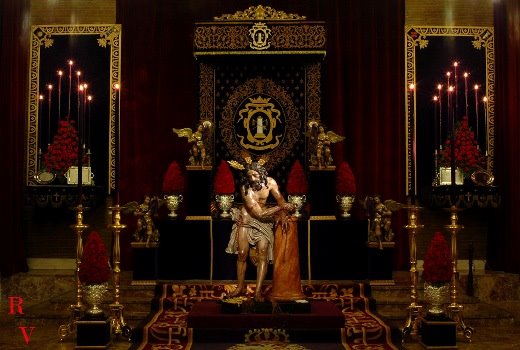
Growing up in the Philippines, one of the very few predominantly Catholic nations in Asia, I was naturally exposed to and reared in a Catholic environment. Seeing that we were once a former colony of Spain, an unabashedly Hispanic Catholicism-- with its multitude of flowers, candles, grotesquely bloody images and exuberance-- took root. In particular, as I have mentioned in my previous post, I took delight in looking at badly-carved, folksy-looking santos, clothed in their excessively-embroidered brocade mantles, bedecked in their 'baroque bling': gold encrusted crowns, aureoles, 'resplendors', and a host of other unnameable miscellany.

However, I always cringed at the sight of crucifixes. I was haunted by the image of a Man hanging from his palms ( it's always the palms ) from a cruel-looking cross. His arms and legs were blackened by bruises and by the constant flow of blood. His wounds gaped at you and exposed raw muscle and even bone in some cases. A crown of thorns, shoved onto His head, pierced His skull and caused even more blood to weep down His face. His entire body was blackened by a bevy of beatings, and wept from a thousand ( according to lore, the wounds numbered some 6,666 all in all ) orifices. It was a sight that made or broke one's faith.

It did not help that, when I was nine years old, I dreamt that I was alone in an abandoned church, with nothing and no one save a crucifix as my companion. In my dream, I remembered looking at that crucifix, and it, in turn, looked back at me. Like some surreal re-telling of St. Gregory's Mass, the Corpus went down from the cross, and slowly came toward me. I panicked, and ran as fast I could, but everywhere I went, the bloody Corpus always managed to catch up.

Why do we love to see Him suffer? Why are we Catholics hopelessly fixated on this image of a dying Man, His bones sticking out and His blood oozing in obscene amounts? Why is something so revoltingly shocking the most common fixture of our Faith?


This is the ultimate paradox of Catholicism. It has never been a 'sanitized' religion. Case in point: the peace ceremony in the Old Rite involved a pious image being passed around to the congregation, who then take turns kissing it. Have you ever wondered how much bacteria is in there? Or what if Ol' Toothless took a whole minute kissing it? It's a bit unsettling to think of, especially in this day and age. But that is how it was done for centuries. Tradition is not so much as an endless reverting to how we think it was always done; rather, it is humbling ourselves and submitting to the way it has always been.

This is the main difference between Anglo-Catholics and Roman Catholics. Whereas the Anglos might have a superior appreciation of the aesthetics of liturgy, have better taste in music and are much more reverent, there is almost nothing behind it. It is a religion based on theory, and there is no sense of fallback whatsoever. Catholics have come into criticism for being distracted at Mass; we go to our favorite shrines to light a candle during the sermon, we scold our children for being too noisy at the Credo, and even crossing oneself looks like an exercise at, oh say, removing a stray booger from one's face.

The beauty of Catholicism is that it is a very human thing. Unlike Protestantism, we Catholics understand that to be perfect does not have to mean giving up being a human. Perfection is not some overnight infusion of grace; it is a process that has its ups and downs which may take years before we can achieve. Sometimes, the greatest sinners turn out to be the greatest saints: St. Augustine's story is familiar to us all, as well as St. Dismas'. It was St. Josemaria Escriva in point 675 of his book 'The Way' who said:

"It's true that he was a sinner. But don't pass so final a judgment on him. Have pity in your heart, and don't forget that he may yet be an Augustine, while you remain just another mediocrity."


It is no secret that we have had many heresiarchs for priests and bishops and that we've had scoundrels for popes. It is precisely because we have had so many sinners in the fold that Catholicism comes off as an objectively real thing. The Church is not some abstraction based on paper; it is the screaming multitude of men and women, saints and sinners, priests and laymen. It is very much a visible thing.

And we are all under the banner of the crucifix. That bloody, beaten, bruised Corpus is a powerful reminder of the love of God for us. I once read a quote that went something like this: 'Sucking your stomach in at the weighing scale-- that is the ultimate self-delusion'. The Crucifix is the visual symbol of the Christian life. It is a life that faces up to the challenges ahead with the knowledge that we will ultimately get something beautiful and profound in the end.

Saturday, March 03, 2007

The Church of the Gutters


There is no bigger festivity in the whole of Manila than the feast of the Black Nazarene. Held for the last four hundred years on January 9th, the feast draws literally hundreds of thousands of participants-- men mostly-- to the venerable Quiapo church. These men, mostly from the lower classes, come in droves, usually armed with a white, woolen towel, a miniature replica of the Nazarene, and are almost universally clothed in Maroon. The highlight of this feast is the procession. At around noon, the gilded carriage of the Black Nazarene is processed out of the church, where it is greeted by a sea of shouts from the thronging crowd. The men wave their towels in the air, while shouting salutations at the image of Christ. This image of Christ carrying His Cross is famed throughout the country as the sole, miraculous survivor of a fire that ravaged a ship en route to Manila from Mexico, and is said to bring fortune, health and blessings to those who venerate it.

Upon the carriage, dozens of men crowd around the statue. They are the 'official guardians' of the image, and are in charge of wiping the Nazarene's face with the towels thrown at them, and subsequently returning these to their owners. Looking at the scene, one would think it were a pagan festival, Jaganatha Puri transported to Manila via some strange coincidence of fate. But pagan festival it is not; it is one of the last vestiges of a simple, unadulterated faith that has been largely supplanted by an unhealthy rationalism. It is Catholicism in its rawest form.

As a child, I remember being fascinated by my visits to more venerable churches of Manila. I marveled at the multitude of life size santos, dressed in their heavily embroidered tablecloths and blond wigs made from abaca. I stared in wonder at altars and retables shrouded in a sea of silver and gold and cried at the sight of a bloody Spanish crucifix, complete with gaping wounds and torrents of blood gushing from them, the arms and legs of the Corpus almost black. I stared in amazement at the numberless women, heavily mantilla-ed up to their backs as they crawled their way towards the altar, and wondered how long they could hold their arms in a 'cross' position while they prayed the Sorrowful Mysteries. Catholicism has never been a middle-class religion. As the title of this post suggests, it is in the gutters where Catholicism has largely been cultivated.


Many conservative and traditionalist Catholics today are sadly disdainful of these practices. It strikes me as strange how many traditionalists are able to memorize as many encyclicals as possible, genuflect until their knees pop, and discern an approved litany from another, but are unable to even pray the Stations of the Cross properly, for example. Many pride themselves in their ability to recite Newman or Belloc or Chesterton at the drop of a hat, but have never seen a Pieta Prayer Booklet before or read about the Fifteen Hidden Tortures. They pray only the approved novenas but are reluctant or disdainful of touching, say, a plastic St. Joseph statue and wiping it with their hankies or kissing its feet. They go to all three masses of All Souls' Day but gawk at the notion of keeping an overnight vigil at the cemetery.

Gone are the simple piety and trust that characterized the faith of our grandfathers. Instead, it has been supplanted by a rationalized paper religion, a Catholicism of the mind but thoroughly lacking in heart.

Catholicism was able to maintain its sanity throughout its troubled history precisely by treating its holy days as holidays. For instance, it is the only religion that honors St. Benedict, that most austere of saints, with the gaudiness and flamboyance of the Spanish Baroque. It is the only religion where 'the servant of the servants of God' wears a gold-encrusted triple crown and is (rather, used to be) carried on a portable throne supported on the backs of twelve men. I recall reading some time ago how John Henry Cardinal Newman once visited a Catholic church in Rome. It was like being in another world for him: people knelt and bowed at the altar, thronged around statues of saints, worshipped bones and other dismembered paraphernalia of dead men. In particular, he noticed how an elderly woman took the prayer booklet of another who had just entered the confessional. Yet through it all, there was a sense of something 'objective' being done. For the first time, he thought, he had seen real worship manifested in the simple piety of these people ( read more about this in I.T. Ker's "Catholic Revival in English Literature 1845-1961: Newman, Hopkins, Belloc, Chestertone, Greene, Waugh").

Catholicism is very much a human religion; it is a religion of the mind as well as the heart. Among the ranks of its saints, one may find superb intellectuals like the Angelic Doctor, Thomas Aquinas, seemingly irredeemable sinners such as Augustine, alleged "hippies" like Francis of Assisi and a host of other personalities. There seems to be a notion that all Catholics are expected to be these perfectly-mannered, insufferably polite, basically very middle-class group of characters. Nothing could be further from the truth. Majority of the world's Catholics subsist on pitiable salaries that go into the feeding and rearing of their children. But that is not what this post is about.

I find it ironic how many conservatives and traditionalists see cultural Catholicism as some sort of disease or malady that is irreconcilable with the proper practice of Faith. It is ironic in that these cultural practices are sometimes the only vestiges left of the old soul of the Church as practiced in the days of our grandfathers. Processions, plastic statues, embroidered tablecloths, all of these were fixtures of the Catholicism of old. Why, then, do we disdain them so much? Perhaps this is the greatest tragedy of Vatican II: how the practice of Catholicism has been reduced to nothing more than having valid sacraments and fulfilling obligation for the sake of fulfilling it.

Make no mistake: valid sacraments are integral to Catholicism. But aside from that, the Church today is seemingly devoid of the character it once possessed. In the attempt to 'go back to the basics', we have spurned the practices of our elders; we have robbed Catholicism of its character. By concentrating purely on a sacramental and didactic model of the Church, Catholicism becomes a mere collection of articles to which we either assent to or not.

Prior to the Reformation, the term 'devout Catholic' was a redundant, perhaps even non applicable term. In the book "The Church: A Pictorial History" (1961), a typical scene in Catholic England was laid out. The account describes how the English, for example, would all recite the "Pater Noster" in the town square at a certain time, and how everyday the churches were packed with worshippers. Their Faith was simple; it was the devotion of a child to his father, the tenderness of a mother to her child. It was not an intellectualized abstraction, but the effusion of love from a dedicated son or daughter. It is sad how these scenes are virtually consigned to the dust bins of memory. Indeed, I wonder what would have become of England had the Reformation not happened; it is saddening to think that this once most Catholic country is now removed of the traces of religion, Catholic or otherwise.

There is something haunting, and the same time comforting, at doing something that has been done for hundreds of years prior to you by people who have already long gone. In praying the Stations of the Cross, I sometimes wonder if a Dominic or a Francis Xavier's knees hurt as much as mine did, or if an Ignatius or an Augustine had an irrational fear of ghosts while keeping vigil in a cemetery. I sometimes if the priests of yesterday actually mumbled their Masses, or if they just spoke really bad and accented Latin as in some cases today. The clasping of hands, the beating of the chest, the double and single genuflections are haunting reminders that this is how it was always done. It is the entire history of the Church, distilled and refined into one action. This is Tradition; it is knowing that somehow, someone, somewhere at one time or another, can walk into a church and worship as he always has. And although you may never laugh with them, talk with them, kiss them or be with them, it is a most comforting thought to have.

Thursday, December 14, 2006

Adversus hostem aeterna auctoritas esto

Thus goes the old Roman adage- "To the enemy no quarter."

In many ways this is especially true today. We live in an age where mercy and clemency are vanishing in place of vengeance and over-the-top political correctness. Nowadays, if someone happens to slip up, the crowd goes into a frenzy worthy of the mob. This is especially evident in the Philippines as shown in all the brouhaha spent on the Cha-cha/Con-con/Con-ass issue(s).

Don't get me wrong. I'm entirely against them, too. Not only does the issue seek to circumvent the constitution entirely, but it is also a mere facade for politicians to extened their reign of terror in Congress or the Senate.

However, I'm also of the opinion that the militants and other various groups opposed to it have crossed the line.

Last Tuesday, 12 December, at exactly 2pm, a massive rally organized by the pseudo-Communists ( I call them this because majority of them wear red all the time ) marched along Commonwealth avenue, obviously to air their views as regards to the Dance of Death ( economic, political, cultural, you decide. ). They carried banners, placards, streamers and other paraphernalia that scremaed variations of 'No to Cha-cha', 'No to Con-con', 'Oust gloria now', 'Lechon-in si De Venecia' and other colorful slogans, such that can only be found here in Glorious Philippines. The rallyists were convened at the door of St. Peter's Church ( the drama! ), with some of their members still platooned in front of Diliman Preparatory High School. As you can imagine, this caused SEVERE traffic that was to last up until 6.30 in the evening. And I don't mean 'severe' in the ordinary, day-to-day sense. This was pressure-boiling, vein-busting, heat-stroke inducing bacchanalia at its finest.

It's moments like these that make me want to be a wannabe Fascist. I'm all for free speech, but please, don't make your business my business. And not helping to clear this mess ( but in fact, even contributing to it ) is the CBCP, which, in my opinion, has degenerated into nothing more than a political mouthpiece for bleeding-heart liberals. Case in point: my very own bishop, the Most Reverend Antonio Tobias, of the Diocese of Novaliches, is one of the most vocal critics of the Arroyo government.

I'm not exonerating the government as well. But really, you would think the Filipino people would have learned by now that bickering solves nothing and leads only to further division. Former President Cory Aquino, ironically enough, is also an ardent anti-Arroyo activist; recall that her reign was besiged by many destabilization attempts, and expect her most of all to know what the repercussions of such actions are.

So what exactly are my political beliefs?

For starters, I'm not so keen on a democarcy. There, I said it. Afterall, 'democracy' is but one letter away from being demoncracy, the rule of demons. I believe that an enlightened dictatorship or even a monarchy would be best. However, seeing as how that's nearly impossible to accomplish in this day and age of extrme political correctness, a system patterned after the Singapore government would be acceptable. In Singapore, they believe in the efficacy of corporal punishment, even for cases that are not that 'extreme'. One might recall that in Singapore, public caning is stil very much a common thing. By God, sodomy is a capital offense there: what's more to want? Remember, a state without teeth is rendered weak and helpless.

Going back to the rally, don't you think that the four hour period spent shouting slogans and calling for an end to Con-con ( haha, another thing, it seems the rallyists forgot that it was already trashed-- THE DAY BEFORE )by the militants could have been better used by acutally going to work? Instead of concentrating on abstractions an overwhelming majority of the rallyists don't even understand, they couyld have used the period instead by working, earning a living, and PROVIDING FOR THEIR FAMILIES. And I'm really serious. Most of the rallyists were from the disenfranchised sector, which we give the politically incorrect term of 'squatters'. I don't want to sound like a total elitist, but it is true when I say that they don't even understand what Cha-cha/Con-con/Con-ass is all about; I'm thinking they're just finding something, anything to vent their anger at. It's sad, I know, when a sector of society is generalised; but such is the sad truth here.

I love my country. But with all these Judases and Caiphases that populate all sectors of the society, maybe even including myself, I cannot blame anyone who decides to leave the country for greener pastures abroad. I can only hope that, someday, the Filipino people will realize just what freedom is.

Tuesday, August 15, 2006

Assumpta est Maria; gaudent angeli


Veni; coronaberis


No, I am not dead.

Perhaps it seems fitting that my latest update in this seemingly frsaken blog takes place on the feast of the Assumption of Mary, that glorious event in which all Catholics profess-- without question-- the entrance of the Blessed virgin into eternal beatitude, body and soul. Most Christians today, even Catholics, tend to underestimate Mary's role in the Christian community. We need only remember that it was Mary's 'Yes' that enabled the Incarnation of Our Lord to take place. One can just imagine the heavenly hosts gripped by suspense, seemingly spending an eternity within eternity awaiting her answer; and their subsequent exultation and jubilation at Our Lady's fiat. It only seems logical that this woman, most wondrous of God's creatures, should be assumed body and soul, permitting neither death nor weakness to stain her. As we celebrate Our Lady's glorious feast, let us be reminded of the eternal truth that we, too, someday shall have to face the judgment seat of Christ. There the just shall receive their heavenly reward, and the wicked shall be consigned to the flames of hell. May this feast of the Assumption open the flood gates of God's infinite graces, that we may someday also share everlasting happiness with Mary and all the saints.

Tuesday, June 06, 2006

In absentia

I apologize for the lack of updates recently, thoguh I regret this slump might continue. I've been busy the last couple of days and I doubt if I can get any free time at all, especially considering that the schoolyear is starting in two weeks. anyway, I'll update when I can. Keep in touch. :)

Thursday, May 25, 2006

'Death to their God!'

As a kid, I just loved watching Cecil B. DeMille's 'The Ten Commandments'. We had it on VHS on 'extended loan' from my grandparents, and everytime I would get the chance I would play the second half of the movie, when Moses finally summons the guts and confronts the Pharaoh about God's demand, that he 'let My people go'. I had fond memories of the incomparabley villainous Yul Brynner, in full royal vestments, literally a god to his people, confronting this old, dishevelled husk of a man whom he once considered his brother. Yes, I know all about the creative license the producers took with the Biblical narrative, but today, the kitschyness of the film still gets me. Nothing beats that classic line, 'Your fragrance is of the wine of Babylon'. Pure genius.

Of course, the title of this post refers to the Pharaoh's infamous remark, when he decides to give chase to the Israelites and bring them to slavery once more. Here was a classic line that expressed the ancient Egyptian Pharaoh's sentiment of superiority and divinity, crystalllized and distilled of any sort of pretentiousness, a raw challenge, as it were, from one god to Another.

Well, doesn't this just remind you of that scene?

They Have No Decency
Too many in media bash Catholicism - and get away with it
By WILLIAM A. DONOHUE


She's a mother who is very protective of her children. She is a believer who accepts the tenets of her faith. And yet, she continues to vent her hatred of all things Catholic. She's Madonna.
In her "Confessions" tour, the former Catholic and now practicing member of kabbalah appears with a crown of thorns while suspended from a giant mirrored cross. It's vintage Madonna: She went back to the well of anti-Catholicism one more time, proving that the old diva cannot dance and sing without exploiting Catholic iconography.

It's not just her. In February, hip-hop artist Kanye West graced the cover of Rolling Stone wearing a crown of thorns with "blood" streaming down his face. The piece, titled "The Passion of Kanye West," divulged the rapper's passion for pornography. It also revealed the Catholic-bashing agenda of the magazine and the musician.

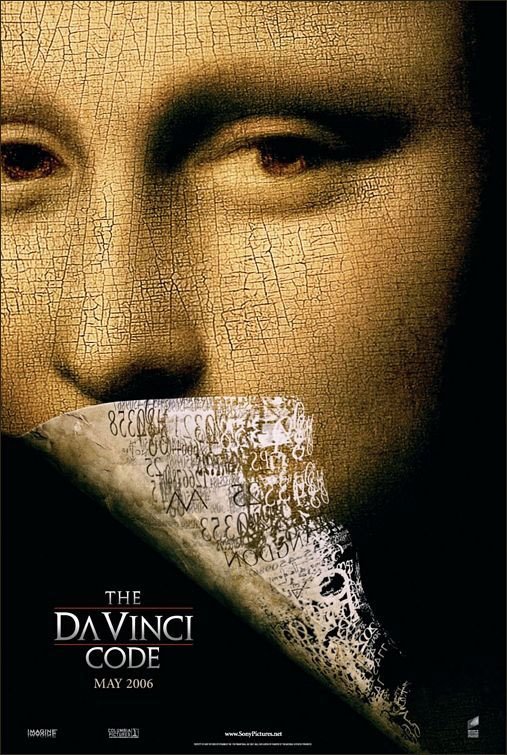
It may be that "The Da Vinci Code" is one of the most inane movies to appear in some time, and it may be that its failure to persuade means Catholics have nothing to worry about. But if so, this is by default. After all, the book upon which the film is based is built on malicious lies about the Catholic Church.

One of the co-producers of "The Da Vinci Code," John Calley, was quoted last year saying the movie was "conservatively anti-Catholic." Leaving aside the silly qualifier, ask yourself: Is there a single producer in all of Hollywood who would boast that his movie is anti-Semitic, racist or homophobic? And to top it off, ask yourself why inoffensive depictions of Muhammad are rarely shown on TV or in newspapers?

The bias against Catholicism is palpable. No other segment of society is continuously the target of vicious jokes by the likes of Penn Jillette or Bill Maher. No other segment of society is subjected to the obscene assaults like those "South Park" delivers over and over again. And no other segment of society is routinely held up to derision on college campuses.

Consider that a student newspaper at the University of Oregon recently put a depiction of a naked Jesus Christ on the cross with an erection. It also showed a graphic of a naked Christ kissing a naked man, both sporting erections. And the response from the university's president? It was so weak that state lawmakers — after receiving color copies of the offensive pictures from the Catholic League — have decided to deal with this incident themselves. All because the president of the university found it politically incorrect to morally condemn the newspaper.

It's not just Catholics who are on the receiving end of these attacks — all Christians are fair game. NBC dumped "The Book of Daniel" because there was no audience for the script, but the producers surely thought there would be one. After all, who wouldn't want to watch a show where an Episcopalian priest dabbles in drugs, the wife is a boozer, the daughter is a dope dealer, one son is gay, the other is a womanizer, the brother-in-law is a thief and the father's father is an adulterer? Just your ordinary Christian family — in the eyes of Hollywood, that is.

To understand what's driving this, consider that our culture teaches that freedom means the right to do whatever we want to do and Catholicism teaches that freedom means the right to do what we ought to do. There's a natural disharmony here, a tension so taut that something's got to give. Never mind that a libertine idea of freedom — liberty as license — is spiritually, psychologically, physiologically and socially deadly in its consequences. It's what sells. Sadly, what is attendant to this perverse interpretation of liberty is a need to lash out at any creed that preaches the virtue of restraint.

The scandal in the Catholic Church did not help matters, but the frontal assault on Catholicism antedated the revelations of 2002. No matter, the kind of hate speech that spews with regularity toward the Catholic Church can never be justified. That it occurs amid all the chatter about tolerance and respect for diversity makes it all the more repugnant.

Donohue is president of the Catholic League for Religious and Civil Rights.


This story originally appeared on The New York Daily News on 23 May 2006

I'm hardly surprised. Hollywood is perhpas the most godless place in the world, yet at the same time, it is god to many people drawn to the life of prestige and immeasurable wealth it offers. It regularly vomits forth films that are thinly-disguised attacks on the Church, starring, of course, equally godless men who will be reduced to dust and ashes in a matter of years. Yet they have the gall wo parade themselves as gods, perhaps convinced of their own immortality. Just look around you. Watch a couple of movies. The Catholics are always depicted as superstitious, ignorant of their own faith, and devoid of morals. Catholic priests are always sleaze bags, gluttons, alcoholics, homosexuals, bigots and the like. Irony of ironies, however, the only good depiction of Catholics can be found in Horror movies. Mostly. When there's a question of some weird, obscure prophecy or the date of the Anti Christ's birth, the Church is always depicted as the one with all the answers. Yet how the world vilifies Her.

'Tis a far cry from the 50s or 60s when Catholics were treated with respect. Have you ever seen Alfred Hitchcock's 1953 classic, 'I Confess'? It was an excellent film which plays on themes sacred to Catholics like the seal of the confessional. The priest is depicted as a man of conviction, dignified, as opposed to the bastardized portrayal of priests found in films today.

Even 'The Exorcist', for all its expletives and controversial scenes, depicted Frs. Merrin and Karas as men worthy of respect, men who were really concerned with exorcising the demon out of young Reagan.

*Sigh*. Isn't it odd that Hollywood, sans one 'l' and given a space in the middle, spells out the words 'Holy Wood'? An obvious reference to the Cross of Christ, 'in quo salus mundi perpendit'-- on which hung the salvation of the world. It is indeed lamentable that we are crucifying our own Saviour by tolerating these things.

Movie review: 'X-Men: The Last Stand' *SPOILERS*

Time for another secular post :)

While 'The Da Vinci Code' was the darling of the media with all its hype, glitz, and promotional tie-ins, there is no doubt that 'X-Men: The Last Stand' was awaited by its loyal fanbase with an event more fervent anticipation. It concludes the trilogy of X-Men movies [ although as of this moment I read that X4 has been confirmed already ], which, in my opinion, brought a new level of dignity to superhero movies. Think of it as what 'The Day The Earth Stood Still' did to the science fiction franchise.

Anyway, I saw this movie today with my family. And the cinemas were packed. Literally PACKED-- from the excited kids to the throng of ex pats who grew up with the comic-- the theater was filled to capacity.

As you may already know by the now, the plot of this third installment focuses on a supposed cure to the mutant problem. This cure, culled from the cells of another mutant, would permanently suppress the X-gene in mutants, thereby making them 'normal'. This naturally causes a huge controversy in the mutant community, with the evil Magneto rallying disenfranchised mutants to his cause. Meanwhile, in the midst of all these happenings, a new, powerful mutant has emerged-- greater thatn even Magneto or Charles Xavier, the leader of the X-Men. The mutant in question is, of course, Phoenix, the twisted and violent personality of the psionic Jean Grey [ who miraculously returns to life after being presumed dead at the end of the second installment ].

X3 is a no-holds barred, extremely fast paced movie. Once it starts, it does not relent. I thought that the tension surrounding 'the cure' was palpable from the beginning. There are some very poignant moments in the film. Especially shocking was a pivotal scene in the middle of the film. This scene was so shocking, that many fans of the comic book reportedly walked out. It literally brought things to a standstill, and many of the people in the theater were teary-eyed.

* * * SPOILERS!!! * * *

This scene which I am referring to is of course the death of Professor X. This happens during a confrontation in Jean Grey's house, where Magneto and company also follow suit. The scene is very powerful. You literally see the Professor being carried into the air by the awesome power of Phoenix. His skin begins to flake away at every contact with her unlimited power. After a brief pause wherein the Professor takes one last look at Wolverine, he shatters into a million pieces. It was a very hard scene for me to watch, since the Professor was one of my favorite characters.

Phoenix also kills Scott/Cyclops after their reunion at Alkali Lake. After sharing a passionate kiss, we see Scott's face flaking away. Then it cuts to a scene in the mansion. When Wolverine and Storm arrive on the scene, all that remains of Scott are his glasses.

* * * END SPOILERS * * *

The confrontation between Magneto's Brotherhood of Mutants and the remaining X-Men was one of the best battles I've seen in years. The desperation and the conviction in either team's resolve was chilling. I won't tell you how they beat Magneto, but res assured, it will leave a smile on your face.

Overall, 'X-Men: The Last Stand' is definitely my favorite movie thus far in this year. My only complaint was that the script was a little... scatterbrained. Compared to the atrocious 'The Da Vinci Code', though, X-Men lives up to the hype and leaves the audience literally wanting for more.

8.5/10

PS: Make sure you don't miss the scene at the end of the credits. IMHO it leaves a lot of things open for possible future installments.

A follow up to 'A moment with Mary'

Well what do you know! I figured that post would be the first to get any comments. Props to Francis and Spooky for being the first ones!

Anyway, here's a little background on our retreat, where I took that picture of Our Lady's grotto. Part of our school's tradition was to hold an annual retreat for the graduating batch of seniors. This is usually done in March, but sources tell me that the school is considering moving the date to the fourth week of June.

The place was called 'Laguna Hills Study Center', which is a compound run by the Opus Dei prelature. The main residence of the Numers was around five minutes walk from the house we stayed in. Anyway, it was a beautiful, well-kept residence. There was a chapel inside, as is typical of the Opus Dei. The entire house was decorated sparsely, although not to the point of horror vacui. There were also various libraries containing all sorts of books, from the writings of Josemaria Escriva, papal encyclicals, and the occassional 'Confessions' of St. Augustine.

We stayed there for three days. There were no televisions or cell phones allowed. Even reading the newspapers was discouraged.

Our typical day would start at around 6:00 am. We used this period to freshen up, take baths, fix our quarters, and prepare for Mass. Before the Mass itself, there was a fifteen minute medidation at the chapel, led by our chaplain. Next, the Holy Sacrifice of the Mass was celebrated, followed by breakfast. Talks were given at around 10:00am to 12:00pm, at which time we would prepare for lunch. Before I forget, there was an average of five to six meditations per day, and I have to admit, I wasn't always paying attention [ mea culpa! ]. After lunch we would have a grace period, wherein we can engage in the activities we like. We also had the Via Crucis everyday; daily examination of conscience; spiritual reading; Rosary thrice a day; spiritual direction and lots of other pious activities.

Needless to say it was a thoroughly alien experience to most of my classmates. This was my first time to attend a retreat as well, but I already had an inkling of some of the things to expect.

Overall, it was a refreshing experience. I really felt rejuvenated after that, and I hope to be able to attend more in the future.

Some more pics:

Picture of the chapel where we held Mass, meditations, and Via Crucis everyday


This is the environment in which the grotto of Our Lady was located.


Interior of the Opus Dei center we stayed in. Note the spartan ornamentation of the room

Monday, May 22, 2006

Gotta get me one of these

Aside from matters religious and liturgical, I think it would surprise many to know that I am absolutely fascinated with melee weapons. That, and Godzilla movies. In particular, I have a thing for Southeast Asian/Indian melee weapons. I've been researching them for a couple of weeks now, and I have to say that I am very impressed at the genius and cleverness of their designs. There's literally an enchidrion of weapons, ranging from the more common [ like the talwar, kukri ] to the ram's horns used solely by Indian holy men [ they're forbidden from using common weapons ]. There is just something about them that beats any run of the mill gun any day of the week. Take, for example, the Indian Urumi, also known as the Chattuval.


Says Wikipedia:

The Urumi or Chuttuval is a long sword made of flexible steel, sharp enough to cut into flesh, but flexible enough to be rolled into a tight coil. It was used and still can be found in south India, and is one of the weapons learnt by practitioners of the martial art of Kalaripayattu. It was most popular in the North Malabar coast of Kerala State, India, and is often mentioned in the ballads of the region.

The sword is a flexible band of steel three-quarters to one inch in width, and long enough to reach from the fingertip of one hand to the finger tip of the other hand when the hands are held outstretched. . . Often there are Urumis with multiple belts on a single handle, which makes it more dangerous to the opponents and wielders alike.


Wow. Just wow. I really, really, and I mean REALLY have to get me one of these very soon!

A moment with Mary


They say that a picture is worth more than a thousand words, and I believe that to be escpecially true with this picture. This was taken around two months ago during a retreat. I had just taken a swim at the pool, and as I was going back to the retreat house, I chanced upon this grotto of our Blessed Mother. I'll stop my rambling now and just let the picture speak for itself.

A visit to Old Manila's churches

I had the tremendous opportity to visit Intramuros [ literally "within the walls" ], the "walled city" around three weeks ago. Intramuros, as some know, was the original Manila during Spanish times. Built in 1571 by the conquistadors Martin de Goiti, Juan Salcedo, and Miguel Lopez de Legaspi, Intramuros remains today a monumental symbol of past times, a forgotten shard of the ancient past thrust in the midst of a glittering megalopolis. One literally steps into a time machine upon entering the alled city-- here the police officers dress in the same manner as the guardia civil, complete with horses and period costume. Intramuros has historically been the home of the See of Manila; the Cathedral is located here, traditionally right next to the ayuntamiento or city hall.

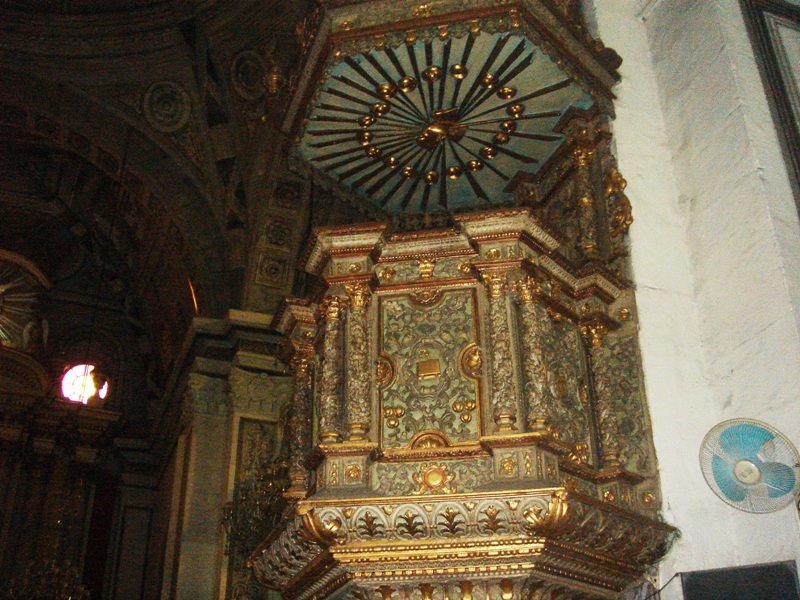
Pulpit, San Agustin church. Note the out of place fan

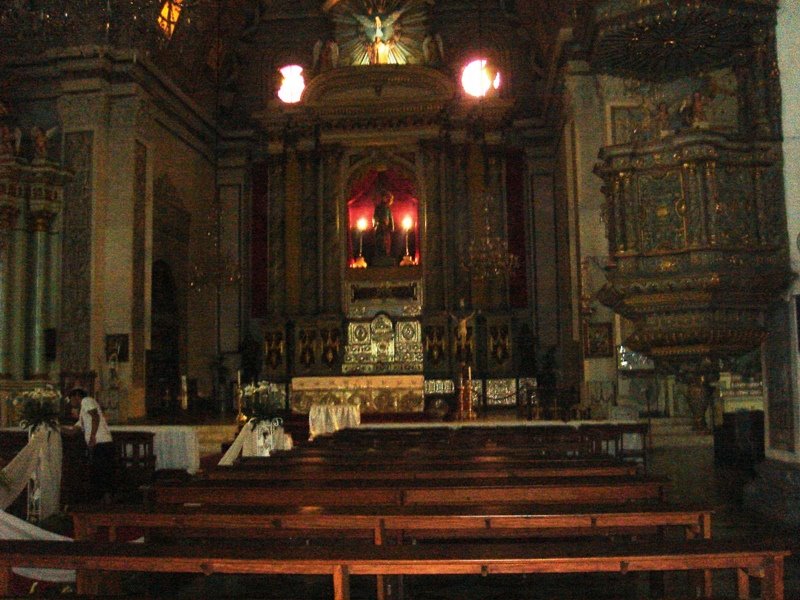
Another hallmark of Intramuros is the beautiful, if ostentatious San Agustin Church. Built and staffed by the Augustinian friars, San Agustin is one of the few churches which managed to escape the ravages of the Vatican II 'uglification'. Here one will find rows upon rows of images of saints, some carved from ivory. The main altar is made of beaten silver, if I am correct. But if tat weren't enough, there is a museum located next door, containing a truly beatific collection of Spanish era religious art. Among the treasures found here are statues of the saints made fromivory and lavished in gold-thread vestments, altar ornamentations, whole retablos [ altar screens ], vestments, and 400 year old psalters. No pictures were allowed, however.

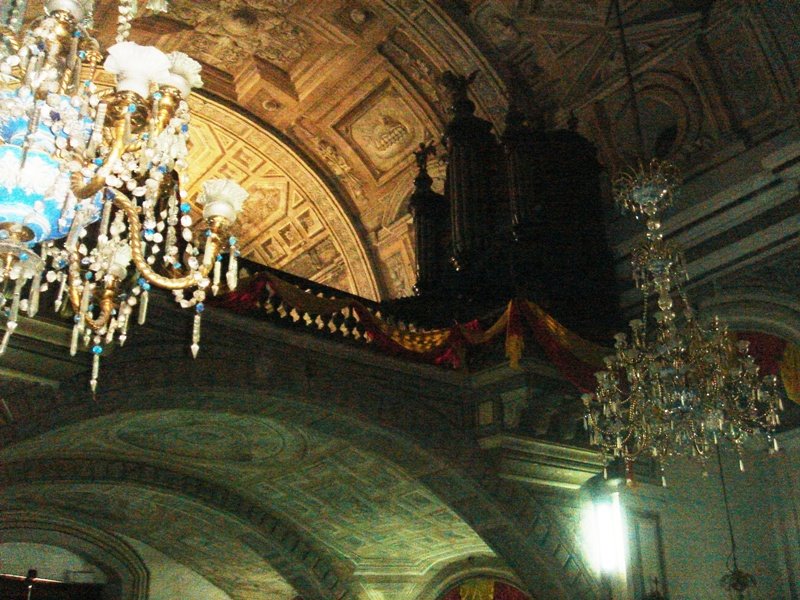
Right: Ceiling of San Agustin church

As well as these the church is gifted with a magnificent trompe-l'oeil ceiling. San Agustin is a favorite venue for weddings of manila's old money couples. Perhaps nothing recalls Manila's unique Spanish identity more than the fact that a good fraction of the confessionals in the church allow for penitents to confess in Spanish.


Left: Altar Mayor of San Agustin. The pictures odes not do it justice

The church is among four churches designated as UNESCO world heritage sites in the Philippines. The other three are, Santa Maria church in Ilocos, San Agustin church is Paoay, and Santo Tomas de Villanueva in Iloilo.


The Manila Cathedral is also in Intramuros. Also known as Minor Basilica of the Immaculate Conception, 'is the only cathedral in the world that was built and renovated six times. It was the seat of the Archbishop of Manila during the Spanish Colonial Period in the Philippines, and still remains to be the ecclesisastical seat of the Archdiocese of Manila.'
Source

'The See of Manila, with jurisdiction over all the Philippine Islands and suffragan to the See of Mexico, was erected in 1578. The first bishop, Domingo de Salazar (born 1512), arrived in Sept., 1581.

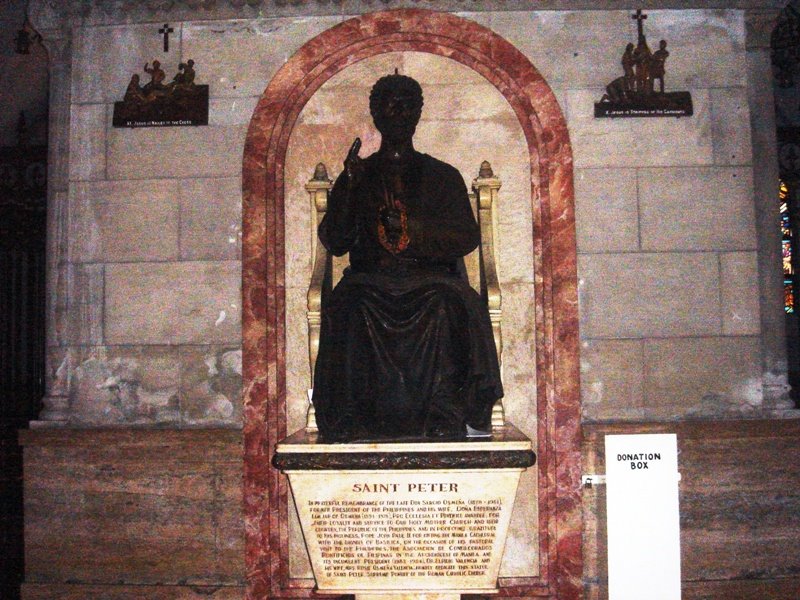
Left: Statue of St. Peter, Manila Cathedral

The first cathedral, made of nipa and bamboos, was built in 1581. It was damaged by a typhoon in 1582 and razed by fire in 1583. The new cathedral, which was made of stone, was made in 1592. It was destroyed by an earthquake in 1600. The third cathedral, with three naves and seven chapels, was started in 1584 and blessed in 1614. It was toppled by another earthquake which shook Manila in 1645. The magnificent fourth cathedral was constructed in 1654 to 1671 under Archbishop Miguel Poblete. It was severely damaged in 1863 by a very strong earthquake that even toppled the Palace of the Governor General of the Philippines. In 1880, another earthquake toppled its bell tower and since then until in 1959, the cathedral remained towerless. '

'The fifth cathedral was constructed in 1870-1879. It was solemnly blessed in December of 1879. The center cross of the dome is a reference point of astronomical longitudes of the archipelago. The magnificent cathedral was toppled into ruins by the bombs of World War 2 in 1945.'

'The present cathedral was constructed in 1954 to 1958 under Archbishop Rufino Santos of Manila and under the supervision of National Artist for Architecture Awardee, Architect Fernando Ocampo. It was elevated into the rank Basilica Minore in 1981 by Pope John Paul II.'


Unfortunately, the lighting inside the Cathedral made it almost impossible to take a good picture. The main altar is dedicated to the Immaculate Conception, and there are numerous shrines and side altars dedicated to various Spanish saints. Among those interred in the Cathedral are Rufino Cardinal Santos, the first Filipino Cardinal, and the late, and much beloved Jaime Cardinal Sin

Fr. Adrian Fortescue: A Remarkable Life


I've been reading about the life of the late Fr. Adrian Fortescue ( 14 Jan 1874 - 11 Feb 1923 ) for the past couple of days. For those who do not know, Fr. Fortescue was the pre-eminent liturgical scholar of the early twentieth century-- not only that, but this great man 'was an artist, calligrapher, composer, adventurer - and a devoted parish priest'. He is also the author of 'The Ceremonies of the Roman Rite Described', considered THE authoritative guide to the proper and dignified celebration of the Traditional Latin Mass.

Read more about this fascinating man here.

Or, if you want:

Click here to purchase the book 'The Ceremonies of the Roman Rite Described'.

Why we oppose 'The Da Vinci Code'


As of this moment, there is a new icebreaker in town. The question everybody will be asking each other within the next few weeks is remarkably similar to another old icebreaker. This time, though, people will be asking, 'Have you seen The Da Vinci Code?', and one can honestly expect this in the watering holes of the elite to the most commonplace neighborhood. For the people who have seen the film but have not read the book, this is their time to revel in their ignorance.

Just why is there such a big fuss over this movie?

We know for a fact that the book claims that Jesus was never divine; that he was married to Mary Magdalen: that the Church knew all about this and committed murder to maintain its power and prestige. All very good material for a film, especially in godless Hollywood. Ask yourself a question, when was the last time you saw a movie wherein the priest was the good guy? Where the priest was not a drunkard, a pedophile, or a thief? Well, you might say there was 'The Exorcism of Emily Rose', but then again, films like these are almost NEVER shown.

I think 'The Da Vinci Code', more than anything, removes the sense of the sacred. Look at it like this: say that you find yourself before a cave, which legend says is the home of an ancient, evil dragon. Then you see a little kitten come out. This incindent is more than adequate to dispel any myth and legend surrounding the cave. The same is true, I gess, with the movie. Once we allow something that questions the most sacred doctrine of Christianity for public consumption, what's next? A film about the Blessed Virgin as a transsexual? A propaganda film about 'Adam and Steve?' A film which shows that Our Lord was gay, and that Peter was really the beloved disciple? Just recall the infamous 'Piss Christ' photograph, or the portrait of the Blessed Virgin made from elephant dung. Allowing these things is but the first step in 'desacralizing' the Faith.

Our Lord said in Mt. 10:34 'Think not that I am come to give you peace, I am come to give you the sword'. Christianity is not a pacifistic love-em-all religion. Often the Gospels would have more examples of 'tough love' scenarios than it does lovey-doveyness. When Our Lord saw the moneychangers at the Temple, He did the right thing to do: He drove them away. What then of a film which might potentially undermine the faith of so many millions who see it?

To put it another way, let us pretend that the Church is a real flock of sheep. You have your shepherds-- the pope, his bishops and priests-- and you have the mastiffs-- the government officials and the patricians. The rest are sheep, who are made up of the common folk. Now, pretend that several of these sheep drink or eat at a poisonous grove. They will naturally get sick, and their interaction with the other sheep will only cause the strange, new disease to pass to the other sheep. Eventually it will reach the mastiffs, and ultimately, the shepherds themselves.

The scenario above is similar to the effects that 'The Da Vinci Code' will have. While it is true that Christ promised His apostle 'that the gates of Hell will not prevail against it', the threat of apostasy is never diminished by Our Lord. In Lk 18:8, He warns us: 'But when the Son of Man comes, think you, will He find faith on earth'?

We have been warned. The evrlasting reward will not come without a fight. Let us draw inspiration from these words of Scripture: Vigilate, state in fide, viriliter agite, robusti estote -- 'Watch ye, stand fast in the faith, quit you like men, be strong' [ 1 Cor 16:13 ]

Good Lord-i...

Nope. This picture isn't from the latest cosmopolitan Austrian Mass [ at least not one of those experimental NOs you so love to hate ], but from the recently concluded Eurovision contest, which is similiar to a pan-European version of American Idol. Only, of course, a bit more insane.

All I can say is... those costumes rock.

Link.

Sunday, May 21, 2006

A most vilified group


Opus Dei chapel at my school


The recent brouhaha concerning the controversial movie 'The Da Vinci Code' has, among other things, brought an unprecedented amount of transparency to the mysterious Opus Dei prelature. Portrayed as the villain in Dan Brown's overhyped book, the author claims that 'The Work', as the prelature is colloquially referred to by those close to it, is a murderous, Machiavellian group, a mafia shrouded in white that would do anything in its power [ and financial clout ] to further its agenda in the Roman Catholic Church. Among the myths surrounding Opus Dei are that it is a power-hungry cult, with connections to many a government in the world. It is also claimed that Opus Dei members are masochists, that it is a Judeo-Masonic organization, that it brainwashes. . . ad infinitum.

Opus Dei seems to be universally hated by Leftists-- apparently because they are seen as a reactionary movement that is hostile to progressive factions in the Church-- and surprisingly by tradionalits, who decry the group's alleged secrecy and 'prima facie reverence'. They are also opposed to its secular mentality, and say that it blurs the line between the laity and the priesthood.

As one who spent eight years in an Opus Dei run school, let me help set the record straight.

1) What is Opus Dei, and what is its mission?

Opus Dei is a personal prelature of the Catholic Church, meaning, in the broad sense, a diocese without borders. It is obviously a part of the Universal Church. Opus Dei is largely composed of lay members: some, who are married, called supernumeraries, make up some 70-80% of the membership. Numeraries, who are laypeople who live celibate lives and live in Opus Dei centers, are the next largest group. The smallest group is composed of priests. Currently, Opus Dei is governed by Bishop Javier Echevarria.

The mission of Opus Dei is to 'Christianize the world'-- without ever leaving it. St. Josemaria Escriva taught that everyone, including laymen, are called to be saints. Obviously these laymen cannot be in church all the time. St. Josemaria taught that we can sanctify out lives by offering our sufferings, works and intentions for the glory of God. Recall that the Holy Family led ordinary lives, and part of that was work. The frown we supressed when we were reprimanded by the boss, the glass of water we momentarily did not drink, that last slice of pizza you did not eat -- all of these can be offered as a pleasing sacrifice to God. St. Josemaria often noted how the world thinks so very little of small sacrifices. Opus Dei aims to help its members live out their daily lives for God.

Most important, however, is making the Holy Mass 'the root and center of our interior lives'. St. Escriva had a great love for the Mass, and he encouraged everyone to attend daily. Remember, the Mass is the most pleasing prayer we can offer God-- it is the Sacrifice of His own Son, the same Sacrifice of calvary, made present for us for the expiation of our sins and our spiritual nourishment. In the Mass, the bread and wine are transubstantiated into the Body, Blood, Soul and Divinity of Our Blessed Lord and Savior. It is truly the supreme oblation, the most sublime tribute we can offer to the divine majesty of God and the source of infinite graces.

There are no monks in Opus Dei.

2) Do Numeraries really whip themselves?

Yes. Corporal mortification, specifically the cilice, has always been part of traditional Christian piety. St. Serafino da Montenegro, for example, is one saint known to have used the cilice. However, the pain and discomfort that they cause have been widly exagerrated in Dan Brown's novel. For example, the cilice induces only minor itching to most people who wear it. These tools are not for masochistic purposes, rather, they help us to share in the agony of Our Lord more intimately. However, these are not the only acceptable forms of mortification. St. Josemaria Escriva always taught that any discomfort can be offered as a sacrfice to God. Thus, refusing a glass of water or abstaining from one's favorite snack can also count as mortification.

3) I've heard that Opus Dei is an elitist organization. Is this true?

Certainly not. In Latin America, for example, Opus Dei is more associated with the working class. There are members who are taxi drivers, firemen, police officers. Opus Dei does not look at a person's financial background as most people would think. Granted, there are many in Opus Dei who belong to the upper crust. Businessmen, senators, lawyers, journalists-- admittedly Opus Dei has them for members. However, this is only a misconception. Here in the Philippines, Opus Dei runs several schools in the provinces for children of less fortunate background. Here the children are taught the basics of farming, for example, or in engineering. AS well as this, they are also given sound doctrinal formation, and Mass is celebrated whenever possible.

St. Josemaria once remarked that a gift of bread will sustain a child for a day-- a gift of books will sustain him for a lifetime. Although admittedly Opus Dei also has schools for the wealthy, they also teach street children in afternoon sessions in the same schools. This allows less fortunate students to have the same education as their wealthier counterparts in the day sessions.

Corporal works of mercy are held traditionally in December. Many numeraries also volunteer to teach catechism to the urban poor.

4) I've heard that Opus Dei brainwashes people. Is this true?

Far from it. Love for freedom is a central doctrine of Opus Dei. If one does not wish to join, it is his choice, and Opus Dei members cannot change that. My own experience with the Work has been very positive. The people are friendly and highly respectful of each other.

5) What about the testimonies of former members and allegations of it being a cult?

One should recall that the Jesuits were originally met with hostility upon their inception. In fact, up to a few years ago, the Society of Jesus was the favorite target for conspiracy theorists and overzealous Fundamentalist Protestants. Opus Dei is new, therefore many people will naturally be suspicious of it. These are normal feelings, and the members of Opus Dei will be more than happy to answer.

Many people have left the Church-- laymen and clergy alike. But do their testimonies validate the claim that the Church is the 'whore of Babylon'? Certainly not. The priest-apostate, Martin Luther, called the Church many a derogatory name: stench-church of the devil, arch-whore of Babylon, among others. Does this, then, make Lutheranism true? No. We know that the Church is true, because anyone who examines Scripture closely will find the Church's teachings in them. Admittedly, the spirituality of Opus Dei is not for everybody, and the Work makes no pretensions that not everybody should join it.

Expect updates on this post

'The Da Vinci Code' is a bloated, discombobulated mess

I count myself one of the "lucky few" who were able to watch 'The Da Vinci Code" on its opening day. As many of you know, that movie was met with militant opposition here in Manila. Even the government, in the person of Sec. Eduardo Ermita, a high-ranking cabinet member, publicly stated that it ought not be shown here, as it might scandalize millions of the Christian faithful. It was even called, I believe, and I paraphrase, "the most pornographic film in history" by an an anti-pornography group, whose leader's name escapes me at the moment.

Well. Okay.

The bottom line: it sucked. Yes it did. I and several of my friends [ curiously one of my friends was the scion of Opus Dei supernumeraries-- the both of them! ] decided to watch it last Thursday, the 18th, mostly because it will be the last time we will be able to go out this summer. Remember, the school year starts here at June-- but for those unlucky souls stuck in the trimester system, it starts in May.

Anyway, the movie largely follows the book's narrative, perhaps a bit too much. I personally thought that Ron Howard did a lackluster job as director. There was so much to be done with the storyline, yet this already campy book turned out to be an even campier film. Tom Hanks carried himself in a lifeless, almost zombie-like manner. Sir Ian McKellen, who is the only good choice in this film, was melodramatic, eclipsing your average Jeremy Irons performance, I thought. The only good thing about the movie was the music by Hans Zimmer-- and yet even that was overused and drowned out most of the film.

Oh, did I mention that Tom Hanks' hairdo is atrocious? Not just plain atrocious... It's atrociously atrocious. So bad that it must only have come from the Devil himself. Or Dan Brown.

In retrospect I realize I probably should not have watched it at all. This is a film which threatens to undermine the faith of so many millions of Catholics in this impressionable country. As the Archbishop of Manila, Gaudencio Cardinal Rosales said, 'Not since the time of the presbyter Arius has there been such an attack on the Divinity of Christ'. I think this is especially true: just 10 years ago, I remember that my relatives would reprimand me if I even mention the words 'Iglesia ni Cristo'. Nowadays, more and more people watch the INC's shows [ mostly for entertainment reasons ]-- and all the while their faith is very subtly eroded without their knowing it. For those in the dark, the Iglesia ni Cristo [ INC ] is a pseudo-Christian cult with deep roots here in the Philippines. Among their claims is that they are the one true church [ after the original apostolic church was supposedly overtaken by pagans and therefore apostasized, creating the RCC ], that their founder was literally the fourth angel of the apocalypse, and perhpas their most central doctrine, that Jesus was only human.

I think this movie might be a double-edged sword. While it may strenghten or encourage most Catholics to learn more about their faith, the majority will undoubtedly start to believe its claims. Let's face it-- Filipinos are very impressionable people. If it looks genuine, Filipinos will probably think it is the real thing. I'm not trying to deride my fellow countrymen here. It's just that the reason more and more Catholics are leaving the fold for sects like the INC is because there is very little catechesis ingrained on them. Granted, we are a much more reverent people compared to, say, Americans or Germans or even the Spaniards who reared us and nurtured us in the Faith. Here, much of the old ways remain: processions, traditions, customs; we haven't forgotten to decorate our altars as many in the West have. The sad fact is that a Lutheran or Anglican church is likely to look more Catholic than most Catholic churches themselves, particularly in the United States or Europe.

*Sigh*. I don't know what to think anymore, as I am very tired. All this brouhaha over this movie has apparently overwhelmed the movie itself. Panned at the Cannes, laughed and jeered by the critics... it really didn't live up to the hype. One thing is sure, though. The Opus Dei, vilified in the book and movie as being the 'Mafia in white', has come out the victor against Hollywood.