Monday, August 27, 2007

On Writing Icons


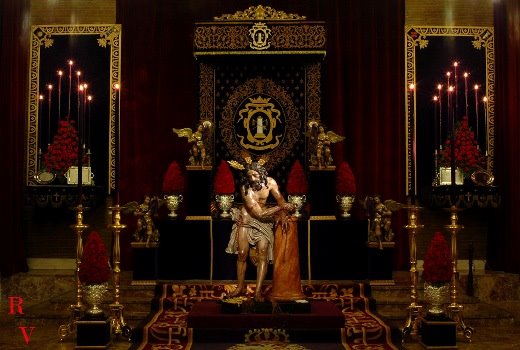
At a lecture on Christian art and architecture a few years ago, I remember being intensely fascinated when the course of the discussion gradually moved to Byzantine iconography. Back then, I was as ignorant of Eastern Christianity as the average Pentecostal: I knew about the Great Schism, the markedly more mystic flavor and some customs of the Byzantines, but my knowledge stopped there. Here in the Philippines, the favored medium for religious art is, and always has been, the Spanish Baroque santo, with its face often carved from ivory, robes that rivaled the most exquisite priestly vestments, and borne aloft on the most ostentatious carozzas imaginable. Naturally, icons to me were alien and smacked of an entirely different world view than what I had grown up with.

The speaker at that lecture was an especially erudite, would-have-been Jesuit nearing eighty, who survived World War II and who now resided and worshiped at an Opus Dei center. He was a rather small man-- skinny and frail-- with the last remaining traces of ghostly white hair on his head. His glasses were thick and round; he wore battered brown sandals in place of shoes. He could recite Virgil, Cicero and Marcus Aurelius in classical Latin at the drop of a hat, and often conversed with our priests in the Roman tongue. One thing that struck me most was when he said that icons, in Byzantine thought, were not so much painted as they are written. I've written about my thoughts on Byzantine and Western religious iconography before, but one thing I still have trouble grasping was the notion of 'writing' icons.

He went on to say that an icon is essentially a revelation, and not just a hope to be realized. St. Irenaeus writes of man as the image of God on earth, a visible 'trace of His glory'. The icon then is at once a profound meditation and an even more profound apocalypse. As I was then only entering my teenage years (I was fourteen when this lecture took place), I was more fascinated with the aesthetic, rather than the theology behind them. I was especially thrilled to behold the icon of the Pantokrator, stern in manner and yet supremely personal. I knew that this was the God I wanted to serve, the God Who is at once the Lord of the universe, and the same Child wrapped in swaddling clothes.

Our speaker gradually came to talk more of his life-- and what a life! Apparently, he was born in the 1920s, a time when life was more simple and when we did not have the cares we do now thrust into our shoulders. He was a very bright student; brilliant would be an understatement. At seventeen, he decided he would join the Jesuits. He had the necessary intellectual clout, and though he did not come from the buenas familias of the day (mostly aristocratic families of Spanish descent) he more than made up for it with his genteel manners and superb breeding, indeed, even putting to shame the spoiled rich kids which were his contemporaries. However, his plans of entering La Compaña were put to a halt: he had been a sickly kid, and many in the Order did not think he would be able to survive the rigor and discipline of a scholarly Jesuit education (later on, he would admit that it was for the better).

Eventually, he came to Manila, and graduated from the Dominican college, the University of Santo Tomas, a laureled and much celebrated hero of the academe. In the years immediately after graduation, he found himself working as a professor in the premiere Jesuit university in the country, the prestigious Ateneo de Manila, which has produced many of the country's greatest minds (he would also study here, in fact, he did his masteral studies here). Back then, only the elite could gather the necessary funds to enroll their children in the university. Thus, our speaker would up teaching the children of industrialists, sugar barons, local royalty, hacenderos, politicians, business and civic leaders, the landed gentry and even the occasional parvenu or two. To give you an idea of just how small the educational elite was in those days, the university was only one building. That is how frightfully small and tight-knit Manila society was, and in many ways, still is.

The war came, and our speaker found himself a reluctant member of the Resistance. He had seen the horrors perpetrated by the Japanese; he had seen, firsthand, the lamented destruction of Old Manila: its great churches sacked and burned, tis venerable houses gutted and razed to the ground, its ancient spirit crushed and bottled up in a haze of modernity in the years after the war. On one occasion, as he was transporting medical supplies to a group of wounded soldiers, a rifle bullet hit him squarely in the back and leg (it still shows through his limp). And, as if that weren't enough, a stray bullet had hit a glass window above him, raining shrapnel and shards of heated glass down onto him (it was a miracle he survived!).

The post-war years would prove uneventful for him, with the exception of the Second Vatican Council. Now, our speaker had a very old-school Jesuit spirituality; he was the type that was unashamed and unafraid to target the children of the elite to further the ideals of Catholicism, as well as being part of one of the last generations of Jesuit-educated men with a firm grasp of being Catholic. As I've mentioned already, our speaker was a master Latinist, and could trade the most devastating tirades, barb for barb, with the most sardonic European minds. One time, in Rome, in American student once came up to him and said rather mockingly, 'I heard your people ate dogs. How uncivilized'. Without missing a beat, he countered 'At least we don't kill babies. How uncivilized'. The American student walked away rather shamefaced!

Like many old souls, he was greatly distressed by the Council. For him, Latin was about the most beautiful language you can find; and with the advent of the vernaculars, he felt as if a part of him had been ripped directly from his person. Perhaps this was why he decided to ally himself with the Work; for La Obra harbored, interestingly enough, similar positions to the SSPX in those days (they shunned people who read Dutch catechisms, criticized sharply profane instruments at Mass, etc.). In the mid-1980s, our speaker was still a professor in the university, but he was already close to retiring. An incident that finally made him leave was an encounter with a spoiled-rotten scion of one of Manila's patrician families involved in the legal profession. Now, the student was only 19, but he acted as if he owned everything in the world; and when our speaker called his attention, the student got up, walked over to him, and spat in his face.

At this point, we were all very silent. The lecture had already come close to 3 hours long, but we were still wrapped up in the old man's recollections. The incident he just narrated was one of the most barbarous I've ever heard, especially in this country, where premium is given to elders. Later on, he would narrate, how the very same student had been convicted of murder. And who was the judge? None other than the boy's very own father the Chief Justice. When the boy was sentenced, the father is noted to have said, 'I would not have pity on you because you are my son. What you did was wrong, and you deserve to pay for it'. If I recall correctly, the son is serving a life sentence.

The lecture gradually came to a close, and we applauded this frail, old man, who certainly hid stories of the most colorful and interesting variety under his frailty. I did not know what to make of those stories until fairly recently; for the most part, they just sat in my head, gathering dust but still displayed proudly and prominently. I guess it is only now that I am beginning to realize what it means to 'write' an icon; for behind the stylized gestures, the billowing robes, the golden backdrops and the mystical rapture lie very human stories. These are stories of temptation, sin, death, and gloom-- the very stuff that humanity is made of. At the core of an icon is the story of a life, and it is this life that is glorified, not for the sake of mere vanity, but as a proof and pledge of hope that something greater lies at the end of our collective experience. And this End is Truth; it is Jesus, Who is 'the way, the truth and the life'.

It is easy to overlook the temptations of the saints, but I do know for an impeccable truth the fact that these same saints who now peer down at us from the vaults of heaven were themselves human once, who knew what it was like to be tempted, to fail, to sin. As St. Macarius once eloquently said, 'The heart itself is but a small vessel, yet dragons are there, and there are also lions; there are poisonous beasts and all the treasures of evil. But there too is God, the angels, the life and the kingdom, the light and the apostles, the heavenly cities and the treasuries of grace—all things are there.' The heart is a wonderful thing, and the depths of its mystery are more than enough for us to ponder on in eternity. It is the bridge that crosses the chasm from our humanity to the sublime perfection of eternal beatitude. It beats, and in every beat, there is God.

Finally, our speaker left the building. As he was exiting, he was held in the hand by one of our teachers, no doubt to help him cross the street where his driver was waiting. I reflected on his wonderful life, wishing mine were more like his. But I digress, since these parts of the story--my story-- have not yet been written. And what a wonderful thing it is, to write this story.

Saturday, August 25, 2007

Dark Night of the Soul


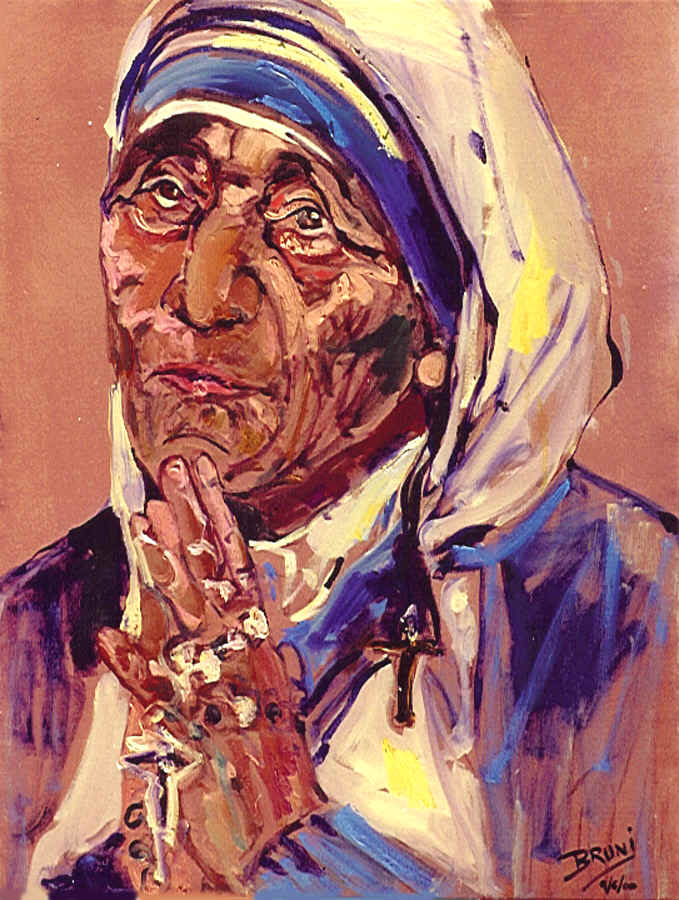
First of all, apologies for the severe lack of updates within the last few weeks. August is proving to be a really tiring month. This will be a short post-- if you've been hanging around the Catholic blogosphere these past days, you'll no doubt have heard of the whole Mother Teresa brouhaha-- how she reportedly encountered severe temptations against the Faith, how at times she felt as if there were nothing out there worth believing. Already atheists are using this article from TIME to support a thoroughly humanistic agenda.

Personally, I believe that, if you really want to know which person is a saint, the first thing you have to consider is that a saint is never really happy on earth. Indeed, I would go so far as to say that the greatest saints were often the most miserable-- for a saint is not so much a part of the ubermesnch, or a rupture in the natural world-- they are simple flesh and blood and spirit, like you and me. The Orthodox have a very evocative phrase to describe icons, and I believe this explanation also suffices for real saints: an icon reveals its subject to what it has always been. Thus, an icon of the Pantokrator is not merely the end product of theological rumination, but a confession of faith in a supreme, omnipotent God at its most primal.

I believe it was St. John Vianney who once wrote that a soul without temptations is to be avoided-- for temptations are the stuff of life, an integral part of it that we can never fully avoid. Temptations don't go away-- they merely change forms. There is a story about a desert father, St. Anthony the Great, if I'm not mistaken, who, when asked once by a certain fellow at which point earthly temptations ended, replied, 'only when you are buried six feet under the ground'. There is a very false, very un-Christian notion that saints are supposed to be impeccable men and women-- but as I've found, the greatest saints were also some of the greatest sinners. St. Paul murdered; St. Augustine was a hedonist; St. Christopher vowed to serve the devil; St. Sara the Black was one of the most accomplished prostitutes of her time.

I thank God that He has given us in His wisdom, a saint like Mother Teresa, whose life is perhaps one of the most profound in the last five hundred years. In her humanity, she was reached the most sublime heights of beatitude, and I truly believe she should be canonized soon. Hers is the kind of Faith severely lacking in these days, and the example of her life is even rarer.

Friday, August 17, 2007

Lux in Tenebris


"Do you know why that mountain is so tall?"

"Why?"

"So that when God comes down from heaven, He can sit on it."

I don't recall where I heard this conversation; I am not even sure if I had ever really heard it before, or if it were just a figment of my imagination, correlated from hundreds of shards and fragments all coalescing to form this bit of dialog. I am sure, however, that, were it ever spoken by a real person in real life, it could only have been uttered from the lips of a child. I don't even care if it is factual-- but it is the truth. There is something about children, perhaps their simplicity and inherent genius, that allows them to be agents of a Truth far greater than the most intellectual ramblings of an adult.

A trip to the Philippine Suzuki Association (it was for one of my classes) yesterday brought me in contact with several talented young musicians. Now, many of my readers have probably encountered the term 'Suzuki method' before-- it is a method of teaching music that is based on the philosophy that music is learned the same way that speech is-- through memorization, listening, and intuition. The revolutionary figure behind this method was a Japanese classical violinist named Shinichi Suzuki, who writes in one of his books that genius is something inherent and dormant in every child-- all it takes is one spark to kindle it to unleash the beauty and wonder simmering beneath. There was a twelve year old girl who played Bartok, Brahms and Vivaldi on violin effortlessly, while another essayed Strauss. It was an edifying sight, seeing these children playing such beautiful music, without so much as even being able to read sheet music.

We must have sat listening to these children play for a whole hour. The first girl I mentioned, whose name I sadly was not able to purloin, channeled an extraordinary-- nay, almost supernatural-- passion and pathos, despite being the product of a broken family. The second girl was a virtuoso at the piano and reached sublime heights with her skill with the violin. And most important and perhaps shocking of all, none of them were over thirteen. Neither of them, I was told, knew how to read notes very well. Yet these two have performed in front of dazzled crowds and likewise dazzled orchestras with their skill.

When I was two years old, my mother enrolled me at art class, because, apparently, I always asked my father to draw dinosaurs, clowns, and cockroaches at every occasion I could. My love for seeing him draw --bring to life-- these creatures which I previously had only enjoyed in the wilted pages of my books, seemed to me then full of vitality, roaring, stomping and rampaging, belying their crude and primitive ball-and-stick outlines. A simple dot for me became a menacing, glaring eye; a dash of lead on paper with small bristles sticking out perpendicularly became the gates of a menacing jaw, about to clamp themselves on a soon-to-be struggling neck of an Apatosaurus. My parents always believed I would end up an artist; they cite frequently that I used to use up an entire sketchbook in two days, no doubt filled with menacing, frightening drawings of T. rex in all his glory.

I must have attended art class for two years; my teacher was an elderly man, in his sixties then, who had the fiery passion and temper of the Spaniards (of whom he was probably descended, judging from his mestizo features) and the tenderness, love, and even carino brutal of a Spanish Baroque santo. On Saturday mornings, my mother would wake me up at seven, and walk to my teacher's studio, as it was only five minutes away (ten if I dilly-dallied). His house wasn't very big: the garage was cluttered with an assortment of power tools, old newspapers, umbrella skeletons, paint stains, drawing boards, and of course, his dear students. I remember we must have been ten, with myself being the youngest.

For some reason, I stopped going to art class. In the course of time and moving from our old apartment to our present day home, I must have left or lost all those sketchbooks and watercolor sets in the transition; I only recall having seen one out of my prolific works in our new house, in fact one of my first, a drawing of a family of T. rexes chasing after a Triceratops, badly inked with blue, maroon, orange and green markers, so much so that today it seems vaguely reminiscent of a neon-lit LSD trip. My hands seem to have atrophied as well: they are now more rigid, and probably less dexterous. All those years writing those five page essays by hand must have crippled them.

Nowadays, I ask myself: what would have happened if I had continued with my artistic pursuits? My first love had always been pen and paper, but whereas now I use ink to put my thoughts on paper, before, I simply stamped paper onto my brain, and enjoyed the fruits of my labor. Had I taken up the piano, as my aunt always wanted me to do, or the guitar, would I turn up a classical musician in the long run, or a rebellious rock star? What might have happened had I stuck to reading Jack Chick tracts longer than I should have? The possibilities are endless, and they are even frightening, to some extent. But above all, I am consumed by the memory of what might, could, should, and will have been, and I derive a certain joy from this exercise.

By any standard, I am already an adult-- but I find myself not knowing any more than I did learn two, three, or four years ago. When you are an adult, everything seems to grind to a halt-- you are now no longer allowed to ask 'stupid' and 'inane' questions, you are to follow a set pattern, the proper way to learn is to read, and an endless litany of dos and donts that follows. Weber writes of this phenomenon of rationalization as a sort of crypto-movement of reduction and redaction of the human being into the mere equivalent of his efficiency; he is anomie, the nameless, the faceless, the anonymous, the phantom so discordantly separate from his body. The individual works, but his pay is but an illusion constructed out of a fear of his debts and obligations, of taxes and needs and wants. Thus, he ends up with nothing. In the world where social contract is upheld to the level of infallible, impeccable dogma, the 'social' part, most ironically, seems left behind, discarded and useless in the machinations of the machine.

We are all, of course, familiar with the Socratic method. In today's information age, asking questions seems to be gradually fading into obscurity. But is the information we hold so dearly the answer to our questions? What does it really matter to know the innermost secrets of the sea and to feel the heat of the sun-- if such things are seen as merely things to be seen and believed? What happened to experience? What happened to knowing? A Confucian proverb proffers is very succinctly: 'Read not ten thousand volumes but into the silence of the stars'. What we sorely need today is not so much as to know the exact number of stars there are that populate the known universe (though it would be nice); what we need to know is what a star is. We need to know what its being is.

A friend once remarked that modern society's obsessive desire for information and progress is symptomatic more of a growing specter of ignorance rather than the spirit of innovation that is usually proffered for our convenience. All the rationalization and standardization, then, are for the use of the dumb, the lame and the ignorant-- not so much for their betterment, but to perpetuate their condition. Thus, it becomes easy for us to lambaste the illiterate as being without knowledge, while we remain hopelessly a slave to technology and information. The illiterate, at least, can produce an exquisite bench or table from a block of wood, while perhaps for the literate, it remains merely a thing of carbon. If 'improvement' is so symptomatic of our age, then why does it still take a housewife four hours to clean her household, the same amount of time that housewives did a century ago?

For Christians, the only recourse is Jesus. And He, at least, remains constant-- the same yesterday, today, and tomorrow, the Alpha and the Omega, the first and the last. He is Truth: unchanging, all-encompassing, the sorrow of the wicked and the beatitude of the just. He simply is. He is our Eternal Companion, at once distant and immanent, Who revealed Himself to us and yet is ultimately unknowable. And this is the knowledge that sustains us, even in the darkest and bleakest of times, because the Light shines luminous and brilliant in the darkness, no matter how deep the shadows are.

As we exited the studio, I left as if I had been struck with lightning. The metaphorical scales fell from my eyes, as even then I felt as if my hearing heightened, and I felt electricity crackling in my skin. The children essayed their pieces flawlessly and beautifully, and with it came the realization that I had witnessed an epiphany. And I could not help but think that they had been touched by God Himself.

Sunday, August 12, 2007

Why I Love Jesus


Father Dwight Longenecker tagged me with this meme around two weeks ago, but it is only now that I have found the free time to answer it (I had to study for midterms). I think it's an interesting subject, and one I've been thinking about lately, even before Father tagged me.

In my senior year of high school, I was a particularly devout student. I confessed almost every week, attended daily Mass, and helped clean up the sanctuary after the Mass. Since my high school, as I've already mentioned several times, was run by the Opus Dei, the oratory was constructed with an especially high standard. Though only as big as a room, the altar was made of solid marble, and the other furnishings always struck me as the best money could buy. On great feasts, our chaplain would wear the most beautiful gold, Gothic chasuble I've ever seen; many a visitor who came to our small chapel would marvel at the integrity and elegance of our Mass paraphernalia.

I was always early for Mass. Back then, the Mass was still celebrated at 12 noon, so I would eat lunch at 12.45 when the Mass had been offered, and I had prayed my usual prayers. One of the most interesting people I've met, and always saw in the chapel, was a second grade student named Gab Navarro. Now, Gab was a very short kid: he had buck teeth, a bad haircut, tiny eyes, and a propensity to act like he was the master of the chapel. At the same time, he was also an altar server, even if his head couldn't even reach the top of the altar. The usual arrangement was that he would ring the bells and help the main server, usually a high school student, in case he forgot anything. Gab's classmates frequently teased him because they claimed he looked like a deranged rabbit. I heard an upperclassman once say, 'He has a face that could launch a thousand ships-- for the wrong reason!'

When the chaplain heard confessions, Gab had a rather annoying habit of going into the sacristy and bugging Father in the middle of some grave sin. His genuflections were awkward, and half the the time it looked as if he were going to fall down any second. He particularly liked the brass candle snuffer, and he would always race me (that was my usual task) to it. But despite all of these things, Gab was a very devout kid-- he prayed the rosary as often as he could, and when he and his classmates would enter the chapel, he would always reprimand them if they failed to genuflect. 'This is how you genuflect!', he once said, demonstrating his rather awkward position. The other kids imitated him, imbibing his awkwardness (it was a funny sight-- five kids kneeling down, palms folded in front of their chest, looking as if they suffered from arthritis).

One time, during a Eucharistic vigil, I entered the oratory and noticed that Gab made only a single genuflection. I called out to him and told him that, when the Blessed Sacrament was exposed, one does not make the normal genuflection, but a double genuflection, and immediately followed by a profound bow on one's knees. 'OK', he aid rather nonchalantly. A few minutes later, a rather emotionally unstable (not really, just extremely spoiled) high school junior entered the chapel and made only a single genuflection. Gab immediately tapped him on the shoulder, and said that he should genuflect on both knees. So the guy makes another genuflection, this time on his left knee. An exasperated Gab tapped him again, and said, rather forcefully, that a double genuflection meant kneeling-- how can you kneel when you drop down on your knees one at a time? The student left the chapel, barely stifling a tear!

It eventually came to be that I had to serve Father during the Mass (all students in our class were rotated, so that all would have a chance to serve). Being nervous, I had to ask a friend of mine to run the rubrics through me, lest I fumble and make a fool of myself during Mass. As usual, Gab was waiting in his favorite seat, the one nearest to the light switches in the back pew on the Gospel side. There was a diptych that covered the tabernacle, and when Gab saw that I opened it by placing my hands on the screen itself, he rushed immediately to my side, and explained that I should use the gold rings at the bottom of the diptych, lest I should smear the images of Sts. Michael and Gabriel with my grubby hands. If Gab doesn't end up a priest, I would surely be shocked.

There is something about children that strikes me; maybe it is their penchant for uttering pearls of wisdom without even realizing it, or perhaps the simplicity and wonder with which they lead their lives. A child knows Jesus as Who He truly is: Jesus for the child is the friend, that face bent with excruciating agony on the Cross, the glorious, transfigured king holding the world in His holy and venerable hands. In universities, where most students are introduced to theology, there is an effort to 'know' the historical Jesus: but the picture that almost invariably shows up is the much-politicized Christ of apocalypse, either the glorious, conquering liberator on one side, and the unchanging, mystical rapture that is the contemplation of mystics. Of course, an emphasis on either side can lead to error: would Jesus honestly support the revolutionary actions of self-proclaimed liberators? Or would he support the ivory-tower-polemics of those who see everything as sinful?

I am the most arrogant person I know; in my early teens, I prided myself on how many anti-homosexual, anti-heretic, and anti-atheist jokes I knew. During that time, the line that divided zealotry from righteous indignation seemed to have blurred beyond all measure for me. I am a wretched sinner, too-- I hate being corrected, I hate being told what to do, I hate talking to people who are stupid, dumb, or who are against my views. I confess that I have had a violent streak in me as well; maybe it is due to my Batangueno blood (Among the Tagalogs, Batanguenos have had a reputation for being violent; their preferred weapon in assassinating people is a fan made of sharp blades called the veinte nueve). It is still puzzling to me how I can still call myself an adopted son of God, in the face of all the evil I have done.

But then I remember Gab Navarro, that little kid who bugged everyone in church, but who is probably the most cheerful person I know. I guess I can consider Gab as a sort of blessing from God-- despite my myriad faults and shortcomings, He has nevertheless led me to this second grade student, whose example is by far one of the most luminous I've experienced in my life. I recall seeing a crucifix once, one of the bloodiest I ever saw. The corpus was bruised black and blue, and dripped blood from almost every orifice. But Our Lord's hands were extended in benediction, blessing even those who called for His unjust execution. I can't help but think that, at that moment, Jesus was blessing me-- I, who don't deserve to be called a Christian, I, who already have one foot firmly entrenched in hell. I am a violent, lascivious, and horribly proud sinner, and yet when I see Jesus, when I see Him looking down from the cross and giving me His blessing, I am at a loss for words. None of us deserve this kind of love, yet He willingly and freely gives us His love, more than what we deserve.

A common phrase which accompanies the image of the Sacred Heart are the words 'Behold this heart which has loved so many men, but is so little loved in return'. And I realize that, however unworthy I am of His good graces, He never gives up on me. The face of Our Lord, serene and yet tinged with the slightest bit of melancholy, is truly the refuge of sinners, the hope of the seemingly damned, and the salvation of even the most monstrous criminals. Despite my mockeries, blasphemies, and other sins, the image of Our Lord remains true and constant.

So I thank Our Lord, not just because He loves me in ways I can't even begin to comprehend, but because He has freely given me His heart, that heart which beats for love of me and is crowned with the thorns of my sins. It is a gift that I am totally unworthy to receive, but still, He holds out His hands and offers it to me. That is why I love Jesus-- for without Him, I am nothing.

Monday, August 06, 2007

The Transfiguration of Our Lord


On the Mountain Thou wast Transfigured, O Christ God, And Thy disciples beheld Thy glory as far as they could see it; So that when they would behold Thee crucified, They would understand that Thy suffering was voluntary, And would proclaim to the world, That Thou art truly the Radiance of the Father!

Today is the Feast of the Transfiguration.

My first encounter with any sense of the Divine occurred in my formative years, at the age of three to five or thereabouts. Growing up in a household with a strong Fundamentalist experience, my father always took it as his solemn duty to develop me into a strong Catholic. I remember a certain night, when the rain was pouring especially hard on our roof; my father woke me up from my sleep, and sitting upright on the bed, began to teach me how to pray the Oratio Dominica. I remember being told the proper way to cross myself; and absorbing this rhythm in an astonishingly small amount of time, he started teaching me the words of the prayer itself.

'Our Father', he would begin with half-closed eyes. I would look at him, praying so serenely, and imitated him as best I could. If I remember my own history well enough, I had occasion to just sit still and watch him pray, and from this, prayer was routinized for me. My mother would sit by and happily observe how enraptured I was at this activity. I was thrilled by the weird gestures, the solemn and measured actions, the gravitas, even the sonority of my father's voice-- though it was occasionally tinted by the patience and care of a nursery teacher.

We would go to different churches on Sundays, though admittedly, almost all of them were incorrigibly entrenched in the 'Spirit of Vatican II'. I would be lying to myself if I said that I did not enjoy those days; now, years later, I have a more objective criteria to judge these masses. One church we went to was notorious for having liturgical dancers prance around like a bunch of flightless birds on solemn festivities, like the Nativity, and other great feasts. The other church we went to was much nearer to our home. But it, too, was a ghastly and almost mocking inversion of Euclidean principles: inside, there was a statue of the Virgin that had terrified me immensely, as it reminded me more of Maleficent than the Mother of God. Too, there was a crucifix in the center-- but the corpus always felt feminine and bizarre to me.

It was not until I entered the historic halls of San Agustin de Manila, the sole remnant of the glory days of Intramuros and oldest colonial church in these islands, that I began to contemplate the greatness of God. San Agustin was a masterpiece of the Spanish Plateresque, a transitional sort of architecture from Renaissance to Baroque. I remember being captivated by the dazzlingly bright chandeliers that hung from its ceiling; and seeing the magnificent altar arrayed in the most precious fittings of silver and gold transported me back to the days I was not even privileged to have known. In the church's museum, there were three hundred year old manuscripts and old antique santos that were as old as any; there were magnificent liturgical vessels, all cast from the rarest and purest gold. Six foot tall statues of the saints were vested in cloth-of-gold, and old photographs brimmed with an almost spectral life.

To the unbeliever, perhaps, an image of a man with a sword wedged in his skull, or of one holding his flailed skin, would be shockingly revolting. The crucifix itself is a ghastly portrait of a dying Man, blood oozing from every pore in His body, more the badge of shame and humiliation than that of a chosen people. But strangely, even in those halcyon years, I knew there was something about these images that defied our human capability to define. As St. Peter Verona holds his severed head, blade still wedged in his skull, a smile forms on his lips. And as St. Bartholomew holds his flayed skin, his eyes are caught in mystic rapture. Why is this so? Surely these torturous ordeals could only reveal the dark and ugly side to humanity.

Our encounter with God begins, in infancy, with our acquaintance with the primordial. In death, for example, it has always struck me with profound irony that we can begin to contemplate what happens after we expire. From the ancient cities of Jericho to the ruins of Etruscan civilization, death has always been treated as something numinous and yet strangely edifying. From Jericho come stories of mummified skulls, filled with plaster and whose eyes sockets have been filled with shells, and from the Etruscans we see a picture of death as something of a grand party. In birth as well, we experience and partake of this mystery. I am still struck with awe whenever I see a child being delivered; I have often wondered what it felt like when I exited my mother's womb, or how it must have felt for her, to see, cradled in her hands, an infant, perhaps not wrapped in swaddling clothes, but is capable of gripping her finger with vise-like intensity.

I have stated many times in this blog that there comes a certain point in life when our faith is irrevocably confirmed forever, or dashed and broken by reality. But what is reality? Too often our picture of reality is bleak and unnecessarily filled with anxieties. We see only the evil in this world: the threat of war, the rumor of impending doom, the injustice among the rich and the poor, indeed, only the vital signs of an apocalypse waiting to happen. In exchange for this we have lost the ability to scale the peaks of mountains and feel the rustling of the wind. We look, but we do not see, photograph but do no paint. It is basically a society reduced not so much to subsistence anymore, but to a mentality and way of life of helplessness. We laugh, but always at the expense of others. We cry, but do not weep.

As I gaze back at those statues of the martyrs, I cannot help but be overcome by a certain sense of pride, or even envy-- but stronger than these is the all-encompassing sense of admiration. I will never understand why the santero decided to portray St. Peter Verona's decapitated head as still smiling, I will never see beyond the perspective of St. Bartholomew's statue just what exactly has so captured his imagination. But deep down, I guess this is waht it means to have beheld the glory of Christ. A man privileged enough to have seen something so beautiful, so utterly transcendent can only weep for joy in such a scenario. But the Transfiguration of Our Lord was not some isolated incident, nor the exclusive province of the Apostles. It is an event dynamic, illuminating, and unending, transforming even the basest and most insignificant of our gifts into something fit to be wept upon and over by the most glorious seraphim.

The only response worth taking in the face of such unimaginable beauty is to let ourselves be burned by that love that burns. It is only then that we thus perceive the profundity and depth of God-- the Crucified and Suffering God, Who entered our history and forever changed it. The saints and the martyrs understood this, and this is what strengthened their wills, the heat and clamor of fire and the coldness of steel no longer able to scare him. Real theology, then, necessarily transcends even religion-- it is not so much as belonging to the Church alone, but a matter of belonging to God. This is something that all Christians must undergo if they ever want to serve God 'with all their hearts, with all their minds, with all their strength'. It is cold in the church, and it is dark; but in that massing darkness, the piercing gaze of St. Peter Verona glints and shines forth like a lone star in the vastness of space.

We who are yet to traverse the earthly plain will never fully understand the mystery of God, and even the saints, who perceive the Divine Majesty for all eternity, can never fully pierce the depths of God's mind. We have but their examples to follow on earth-- and it is not an easy task to accomplish, as I have said before. But we have them to guide us on the way. And the severed head, the flayed skin, that piece of marrow and fragment of skull, are pledges of hope, and an inestimable assurance of love. Glory to Thee, O Lord, glory to Thee!

Wednesday, August 01, 2007

On Religious Illiteracy


'A luminous morning, of unusual and mysterious splendor'. These were the very words His Holiness Pius XII used to describe that fateful day of November 1st, 1954, a day made solemn by the special honor that it was on this day that the Dogma of the Assumption of the Blessed Virgin Mary was ratified, confirmed and solemnly defined as part of the Deposit of Faith. For Catholics, this was the pinnacle of papal infallibility; the ceremony was made doubly stirring by this most solemn exercise of papal supremacy, as well as the rareness of such an event. It is said that hundreds of thousands, from all walks of life, clogged up the mighty square of St. Peter's, spilling all the way into the Via della Conciliazione, as all over the world, millions more joined in on this most solemn of events.

From the faintest glimmer of dawn on that day, St. Peter's was already wrapped in a thick fog, the morning mist coolly kissing the cheeks of the attendees. At the end of a long procession, the Holy Father finally emerged from the great bronze door of the basilicas, seemingly swung open by some mysterious force. Seated on a magnificent sedia gestatoria with the canopy, carried by a handful of men, shielding the Pontiff from glaring heat, it is said that the sun burst forth at this very moment, the mist lending greater radiance to the dancing sunbeams. High above, gleaming brightly like a sickle of purest silver, the crescent moon blazed astonishingly clear.

But the spectacle and wonder of this day was yet to come. When the Pope, rising from his seat, reached the moment of the definition itself, it is said that the multitudes of people gathered suddenly became silent, so silent, that you could literally hear a pin drop. In his lofty and elegant timbre, Pius XII read aloud the Latin words, as the hundreds of thousands of worshipers dropped to their knees, trembling in awe at the majesty of what was about to transpire. For a whole minute, the crowd knelt motionless, as Pius XII's voice resounded through the airwaves, crisp and clear. But in that span of sixty seconds, the entire horizon of Catholicism forever changed as we knew it; it was an event of such significance that brought to mind the entire history of the Church, from Her earliest days of inception down to the trials She has had to endure. In those sixty seconds, the darkest depths of the star-gulfs bowed in the face of divine light, as even then earth and heaven trembled as one.

Such an event could not have transpired without the cooperation of prior established Faith. To the skeptic, the definition of the Assumption was, at the basest level, an act of mere legalistic rhetoric. Seen through the eyes of faith, however, it is an event of such greatness and profundity so as to be likened to the creation of the world. In the Philippines, it was used as an excuse to hold processions on an almost daily basis; it was the triumph of Marian devotees, the scourge of heretics, the banner of a proud and glorious Church. The populace, ever enamored of such baroque expressions of faith, would seem purveyors of distasteful and superstitious beliefs by those alien to our culture; indeed, many Protestants used this event to bolster their confidence in what they saw as the ungodly inventions of Mother Rome.

The Calvinists are wont to decry without a moment's notice the doctrinal errors of the Church, and they do so with an animated fervor driven by an almost pharisaic zeal. The Aglipayans decry the Catholics for being the dogs of the Spaniards; the Iglesia ni Cristo decry our festivities as the surest mark of our decadence, excesses, and subsequently, apostasy. It is no secret that the more radical Protestant sects have no desire nor use for such semblances of humanity in their theologies; the Protestant way of life is essentially a redaction of the Gospels into nothing more than ethical, moral treatises. Thus, we can see how they can so easily shove processions, parades, and sacramentals so easily: what difference, then, does it make to shove aside miracle stories of water turning into wine, the dead rising from their graves, and donkeys speaking to their masters?

The Jesus of the Gospels, let us recall, had a taste for the extravagant. In our modern culture, this word has sadly become too synonymous for 'excess' and 'indulgence'. However, the true sense of the word is more akin to 'extraordinary'; it is not so much as an exaltation of worldly vice, but a confession that what we are witnessing is not something out of the ordinary. When the penitent woman poured oil on the feet of Our Lord, whom was He praising? Certainly not the hypocrites who sought to make better use of it; like Martha, we too are often deluded into doing something else. Similarly, when David pranced naked in front of the Ark and made love to his mistress, his officials conspired against him. And yet he was the beloved of God, His anointed one--are we honestly too wise as to question the decisions of God Himself? The Protestant ethos, while ironically professing linkage to the historical Jesus of the Gospels, have, in stripping the narratives to their essentials, unearthed not the flood of divine grace that they would expect, but a legal tender, one no different from a Hallmark greeting card.

It is strange, perplexing, and oddly amusing how Protestants can go on thinking that the Faith is just some set of abstractions and legalisms. Too often people have derived a certain schadenfreude at seeing Protestant missionaries, who, while doubtless of good faith, are still shocked and scandalized that the Philippines is not the ordered, structured communities they have come to associate their religion with. In Manila alone, it is still a common sight to see old, graying women, walking to the altar on their knees, wailing and sobbing their penitence for all to witness. In a certain part of Lucena, penitents on Good Friday go about their business drunk; flagellants whip themselves into bloody frenzy; images of the Virgin are paraded in festivity, festooned with flowers and lights to dazzle even the most baroque and rococo in spirit. All of these things seem 'illiteracy' and superstition to him: this exuberance and extravagance seem to suggest, not the faith of the Gospels, but the frenzy of the bacchanalia, the chaos of the dervishes and the decadence of the orgy.

However, it is an interesting thought that even the most primitive cultures have an inkling that true religion transcends mere virtuousness: the former, anthropologically speaking, is myth, while the latter is but a social fact. And lest we forget, the earliest followers of Our Lord were not exactly scholars themselves-- their conviction in Christ rested on His being a miracle-worker alone, and if they believed in Him as the Messiah, they expected Him to be the divine man, conquering hero to crush the invaders, and not the human God Who suffered. The Gospels point out to a Christ that is majestic and unchanging, and Who, while being fully human, was nevertheless still God veiled in flesh. Our salvation does not come from intellectual assent, but from a continuous confession of faith in the Crucified Lord; perhaps one reason that many Protestants have all but ceased to include the more 'fanciful' baggage that comes with the Faith is because they have forgotten this side of glorious humanity in the divine equation. And ironically, this is born out of a desire to restore our conception of the Lord to the 'pristine' image of the Gospels.

When His Holiness Pius XII spoke those words which forever fixed the Assumption into the immovable, irreformable Deposit of Faith, the faithful Catholic rightly saw it as proof of the glorious continuity of the Church, at once timeless and 'semper reformanda'. He is able to tremble on his knees, not just out of conviction, but by the simple fact of his being able to witness it firsthand. For extravagance has a part to play as well in the dramaturgical realm; it serves as proof that there is something far greater, something primordial, that is above us. It is the action that moves our counter-action, the movement of the puppeteer's hands that gives life to lifeless strings, to paraphrase van der Leuw. It is this reason why we have always regarded relics with such care and attention and why we have always seen this potent mixture of frenzy and divinity with such loving eyes. Man craves for the extravagant, and for the atheist, this is the one thing that seems to be a perennial thorn in the side.

True theology, then, necessarily transcends the legalisms we have otherwise come to know, and these, in turn, should necessarily adumbrate to the transcendent. When we are told of how St. Francis once licked the pus-bleeding wounds of the leper, we are shocked and appalled; either he was the most extravagant pervert on earth, or the greatest and most profound of saints. The Church, in Her judgment, has rightly chosen the latter. As I have written before, the Cross is not easy to bear: it is the cruelest and most ignominious of punishments, the fount of humiliation and a death that not even the most depraved of criminals deserves. The least we can do is to honestly bewail our sorrows. Sophistry and exegesis will not help you carry this cross, and neither will they help ease the burden of your humiliation. It is a strange and sad day when illiteracy is equated with the beautiful and the extravagant. It is sadder still that we are increasingly becoming 'illiterate'.

Tuesday, July 31, 2007

Take and Receive, O Lord


Today is the Feast of St. Ignatius of Loyola. I will try to make this post as short and sweet as possible.

There is a statue of St. Ignatius that I have always admired. It depicts the saint, kneeling in profound adoration, looking skyward in deference to Divine Majesty. The saint's eyes are fixed, enraptured, and seized by a childlike wonder. In his hands, a sword, gleaming silver, cradled like a fragile gift in his arms, ready to be put to the service of the Almighty at a moment's notice. As I child, I remember gazing up at this statue and thinking to myself: who is this man? Why does he have a sword? What did he do? Needless to say, I was captured by this image of the saint from the very moment I first laid eyes on it. At certain points in the day, when the sun would revel in all its glory, the sunbeams would strike at the saint's face and set fire to his sword. It was a glorious thing to behold.

The story of St. Ignatius and his First Companions is something most of us are doubtless familiar with. Born a nobleman in the Basque region of Spain, the saint's aspirations in life were as worldly as can be. He desired power and glory, conquests and military victories one ofter the other. Of course, that fateful day came when a cannonball hit Ignatius's leg, shattering it and his ambitions of becoming a celebrated soldier. But with it came the realization that he was being called to something far greater than he had ever imagined. I remember thinking to myself how this incident must have been unbearably painful; I recall getting shivers down my spine and my flesh quailing at the thought of being hit by a cannonball.

Ignatius entered the University of Paris, where he surely must have been the odd one out-- let us recall that he was a good fifteen years older than both Francis Xavier and Peter Faber, his first companions. As well, they excelled academically, and being roommates with Ignatius, were tasked to tutor him in these fields. A Jesuit Scholastic friend once joked, 'If Ignatius were in the University today, he would probably be the scourge of the Jesuits and be placed in Basic Math and Basic English'. So how did this nobleman with worldly ambitions come to found the most academically-inclined (but not necessarily orthodox) orders in the Church today? And what is it about Inigo that makes him such an enigmatic figure still?

I have met many people in my life so far-- good, bad, charismatic, melancholic, scholarly and facetious-- but I have never met someone who has had such a remarkable transformation. I have known former druggies who have become numeraries and seemingly pious individuals fall to the whims of the flesh. Is it impossible then in this present age to become a saint? With all the excesses and self-aggrandizing so prevalent in modern society, it is difficult not to lose focus. We are constantly being misguided and thrown off course by a combination of many things, chief among them our unshakable pride. I admit that I am too often a victim of such circumstances.

I guess it all comes down to the Cross. We have heard it said that the Cross is the source and summit of the Christian life-- to embrace the cross and bear it alongside Our Lord is the path that all Christians must ultimately take. The problem with many of us is that we deliberately choose to live as if the cross were never there, that it is something reserved for a select few while we go on with our lives and indulge ourselves in the grossest excesses possible. The first Jesuits were not immediately accepted by the established Orders-- they viewed La Campania as something of an anomaly, a strange, if heretical, admixture of the divine and the worldly. If you want to get a feel of how it must have felt to be a Jesuit back then, one only has to look, ironically, at this Order's own aggressive 'treatment' of Opus Dei. And unless we forget, many Jesuits have been martyred in the past.

The late Father John F. Hurley, wartime superior of the Jesuits in the Philippines, was almost killed when he defended a Filipina nurse from being gang-raped by a thrall of bored Japanese soldiers. If I remember correctly, they stabbed him several times with their bayonets (I'm not really sure; I'll check my sources and edit this if need be). Still another Jesuit, Father Ignacio Alzina, was criticized and mocked by his superiors for building a monstrance in some deserted, colonial outpost that was 'more fitting for a cathedral in Seville' than a 'rural barrio in the Philippines'. He replied, 'The God of the Filipinos is the same God of the Spaniards!'. But these are local figures: we need only to recall the name 'Francis Xavier', 'Edmond Campion', 'Robert Bellarmine' and a host of other names to be reminded of how much this Order has accomplished. And each of these saints have something in common: they all learned to embrace the Cross. It is an obedience silent and serene, and it is the only obedience worth following: it is obedience done out of love.

When I was growing up, my father always taught me to pray the immortal prayer of St. Ignatius. As I closed my eyes and folded my hands to pray, I would repeat after him these words, first spoken some five hundred years ago by a soldier with a broken leg who was not as academically gifted as his own sons: 'Take and receive, O Lord, my liberty; take all my will, my mind, my memory! All things I own and all I hold are Thine!' I pondered over these lines countless times, absorbing its rhythm before I ever learned to understand what it is all about. I guess it is only now that I am beginning to see what it is all about. It is, simply put, a prayer of surrender, a desire for 'annihilation', of being one with God, and becoming His alone. It is difficult to explain with words alone-- it is something far more visceral, more gut-wrenching than any theology could ever produce. Its irrationality is its own source of illumination and inner clarity, its rhythms the fount of conviction. It is the Cross, as expressed in words.

Our Lord said, 'If anyone wishes to follow Me, let him take up His cross and do so'. And lest we forget, the Cross is not easy to bear: it will wear you down, crush your bones, and be a cause of much ignominy and humiliation for the one who carries it. But it is the only path worth taking. Only by loving the Cross can we ever hope to follow Christ. And it is strange, impossible, even downright insufferable at times; we have but the face of Christ to prod us on in this most arduous of journeys. I imagine that is what St. Ignatius must have been looking at when he knelt down, and offered his sword for the service of the Church. He was looking at Truth.

Friday, July 27, 2007

Solve et Coagula


The Alchemist stood near the open window, his crooked, bat-like nose glinting like a slithering serpent under the pale of the moon. His eyes, gray and deep with age, glittered with feline cunning and reptilian calculation, while his long, bony fingers, like ghostly wisps of smoke, clung heavily to the ancient leather covering of the equally primordial book he held in his hands. A long, thin beard, shining silver in the darkness of the room, seemed to writhe from withered stalks, moving with an unnatural vitality that spoke of forces far beyond human comprehension.

Near him, the girl sat in fearful contemplation, seized at once by childlike awe and impending dread. She was young, not yet eighteen, but had the disposition of one beyond her young years. Her auburn hair shone like fire in the eldritch night. The chamber was cold, perhaps too cold, and it sent shivers crawling up her spine. Tears seemed to crystallize at the moment of their formation, and even the sweat on her brow began to chill with morbid complacency. She bit her tongue hard, blood trickling down her lips and flowing down her face like a livid river. It was the best she could do to stay awake-- to stay alive-- in that hour of abandon.

The Alchemist shifted from his contemplative posture, and moved towards the girl with the elegance and grace of a specter. His eyes bored themselves into her soul, as the volume he held in his hands began to throb, and beat, like a living, disembodied heart. The long, bony hands began to reach forward, clawing their way through the thick of the night air like a bat hunting its prey. The Alchemist's nails were long and yellow with age, cracking and manifesting a moribundity that seemed more supernatural than natural. His lips parted, and revealed two rows of yellowed, sharpened teeth, anchored in return to gums that dripped blood and were black with abuse.

The girl watched in horror as the long, bony arm began to reach for her. She silently prayed through clenched teeth that this ordeal might be over soon. In her mind, images of the past, of carefree days and halcyon youth, began to race in a fashion worthy of an epiphany. But it was not always like this; for there was once a time when the Alchemist, too, despite his embracing of his damnation and sinfulness, was once very much like her. He too was once a man; but where all traces of humanity and decency used to be now reside an implacable pride, surrounded by impregnable hubris and a criminal obsession for the good. And now she gazed at the Alchemist in pity, seeing his disfigured face, made more bestial by the soft glow of the moonlight, moved, top, to pity at the sight of his complexion, of which only the dead and the dying had a share. For indeed the Alchemist was grayer than stone, and the coldness in him was even greater.

"What is the Secret?"

The Alchemist hissed through his mouth, his saliva spraying from his foul maw like the hiss of acid. His eyes burned with a sick curiosity. There came no answer from the girl, silent and immovable as she now was. Her hands, bound by ropes, were now sore with blisters; she could feel her wrists being cut open and the blood leaving her fingertips, leaving them gray as the Alchemist's own skin. The old man moved closer to her. "What is it?" But still, there was no answer that escaped her lips. A reptilian smile crawled across the old man's withered husk of a face. Whether the Alchemist relished this moment or not, his cryptic smile would not tell.

In his mind, thoughts, countless and infinite, began to race and swirl with preternatural speed. Questions of the stars began to envelop the Alchemist's head, and the dim beating of drums and the ululations of primordial chaos began to dance in his mind. He began to descend into the spaces between seconds and traverse the eternal distance between the now and the eternal. Now, his face seemed to twist with lecherous glee into something far more horrible than a smile: a look of happiness. He reached forward again, this time cradling the girl's face in his right hand. He could feel her apprehension, the fear ripping through her like a knife.

"What is it?" His voice resounded throughout the vacuum of the room, reverberating with echoes each said differently: at once mocking and reverential, threatening and compassionate. It seemed as if the room were flooded by voices, legion and yet one. The girl stared back into the hard, cold eyes, and looked at them with her own piercing ones. In a move totally unprecedented yet seemingly anticipated, she put her quivering, tottering hand on the Alchemist's bony wisps masquerading as fingers. And she stared at him as intensely as she ever had before, or after, in her life.

As their eyes connected, her sapphire blues perceiving the coldness and distance of his silver-greys, there, in the intersection of time and space where each melded into the aether, and into each other, there seemed a spark of light, fleeting and ephemeral but bearing the wisdom of the ages, to dart between. She perceived his thoughts and saw through his eyes, as he likewise did. She saw how his pride had once consumed him: how, abandoned by his loved ones, he sought refuge in the arcane and the occult; how he sought the secrets of the stars, how he desperately wanted to tap into the ageless whispers of the firmament and the unfathomable deep below. She saw through his eyes how silver became gold, and gold became silver, and lead both, and understood the timeless craft through which this was brought to be. She understood the speech of the beasts and conversed with the rain and kissed the face of the sun.

The Alchemist, in turn, tapped into her thoughts. His mind, cruel and scarred by vicissitudes far beyond his reach, could not fathom the joy and light in hers. He saw through her eyes how, before rumors of the Great War had even been born, she would run across the corn fields and chase butterflies for her sisters, and, running barefoot through the rough and tumble, her feet were scarred and blistered. He perceived the simplicity of her life, the joy of being loved, the warmth of a hug, and the joyous annihilation of being one with the Other. He felt the rain washing down his face, and felt as if a lightning bolt had just struck him squarely in the chest. His mind seemed to melt into his heart, as his breathing became more robust, his chest heaving and sighing with an almost suicidal enthusiasm. The Alchemist wanted he scream, and scream he did: but no sound escaped the warbling of his jaws, the thunder that was building up in his throat crushed to deafening silence.

As the visions ended, both the girl and the Alchemist seemed to have aged a thousand years in the process. Though lasting but mere milliseconds, each felt as if they were locked in a never-ending now, an eternity of confusion, highs and lows, from the deepest depths of despair to he farthest reaches of serenity and beatitude. The weight of the visions seemed to crush them with invisible yet tangible force, as the moonlight overhead lent its twilight in the massing darkness below. His knees were weak and wobbling; he had not the strength to get up. He fell to his hands, still reeling from exhaustion. As he looked up, his eyes were met with a most wondrous sight.

Before him, the girl now floated in the air, seemingly suspended on the arms of an angel. She shone with such brilliance that flooded the whole room, and indeed the surrounding environment, with the light of beatitude. Her head, once naked, was now laurelled with a golden crown; her eyes flashed lightning, and her voice was like a silver trumpet. Her limbs moved with a gracefulness and delicacy that seemed to be given by God Himself. She was bathed in tremendous brilliance, flashing, transforming, captivating, and her haloed head rested majestically on her neck, tall and proud, as even then to the Alchemist her raiment—no longer the meek and humble woolen smock as before, but the glorious armor of the battle-scarred—radiated with fiery intensity.

He could feel his eyes melting away before so wonderful a creature. His heart, which, moments before knew not love nor warmth, was now seized by the most joyful pain imaginable, that of the realization that it had not known such a mysterious thing before in all its years of solitude. The Alchemist prostrated himself, and stretching his hands, sought to touch even the feet of the being now before him. And, just as before, when he finally found a reason, a purpose, an idea to devote himself to, the brilliance faded once again into darkness; luster turned to rust, as the light that shone brighter than the sun itself paled into the sickly light of a full and leprous moon. Before the Alchemist lay the girl, prone and prostrate. He scrambled to her, seeking with feverish madness to touch something of the wonder he had just beheld; but to no avail. The creature was gone, and the Alchemist was left alone, once more with girl: dead.

In the midst of it all, the Alchemist wept, and no tears came from his eyes, but instead a loud and powerful sound reverberated in his throat and erupted, with the sound like the shredding of mountains, into the cold and desolate night. Outside the high walls and impregnable towers of the castle, the war still raged on. Soldiers hacked at each other still, heads flying through the air with the grace and beauty of a ballerina; blood smoked in torrents, as the clang of sword upon shield, and the droning sea of war-cries, kettle drums, war marches and shouts of victory and defeat, continued unabated, perhaps never destined to end at all. As the Alchemist surveyed the scene from his ivory tower, his heart was moved to pity. And he left, just as soon as he had taken his first glance. In the midst of the battle, he had found his heart, and he did want to part with it anytime soon.

Thursday, July 26, 2007

Ouch!

Today was a very unlucky day for me. I was playing baseball with my ten year old cousin Martin some hours ago. Feeling tired and crushed due to the bevy of tests I had to take yesterday, I thought it would be a refreshing change of pace to catch up with some fun and relaxation. During the game, I decided to take a brief break to let Martin practice his swing. He must have swung the bat for three minutes straight, and half the time it looked like he would just lose his balance and be thrown off by the weight of the bat. As I was drinking some Gatorade, there was a loud thud, an excruciating second of eternity, and the realization that the bat had just connected near the middle of my back. Ouch. I spat out my Gatorade in a fountain of blue that erupted with the force of a mini-volcano. And, as if that weren't enough, I was sitting near the edge of a somewhat tall mound (around 4 feet) where the diamond was located. So I fell, knocked off my prone position, tumbled across the grass, and landed in a puddle of mud. At least I missed the dogshit by a couple inches.

The moral? I don't think there's any, just that ten year olds should never be left alone, LOL. :P

Tuesday, July 24, 2007

Contradiction


I took this photo almost a year ago. It is a picture of one of the chapels here in the university. Strangely enough, I've always liked it, in spite of how 'unchurchly' it looks. I guess it has something to do with the exquisite lighting and the warm blend of colors. My own preference for church architecture is somewhere in the intersection of High Gothic and wildly extravagant Spanish Baroque; thus, it would seem strange for me to like such a modern looking edifice. This photo always cheers me up, though. I wish I could take more like it (sadly, my crappy T7 shakes too much, and most of the photos come off with a lot of noise).

Monday, July 23, 2007

With A Sigh...

A post of somewhat personal nature :( . I tried to make it as short and sweet as possible, as well as edited out some parts which are too personal to mention.

I had my first girlfriend when I was fourteen. Anika and I were the cutest couple you ever did see-- she was a year older than me, had rosy cheeks that flushed every time she smiled, dark brown hair and a pair of puppy dog eyes that could melt even the hardest of hearts. We had known each other prior as friends, but it was only when we would up in the same tennis class that we really became close. She was my doubles partner who made sure to make up for my stupid backhand, a fact which she never forgot to tease me about. After the lesson, we would always go to a Starbucks near the place to grab something to drink, which is ironic, since she isn't really a coffee drinker. There, we would swap stories of every stripe and color imaginable; in fact, we even had our own unofficial corner in the back portion, where the baristas would sometimes ask us to tone down our laughter a notch.

The difference between the two of us weren't really remarkable-- she was a vegetarian, I was a carnivore; she liked ice cream and sweets, I liked them only after dinner. She was a naturally outgoing person to my shy and introverted self. Of course, we never really did anything 'serious' together (you know what I mean!), since Manila society is simply too conservative and frowns upon pre-marital affairs (the joke is that men here are so innocent before marriage but wind up having more than one mistress in the course of the marriage). Besides, all the girls I like come from conservative families, and she was no exception. Most of the time, we would just hold hands, snuggle every now and then, and just look cute: PDAs were a faux pas, as were groping and any of that sort. She always managed to make me smile in the most goofy way possible.

She was also a very talented ballerina. One time, she executed such a flawless pas de deux that drew tremendous applause and standing ovations from the audience; she later named it the
'Candy Corner Gumdrop Kadoodle',which was one of her nicknames for me. I still don't know where that came from. I on the other hand named one of my experiments after her (how positively... nerdy!). For two years, we were 'besties' and shared all our secrets together, some of which only my confessor knew (and in the privacy of the divine tribunal, no doubt!). In fact, there even came a point when I would make two confessions: one sacramental, and the other to her, which she kept with absolute silence and fidelity. Every two weeks, I would also give her a stuffed bear, and she must have amassed a massive collection by now.

One fateful night, a few months after I entered senior year in high school, she called me at the dead hour of 12 midnight to tell me it just couldn't work out between us anymore. I was devastated by the news, moreso because just two nights before, we went to see a movie, and there was absolutely no trace, no hint, of any trouble at all in her face. She still spoke to me with the same candor as when we first became official. She still gripped my arm when she was sleepy, and still jolted me back to reality when her grip tightened at every suspenseful moment. The day before she called me, she was as happy as ever, smiling and giggling in her usual way.

I eventually found out that there was another guy involved, but I was too defeated to even make a fuss out of it anymore. I silently wished that the other person would die the most horrible death-- I fancied myself shooting him execution style, setting him on fire, and other such diabolical schemes that a love-scorned mind could only concoct. I began to see her less and less; though we had broken up, we still talked to each other, however painful it was for me. All of that, those times spent chatting at Starbucks, seven hour long phone conversations, those heaps and heaps of bears, everything, seemed to have just dissolved out of the blue. That's two years down the drain.

In late 2006, after what seemed like eternity, I received an email from her. I was shocked to read it. It turned out that she had gotten pregnant since that time we broke up, and was about to give birth in a few months' time. Reading those words sent shockwaves of anger clamoring up my spine: how could she do this to me? But I was also filled with awe, and a certain sense of wonder and amazement, that the girl I used to guffaw and hold hands with was now about to give birth. I remember thinking that I should have just knocked her up all those years ago; that way, the child would have been mine, and we would not have come to this situation. Needless to say, my emotions, bottled up as they were, began to take hues and colors that I had never seen before, from the coldest and most distant colors to the flaming red of passion. I felt exhausted every step of the way.

Finally, the day itself came. On July 19, 2007, Anika gave birth to a beautiful baby boy, bouncing and crying his way to the world on his mother's arms. He had some of her features: her rosy cheeks, beautiful eyes, and even her hair. From his father's side, he inherited his bulky build (the guy wasn't fat, but neither was he skinny) and whitish complexion. In a way, I was also filled with happiness at seeing her, baby cradled in arms, becoming what she always wanted to be. In my heart of hearts, I knew she would become an excellent mother; else, how could she have made me feel all those years ago? I also reconciled with her boyfriend; it wasn't an easy decision, and my pride is still wounded, but it was for the best. It was simply time to let it go.

Today, I received something in the mail. It was a small box, wrapped in red, and tied with a pretty pink bow at the top. I opened it and discovered a small stuffed animal, a bear, holding its heart in its hands. I immediately recognized the bear as the same one I had given her on our last major date. Our names were still etched on the bear's heart: 'Candy Corner Gumdrop Kadoodle heart Kissycheek Bubblegum Dandylicious forever' (people in love come up with the weirdest names!). With the bear came a brief note, written in the same hand, by the same hand, in her trademark pink:

'It's time to give back the love. Love ya always, M. Never forget that. Thanks for everything, I knew it was difficult for you to accept what happened. I know I can never equal what you have done for me, and there is simply no excuse for that. Just know that you will always have a special place in my heart. Forever and a day, with the same hugs and kisses. -A'

As I read those words, I knew I found peace. I've not stopped tearing up since then.

On August 15, 2007, the feast of the Assumption, I will meet Anika, perhaps for the last time. I will see her child christened and initiated into the life of the Church, indeed a cause for massive joy. She and her boyfriend, I am told, will be married hopefully within the next four months, but that is something, sadly, I would not be able to witness, as they will be migrating to Canada in a few weeks' time. Thus, on that day, I will not only be a spectator, but I will also feel like a father, giving up her daughter to another man; only in this case, I will be giving it up to a rival. But those days are gone now. As she herself said, it's time to give back the love. I think to myself now what I would say to her soon-to-be-husband: would I be like a doting father and tell him to take care of her always? Would I be like the best friend and tell her how great a girl she is? Or would I be the frustrated-but-now-contented former boyfriend? Only time will tell. But this I know to be true: I can now honestly tell her that I love her, and that is the greatest gift I've come to realize in this affair.

Congratulations, Anika! Ad multos annos.

Saturday, July 21, 2007

The Beginning of Wisdom


I could tell he was intimidated by me, judging from the way his eyes shifted when I spoke to him. His voice was almost like a whisper, and his almost-four-foot height, supported by thinly nourished bones and covered by dark, sun-scorched skin, seemed to shrink the more I came closer to him. Kobe is six years old, and comes from a poor family: the elder in a brood of two, he is currently a second grade student in one of the more depressed areas of Manila, Payatas. This place has acquired a nasty reputation as a 'garbage city'; for Payatas is actually a landfill, where a significant part of the city's waste ends up in. And although Kobe's school is far from that fabled epicenter of garbage (it is so large that it is divided into four areas), the stench of rot and decay still clung to the air with magnetic intensity.

When I first got the news that we were assigned to the Payatas area, my heart sank. In the Philippines, ROTC has basically been reduced to an option; gone are the days of endless push-ups, marching drills, target shooting and the like. Instead, many universities are opting to substitute the NSTP (National Service Training Program) component in place of military training, a move which has drawn a lot of praise from several sectors of the society. I landed myself in one of the LTS (Literacy Training Service) sections; easy enough, I thought. After all, we would only be teaching kids, and I love kids. Of course, I never expected that we were going to handle entire sections, who, even though they were already in the first and second grades, have never been able to read.

Kobe is one such student. When I first met him, he was huddled in a corner of the classroom, drinking orange juice from a tetra pak. His legs were dangling and happily swaying in front of his chair, and he had two sharpened jumbo pencils to one side of his desk. His hands rested on an old ream of pad paper, which must have been several months old at least, judging from how yellow and crumpled it looked. I was assigned to teach two kids, but the other one, Jerry, was sick; thus, I was left alone with Kobe. This seemed to make Kobe even shyer than before. I introduced myself to him and shook his hand, which he accepted with certain trepidation. He must have thought I was one of those rich kids who looked down on his kind. Despite this initial shyness, however, I was pleasantly surprised at how well-mannered and disciplined he was.

After the introductions, I explained to him that we were there to teach them how to read. I produced a sample Dolch test from my folder, and put it in his hands. For those who don't know, the Dolch test is a classic test aimed to imbibe reading and comprehension skills to non-readers; it is basically a list of simple words, which, when repeated several times, is designed to impart the rudiments of functional literacy to the unlettered. He accepted it with trembling hands and a look of certain defeat on his face. I briefly went through the list, and decided to separate the words into several chunks to better facilitate the lesson. I pointed out the words to him, and I could tell he was severely conscious of himself. But more than that, he didn't seem to have a shred of confidence in him at all.

When we were running through the list, I was shocked at how little he knew; I am well-aware that illiteracy among the poor is fast becoming a prevalent condition here in the Philippines, but I never imagined it was this bad. I pointed at the words 'black', 'and', 'away', and several others which the toddlers of the rich would surely have memorized and comprehended by the time they learned to walk. But here was a six year old who still struggled with his letters; is this an 'i' or an 'l'? While he knew his ABC's backwards and forwards, he could never manage to string them together. Thus, 'brown' for him is merely 'b-r-o-w-n', and 'yellow becomes 'y-hello-wa'. I think it is safe to say that letters for him are basically just black marks on white paper, hieroglyphic and utterly beyond comprehension. There came a time when I was all too ready to give up on the boy.

But there is something about him that defies explanation. I do not know if it is the way his face lights up whenever I explain something new to him, or how his ears would perk when I read some English words aloud. When I gave him a treat for every correct reading of a word, his legs would sway back and forth for minutes at a time. There was a time when he led me by the hand, excited and enraptured, to meet his baby brother, who was only several months old then. And whenever I entered the classroom, he would never fail to show me his pencils, sharpened by knife by his mother (they had no money to even buy a pencil sharpener), which, by all accounts, were probably used by his own cousins or parents as well. Kobe knew he lagged behind the rest of the class; his partner, Jerry, while intelligent, was a sickly boy, and so had to drop out of his Saturday classes.

There is something, too, about the way he strings together his letters to form new and exciting words. When I told him that 'to', 'two', and 'too' were all pronounced the same (or similarly; the Filipino accent pronounces them entirely alike), his face lit up, as though he had just experienced something magical. And although most words to him were just a combination of different sounds, both guttural and ephemeral, smooth and chunky, he relished this 'power' over them. Each new combination, transposition and translation was like a whole new world being opened up for him. 'Kuya, para kang Diyos! Ang galing mo!', he said to me once (In English: 'Kuya, you are like God! You're awesome!'). I guess he was referring to how clever I must have seemed to him, what with all the tricks I showed him.

And Kobe prayed. He would always lead his class in prayer before the start of the lessons, urging them excitedly and bashfully to stand up, hold their palms together, close their eyes, and maintain absolute silence; if we are so noisy when we talk to God, how could He ever hear our prayers?, he said, to the delight of all in the room. But Kobe's prayer defied convention and limit, and reached out even to his daily life. I guess what I find most impressive about him is the fact that, even though he is academically not up to par with the rest of his peers, he never made a fuss about this. He was proud to admit it, and grabbed every chance to tug at my shirt and ask me to explain something he did not understand to him. His is a pure and simple faith, free from the delusions of self-proclaimed wisdom and false piety of many adults. He was the freest of men, and he used this immense freedom to freely admit his own shortcomings and failures.

We were once not too different from Kobe, but often with age comes hubris and hidden pride. In my eighteen years of life so far, I have gone from being the crybaby of our batch in first grade, to the rebellious problem child in third grade, the geeky know-it-all for the rest of my elementary years; the pious sportsman in my freshman year, the sulking 'emo kid' in sophomore year, and now, the still-not-so-diligent student-who-is-trying-to-get-as-much-A's this semester in the hopes of impressing someone (wink wink). But through it all, I've always managed to discover something new and hitherto unexplored about myself. I guess what I am discovering now is my compassionate side; no longer do I mind the gallons of sweat, the scorching heat, the irritating noise and the extra effort-- life is simply too short not to experience these things. Let everyday be ephemeral and fleeting, because it is only through this that we encounter what beauty is really like. It is the stepping stone to an immense mystery which lies at the very bottom of human experience.

In a way, the love of God has never shone so bright and clearly for me than now. As I gaze on a statue of the Nino Dormido-- the sleeping Child Jesus-- many details which I have not noticed before suddenly jump at me now. The Sleeping Lord is sucking His thumb, head resting on pillow, and on His face, a serene and peaceful expression, free from all thoughts of the terrible torment He will suffer in several years' time. What dreams might the Little Lord have had? Did He dream, perhaps, of some human memory? These are questions, not answers, and will perhaps always remain within the realm of speculation and miscellany. But for a brief time in the short history of the world, God slept, and rested His head on His Mother's chest.

Today, three weeks since I first met Kobe, I am still held in awe at how much wonder and beauty he is able to find, without even trying, in the most mundane of things. When I saw him awhile ago, he still had problems comprehending even the most basic words; 'today' for him is still a bauble of intelligibility, as are 'ranch', 'salad', 'three', and even 'paper'. But beyond the academics, the extreme shyness and lack of self-confidence, there is wisdom in him. It is small,fragile and fleeting, but beneath the dark exterior glitters a diamond in the rough, more splendid than all the jewels and treasures of the world. To this day, I do not know who is teaching whom.

Thursday, July 19, 2007

Ecumaniacalistic


The day I dreaded most when I entered university was not the day I would have to take my Accounting finals (though it's pretty close), nor is it even the day I would have to take my oral exams at the ungodly hour of four in the morning. It was the day when my Theology class began. Unless you've spent the last forty years hiding under a rock, you will no doubt be familiar with the Sons of Loyola, and how that illustrious Order--once at the forefront of the Catholic vanguard against the deceptions of the modern world-- has virtually sunk with a near-pathetic whimper to the whims and wiles of modernity. Los Jesuitas son diablos, my grandfather used to say in his heavily accepted Spanish. Though a product of Jesuit education himself, he was never one of the aristocrats that otherwise made up the entire population of his class. He was accepted by pure merit of his intellectual capacity alone, which his mates never let him forget.

It is a strange and ironic fate that has befallen me: in my elementary and high school days, I was formed, through much rigor and stringency, by the Opus Dei, and now, in my tertiary years, I am being molded by the Jesuits. There is a marked difference about how these two groups (I hesitate to use the word 'Order' because La Obra is technically not one) conduct their business. Whereas the Work taught me the supreme importance of fidelity to the Magisterium, the sublimity of piety, and all that 'good stuff', Jesuit education stresses an entirely different spectrum of Christianity, chief among these ecumenism. It is entirely fitting and proper to describe this as culture shock, I guess. There is even a running joke among the people from Opus Dei schools studying with the Jesuits as regards the difference between the two:while a priest of the Work drives a Mercedes Benz, a Jesuit expects to be driven in one.

So it did not really shock me when our group was chosen to do a report on intra-campus ecumenism. One of the chief points we focused on was the role of the Blessed Virgin Mary in Protestant Fundamentalist theology; it sounds like a daunting task, and it is. Perhaps the hardest part of all was agreeing to shirk away from any theological debate; because, as our professor said, ecumenism is primarily a dialogue (uh huh), without unity-- the object of Our Lord's sacerdotal prayer in John 17:21-- could never be achieved. I dreaded the prospect as the days gradually flew away like leaves. And come it did, on Friday the 13th, no less.

There we were, seated in a badly-rendered semicircle. I was at the middle, while the rest of my mates flanked me on either sides. One was too busy sending text messages on his cellphone, the other was bored to tears. The only other person interested in getting the job done was a notoriously liberal Catholic. On the other side, huddled together like foreigners in a strange land, were our Protestant 'guests'. They fit the typical Fundamentalist image in the Philippines: one of them, a male, was twenty years old yet looked twenty five, and the other, a female, was twenty two years old, yet looked a day over fifteen. I remember examining the two of them with cold detachment: how they whispered to each other in barely restrained tones, how they were reluctant to say anything (at first) in the interview, and how they would practically stop and stare at each other whenever the name of the Blessed Mother was mentioned.

The girl, as it turned out, was raised in a Catholic family, but like many of today's youth, an increasing disconnection between her and the 'outmoded', 'outdated' Catholicism of her parents facilitated a change of faith in her. Says she: 'I just couldn't figure out Catholicism.' The boy, on the other hand, grew up in a Protestant family, one of the first, in fact, in the country, after the disaster of the Second Vatican Council. I noticed how their eyes would always evade mine, and I noticed how my eyes could not really look them in the eye. It was a befuddling situation; I could tell that none of them really looked forward to the experience. In my heart of hearts, I knew that I could never be swayed by their arguments, and doubtless, they held the same thoughts as well. Their words were even, calculated, and well-chosen; I picked the most difficult questions I could think of.

'Do you feel ostracized in the campus for your faith?'

'Do you honestly believe that all Catholics are going to Hell?'

'How do your parents feel about your decision to leave the Catholic faith?'

'Do you ever feel like you are missing out?'

'Is there any particular Marian dogma that you find 'repuslive'?'

'Are you aware that the 'Hail Mary' comes from the Bible? How does this affect your Fundamentalist beliefs, if it does?'

I must have fired off question after question for twenty minutes straight. I could not tell if it was the sadist in me, but I relished being given the chance to ask these questions out in the open. They, in turn, answered me with precision, never missing a beat, and with a ready apologetic for anything that might come into question. I had my TAN Books waiting to one side of my bag, ready to be picked up at the slightest provocation.

Looking back at this incident, I guess I am rally reflecting more on myself than on the Fundamentalists. Let us face it: modern-day ecumenism is largely a sham, designed for mere dialogue, but without any hint of catharsis or resolution at all. It is simply a bunch of bobbing, talking heads, repeating the same things which much of Christianity has always held to be true and sacred in the past. I am Catholic first and foremost because I was born into that Faith; I am a Catholic, because I know it to be true. To filter through my entire history, and how I arrived at the conclusion that the Church is the one, true Church founded by Our Lord, would probably take years and tons and tons of words for me to articulate. I am no St. Augustine, and neither am I Rahner. Ultimately, it all boils down for me for the simple fact that it was in the Church that I first experienced the primordial and the transcendent. It is true what they say about the Church being the birthplace of wonder; it is this conviction that has sustained me through all these years. I did not sit for hours under the gaze of San Baraquiel, sword in hand and eyes flashing with power majesty, only to dump this Faith in the end.

The devout Catholic in me would weep at the thought that a daughter of Holy Mother Church would leave the Mystical Body of Christ for a bunch of tambourine-wielding, tabernacle-dancing, slain-in-the-Spirit glossolalia aficionados. But were I placed in the same situation, were I pulled out from under the noses of the numeraries, I do not think I could still have the conviction of remaining Catholic. Fundamentalist rhetoric is simply a fool-proof, air-tight case against Catholicism to those who have never even bothered to learn more about their Faith. I too have many Protestant relatives, and even if they are technically apostates, they will probably still reach heaven first before I do, poor and wretched sinner that I am. However, this is not to say that this is legitimate grounds for leaving the Church; I can think of no reason why such a thing should ever be done. But then again, reasons are only secondary to the whims of the heart; if there is anything I have learned so far, it is that Christianity is more than just the sum of its rules and dogmas; to be a Christian is to become the Faith that has been handed down to us.

Perhaps this is why apologetics does not automatically make one a good Christian. It is simply a means to an end, although a symptom of the corruption our age is manifested in its being twisted to become an end in and of itself. It is a sad day when the whole of Christianity is reduced into a colloquialism of philosophy, a mere syllogism rather than God's presence in one's daily life. As a wonderful saint once put it, 'Go and preach the Gospel; use words, if necessary'.

In the end, as I shook the hands of the people we had just interviewed, I saw a brief, smile shy flutter in the girl's face, but like the flickering of flame, it was gone in an instant. I felt her hands, how warm they were, how 'alive', and I thought to myself that this must have been what it was like to shake the hands of the Magdalene, or to kiss the face of the Blessed Mother. I came away from the interview unconvinced of even the best arguments that Protestantism could offer, and I left with the knowledge that theirs is a sadly irrational position. I have no doubt that they left with their beliefs intact, and I imagined that they must have gone to their worship service more rejuvenated than ever. But if there is anything positive to come out of this experiment, I no longer saw them as the abstract 'enemies' as I once did; they were human again, with flesh and blood, and born with the capacity for great love and emotion just as myself. Somehow, in the midst of it all, and inscrutably enough, I had made friends.