Tuesday, September 30, 2008

Prayers for My Father

Of your charity please say a prayer for the recovery of my father, who was admitted to the hospital tonight after complaining of chest pains. This is the second time this has happened to him; the last one was in December of 2002. Please storm heaven for his quick recovery. Thank you.

Funeral Customs

Whenever someone dies, I always make an interesting discovery. Most of these revolve around various practices and curiosities I often see being done when a loved one dies. These range from such customs as putting an extra chair for the deceased on the dining table, the belief that the deceased's body can and must never be left alone in the funeral parlor, the telling of riddles, or bugtongs as we call them in Filipino, the severing of the clasped rosary, the ninth, thirtieth, and fortieth day commemorations. To be honest, I never quite understood the rationale and piety behind them, but I will try to list as many as I can in this post.

The first custom is holding a banquet in honor of the deceased. Now food is very central to Filipino culture, but during funerals, when there are hundreds of guests to feed (a local belief is that the average person will know 250 people in his lifetime, hence many wealthy families often prepare for this amount), banquets often turn into truly sumptuous events. A place of honor is reserved for the deceased; the chair is left unoccupied, and often has the best servings of food. This could probably be an influence of the Chinese, who often buried food, clothing, and other paraphernalia with their dead.

Another belief holds that the deceased must never, ever, be left alone in the funeral parlor. Local piety holds that the soul of the deceased will get angry if he is not prayed for, and would often haunt its negligent relatives. That is why many Filipinos often 'camp' in the funeral parlor; they sleep, eat, and sometimes even bathe in them (in the bathrooms, of course!) until the day of burial comes. Corollary to this is the belief that someone must stay awake and keep vigil with the deceased for the whole night. To accomplish this, the old-timers would often tell 'bugtongs'. A bugtong is a sentence or question with a hidden meaning, which often functions as a riddle. Here's an example of a bugtong:

Buto't balat
Lumilipad

Loosely translated into English, it is:
Skin and bones
Flying

The answer is, of course, a kite. A bugtong often "fetishizes" mundane things and customs (kaugalian).As far as I know, this practice has been around since Pre-Hispanic times; it survived the Spanish colonization and was given a Christianized facade.

Another interesting funeral custom is the severing of the clasped rosary. Among Filipinos, it is a norm to place a rosary in the deceased's hands as a sign of piety. However, before the body is ultimately buried underground, a relative or loved one of the deceased, usually a female, severs the rosary; it is left in the clasped hands of the deceased, however. This is because they believe that, since the rosary essentially follows a circle, it thus goes round and round, i.e., forever. Thus, it could be seen as a sign that the deceased would have to spend time in purgatory forever (if he is bound for eternal glory, anyway). With the cutting of the rosary, the deceased's loved ones are symbolically freeing him from the fires of purgatory.

I've also seen, in old photographs, how the old-timers used to tie a band of narrow cloth around the deceased person's jaw, thus keeping it tightly shut. I don't have an explanation for this, but I've heard that it keeps the body from being possessed by demons (that is, they prevent them from entering the dead person's mouth). I've not yet heard a good or convincing explanation for this yet, though.

Finally there is the custom of commemorating the ninth, thirtieth, and fortieth days since the death of the loved one. The ninth day, of course, is the culmination of the novena masses for the repose of the soul; it is called the pasiyam, literally 'the ninth'. The thirtieth day commemoration is probably more of a Tagalog practice (I am not really sure), and is mostly held for women. Forty, of course, is a very loaded number in Scripture; there were forty days and nights of rain that flooded the earth, forty days and nights spent fasting in the desert; it is most probable that the fortieth day commemoration is symbolic of the soul's 'calvary' and is perhaps a celebration or reminder that, often life comes through death. It is, above all, a ritual of hope.

It is worth mentioning, too, that women often lead in the prayers; usually, the matriarch of the clan is the prayer leader, if there be no priest present. As is customary, all of these commemorations end in a feast.

Friday, September 26, 2008

St. Peter's Mother


Among the Tagalogs, this story of St. Peter's mother is a very popular folk tale. I remember reading a version of this story way back in second grade, with some of the circumstances altered; still, the essence of the story remained. This version was the one I often heard from my relatives groqing up.

It was said that St. Peter's mother was a very avaricious and greedy woman. One day, when she had lived almost the whole of her life, she summoned St. Peter to her bedside. With a weak but firm voice, she said to St. Peter, 'Entreat you the Lord for me that I be granted many more years to come'. St. Peter, being the obedient son that he was, went to the Lord to seek His help.

So it came to pass that St. Peter saw the Lord one day, after He had just performed a miracle. He flung himself to the Master's feet, and said 'O Lord, You are great and powerful indeed, and no earthly praise is fit to honor You. But my mother is old and sick, and has asked me to spare her life.'

The Lord looked at St. Peter and said, 'When a tree is old its leaves wither and die. But since your mother has asked to be given more years to her life, it shall be done. Plant this seed in your garden, and as long as the tree shall bloom, your mother will live.' St. Peter fell before the Lord and thanked Him. He reached home, when, in his excitement, he forgot to plant the seed in his garden. It remained in his pocket for days, until finally, St. Peter's mother died. The saint was inconsolable, and wept and cursed, but he resigned himself to the will of God.

Nine days after his mother's death, St. Peter had a vision. In that vision, he saw his mother, wrapped in flames, and once again, St. Peter's mother asked her son a favor. 'My son, I am trapped in purgatory, and I am parched beyond relief. Tell the Lord to snatch me away from these unbearable flames'.

Guilt gnawing at his conscience, but at the same time afraid of being rebuked by the Lord for his incompetence, St. Peter debated whether or not to go to the Lord. But in the end, he decided to muster up his courage, and ask the Lord for another favor. So it happened that he chanced upon the Master once more; and again, he flung himself at His feet, and asked 'My Lord, my mother has died because of my incompetence; but now she is in purgatory, and the flames, she says, are unbearable. She asks you to free her from that unspeakable prison!'

The Lord looked at St. Peter and said, 'As I told you, a tree that withers is near death. But since your mother asked for a respite against the pains of purgatory, it shall be granted her. Take you this rope, and when you see her again in your visions, throw the rope to her, and she shall enter Paradise. But be you warned, this is the last favor I will grant your mother.'

That very night, St. Peter's mother appeared to him. 'Mother, the Lord has granted your request! Take the end of this rope and climb up, and you shall enter the gates of paradise!' Overjoyed, St. Peter's mother quickly snatched the rope, and began to climb up in earnest; but just as she was about to escape the mouth of purgatory, she felt a tug on her ankle. Below, she saw a chain of souls, all miserable and yet at the same time hopeful. The soul immediately below her said, 'Take us with you that we too may quench our thirst!' But St. Peter's mother, being greedy and avaricious, tried to shake away the souls clinging to her feet.

And suddenly, in the midst of it all, the rope snapped, and St. Peter's mother fell into the deepest pit of purgatory, eventually landing at the gates of Hell. She alone fell to such a great depth. There she remains to this day, waiting, beyond all mortal rescue, until that Day known to the Lord alone, when heaven and earth shall pass.

Wednesday, September 24, 2008

Dostoevsky on Hell


Fathers and teachers, I ponder, "What is hell?" I maintain that it is the suffering of being unable to love. Once in infinite existence, immeasurable in time and space, a spiritual creature was given on his coming to earth the power of saying, "I am and I love." Once, only once, there was given him a moment of active lifting love, and for that was earthly life given him, and with it times and seasons. And that happy creature rejected the priceless gift, prized it and loved it not, scorned it and remained callous. Such a one, having left the earth, sees Abraham's bosom and talks with Abraham as we are told in the parable of the rich man and Lazarus, and beholds heaven and can go up to the Lord.

But that is just his torment, to rise up to the Lord without ever having loved, to be brought close to those who have loved when he has despised their love. For he sees clearly and says to himself, "Now I have understanding, and though I now thirst to love, there will be nothing great, no sacrifice in my love, for my earthly life is over, and Abraham will not come even with a drop of living water (that is the gift of earthly active life) to cool the fiery thirst of spiritual love which burns in me now, though I despised it on earth; there is no more life for me and will be no more time! Even though I would gladly give my life for others, it can never be, for that life is passed which can be sacrificed for love, and now there is a gulf fixed between that life and this existence."

They talk of hell fire in the material sense. I don't go into that mystery and I shun it. But I think if there were fire in material sense, they would be glad of it, for I imagine that in material agony, their still greater spiritual agony would be forgotten for a moment. Moreover, that spiritual agony cannot be taken from them, for that suffering is not external but within them. And if it could be taken from them, I think it would be bitterer still for the unhappy creatures. For even if the righteous in Paradise forgave them, beholding their torments, and called them up to heaven in their infinite love, they would only multiply their torments, for they would arouse in them still more keenly a flaming thirst for responsive, active and grateful love which is now impossible.

In the timidity of my heart I imagine, however, that the very recognition of this impossibility would serve at last to console them. For accepting the love of the righteous together with the impossibility of repaying it, by this submissiveness and the effect of this humility, they will attain at last, as it were, to a certain semblance of that active love which they scorned in life, to something like its outward expression...

I am sorry, friends and brothers, that I cannot express this clearly. But woe to those who have slain themselves on earth, woe to the suicides! I believe that there can be none more miserable than they. They tell us that it is a sin to pray for them and outwardly the Church, as it were, renounces them, but in my secret heart I believe that we may pray even for them. Love can never be an offence to Christ. For such as those I have prayed inwardly all my life, I confess it, fathers and teachers, and even now I pray for them every day. Oh, there are some who remain proud and fierce even in hell, in spite of their certain knowledge and contemplation of the absolute truth; there are some fearful ones who have given themselves over to Satan and his proud spirit entirely.

For such, hell is voluntary and ever consuming; they are tortured by their own choice. For they have cursed themselves, cursing God and life. They live upon their vindictive pride like a starving man in the desert sucking blood out of his own body. But they are never satisfied, and they refuse forgiveness, they curse God Who calls them. They cannot behold the living God without hatred, and they cry out that the God of life should be annihilated, that God should destroy Himself and His own creation. And they will burn in the fire of their own wrath for ever and yearn for death and annihilation. But they will not attain to death....

- The Brothers Karamazov

Saturday, September 20, 2008

Liturgical Excerpts from 'Ivan the Terrible'

These are incredible. Clips from a 1943 Russian film, 'Ivan the Terrible'. I actually saw these a couple of months back but have only remembered to put them up recently.


And here is Part 2

Wednesday, September 17, 2008

Pater Noster


Not all modern sacred music is bad; case in point, this divinely sublime setting of the Pater Noster, as sung by the Philippine Madrigal Singers. This was composed by a local composer, John August Pamintuan; the Madrigals have won countless praise and accolades for their impeccable singing. This piece is simply moving!

Tuesday, September 16, 2008

The New World Order, circa 1942


From Strange Maps.

Follows a quick explanation of which nation belongs to what coalition. It's interesting, to say the least.

* The United States of America (USA): the US, Canada, all Central American and Carribean states, most Atlantic islands (including Greenland and Iceland), most Pacific islands, Taiwan, Hainan, the Philippines and several now Indonesian islands, including Sulawesi. This was to be the dominant power in the world, military and otherwise.

* The Union of Soviet Socialist Republics (USSR): the Soviets were to be rewarded with Persia (Iran), Mongolia, Manchuria, Finland, and all of Eastern Europe, which subsequently would form part of the Eastern Bloc (excluding Albania, but including the real-life maverick state of Yugoslavia, socialist but anti-Soviet). All of theses states were simply to become member-states of the USSR. Austria and most of Germany, although ‘quarantained’ are shown within the Soviet sphere.

* The United States of South America (USSA): including all South American states, with the three Guianas as a single constituent state and the Falkland Islands part of the USSA.

* The Union of African Republics (UAR): All of Africa as a federation of republics.

* The Arabian Federated Republics (AFR): covering Saudi and all other states now occupying the Arabian Peninsula, plus present-day Iraq and Syria.

* The Federated Republics of India (FRI): Present-day Afghanistan, Pakistan, India, Nepal, Bhutan, Bangladesh and Birma (Myanmar).

* The United Republics of China (URC): A federation including all parts of present-day China, Korea, the erstwhile French colony of Indochina (now Vietnam, Laos and Cambodia), Thailand and Malaya.

* The United States of Scandinavia (USS): Norway, Sweden, Denmark.

* The United States of Europe (USE): the Benelux countries, the German Rhineland, France, Switzerland, Spain, Portugal and Italy.

* And finally the British Commonwealth of Nations (BCN), including Great Britain, Australia, New Zealand, Sri Lanka, Madagascar and most of Indonesia.

Smaller entities include Eire (the whole of Ireland), Greece (including Albania), Turkey (excluding European Turkey), Hebrewland (the Holy Land plus Jordan) and Japan. The three axis states (Germany, Italy and Japan) were to be ‘quarantained’ until they could be readmitted in the family of nations.


True story: in the 1940s, there were groups in the Philippines which lobbied intensively for the country to be annexed to the United States. This was post American independence, mind you. There were also groups which supported its 'repatriation' to Mother Spain; it is a little known fact that many Falangists made the Philippines their home base, in fact, there were even demonstrations in support of the Falange during that time. The multi-millionaire Andres Soriano (then worth almost a whopping $100 million), who relocated from Spain to the Philippines, was one of the most well-known Falangists in the country.

Monday, September 15, 2008

A Family Thing

I never met my maternal grandfather. Peregrino--Perry, as his friends called him-- was a foreman working for Ford in the 1950s to the 1960s, as well as an occasional shop teacher. In my mother's house there used to hang an old picture of Peregrino in my grandmother's room, and I remember looking at a stern, authoritative figure, with perfectly coiffed 'Jose Rizal' hair, eyes that looked at imperceptible sights in the far off distance, and a thin, hazy suggestion of a smile. When I was younger and I misbehaved, my mother would tell me stories of Lolo Perry-- strict, stern, and disciplinarian-- and how my behavior would simply make his blood curdle. They were quite the stories!

This much I know about Peregrino: he was born in the province of Catanduanes in the 1920s, whereupon he was orphaned at an early age, and had to be raised by distant relatives. Coming from a poor family, he had to start work at an early age; by the time he was in his teens, he had seen the grit and grime of the real world, and vowed to make a better life for himself. Now in those days, these decisions were literally life-altering; and thus it came to be that Peregrino left his home in Catanduanes to begin his sojourn in Manila. That was the last he ever saw of his brothers and adoptive parents.

He met my grandmother in college--she, studying mathematics, he, a vocational course in engineering. The whirlwind romance eventually blossomed into a marriage; Peregrino would move his family to the (more or less) suburb of Santa Ana in Manila, where they lived in a compound leased by their Spanish landlords. They would spent the better part of a decade and a half in that compound, until, tired of the congestion afforded them by Manila, they eventually relocated into the then newly developed Teachers' Village in Quezon City. They had a small bungalow built, with enough land to raise some farm animals. It was the first house in that street, and even today, my mother's house carries the patina of age and history on its walls. This was around 1965.

Now, my grandfather wasn't able to go to a 'proper' university; but this did not stop him from constantly reinventing himself. Since his immediate bosses were Americans, he gradually developed his English skills; in fact, he forbade any and all materials not in English to be read, listened to, or watched in their house. At the dinner table, Peregrino, with characteristic solemnity, would admonish his children to 'Masticate your meat' and to 'rectify your bad manners'. Disobedience, or failure to comply with his orders, meant immediate punishment. When he would argue with my grandmother, it was always in high-phalutin' English.

Like many Filipino fathers, my maternal grandfather was not exactly very pastoral. His word was law, and in his house, he was king. He was also somewhat of an amateur athlete, with an easily bruised ego; one time, challenged by a younger colleague at the factory, the then already 55 year old Peregrino ran a mile in an effort to beat his younger opponent; he lost, but his simmering temper certainly shut up the competition! Conversations with Peregrino more or less followed an interview format; 'How was your day?', was followed by 'Have you eaten?', and then by 'Have you done your chores?', an optional (but liberally used) 'Why is the standard of your work very poor?' and then finally by a reminder to 'Thank the Lord you're still alive'. That was it.

Peregrino, like all men, had his faults; his was an irascible, stubborn, almost Iberian temper. He kept mostly to himself; as mentioned, he had an easily bruised ego, and he was always very demanding. But for all his flaws, Peregrino was really a simple man. He was a man of genteel manners, who never failed to welcome visitors with his company. Often, Mormon missionaries would come to visit their house, and he would invite them in for polite conversation. When the topic of polygamy was brought up, however, he simply could not restrain himself and would chase them off the gate with his bolo. He found joy in fixing broken appliances; he would always wake up at four in the morning to inspect the grounds. No dead light bulb, no broken link of a chain, no clogged toilet, no stray piece of garbage escaped his eyes. Even today, at my mother's house, all the appliances are the same ones that my Lolo Peregrino had built, albeit with some tweaks, alterations, and many repairs done over the course of the last three decades.

He died of cardiovascular failure in 1987, at the age of 66 (67?). Ironically, he was on his way to the Philippine Heart Center, which was only a few blocks from their home. As it happened, an ashen-faced Peregrino suddenly slumped to the ground; by God's grace, a tricycle driver (picture a motorcycle with an attached sidecar) nearby witnessed the event, and carried him on his back to the Heart Center. He would not last for much long; a few more days at the hospital, and he would succumb to the sleep of death. He died on 17 January, exactly a week before his birthday.

Almost a year ago, as I was having lunch with the family, the topic suddenly shifted to my late maternal grandfather. Appalled at the way my sister was chewing her food, my mother admonished her to 'masticate your meat'. I sat there, listening to her stories, when a sudden chill crawled up our spines. The date was 17 January.

Saturday, September 06, 2008

Sunday, August 31, 2008

Lord Have Mercy!

Orissa Burning

Please storm heaven for the safety of the Christian population of Orissa. The barbarism and hatred being shown them could only be the handiwork of the Devil. Please, for the love of Christ Our Lord, pray for them!

Saturday, August 30, 2008

LOL


I love that site!

Friday, August 29, 2008

I Think I'm In Love With You

I don't want you to get hurt.

Although I've only known you for a short while, it's safe to say you've turned my world upside down. It's really crazy. You always know the right words to say to make me laugh, melt, and think. This is the first time I've ever felt this way. It's a mystery, really. But for the past one and a half weeks, it's been a hell of a roller coaster ride, and one that I've loved immensely. I'm still convinced you're perfect. I know that you are. But please understand when I say that I think I'm living a lie. It's difficult, really. Earth shattering. Heart breaking, especially. So this is what it feels like to be in love. This is what we all go crazy for. I'm sure it's beautiful in the long run, but for now, I can't stand the burden it's taking on me.

I know that there's a chance you'll be angry with me. I've prepared for that. But it's better than keeping anything at all from you. I think I'm ready to take that risk now. It's a shame that I've only had the courage to overcome the internal turmoil now, but it's better late than never. I don't want you to get hurt. I don't want you to be scarred. I don't want anything to happen to you, or me. I know that you're a good person, and it is just a shame that I haven't been able to reciprocate that well enough. Please understand, this is incredibly hard for me as well; too many things have happened lately. I know that these are not excuses, and can never be used to justify anything. I don't want to lie anymore. I want to be honest with you.

Let me try to make it up to you before it's too late. Help me to become a better person. Though there's a slim chance of anything 'real' happening between us anytime soon, I know in my heart of hearts that I need you to be there. Someday, somehow, I will make it up to you completely-- and I hope that you and I will finally be happy. Please, forgive me. I am truly sorry.

Thursday, August 21, 2008

Of Machismo, Lenten Rites, and Bread


Note: This was originally a paper for a sociology class. I've edited it slightly to make it more 'blog-gy'

I've been meaning to blog about the San Pedro Cutud Lenten rites for a while now. It's one of the most controversial practices here in the Philippines, owing to the obvious fact that it is, in the end, a ritual crucifixion, completed with scourging and real nails. For sure, the official Church decries this excess of devotion as bordering on fanatical, if not pagan; almost all the bishops of Pampanga province, where these rites take place, are thoroughly against it. I myself am ambivalent to it at best; it is a rite that involves a lot of spectacle and theatrics, that much is true, and one always has to be wary of that. But then again, I've never had to be crucified, so I will not pass judgment now.

Basically, on Good Friday, in the little town of San Fernando in Pampanga, a group of male devotees and the occasional woman would be taken to the small hillock-cum-rice field of San Pedro Cutud, three kilometers away from the city. Along the way, the devotees would cover their faces and beat their backs with makeshift scourges. To make the process easier, the backs of the devotees are first pierced by glass, to get the blood flowing. From there it is a simple matter of flogging the back with the flails, at the ends of which are attached thin strips of bamboo.

Whenever a church is passed, the devotees would stop, kneel outside, and increase the vigor of their penitence. Some who are flamboyant enough even ask help from other devotees; they prostrate themselves unto the dust, while the appointed onlooker flogs his back. This process continues until the mini-Golgotha of San Pedro Cutud is reached. From there, some of the men eventually depart; only a few go on to actually be crucified. The crucifixion itself is a different act, a different ritual; costumed men representing the Roman soldiers seize the Christ(s), dragging them onto the hillock. The crowd of onlookers, some dressed to look like the Jews, jeer and spit, all part of the ritual.

The crucifixion itself is a very straightforward business, however. Once the Christ(s) have lain themselves on the cross, their palms are nailed to the wood. To prevent possible infections from the ordeal, nails which have been soaked in isopropyl alcohol overnight, are hammered quickly, avoiding bone as much as possible. The feet, too, of the penitent are nailed to a small wooden platform, to prevent the body from sagging. Once this is done, they are left to stand for all of three minutes before being taken down; I've heard stories as well of some penitents pronouncing the words of Our Lord as He agonized on the Cross.

It's interesting to note that majority of the penitents are not exactly regular Mass-goers; I think it's safe to say that these men are on the 'periphery' of the Church's life. Some of them are borrachos, polygamists, some may not even have stepped foot inside a church in decades. Of course, I'm not saying that all of these men are of questionable character-- hell no! So what exactly is in this practice that we find so repulsive?

In my opinion, it's not so much as the San Pedro Cutud rites are repulsive, so much as they are 'different' and 'naive', that makes them so foreign. There are no prescribed liturgical texts or any official framework upon which the rituals are built. Hence, they are not regulated, and are therefore peripheral; it is integrated more into the sphere of daily life than it is with the commemoration of Our Lord's Passion and Death. I say this because, at the bottom of it all, these rites are attempts to petition the needs of the gut-- food, shelter, jobs, livelihood-- rather than mere pious attempts to edify the heart and soul. It is literally bargaining with God-- scandalous at worst, naive at best-- by the loudest, most theatrical ways possible.

I think it's very easy to blame the people who partake in the rites as seeking glory and fame for themselves; that may be partially true, but as I've already said, I have never in my life had to be crucified for a morsel of bread and water. Perhaps, in the end, we do not think life is so important as to suffer and die for it, so as to live. Most of us are too 'comfortable' to see life as it is outside our borders. and the truth is, life is hard. It's difficult. It's a back-breaking ordeal. So it may be that this is not exactly the most appropriate channel to ask for God's help and blessing; it could even be construed as mockery of Christ's sacrifice. I certainly won't be having myself crucified soon, that much I can say, but that's because I know I don't have to.

But it's a terrible fact of life that others have to. It almost shames me to think, that, had my situation been the other way around-- would I be so selfish as to show my love for God in such a manner? Would I be willing to be called a glory-seeker and a conman just so I can feed my family? My answer would probably be no.

Tuesday, August 19, 2008

That Still, Small Voice

My great grandfather, Tatang Angel, was a Mason. He was born in a very different Philippines than the one I know today, when it was still Filipinas, and the 'lengua Sajon'-- as English was known then-- was still considered unacceptable. He was a teacher; he was the principal of the local high school in Quezon province, and was apparently quite good at it. In those days, being a Mason meant being anti-clerical, possibly atheistic, and entailed a hostility to the Church. While being a Mason still entitles one to being ostracized by one's community today, the ideological differences were remarkably more defined back then.

He married my grandmother sometime in the 1920s. Where they were married no one remembers now, but cases of Masons being married in the Church were supposedly not that rare. Of course, once they married, they never went there again. When Angel finally had his own family, Mass was not an option at all. He forbade my great grandmother Felina from going to church, and would chastise her if he caught her doing so. For Felina and their young daughters, among them my grandmother, that meant sneaking out of the house at the crack of dawn to catch the first Mass of the day. They would cut little pieces of cloth from old blankets, and even the mesh from the window screens, to serve as veils.

For much of her early life, my grandmother attended Mass in secret. Even when she received her first Holy Communion, it had to be under her father's nose. Still, my great grandmother Felina would go to great lengths to teach them of the Faith. Although she herself probably never received excellent catechesis, she made it a point to teach their children all the devotions that she, in turn, was taught by her mother. To the day my grandmother died in 2004, she would pray the rosary three times daily, and would spend at least an hour reading Scripture. She was fiercely Catholic, who demanded that even their non-Catholic household help join the family in their prayers.

My great grandfather eventually became a well-respected teacher. When World War II dawned, he took it upon himself to move his family constantly, so as to avoid persecution by the Japanese. As a teacher with nationalistic ideas, he was seen as a threat by Japan, because he could potentially incite his students to rebellion. They moved several times, often in secret, often at night. Then the day came that the constant exhaustion and stress finally caught up with his wife Felina; she fell ill during one relocation. Several weeks later, she was dead.

Whether Angel had abjured Masonry at this point I don't remember; but it was certainly true that he had a change of heart at this point. Sometime after the war, great grandfather Angel repented, and was received back into the Church. No doubt Lola Felina had something to do with his conversion; needless to say he spent the rest of his life a Catholic. To this day, all of his daughters are devout Catholics-- four of time, who have been living in the United States for at least forty years now, remain as steadfast as they were back in the 'old country'. His youngest daughter, a religious sister, followed in his footsteps and became a teacher and a brilliant chemist, writing her thesis in German; my grandmother, the eldest daughter, founded a school in honor of the Santo Nino, who would do wonders for Angel. She married my grandfather in the 1950s; she taught him how to pray.

It shames us to think, that we, with all our conveniences and tools, have done so little so show our love for Christ. I thank God for my great grandmother Felina and her little square pieces of mesh, her propensity to wake up early, and her undying patience.

Saturday, August 16, 2008

Busy

Pardon the recent drought in blogging. I have been very busy and simply cannot find the time, effort, peace, and ideas to blog. I will, however, continue to blog, and have several posts lined up in my head waiting to be published. This month is proving especially challenging for me, although I reassure all my readers of my intent to continue posting. I also ask your prayers for an intention of mine-- please storm heaven for this. Thank you all so much!

Monday, July 28, 2008

Eden


I took this photo today, at around noon. As you can see, I am still a beginner at photography, so please forgive any compositional or technical 'imprudence' on my part. Hopefully, with my new camera, I will be able to post more original content. There is a slight window of chance that I will be free on Wednesday or Thursday, so I may just post some photos of old colonial churches. Watch out ;).

Friday, July 25, 2008

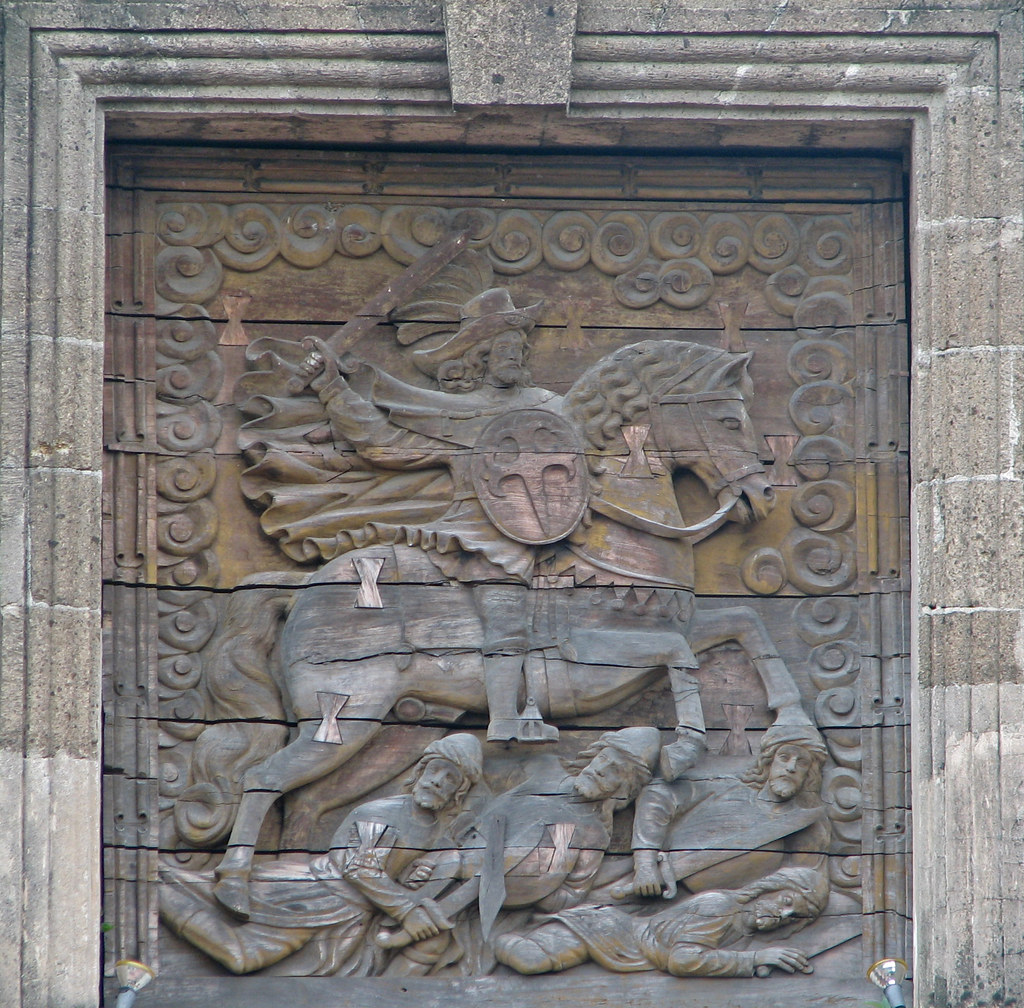
Santiago Matamoros


In Spain, the 25th of July is celebrated with great pomposity as the feast of St. James the Great-- or, as he is popularly known there, Santiago Matamoros. The epithet Matamoros literally means 'Moor-slayer', and was appellated to the saint by the Spaniards during the Reconquista. The story goes that, at the eve of the battle of Clavijo, the saint appeared to a soldier in a dream. The next day, on the battle itself, the Christian armies-- being vastly outnumbered-- were greeted by the sight of a knight astride a white horse. It was St. James himself, riding through the enemy hordes and slaying the Moors. To this day, many Spaniards shout 'Santiago y cierra Espana' (St. James and strike for Spain) as a battle cry.

The photo above is from Fort Santiago in the Philippines, taken from Fra Lawrence's ever excellent photostream.

"St James the Moorslayer, one of the most valiant saints and knights the world ever had ... has been given by God to Spain for its patron and protection."
- Cervantes, Don Quixote

Wednesday, July 23, 2008

Some Observations

I have been very busy these past few days. I've taken an interest in photography again after the longest time, so I enrolled myself at a basic photography class. Although I have to say, it was a bit difficult, because I am a masochist, and stuck to using my old, very old, nigh ancient, Canon EOS 500-- in film, of course. I was a bit disappointed because the pictures, when they were finally developed, seemed to be hazy, not so much as a result of poor skills but because there seems to be a leak in the camera that let light in. Very disappointing. Luckily, a place nearby is selling the new Canon 450D DSLR at a mere Php 42,950, complete with a basic wide-to-normal lens (18 to 55mm). That's less than a thousand US dollars, good enough, I guess.

I've also taken two of my old lenses to the cleaners. One is a Tamron 35mm to 105mm, the other is a Sigma, 28mm to 200mm. The latter is lacking a lenscap so I can only imagine how much that is going to freak out the shop's proprietors.

Also, I find it strange that I seem to be asked all the time whether I had a permit to take photographs in public. Yesterday morning, I was shooting at the uberchic Greenbelt Mall (and I use that term loosely, as it is really more a lifestyle center) when I was approached at least three times by two different guards if I had permission to take photos of the mall's public space. The same thing happened when I went to Manila Bay that afternoon. I wasn't aware the city officials owned the sunset. What's really irritating about the Greenbelt incident is that the patriarch of the family that owns it, Jaime Zobel de Ayala, is himself a photographer! The Zobel de Ayalas are quite possibly the wealthiest family in the Philippines; the immediate branch, based in Manila, is worth at least $2.6 billion; the Spanish based part of the clan (who own Sotogrande, the most exclusive, most expensive address in Spain), at least $1.7 billion. Another branch also based in Manila is worth almost $700 million (I think the Zobel side).

Slight Edit: I just came back from said mall after picking up something for my sister. I had to pass through it to get to the train, so I thought I might as well enjoy the experience... There was a Bang and Olufsen store there, which REALLY excited me, as I have admired their products for a long time-- but the prices are murder. I was looking at a pair of headphones which cost something like Php20,000 (around $400++). Wow, that is expensive. There were cheaper products to be sure, but the prices remain relatively high. If I only had the money... :(

Finally, after six long years of agonizing waiting, Terminal 3 of the Ninoy Aquino International Airport is open. The new airport is one of the more infamous white elephants of the Philippine government; its opening is good news, especially now that tourism here is booming (again). Although the 3 to 4 million visitors we have every year hardly compares to the tens of millions that visit Thailand and Malaysia. Ay, politicians can be so stressful. Would that they were buried in the Film Center instead of all those workers.

On a Starbucks, at 10:04 pm: Jeff Buckley's 'Hallelujah' starts to play. A man in his thirties cups his face in a corner; an elderly American couple sweet talk each other; a housewife, with a worried look on her face calls her son, only to be screamed at; a newly graduated employee, clad in an ill-fitting shirt, romances his girlfriend; a man sits alone in the far corner, his drink before him, untouched. He is carrying the weight of the world.

Thursday, July 17, 2008

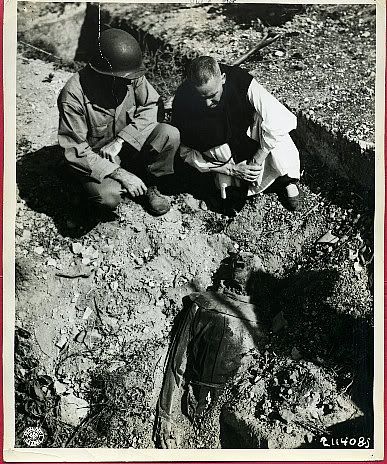
A Thousand Words


Found this on the Skyscraper City Forums.

The caption reads:
"Brother Jose Marjabacas and Col. Walsh look at the remains of the Father Superior of the Philippines. Trying to escape from a tomb in which a number of priests and sisters were held prisoner, the Japs shot him. 1945"

Link: Wartime Philippines

Wednesday, July 16, 2008

Bit of Nostalgia

Growing up, I never really understood when my parents and grandparents would wax nostalgic, and reminisce about the 'good old days' of the Philippines before the Marcos era. Hearing them talk, you would sometimes get the idea that Manila might as well have been an American city back then. Sadly, the distance of time, memory, and shame, have all but rendered this vision a dream. So it is indeed chilling when I see videos like this-- made in 1955, back when my grandparents had the honor of living in the second most powerful economy in Asia, only next to Japan. It's haunting, really, how times have changed.


EDIT: I know it's a commercial for Coca Cola, but I still think it provides a valuable glimpse into the past.