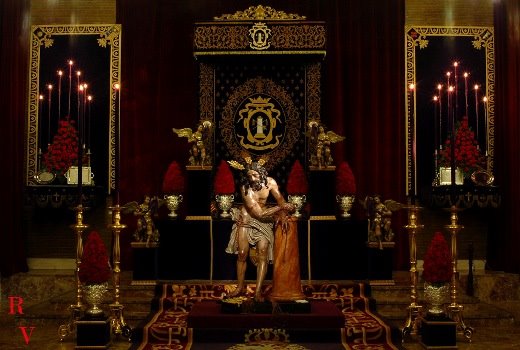
Detail: The Deposition by Rogier van der Weyden






Cash Advance Loans

(...but with emphasis on the "something like it" part)
A few weeks ago I found myself at Mass in a church I'd never been to. Well, not exactly--more like a church I had not been to in years, more than a decade in fact. Before the Mass started I noticed the choir was practicing some songs, mostly schmaltzy, poppish, sentimental tunes all too common in Catholic liturgies today. And lo, what should I hear, but that perennial favorite in Manila churches during the 1990s-- Don Moen's Give Thanks! I have to confess, most of the churches I attended in my childhood had (to be blunt) crappy liturgies-- girls dressed in green sacks with yellow tambourines dancing in the altar, homilies about "the bad old days", basically the works. But the Don Moen song was almost always sung in all of the churches we attended. So it was with a mixture of nostalgia, and a little indigestion, that I listened to it being sung in a Catholic church once more.
Off hand, though, I must say: doesn't it sound suspiciously like this song from the Pet Shop Boys?
Brussels, I was told, was a city one either loved or hated; the room for compromise was small, if not non-existent, and since there was nothing to see in there anyway (unlike Liege, Louvain, or Brugge), it was not really worth seeing. Still, I found the place charming, mixing the most splendid urban decrepitude with some of the most gorgeous architecture I've seen yet (I am quite partial to the Brabantine Gothic). When, on the second day of our brief stay in Brussels, it was clear that the rest of the family were more keen on sleeping and eating, I decided to tour the city-- or at least a section of it-- on foot. It should be easy; my hotel was right across the Bruxelles-Midi station anyway, but I didn't want to waste my money, so I took the more romantic option.
It was an aimless forty five minutes of walking that followed next; I passed through some predominantly Turkish neighborhoods, where hundreds of Muslim men congregated outside sidewalk cafes. There were very little women, I noticed, and they were all staring at me-- I was the only non-Turk walking the streets then, which must have struck them as odd. It wasn't long before the towering, magnificent spire of the Brussels Town Hall reared itself to my right-- a glimmering spike of pearl and silver it looked to me, crowned by a golden statue of St. Michael trampling the Devil underneath. Finally, I found myself in the middle of Brussels' spectacular Grand Place. When I got there, a function was about to begin at the Town Hall, evidenced by a large number of men and women dressed to the nines waiting outside the premises. The cops were also there to secure the place, as were the last wave of tourists for the day, taking photo after photo of every architectural detail imaginable.
Soon I found myself on the main road again. This time, a different landmark caught my eye-- it was the Rainbow Flag that now asserted itself, and I realized that I was in the middle (or perhaps the threshold?) of Brussels' gay district. Curiously, I spied a Catholic Church just ahead of me; and more curious, it stood within walking distance of a gay bar. I tried to enter the church, but it was almost half past nine by the time I got there, so it was already locked. Ah well, I thought. Then a priest of the Armenian Church passed by, accompanied by a family of four; or rather, he accompanied the family of four on the way to their nameless destination. They noticed me holding my camera, and the priest smiled at me-- which I naturally intuited as him saying "Yes, young man, I do not mind having my picture taken by a curious tourist such as yourself."
I felt a tap on my shoulder, and when I looked around, I saw a huge man, probably 6'2 or 6'3 and 250lbs, shod in the tightest of shirts I'd ever seen. Are you a photographer? he said. His voice was deep and gravelly and had a musical quality to it; like a pirate's, who sang opera in the shower. Yes, well not really, I like to take pictures, but I'm not a photographer. Oh? he said. Do you not have a license? I don't, I said, it's more of a hobby than anything. He gave me a grin, as if to say that he understood what I meant. But you are a Catholic? I mean, why are you taking photos of the church? Yes, I answered, I'm a Catholic, and I was just at the Cathedral earlier, I loved it, it was gorgeous, I took so many photos. Then the man's face twisted into an inscrutable smile. I'm a Catholic too he said. Well, I was, but I gave up that shit a long time ago. He stressed the word shit as if it were the key to understanding the universe, as if in it were sublimized all the wisdom, folly, and cosmic mystery of all the ages that have been and were yet to be. Come with me, you look tired! he said. Being the adventurous sort, and being in an especially adventurous mood that night, I acquiesced, and followed the rotund gentleman.
It didn't take long, since as I soon found out, he was seated at the gay bar near the church. Sensing my apprehension, he said, Don't worry, I'm not going to do anything. It's just food. We got to his table, where a bottle of red wine was waiting, a glass for himself, and some napkins neatly piled to one side. So, he said. Then a pause. Yes? So I'm trying to understand, what is a young man like you doing with the Church? I smiled sheepishly and fumbled for a semblance of an answer. Well you see... It's like this... And then... The overarching theme of my rambling answer was that: a) I am a product of history, and that history, as it stands, was largely shaped by the Church; b) I owe a lot of my education to the Church; c) the Church has always made sense to me (a crappy answer); and d) that, no matter how I tried, I can't escape the Church. The man licked his lips for a moment, trying to find an answer. Finally, he spoke: I was born in the southern Netherlands, he said, and in university I was part of the Student Catholic Action. I discerned a vocation to the priesthood and lasted two years in the seminary. Then, as if he realized it wasn't in chronological order, he added: When I was younger, my family would always visit the Black Christ of Maastricht in the summer. We also prayed the rosary every night as a family. My uncle was a priest, he said. You are a Pee-noy, right?
I replied: in our family, there are only a handful of priests, and they're all second or more distant cousins of our branch of the family. Yes, I am from the Philippines. From the glorious and dirty city of Manila. There is a Black Christ in the Netherlands too? In Manila, we have an image of Christ called the Black Nazarene. Every year, the procession attracts millions of the damned and the desperate. A nanosecond of a lull followed; then I asked him, what made you leave the Church? He heaved a huge sigh, and said, Why, the fact that I'm gay of course! He said it matter-of-factly and followed it with a huge, booming laugh. A pirate's laugh, who probably had a taste for Jacques Brel. I'm waiting for my boyfriend, he said. How old are you? I'm twenty two, I answered. You are? But my dear boy, you look like you just crawled out (he emphasized this) of your nineteenth year! Well thanks, I said. My boyfriend is nineteen! But he's taller than you! Then as if the cosmos conspired to prove to me that this gentleman did indeed have a boyfriend, his phone rang as he was saying all this. His ringtone was a Kylie Minogue song.
He's coming in a bit. Am I keeping you? You should meet him, just shake his hand, he's a Catholic too, an altar boy. Intriguing, I said, and no, you're not keeping me. I'm just enjoying the city by myself. Then I asked him: an altar boy? Really? Deep down, though, I really wanted to ask what he was doing with a barely legal piece of jailbait. The gentleman answered: indeed he is. He's Italian you see, French Italian to be precise. And where is he coming from? From Benediction, at another church, with his grandmother. A lull, then he asked me: What are you doing in Brussels, anyway? I answered that I was on a family vacation, but that they decided to stay in the hotel because they were too tired. I rarely travel with family, he said, because they never want to go to the places I want. They can be quite burdensome! he said with a chuckle. Like the Church? I said. A deep laugh, a slap on the table; Exactly like the Church! I said: "In the past we had the Church, which meant, we had each other." Oh? And where is that from? Is that the new SCA slogan? I answered that it was from a Martin Scorcese movie, The Departed. Scorcese is that bastard who never won an Oscar, right? That's right, but he finally won for that movie. Ah, that's good. They keep screwing with that guy. He's a lapsed Catholic too, I said, but he followed by saying that he was not so much as lapsed as "willfully removed." Puzzled, I asked him if he was an excommunicate; he said, Relax, no queen in a fancy dress can make me leave the Church if he wanted. I left on my own accord.
He drank some of the wine, offered some more to me (to which I declined), and then proceeded with his story. The Black Christ of Maastricht, he said, was from Palestine; a nobleman who had fought in the Crusades, realizing he had not brought a gift for his youngest daughter, gave her a nut that had fallen among his belongings in the Holy Land. The grateful daughter planted it in the ground, and it eventually blossomed into a strong, sturdy tree. Then one night, a storm came; a bolt of lightning flashed down from Heaven and struck the tree, much to her sadness. But when the dust had settled, the daughter revealed that she had seen, in the middle of the tree, an image of the Crucified Lord. That was how the devotion started, he said; my family had been devotees for three generations before me, he said. For seven hundred years, that image of Christ has been revered, he said. I sat there listening to him recount, like a wide eyed child, this fascinating story. Then his eyes shifted, and he exclaimed aloud. The boyfriend had arrived.
What a vision, he whispered to me. The young eromenos was the type of boy every gay in my school went gaga over; tall (but not as tall as the Dutch man, who would be of average height in the Netherlands), sturdily built, but not overly muscular, lithe, nimble, with a square jaw, a dark tan, a swimmer's ass and legs. Notice the package? He said, with a wink. I tried not to get too embarrassed by his comments. He stood up and greeted the boy with a peck on the cheek, and introduced me to him. He's a fucking crazy Catholic too! he said, and the boy smiled at me, and asked if I had been to the Vatican. I answered that it was not in our itinerary this time, but maybe next year we might visit. I've been to Mass at St. Peter's countless times. The Holy Father is such an inspiring figure! His accent, I noticed, had a slight, almost imperceptible Midwest twang to it. We talked for one more hour, before I realized it was getting late, and that I had to go somewhere with the family in the morning. We said our goodbyes, and the boyfriend took a picture of us. Goodbye, they said, it was nice meeting you. I bade them goodbye and turned around, but not before seeing the older gentleman stroke the younger one's chin before biting it.
By the time I got back to Bruxelles Midi it was already dark. A Ukranian man offered to cross the street with me. We crossed the street together, and parted at the other end. I came back to Park Inn, exhausted, gratified, and a little puzzled; I drank a beer-- the only time I drank alcohol in my entire stay in Europe, believe it or not, and fell asleep.
I was three years old in 1992, when my parents took me to the theme park for the first time. As a child, I remember being absolutely scared of loud noises and clowns and mascots, and so to assuage my fears, my mother would buy me either toys or candy. That night, I saw a Batman action figure being sold in one of the flea markets in the complex; it was one of those cheap, China-made knock offs, made of poorly cut PVC and with a bad paint job. It even came with a cape, albeit one that was poorly stitched. I looked longingly at the toy, but I realized I had no money; so I waited for the shopkeeper to turn around, before grabbing it and running towards my mom. "Mommy, Mommy, I want this!" I screamed loudly and ran as fast as I could; but when I reached her, she gave me such a slap on the cheeks. "Idiot! Do you want to be thought of as a thief? Go back there and return that thing now!" I did as I was told, but she still ended up buying it for me. Batman lasted a few nights before his legs snapped off and his neck bent permanently to one side, his cape torn off by too much play.
Around a year later, I was at the grocery with the family. Boy that I was, I was a natural nuisance to everyone, and as a result, received a rather severe scolding from my dad that day. No candies for you, he said, no trip to the toy store or visits to your cousin or bedtime stories with your aunt. You've been a bad boy and need to be punished. He said this just as I found a tube of Spearmint Mentos, and as I was about to put it in the shopping cart. In the early nineties, paying for one's groceries, especially in Manila, seemed to take forever; and for what seemed like an hour, we waited in line. And what should appear next to me but a whole shelf of Spearmint Mentos-- tubes and tubes of them? Again, I waited for their eyes to linger elsewhere; and at the age of four, I stole something for the first time. That was a Sunday night, and on Monday morning my parents would hie off to work, which meant I could eat my candies guilt, and punishment, free. Just after lunch, I asked our Yaya to fetch my jeans from yesterday; there was something I had to see, I said. When she returned, she was followed my by grandmother and at least two aunts. Why do you have candy in your pocket? I don't know! Maybe it fell? No one believed me, of course, thankfully. I was duly and dutifully hit with a wooden spatula.
It used to be the custom in our family for us children to take off our parents' shoes after returning home from work. My father had grown up with it, and being a stickler for tradition, decided to pass on the tradition to us. City life, however, had no room for such archaic manners. One time, instead of doing as I was told, I instead shouted at my dad to take off his own shoes. He did, but for some reason, I had the sudden urge to piss, and I ended up pissing in his shoes. As if that weren't enough, though, I ended up... hitting the soup on the table. Because of that, I ended up spending the night locked outside the house. It still puzzles me why I did that. Thankfully a drunk uncle had come home in the nick of time (i.e., half past twelve; we were living in a family compound then) and allowed me to sleep in his room.
In 1996, I was the most popular boy in my school. I skipped classes and was always at the playground, but still ended up getting good grades, much to the consternation of my teachers. One day I was with Joseph, Jordan, and Joven in the playground, and we were throwing sticks at each other. I think we were trying to see which of us was the strongest, which of us could throw it farthest; and so, we made a bet, whoever can throw the most number of sticks over the wall would win a prize. We did just that; and when it was my turn, I summoned all the power in my biceps and threw the damn stick well across the wall; there was a splash, a noise like falling kitchenware, and a shout. I was doing my victory dance when all of a sudden, a booming voice thundered overhead, launching into a stream of curses and expletives far too complex for me feeble seven year old mind to comprehend. "P----- I-- mong h-------k kang bata ka! Tinamaan mo anak ko sa mata, p-----a!" (More or less: "You m----rf-----g s--t of a child! You hit my child in the eye, you j--k off!") I ran off to my teacher and cried for the rest of the day.
Sometimes I wonder why these are the sins I remember the most. I still don't know why, but they just won't let me go.
May is the month of Mary, and in the Philippines May is always a month of fervent activity and prayer. In Antipolo, pilgrims from all across the land make their way on foot, to venerate the image of Our Lady of Peace and Good Voyage. The pilgrimage is an ancient one, attended by both pleb and patrician; it was, and still is, customary to walk all the way to that hallowed shrine, and during Holy Week the number of pilgrims can swell up to nearly a million, with hundreds of thousands arriving on Good Friday alone. The Santacruzan is another popular tradition, which is a pageant commemorating the finding of the True Cross by St. Helena; she is often escorted by a young boy in a faux ermine cape and crown, Constantine. This is a tradition is still observed religiously in every part of the country, though variations in local practice do occur, some more... "Creative" than others (prompting the Archbishop of Manila, HE Cardinal Rosales, to state outright that transvestites were not to play the role of St. Helena under any condition).
That being said, I most associate May with a hymn, sung in farewell to the Blessed Virgin. Since the month has already come to a close, I thought I would post this video. The "despedida" is a hymn common to practically all of the former colonies of the Spanish Empire, which speaks volumes of the depths of Marian devotion extant therein. MY favorite despedida is the one in honor of Nuestra Senora de la Santissimo Rosario de la Naval, which is posted above-- once called the "gran senora" of the Philippines, no doubt for the extravagance of her jewels and the great role she is said to have played in securing the Philippines from the Dutch and the British-- and therefore, keeping her Catholic to this day. From the video:
The Despedida a la Virgen, said Nick Joaquin, was probably the greatest religious song of Old Manila, and was composed by a certain P. Hernandez centuries ago.
Recently arranged by the late Maestro Lucio D. San Pedro, it was sung in the old days by the Tiples de Santo Domingo in public only for 10 consecutive days in a year, that is during the Novenario and the Fiesta of La Naval de Manila in October. Their rendition of this haunting song is unmatched to this very day...
One unique feature when the Despedida is sung, when the tiples come to the part "dame tu bendición, Madre del Salvador!" the entire congregation kneels as the main celebrant incenses the Virgin.. It brings to mind the practice in the old days when the Santo Rosario is triumphantly brought out in procession on the streets of Intramuros, the people would kneel down in homage to La Gran Señora de Filipinas and stand up only until her cortege has passed by them.
In the old days too, when the coro de tiple reaches the last lines "madre amorosa prenda de amor..." the heavy curtains on the central niche of the main retablo in the old Santo Domingo would roll down to cover the Santo Rosario from view until the next day.. Until recently, this practice was continued in the new Santo Domingo..
For the Dominican missionaries however, it was more than just a religious song for the novena in October. It was the song of farewell that they sing to the Virgin before they leave for the missions, of which a number of them are never to return alive or would die as martyrs for the Faith.
"permiteme que vuelva tus plantas a besar.." - the Despedida was a prayer of entrusting, a prayer of hope, and a prayer of love, a fervent wish to be able to return again to her throne and to kiss her feet..
So guys, especially those devoted to the Santo Rosario, learn to this song by heart or at least try to understand its meaning. So that when we sing it to her this October, whether from memory or holding and reading our copies, we can sing it with our heart. The Despedida a la Virgen is the most meaningful and sweetest song of La Naval tradition..
We are indeed lucky that the move then to have it translated and sung in Tagalog did not pushed through lest we lose the poetry and the lyrical quality that goes with the song which is not achieve when a translation of a song is made.. You may get the tune right but the original thought suffers in the process..
As Providence would have it, we are still singing the same song to the Santo Rosario in the same way that San Francisco Fernández de Capillas and his companion martyrs, San Lorenzo Ruiz de Manila and his companion mayrtrs, San Vicente Liem de la Paz and his companion martyrs sang it in front of the very same image, yes, in front of the Santo Rosario, inside the Church of Santo Domingo, then in Intramuros!

So I am in Luxembourg at the moment, on a totally unplanned leg of a long-delayed summer vacation. My aunt, who had been living in Germany for some years now, decided to surprise us with a trip here; and who were we to refuse? It is an enchanted place, mountainous, romantic, and yes, full of nuns who go out in public wearing veils. In many ways, I guess it represents the 'primordial' icon I've always had of Europe-- that of an almost rural tranquility colliding head on with the comforts of the modern world. As I type, I'm enjoying a pint of Ben & Jerry's Chocolate Fudge Brownie (price is the same as in Manila, unfortunately) and listening to some German grandmothers argue about their next trek. And since this is a Youth Hostel, one can never be rid of the presence of half-drunk backpackers, who number less than they did in Zurich, at least.
A very strange realization hit me on the way to Luxembourg from Germany. I don't know why or how, but during the almost six hour train ride from Stuttgart to Luxembourg (with a few added delays, including a missed train), I came to the conclusion that life had become... too convenient. Perhaps "convenience" isn't even the right word, so much as "too friendly" or "too accessible." This is not to say, of course, that I am one to decry the various developments, technological or otherwise (but with special regard to the former), that have sprung up in the last few decades. Certainly, no one wants to come back to a time when traveling was limited to the very rich, or when intercontinental transportation cost more than an arm and a leg and took forever to accomplish; only that there has come to be a very "Cartesian" mentality that we now apply to everything. For better or worse, the world has lost much of its menace; one no longer fears to travel at night, in fear of the elemental terrors that lurk behind every shadow; and we are no longer so obliged to honor the coming of the day by worshipping at the crack of dawn (an innovation for which I am at once annoyed, and also extremely grateful).
I am not saying this to sound like some overzealous travel "purist"; nor am I saying it to purposefully come off as a grouchy, unsatisfiable lout. I think, though, that I have come onto a crossroads of sorts, marked by that staggering moment of realization that the world-- my world-- has inevitably changed. Again, I am not sure how or even why, but all I know is that with it comes an admission of the finality of these changes. It is almost as if I am finding myself saying, "This is you; deal with it." If I am being ambiguous at this point, then perhaps I am moving closer to what I want to say, which, to be honest, still appears to my imagination in fragments, and not as an easily manipulable whole. I will admit, though, that in the last couple of weeks, perhaps stretching even back to March, I've been struggling a lot with a certain personal issue that could fundamentally alter many things I've always come to hold dear. But now isn't really the time (yet) to talk about that. Perhaps in the future.
Anyway, this post was not really meant to be of special importance. It is really beautiful outside, even at this time, (which is why it took me almost three hours to type this!), and the people are all tall, blond, and gorgeous (a fact which my mom keeps reminding my sister-- "When you get married, get married to a German, so you'll have tall and beautiful and possibly blond kids and improve our race"-- I dunno what to think anymore). So I shall sign off, and hie away to socialize and maybe even flirt a little.


One of the most unique Good Friday rituals in the Philippines that I've yet come across is the procession of the Santo Entierro of Lucban, Quezon. Since part of my family hails from Lucban, I thought it would be a great opportunity to further research some of the traditions still prevalent there. Like the Quiapo Nazarene of Manila, Lucbanins believe that the image of the Dead Christ holds miraculous powers; it is processed around the streets of Lucban and accompanied mostly by men, who vie against one another to be able to touch its bier. The procession usually begins after the Adoration of the Cross has concluded, and almost always finishes just before midnight. The video above is one of the best, if not the best, documentations of this ritual yet. It starts in the morning, when the priest gives his blessing to the maroon-clad escorts of the Dead Christ. On their shoulders they carry the ropes with which they will pull the bier around the city. Then follows a procession of men in white, a carryover from the folkloric past of Lucban. There is a term for them that I cannot recall at the moment; it is their task to remove the Crucified from His Cross and lay Him in state. The ritual of the pagtanggal sa Krus was just one of the many elaborate and often dizzying Holy Week practices of the Philippines that were either willfully forgotten or suppressed in the aftermath of the Second Vatican Council, casualties of "relevant" and "participatory" liturgy. While it has not disappeared completely, the number of parishes in which this ritual takes place has been vastly attenuated. Notable examples, aside from Lucban, are Pakil in Laguna, Baliuag in Bulacan, San Jose (home of the famous "bamboo organ") in Las Pinas, and some others which escape my memory. The procession of the bier is accompanied by the haunting sound of bamboo clappers, usually three feet long, and numbering in the dozens.
The devotion to the Senor del Santo Entierro is vastly more popular with men than it is with women; since women practically have the rest of the year to be pious and devoted, the men seize the disturbance of Good Friday as a sort of heightened opportunity to display their fortitude, strength, and determination. Men who rarely, if ever, go to church are most active on this day: whether they be out in the fields scarring and whipping their backs, or else risking the crush of tens of thousands of people in an effort to kiss or touch the image of dead God on His way to the grave.


(I am out of town at the moment, but I thought I would share this news here on this blog, since I found it quite sad. My own Holy Week activities were also curtailed, though certainly not willfully. Ah well. Here's to next year's processions. I guess my suspicions were warranted when I couldn't find new videos of the Esperanza de Macarena the whole day on YouTube. From The Telegraph.)
Rain in Spain puts dampener on Easter parades
Seville's famous Good Friday processions were cancelled for the first time since the Spanish Civil War, bringing bitter disappointment to women allowed to participate in the religious event for the first time ever.
Torrential rain meant it was the first time in almost 80 years that all of the six night-time processions – the highlight of Easter Week – were cancelled. The last time was due to political unrest in the lead up to the 1936-39 Spanish Civil War.Known as "La Madruga", the processions running from midnight until dawn on Good Friday are organised by religious brotherhoods within the southwestern city and attract tens of thousands of onlookers who line the streets to watch the solemn parades.Spanish state television showed scenes of people crying after the processions were cancelled at the very last minute. The heavy downpours had made the streets too treacherous, organisers said."The weather is getting worse. The weather front has hit us directly. There is more water on the way," said Adolfo Vela, the head of one of the brotherhoods.The processions, which date back to medieval times, feature hooded penitents marching through the cobbled streets of the Andalusian capital bearing huge candles.
(In which I rant uncharacteristically about the Church)
Like anywhere else in the world, McDonald's in the Philippines serves really bad food-- their burgers are dry and usually bland, and the only thing I order from them is their fries. They usually come up with good commercials, though. The video I posted above is their latest TV commercial-- actually, the premise is not really exclusive to the Philippines, as I also found this Indian version on YouTube. At the start of the commercial, the girl asks the boy "Am I your girlfriend already?" To which he replies, more or less "No way! I'm not yet ready for that. And girlfriends are quite demanding; they like this, they like that, I don't know what they like." The girl answers "But all I want are McDonald's fries..." After which they head to the fast food to buy it. Anyway, the commercial was removed by McDonald's a few days ago because the Catholic Bishops' Conference of the Philippines somehow deemed it an attack on the traditional values of the country.
People say all the time that the institutional power of the Church in the Philippines is waning, and I didn't really believe that until now. To focus so much attention on this commercial, I think, was just abso-f-----g-lutely ridiculous and inane on the CBCP's part. There is nothing malicious at all about that commercial! It's two kids buying cheap french fries for crying out loud. Heck, if the CBCP intends to go on a commercial purge, they should also have McDonald's destroy every last trace of this commercial, which, if you ask me (though I won't really answer that), equates fast food with the age-old practice of Simbang Gabi. Instead of worrying about pop culture-- it has always been perverted in some sense, and will always be-- how about fussing over the Liturgy for once? Too many parishes in Metro Manila have priests who still have no idea it's Lent and still keep giving the cheesiest, most barf-inducing homilies day in and day out. Liturgical music is almost universally horrid, attendance at Sunday Masses are dwindling, children are being taught idiocy in Catholic schools, and to top it all off, the Church is losing members to the many sects that now crowd our religious landscape. Wake up, Excellencies; to say that, because the Church in this country has always been respected in the past, does NOT mean it will continue to be deferred to in the future. The youth of today are beyond your control and are not so obliged anymore to keep the Faith out of a sense of tradition. Secularism IS creeping in but to continue using old tactics against a demographic that have taken the postmodern to heart is, I think, a losing battle.
Whether the CBCP likes it or not, cafeteria Catholics will end up ruling the country one day. I am not really so surprised anymore though, since I believe that has always been the case. Heck, even in the 1700s Church and State in the Philippines always clashed, and more violently at that: a governor general once had the Archbishop of Manila imprisoned after an incredible stand off in his private chapel (where he held the Blessed Sacrament close to his heart, but, when fatigue had finally taken its course, dropped it on the ground), and on the flip side, a friar-instigated mob even assassinated the governor general Fernando Bustamante y Bustillo and his son. Nowadays though the primary weapon of the secularists is discourse; and if the leaders of the Church don't realize that soon enough, it will lose a lot more of the respect and the prestige it holds to.
My dad was telling me about his experience of attending the Mass for the Beatification of San Lorenzo Ruiz, the first Filipino saint, in Manila last night. It was 1981 and Pope John Paul II was in Manila to meet with the youth of the country. On paper, Martial Law had already ended, but in practice, the Marcoses still lorded it over the country, their generals and cronies getting fat on their abuses of the people. It was the first beatification ceremony outside the Vatican; hence, the Mass was naturally packed with people.
"I was a senior at UST (University of Santo Tomas) then, which hosted the Pope during his visit. Since I knew some people who were part of the committee that dealt with the Pope's visit, I was able to get tickets for his final Mass quite early. I went with my four sisters who were all in Manila at the time.
There must have been a mix-up with the tickets, since when we came to our designated seats, we found that we were seated together with the religious! Directly in front of us were so many nuns and priests, and when we took our seats, we could hear some of them groaning. We were the only laypersons seated there, and one of my sisters even forget her veil. So there we were, being eyed by some grumpy nuns and all we could do was look down. I heard one of them say that "These must be one of those new groups who've taken up the Jesuit spirituality", etc. One of the nuns in front turned to face us. I think she was curious why we were seated there, so she asked, "What congregation do you belong to?" "Oh, Sister, we belong to the Congregacion del Hermanas de San Antonio (Congregation of the Sisters of Saint Anthony-- His name was Antonio); I am the priest assigned to them. I was wearing a barong, so they thought that I had chosen to wear plainclothes instead of clericals. Later, another nun, this time from behind us, asked what congregation my sisters were from. I answered that they belonged to the Hijas del Salvador (Daughters of the Savior; Salvador is my grandfather's name). Thankfully, after that, the questions stopped.
We also saw Imelda Marcos make her way near the altar, where she had requested a specially commissioned prie-dieu for her use. In true Imelda fashion, she had come attired all in black; she had a gigantic, diamond-studded peineta clipped to her head (a sort of comb that held the mantilla, popular in Spain), but which looked more like a tiara, covered with a gigantic black veil. I think the rumor went around that she asked her hairdresser to make her hair resemble more closely the hair of the Blessed Virgin. Anyway, she arrived escorted by a bemedalled general holding a golden umbrella to shield her from the sun; it was rumored she wanted to receive communion from the Pope, and was even practicing her kneeling and sobbing. But I think the Pope was too exhausted, so he just gave communion to the altar party."
It is interesting to note that His Holiness came to the Philippines, not at the invitation of the Government (and in fact, the Papal Nuncio at the time was said to have canceled a lot of planned activities with the Marcoses), but of the youth of the nation. I must say, Mrs. Marcos is one ostentatious hag, too.
While cleaning my room earlier, I found an old diary I kept in my freshman year at the university. It was an old moleskine, my first one, but only the first fourteen or so pages have any writing in them. Be kind; I was seventeen when I wrote this, so do expect it to sound a little emo-ey, as odious as it is.
6/21/06
I am keeping a diary for the first time in what seems like many years. Why? Well, since I am in college already I thought it would be nice to record my thoughts for once. Would be nice to reminisce on these first few days of independence after my graduation. I sat through my first classes yesterday-- two straight sessions of English. Well, I am quite excited about it: I've never seen so many people enthusiastic for class! Unlike High School, where everyone just slept. For literature yesterday, our homework was to write an essay about love--I know, right? So soon?-- to be submitted next Monday.
I keep thinking about the subject in my head, and as a result, I lost a bit of sleep over it: not good, since my first class starts at 7:30 a.m. The first time I really fell in love with someone was just a little over one year ago. It didn't end well. Not at all. I expected myself to cry, but didn't. Maybe because it was just an emotion? Then again, emotions... just play on our other emotions. Maybe I wasn't really in love? Maybe I just knew from the start that it was not meant to be? But what does it mean to fall in love, in the first place? One of the girls in my class who sits next to me told me that it was impossible to go through life without falling in love even once. I told her that I did, but also that I accepted it so quickly. She told me that I was still immature [but in a kind manner of course]. That I haven't felt how beautifully sad it was to have had and lost, and haven't had the courage yet to escape from myself. Or something like that.
I think I will attack my essay from that angle. I think, to have fallen in love, is in the end to be thankful to that someone-- for completing me, for giving me hope, and also, and most importantly I think, for destroying me. Thank you for building me up, and for tearing me down; I am now whole. I now know what it means to have everything, and lose it all in a blinding flash. I know, it doesn't really make sense. But who says falling in love even made sense in the first place? Someday, I hope I will be given by God the grace to understand all of these terribly confusing things.

I am writing this under an appreciable mental strain, brought about by a surplus of graduation-induced rejoicing; at the moment, it is 6.15 in the morning, and the sun has barely risen; outside, the cock crows have just started, and the birdsong is still light and cheerful. There is something very spiritual about the scene; the half-grey light slowly being overwhelmed by the sun's warm, golden rays, with naught but the witness of a few animals outside to hail the coming of the dawn. Inklings to the spiritual life tend, as of late, to manifest themselves to me in such silences; but there was a time, too, when I associated silence with the deathly cold of the tomb.
The environment I grew up in can best be described as apocalyptic. Though I was born and raised Catholic, the earliest memories I have of religion involved the conversion of the maternal side of my family into Born Again Protestantism. Weekly lunches would often be transformed into lengthy debates about Biblical things; I remember the word "Actually" being bandied about a lot, and henceforth, I would associate that word with a kind of blessed smugness-- as if he who used that word were already "in the know", as it were. There too was the image of an aunt, huddled and kneeling near her closet, eyes firmly shut in mystical contemplation of the hidden truths of God; she was fasting, she said. And lastly, there is the image of yet another aunt, falling down on the floor after being "slain in the Spirit" by a frenetic pastor, then afterwards bursting in tears, where in joy or as a result of a concussion, I do not know. By the time I was in first grade, almost all of my aunts on my mother's side had completed the transition to Protestantism; today, I often find it funny how their political convictions run the gamut from almost libertarian, to batshit crazy conspiracy theories; yet they still somehow insist that theirs is a "universal faith".
The first experience I could truly call "spiritual" happened just after my third birthday. One of the neighbors had given me a plastic bag full of "tex"-- trading cards, usually with images of anime characters or Marvel/DC superheroes, measuring some 3 by 2 inches. The game was simple: you placed a card on the thumb, and then you flick it to the ground. The one whose tex landed face up would win the other's cards. I received probably twenty five of them in total, all of them still crisp and not worn along the edges. Most of them had prints from the X-Men Animated Series (a wonderful cartoon, by the way) or Son Goku (of Dragonball Z fame) in Super Saiyajin Mode. After I had devoured my share of my cake, I took the tex to the living room, and proudly showed them off to family. But an aunt had seen the pagan images on the cards, and brought me to her room. She told me that these cards were tools of the Devil to draw me away from God.; that, if I were to truly love Him and serve Him, I would get rid of them at the soonest possible time. Moved, I promised to God and my aunt that I would not stray away from Him: and, under her watchful eye, I began to tear them up one by one. When I had finished the deed, I went back to the living room as if nothing had happened; I later proudly announced to the neighbor boy that I had gotten rid of his evil presents. I think that was the last time we had guests other than family come to one of my birthday parties.
While stories of extreme self-abnegation often figure in the classics of Christian spiritual literature, one characteristic which could be said of these stories is the presence of a delightful synergy between God and man. There was nothing forced or contrived in them, but on the contrary, were even born out of what one might call a supernaturally inspired spontaneity. In contrast, and in hindsight, I realize that much of the abnegation I experienced as a younger boy were often committed out of a hidden, but very real fear: it is the fear that one would not measure up to an idolized angelic standard. There was an almost masturbatory obsession and neurosis with how I was often expected to act. I was taught that having crushes on girls at a young age was sinful; that to dance the Macarena was sinful (I was in second grade!); that to even listen to love songs was sinful, because only God can be the object of love, and all other loves are depraved and polluting of oneself. Mortification thus became a way to assure oneself of his righteousness, the diametrical opposite of the word. I thus developed a "one trick pony" kind of spirituality, one that seemed to focus exclusively in reminding myself that I am nothing: that I was an incorrigible monster, and that all my actions would somehow ineluctably lead to failure if I failed to keep God in mind.
I readily admit that one of my worst vices is jealousy. I can easily harbor grudges against people whom I perceive to be better than me-- who excel more than I in academics, in piety, or indeed any and all other categories. There is that drive-- an almost aggressive desire for cold-blooded schadenfreude-- that has always lurked within me that waits to pounce at any opportunity it can latch itself onto. Most of the time it fails; but when it does succeed, when my ego has been succored sufficiently by the losses of my "enemies", I realize how much of a monster I can become. Like Cronus devouring his sons, my ambition and desire for recognition can get the better of me, leading me to choke and eventually vomit. But there is also a realization that this can only happen because I have made spiritual bulimia into an idol: a daunting, immutable, universal standard, wherein hatred of the self is deemed an exemplary virtue, and sin was almost looked upon as the natural state of man. Call it Jansenism or Puritanism if you want; I am not entirely sure if it can be called either. But I am now convinced that I once held sourness as the very odor of sanctity itself, and scornful rigorism, which masked itself as piety, ruled all my actions. To be sure, mortification is needed for the growth and maturity of one's spiritual life; but what must be remembered here, I think, is that one's spiritual life is not a thing divorced from his daily life; the former informs the latter, and the latter mirrors the former. To be bound and shackled to a sickening, depraved angelism-- to exalt the grotesqueness and corruption and boils and festering wounds of the body-- is to turn God into a titanic, cosmic asshole and sadist-- and such a thought can only bode badly for the future.
It may seem ironic coming from one who has always been fascinated with some of the (admittedly) darker aspects of faith; I have written so much about flagellation and other bloody forms of penitence in the past that it may already seem as if I thought of them as necessities. To be honest, not all who undergo such feats necessarily end up having deeper, spiritual roots. But I am always amazed at the remarkable freedom with which they choose to make their pledges. It is said that a panata-- the sacred vow between God and penitent-- must be honored for as long as the penitent has sworn to do so. Still, others (mostly their sons or next of kin) choose to continue the devotion in thanksgiving. Much like the Latin lex talionis, the Filipino word ganti can mean either to take vengeance, or to reward with a gift. The supernatural laws of obligation still remain inscrutable mysteries to me; but there is always that faint, discernible trace of freedom in them that makes the artificiality of this contrived angelism more evident, more incomprehensible.
This is something which I still need to deal with. For a very long time now, that gigantic chip has been burying itself so deeply into my shoulder that to excise it would cause a lot of pain. But such a warped view of the spiritual life is a malignant tumor which needs to be attended to before it metastasizes into something that can no longer be controlled, and I end up becoming a spiritual pervert-- for whom joyless sadomasochism is the very pinnacle of perfection.
Last night I had the most terrifying dream. Terrifying, not so much because it involved inconceivable cosmic horror or anything, but because it felt so real, so stark, so possible.
In the dream, I was driving my car up a dusty old dirt road that wound up a bare hill, save for some splotches of greenery and the occasional cluster of trees. The sky was dark and grey above, and the birdsong mournful. There was a contemplative silence that hung like doom over the entire hill. The trail led to an old church, its lawn weed-strewn and the the earthquake baroque architecture of it nearly obscured by vegetation. The church looked like it was at least 400 years old; it was enclosed by an iron gate, and there were leering stone eagles that perched atop the posts. I parked my car by the old church; the door was opened, and I stepped in. It was dark inside, the kind of darkness one associated with a coming storm. The altar was obscured by the gloom, but I could tell there was a huge crucifix on the retablo. There was a light that came from northern end of the church; I discovered its source to be door that opened up to a patch of land, an extension of the cemetery. I went there and looked at the names of the people buried; I found many Basque names, and here and there some headstones contained no names but only the carven faces of the cadavers buried underneath. There was a roaring sound, like waves smashing onto a cliff, and I discovered that the hill somehow jutted over the sea, black and foaming and turbulent.
Suddenly, I saw a figure to my left. It was a man, naked and tall, his back turned to me. He stood maybe fifty feet away from me, and I somehow knew that, despite his age and gravity, he was no more older than I was. I felt compelled to approach the unmoving stranger. Hesitantly, I approached; strangers in dreams are always bad omens, I thought. My footsteps were becoming increasingly louder, crunching twigs and dried leaves under my feet, but still the boy made no movement. Finally, I was just a foot behind the stranger, when I heard a voice. "You've been here before", he said, "In fact, you've never left. You were always here." Then suddenly, the stranger turned around; and as I beheld his countenance for the first time, a chill crept up my spine as I discovered that there was no countenance; the man's face was as blank as a fresh slate of tombstone, as silent, as deadly, and as brooding as the stone witnesses around me. Then it began to rain violently; the storm winds whipped up the rain into a frenzy, hitting my face with such power. But the naked stranger remained as immobile as ever; and somehow, I understood that he was crying, despite his lack of a face. He pointed some distance behind him, and motioned for me to follow him.
We came to the edge of the cliff, a point which somehow sloped upward and then ended abruptly. Directly below were some ships that seemed to have been magically transported there from vast gulfs of time and space. They looked as if they were Viking longboats, but instead of a dragon prow they had lion heads, and the ships were painted black and their sails were red. He then pointed to a pile of rocks I had noticed before. "Dig", he said. And somehow that voice became feminine and melancholy. I quickly distended the pile of rocks with surprising ease; I dug through the layer of soil freshly laid, and after some time, I discovered a coffin. I smashed the coffin with a hammer the stranger gave me; and as the wood splintered and eventually gave way, I saw what looked like a mannequin lying in it. A terribly hyperreal mannequin-- which, while plastic, had been given glass eyes, hair, and all manner of varying imperfections to make it seem as human as possible. The eyes of the mannequin were open in a sort of dumb expectation. I heard the stranger speak once again. "I told you; you have always been here. And I have never left, too."
I felt my blood boiling for some unknown reason. I screamed at the naked stranger, struggling to get out of the pit as quickly as possible. In rage, I dove at him with the hammer, with which I sought to bash his brains in. But no sooner had I thrown myself at him did I trip and fumble, as if I were felled by some invisible wire and now gotten myself entangled in it. Then I discovered the source: the wires were very real, and attached to the naked man, as if he were a gigantic marionette-- and that, indeed, he was. I turned him over, and discovered that he still had no face. The wind and the rain were howling then, and in no time, the pit began to fill with water. I felt like crying; and then I woke up.

The Church condemns the belief in anting-anting, or amulets, as superstition, but that has not stopped many Filipinos from putting their trust in them. A lot of folk Catholic myths and legends really have to do with anting-anting; among the many beliefs associated with it, it is believed that the power or efficacy of these amulets tends to wane over time, and therefore, must be recharged; Good Friday is thought to be a most propitious day for this. Various amulets are said to be able to grant different powers, from invisibility, protection from curses, invulnerability to bullets and knife-thrusts, and even a supercharged libido. The documentary above is really more about martial arts, but it shows how strongly these superstitions have been wedded with the culture.
 | My Peculiar Aristocratic Title is: Bishop Lord Miguel Carlo the Strange of Peevish St Victor Get your Peculiar Aristocratic Title |