Tuesday, April 08, 2008

Tagged

It's been ages since I was last tagged, so I'm answering his one with great gusto! Thanks to Andrew for providing me with something to work with and killing my boredom.

The Rules:

a)The rules of the game are posted at the beginning
b)The blogger who gets tagged must answer the following questions about himself
c)After this has been accomplished, the blogger tags five more to answer the meme, and leaves a comment at their blog to answer it

1) What I was doing ten years ago:

8 April 1998 - Enjoying a trip to the beach in sunny Puerto Galera. I remember my little inflatable rubber boat got caught in a very powerful gust of wind, and I had to chase it for around 300 feet before I finally caught it. Then it got blown away again.

2) Five Things in My To-Do List

2.a) Get my grades from school (I got two B+'s! No A's, though :( )
2.b) Fetch my cousins
2.c) Clean my room, it's just an incredible mess
2.d) Read a book
2.e) Pray, and pray hard

3) Things I Would Do if I Were a Billionaire

3.a) Build the biggest church in the world, which I will personally furnish hahaha
3.b) Donate a significant sum to the Vatican
3.c) Build a resthouse near the Tubbataha Reef in Palawan
3.d) Build schools for the needy
3.e) Buy exceedingly rare books

4) Three of My Bad Habits

4.a) Pride (I can be a very arrogant person)
4.b) Lust/Impurity (Sadly, I can be very susceptible to the wiles of the flesh)
4.c) Backbiting (There was a time when all I could say about a person was gossip)

5) Five Places I Have Visited

5.a) The Grand Canyon, Arizona, USA (It was quite hot! I've never had bigger sweat stains in my life, LOL; but the view was incredible ['02])
5.b) Manhattan, New York, USA (We went to the Empire State building, FAO Schwarz, the Museum of Natural History, Liberty Island, and passed by the WTC [this was back in '00])
5.c) Panglao Island, Bohol, Philippines (some VERY beautiful beaches, great people, and I got to see Baclayon church, second oldest in the country ['07])
5.d) Victoria Peak, Hong Kong (I was with my siblings; we then proceeded to Ocean Park afterwards ['96])
5.e) Singapore (I've been to Singapore a lot of times, so much so that I've visited all the major sights there; also shopped at Orchard Road. I bought a pair of shoes ['05]).

I've been to a lot more places, but in the interest of time, I just listed the above off the top of my head.

6) Five Jobs I've Had

Hmm... This is difficult, since getting jobs while in HS here in the RP is an alien practice. But thankfully, I've had my fair share of experience.

6.a)Facilitator for a summer camp (entirely pro bono; '06)
6.b Assitant for my mom's business (an on-off thing; '04 to '05)
6.c)Part-time tutor (for some of the younger kids in school, but I saw this as voluntary work; '05)

7) Five Snacks I Enjoy

Though this category was not in Andrew's list, I've seen some versions of this meme that included this, so I might as well add it. Besides, snacks are awesome! Yum! (Be forewarned, though, that the things I'm about to list are unhealthy as fudge).

7.a) Chicharon (Fried, crispy pork rind, best enjoyed by dipping into spicy vinegar)
7.b) Toblerone (I really like it)
7.c) Smores ( A guilty pleasure)
7.d) Chocolate mousse cake (A favorite of mine since time immemorial!)
7.e) Mentos Spearmint (LOL)

I also want to try a snack called 'Filipinos', which are, apparently, a kind of biscuit in Spain. I hear they're terribly tasty. LOL.

8) Five Places I've Lived

I've lived in Quezon City, Manila, all my life. We have had three different houses, though, but always in the same city.

That's it. It took some time, but in the end, it was quite enjoyable, really. I tag the following people, should they choose to accept:

Arturo Vasquez of 'Reditus'
Jeffrey Smith of 'The Roving Medievalist'
Eegahinc of 'The B-Movie Catechism'
Ken of 'Hallowedground'
Mark Scott Abeln of 'Rome of the West'

La Perla del Oriente


Sunset at Manila Bay

Now that I have more time on my hands, I hope to be able to blog on things closer to home; there are so many things in Manila that deserve their own posts, including the city's many churches, its quirks, and of course, the horrible traffic jams. And yes, even that can have some spiritual meaning. I've also been meaning to post more about Intramuros, the 'Old Manila', and its famous churches: San Ignacio, San Agustin, Santo Domingo, and many more. Sadly, only the Augustinian (which is to say, the second, LOL) church survives to this very day-- the rest were destroyed in WWII, along with priceless other structures (did you know that Manila was the second most devastated city in WWII?). These should be interesting, to say the least.

Monday, April 07, 2008

Summer

It's summer already in my part of the world, and I'm enjoying every minute of it!

I'm sorry I haven't been around lately-- the last few weeks of school, followed almost immediately by the freedom that summer brings, can prove to be a very potent potion. I've visited museums, spent hours in bookstores, and numbed by butt to movie marathons of Godzilla and Hammer horror-- a very enjoyable thing, I assure you. Of course, all this couch potato slouching will take a toll on my body, hence I'm also doubling my time at the tennis court (it's great that I have my cousin over to indulge me, plus her cute friends are also a boon, LOL).

Posts soon; for now, I have to get back to watching 'Conan the Barbarian'.

Thursday, March 27, 2008

Why Is This Night Different From Every Other Night?


'Why is this night different from every other night?'

Maundy Thursday has always been a day of great drama for me. From the time that I could walk, my parents would always take me 'church hopping' on this most holy of nights in the traditional 'visita iglesia' so dear to the Filipino people, the Tagalogs especially. I remember visiting provincial churches--grand, dusty, and tainted with the weight of history--and being awed by the whole experience. The sight of many veiled women, wailing and chanting prayers on their knees, and the heat of literally thousands of bodies packed into a small nave will forever haunt me for the rest of my life.

Oddly enough, Maundy Thursday is also a day of great setbacks and mistakes. There is always something happening during the day that makes it so mundane. Come evening, however, it is a different matter entirely, and this year was no different. One of the most spine-tingling sights for city dwellers in Manila is surely the sight of hundreds of tall buildings, utterly unlit, standing like silent sentinels in a sea of shadows. Every year, this scene is rehearsed again and again, but the potency is as strong as ever.

This year, we visited seven churches as usual-- a far cry from the fourteen churches that my father used to visit when he was my age, and barefoot, too. But just what is it about Maundy Thursday evening that is so different? This year, we followed almost exactly the same route as we did for Maundy Thursday last year. I will focus on the churches of Intramuros. When we reached the walled city--Old Manila, Spanish Manila-- it was probably the visual equivalent of being hit by a tidal wave. I had to suppress a sarcastic chuckle at the sight of so many cars trying to enter through the ancient stone walls, while guards dressed in guardia civil attire herded SUVs and sedans to safe, suitable parking spaces. But more than the cars was the sheer number of people, many of them poor, and almost all of them fulfilling a panata, trudging through the small (relatively speaking) portals of Old Manila. Again, there was a suppressed chuckle, as the a sizable portion of the milling crowd, especially the boys, seemed to be dressed like cholos, faux bling bling and oversized anime shirts and wifebeaters being an 'unofficial' dress code.

Many of them bore crucifixes, the kind that looked mass-produced but had its own unique quality, and almost all of them sporting a bloodied corpus of the Crucified. Many still were barefoot, mud and filth caking the soles of their feet. They numbered in the thousands, squeezing through the churches in undulating waves. The scene at the Manila Cathedral, for example, was too much for words to describe-- hundreds must have crammed through the small chapel where the Blessed Sacrament was reposed. Outside, in the body of the cathedral, bands of penitents knelt on the cold stone floor, praying the Via Crucis. The pews were filled to the brim with men and women, young and old, rich and poor alike. It was like a scene from the bible-- like the crowd before Moses as he parted the Red Sea, like the people of Jerusalem gathered at Golgotha to witness the death of the God-man.

Still in Intramuros, we proceeded next to San Agustin church, oldest of all the houses of God in the Philippines, the sole survivor of the great churches of Intramuros, the crowning glory of Old Manila. It was a five minute walk to this church from the Cathedral, but it lasted more than that, due to the sheer number of people trudging through the streets. I saw Spanish, Chinese, and Malay Filipino walking side by side that night. It was a sight to behold, and one to chill the blood of even the most hardened atheists. Entering San Agustin was an experience unto itself; the patio of the church was literally jam-packed with devotees, praying on their knees, and waiting for their loved ones to come. Inside, the church was lit very somberly; but the Baroque splendor of this ancient church still shone, and stood out amidst the shadowy darkness. I saw many a child looking with eyes-wide open at the sorrowful images of saints in their gilded niches. It was like being transported back in time, like 'seeing a glimpse of heaven from purgatory', as a lady next to me described it.


It was in Chinatown, though, that I grasped just what this day meant for me, and for many more out there. As we entered Binondo church, where the first Filipino canonized saint Lorenzo Ruiz once served as sacristan, I was struck immediately by the sight of a group of penitents, fifty at least, walking to the main altar of the church. They were poor people-- barefoot, dirty, and obviously tired. Ahead of them were four boys-- three bearing wooden crucifixes, and another holding a processional garden torch. Behind them knelt the rest of the group, holding rosaries and prayer books in their hands, many with eyes caught in a mystic rapture, and many more caught in a wave of emotion as to make them tear up. For five minutes at least, they recited their prayers, to the amazement and astonishment of the other pilgrims, including yours truly. Afterwards, when they had finished their prayers, they were gone as quickly as they had entered the church. It was truly one of the most amazing things I had ever seen.


The only other church we visited which we had not visited before was San Sebastian church in Quiapo, Manila. It is notable as the sole all-steel Gothic(!!!) church in all of Asia, and is one of the most intriguing churches in all of Manila (until 1975, it remained closed to the public for all but a few days in the year). San Sebastian loomed before us, its tall spires framing the bright moon above; even from a distance, and while seated inside the car, one could see the sea of people making their way inside the church. Inside, San Sebastian was packed to the brim; it took us practically five minutes to cross from the vestibule to the nave, so many were making their devotions, and so many were venerating the image of the Nazarene and the Senor de Paciencia at the nave. The confessionals were all robed in purple, and had large crowds swelling at every point. Again there were the penitents, still barefoot, making their pilgrimage to this house of God, while the number of devotees venerating the two images stationed near the entrance of the church still grew with every passing minute. We left the church, exhausted, hassled, and most importantly, awed to our wildest wits.


Outside the church, it was a catastrophe. The already cramped streets were littered with refuse and garbage from the day (on mornings, this part of Quiapo becomes a wet market), a sight which contrasted sharply with the magnificence and splendor of the churches we visited. Yet in that hour, something within me understood something. Suddenly, everything made sense-- the garbage on the streets, the barefoot penitents, the bands of pilgrims, and the stripped altars. Suddenly, one could see: this night was, indeed, different from all other nights. The drama of the Passion had begun; the die has been cast, and the scenes which had been so familiar to us from the beginning repeat themselves, and we are transported back to the days of old, and I, at least, understood my place in the scheme of things; and that place is in the pews, grieving with the rest of humanity, and keeping vigil with Our Lord in the last hours before His execution. It would be better to say that I was bludgeoned with this truth than actually understanding it.

At 11pm, I finally got home, and with only a couple of minutes more, I once again hear, in my mind, these words: Why is this night different from every other night? And still, I cannot provide an answer, save a couple of ramblings and stories that try to approximate this single, supremely sublime piece wisdom: I kept watch with God at this night. That is why it is so different.

Saturday, March 22, 2008

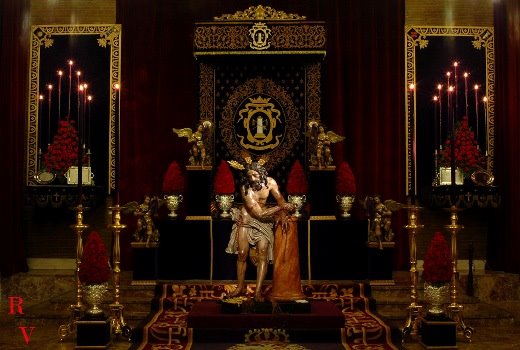
Altar of Repose


From Santo Domingo church, the Dominican mother church here in Manila. I had a very interesting Maundy Thursday, but right now, I am occupied by a lot of very time-consuming things. I'll post about it soon, probably on Easter Sunday.

Monday, March 17, 2008

This Kicks So Much 'Sass'


(I censored the un-Christian word above, to use a line from Ned Flanders).

The Iglesia ni Cristo are a local pseudo-Christian group that denies the divinity of Christ, the Holy Trinity, and pretty much standard Christian doctrine. They claim they are the one, true, church, and that their founder, the late Felix Ysagun Manalo, was the last true prophet of God ('sugo ng Diyos'), sent to re-establish the true church on earth after virtually disappearing in the supposed 'Great Apostasy' that occurred in the early years of Christianity. They have been accused of extremely fraudulent exegesis by many scholars and even brainwashing tactics (one of the features of their services is that you are given an 'attendance card' which you have to get signed on on Sundays and their other holy days; failure to do this warrants a visit to your home by their leaders). They are one of the fastest growing religious cults here in the Philippines, incidentally.

Tuesday, March 11, 2008

Crucified Frogs and Holy Mountains


One of the strangest superstitions I've read about happens every Good Friday in the island of Negros Occidental, here in the Philippines. It is said that Good Friday is the most auspicious day of the entire year to obtain power, blessings, and even strange abilities; it is a day when God Himself is seemingly 'dead', and the elements are at the behest of man to manipulate them to what he wills. To obtain a bountiful harvest, it is said that, on the precise moment when Our Lord is said to have died-- that is, 3pm, one must take a frog, and crucify it on a wooden board. The frog must imitate the position of Christ, with hands outstretched. This being done, a rain cloud will immediately form overhead, provided the ritual is done accordingly.

Another superstition native to the Philippines states that Good Friday is the day when new anting-antings-- amulets generally resembling sacramentals but which have strange, even occult symbols inscribed upon them-- are 'born'. To obtain one for yourself, stand under a banana tree, and again, wait for the magic hour; the 'heart' will eventually drop a fully-formed anting-anting, which is said to have numerous powers and effect many graces. Of course, grace, or grasya, as understood in the Philippine context usually meant a favor from the Divine.

Then there is also Mount Banahaw. Since the early part of the twentieth century, this so-called 'holy mountain' has been a pilgrimage site for legions and legions of believers, Catholic or otherwise. The story goes that an angel, or the Holy Ghost, appeared to a local hermit, and told him that the mountain just yonder will be the site of the New Jerusalem. Today, Mount Banahaw is home to numerous cults, too many and too fascinating for me to describe in one post. Some of these cults believe the Philippine national hero, Jose Rizal, to be God himself; others worship an Old Mother type of figue, dressed in immaculate white robes and a ridiculously large triangle behind her head. She is, believe it or not, supposed to "God the Mother" or one of the multiple titles of the Blessed Virgin; she also says the "mass", either in archaic Tagalog or pig latin, ad orientem.

Many pilgrims choose to climb Mount Banahaw on foot. The pilgrims visit places like the Balbas ng Ama (Beard of the Father) and the Buhok ng Ina (Hair of the Mother), sacred springs and fountains and curtains of lichen that curiously resemble growths of hair, hence their names.

Good Friday in the Philippines is, most curiously, not a very Christ-centered event in the usual sense. Aside from the procession of the Santo Entierro, the image of the dead Christ, which happens to be a major event in some provinces akin to how the Quiapo processions are in the city, Good Friday seems to be 'devoid' of Him altogether. This is the day when demons run loose on the face of the earth, since there is no Christ to cast them back to Hell, and conversely, a day of great power as well. Indeed, it would seem as if the whole order of things were inverted on this day: God is dead, hell is triumphant, heaven weeps. Even today, there are still many families who forbid laughing, dancing, jumping, and even bathing altogether on Good Friday, as these may disturb the sleep of Christ.

What are we to make of this? Should we be worried? I guess it all depends on the viewpoint with which we see these things. For the Catholic convert, such a display of enthusiastic despair will definitely leave a scandalous impression. But for many who grew up immersed in the strange, enchanted world of Catholicism, such events will appear quite 'commonplace'. The more I think about it, the more I am convinced that our modern preoccupation with liturgical purity is not very traditional at all. I say this, not to spite those who love our liturgy, but because for the better part of the last two thousand years, the liturgy was considered the domain of the clergy. The lay people thus had to contend themselves with something equally as magical, yet distinct from the official functions of the Church. Thus we have processions, and extra-liturgical acts such as the chanting of the Pasyon, brotherhoods of flagellants, men who have themselves crucified, and so on.

We have to remember that religion is primarily cultic, and only secondarily dogmatic. Worship, sacrifice, and ceremonies are, it can be argued, constitute a bigger part in our working definition of religion than creeds, beliefs, and polemics. In fact, one need not look too far to observe this phenomenon: visit any Mexican or Italian churches and note how the people behave. They stoop and cross before statues, kiss plaster feet, offer garlands of flowers, pin dollar bills onto a saint's breast, carry its bones on their shoulders, and kiss bloodstains, torn pieces of cloth, shards of scalp and bone and other such paraphernalia inside golden reliquaries. Suppose the iconoclasts had their way, and veneration eventually became consigned to the dust bin: would we then view these devotions as superstitions too?

Granted, the things I have mentioned above go beyond the mere realm of superstition, even crossing over into the realm of black magic. There is a reason why witches and ghouls and goblins are said to wander the world every Good Friday (as if Christ died every Passion Day; but that is something I'll tackle somewhere else). With the Great Hero down for the count, who is to stop the forces of darkness from doing their work? It is very striking that one of the most powerful ('literally' and symbolically) figures of Christ is the image of Him entombed in the sepulchre; it is the object of devotions of the populace during the Triduum, where thousands line up just to kiss its feet. Again, everything is reversed: the fallen become conquerors and the seemingly victorious are cast back into Hell, without them even knowing it. The folly of hell is revealed, and the Divine Wisdom reveals Itself, triumphant, a conquering hero Who has vanquished the night.

My point, basically, is that the things we believe are not just things to be read, as if the life of Christ were a purely textual event: it is not. Surprisingly, the naivete of the uneducated and the uncatechised show a fundamental rupture that we would otherwise not have seen: that the God-Man was, first and foremost, a God-Man. This is and was not a petty semantic formula, but a truth infinitely more profound than creation itself. It is, in a word, magical. I imagine this almost pagan notion does not sit very well with us today because we are too focused on OUR part of religion: the what and what not to do, the how to do, and so forth, that we forget God's part of the whole deal. Ultimately, crucifying frogs and anting-antings are just magnified superstitions; but whatever we make of it, let us ask ourselves if what we are following is actually a religion, or just a mystical book of etiquette.

Perhaps we're wondering, what's the difference? I think it is rather simple: a religion actually saves the sinner. An etiquette book merely gives one respectability. There is a world of a difference between the two.

Sunday, March 02, 2008

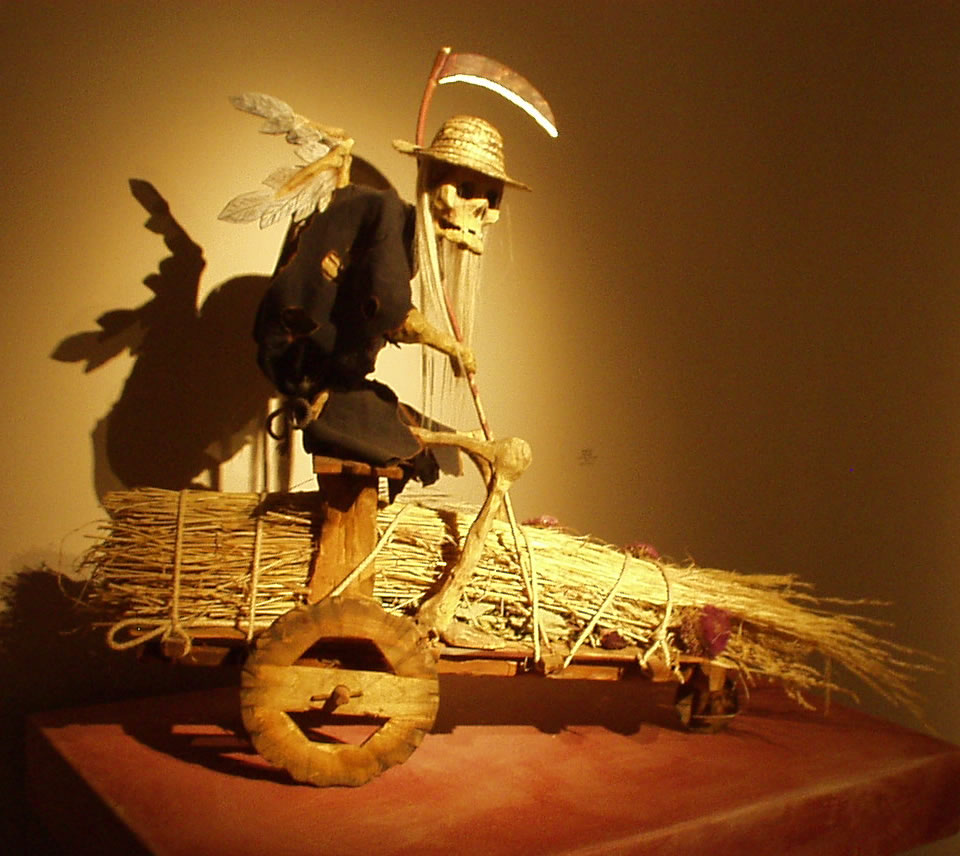
Death Cart

Friday, February 29, 2008

My New Guilty Pleasure


Via Arturo Vasquez's excellent (new) blog Reditus, I cam across this blog called 'Stuff White People Like', which is proving to be my newest source of entertainment... And I must say I am quite entertained! It has everything your typical Caucasian liberal would like, such as Asian girls, standing still at concerts, bottled water, and hating your parents' religion. Of course, it's meant as a parody, although I can't help but feel a lot of the stuff listed there also applies to me, LOL.

Just a note, in the Philippines we have a 'one drop rule' that basically states that ever the smallest drop of European blood is enough to make one white-- which in this country is considered a good thing. Thus you have wannabe hipsters, rich kids, and the nouveau riche constantly playing up the fact that 'I have 1/128th Spanish blood!' to everyone they meet-- especially foreigners. This is actually quite an amusing topic, which I think is common throughout all of Southeast Asia; I promise to write all about this when I have the time!

Friday, February 22, 2008

Oh My Gulay!


'Oh my vegetables!'

This is a picture of a truly gigantic 'processional' monstrance from the city of Seville in Spain. I say 'processional' because there's no way that could fit under the roof of a normal church-- but then again, I could be wrong, as many cathedrals in days past were built with titanic proportions. Do note the double halo/sunbursts and how it is virtually its own altar. The Blessed Sacrament has not yet been exposed.

Before I Forget


I've had these pictures lying around in the computer for a while now, but have completely forgotten about them until now. They are pictures of a particularly grotesque, late medieval German crucifix, if I recall the captions correctly. So yes, morbidity seems to have been a truly Catholic-- in both senses of the word-- characteristic feature of Christian art. I guess this puts to rest that Spaniards just love their gore.


Adoramus te Christe, et benedicimus tibi; quia per sanctam crucem tuam redemisti mundum.

Thursday, February 21, 2008

Another One


bantayan - luhod
Originally uploaded by adlaw
From the island of Bantayan, just off Cebu City. This shot was probably taken on Good Friday, judging from the veiled cross. And no, these women are not hyper-traditionalists-- just ordinary housewives with ordinary concerns and ordinary problems. I will stop now and let the picture speak for itself.

Wednesday, February 20, 2008

I Love It!


Only in the Philippines do you see such a glorious clash of styles! These are obviously kids, who were made to wear tunicles (I think in the Spanish tradition tunicles and dalmatics are sometimes indistinguishable, and I just have to say that the processional cross and tapers are wonderful, in a way that only Catholics can appreciate. I just wish there were better collarines, though, those brown things just look wobbly and out of place. And the guy with the camera-- priceless!

Sunday, February 10, 2008

Hiatus

I'm putting the blog on a brief hiatus, since I am predicting a very busy schedule for myself these coming weeks. Also, there is a slight chance that I will be going out of town for about a week, where there is little to no internet connection available. And, while we're on the subject, my ISP is being a bitch again, and has been for the last five days. I am sorry for this delay, and I will be sure to answer your emails at the soonest possible tim. Thanks. :)

BTW: Go see 'Cloverfield'. At all costs. :D

Monday, February 04, 2008

Because I Can

Tuesday, January 29, 2008

In Praise of Bad Taste

Of Plastic Images, Glow in the Dark Virgins, and Calendar Piety


Some of my earliest visions of heaven were formed by my many trips to my paternal grandparents' house in Batangas. I do not come from a wealthy family; at best, there was the promise of land and wealth that never really blossomed because of the War. Thus, my grandparents, though born considerably better off than most Filipinos, had to revert to their blue collar roots to eke out a living. As I've probably mentioned before, much of my family on both sides consists of educators-- my grandparents were no exception. Lolo Salvador was the city agriculturist of Batangas in the 1960s, while my Lola Fermina established (eventually) one of the foremost schools in that area today.

They were simple folk, who wore their religion on their sleeves. My grandmother, even at an early age, already made a reputation for herself as an hermana de la Iglesia, a sister of the Church, because she was a constant presence in the town church: whether for benedictions, masses, novenas or whatnot, my grandmother was always in church, either shuffling her mantilla and fingering her beads while seated in the pew, or talking to the Monwsignor and giving him advice on anything and everything under the sun. My grandfather was not very religious-- but by the grace of God, and through the stubborn persistence of my grandmother, he eventually became devout, even becoming an Extraordinary Minister of Holy Communion. He still reads Scripture at least an hour a day and prays the rosary three times, as he did when my grandmother was still alive.

They lived-- and still live-- in a quaint little house, neither too big nor too small (more than enough space for six children-- in a narrow street near the town square. When my grandparents were younger, they used to walk to the church everyday, as most colonial churches in the Philippines were established such that it faced the town square (or the square faced the church, rather). The house has changed very little since the 1960s, at least in terms of design; in the 1970s, though, my father tells me that they kept some pigs and poultry in the back yard, now converted into a dormitory of sorts (they also happened to be near the provincial college).

In my grandparents' house, my then four or five-year-old eyes marveled at the antiquarian surroundings, but the thing, or things, that most impressed me was the sheer number of religious images in that house. In the dining room, for example, hangs a huge tapestry of the Last Supper, some five by eight feet in all. Near the dining room was the family room, which had the unusual arrangement of having a wine rack built into the wall. Next to the wine rack was a wide cabinet where were displayed literally hundreds of little Santo Ninos-- estampitas amassed through out the years, some of bronze, zome of wood, some made to look like bronze or wood, and others of cheap, poorly painted plastic.

Under the stairs was a small alcove, reached by passing literally through a faded velvet curtain, where images of Christ the King, the Virgin of Guadalupe, some more Santo Ninos, holy plates (I kid you not) and glow in the dark plastic figures of the Holy Family and an antique, ivory Santo Nino dressed in gold-plate and elaborately embroidered brocade were enshrined. There was also a light fixture in the form of the Holy Ghost as a dove, whose tail had been replaced with a red light bulb.

Even in the bathrooms one did not escape the gaze, or as I used to think, the glower of Jesus. In almost every bathroom was placed a headshot of the Divine Mercy, probably cut out from some pious publications, glued onto a piece of card and covered in plastic, and 'enthroned' in the 'throne room'. I used to think it was to prevent the boys or their play mates from engaging in 'pocket billiards' during 'the sacrifice', or at least when they took a bath. There were also xeroxed images of the Arma Christi, again pasted onto card and covered with plastic, that hung above door posts, and even little secularized angels, made from porcelain, that stood next to the Holy Family(ies?) on some more cupboards.

Now, my grandfather, even in the 1960s, could be considered an extensive traveler. He took as many photos of the places he had been to, including one of himself in a bus in Washington DC (this was at a time when segregation was still enforced or the norm), and one in a church in Canada. He liked collecting keychains, and even had whole cupboards full of them. His favorite was apparently one that came from the Vatican, just before the Council.

Upon reaching the second floor of the house, one is greeted by the sight of a gigantic rosary hanging from the wall, the same kind that is (apparently) used in Mexican weddings to join the bride and groom together. Although it has lost a few beads since, it is still an imposing sight. I even remember thinking that it must have belonged to giants before my grandparents acquired them. There are yet more headshots of the Divine Mercy, and even some sappy, framed Scripture quotes that hung in the walls. Needless to say, just about ever nook and cranny had some trinket or religious item in it. But that's not even including the Master Suite...

The last major repair done in that old house was in 1991 or 1992, when the Master Suite was renovated. Entering into that room, one immediately sees walls upon walls covered in pious calendars, some from the Archdiocese and even some from foreign countries, all showing sacred images: the Sacred Heart, the Immaculate Heart of Mary, the Divine Mercy, Our Lady of Guadalupe, Senor Santo Nino, the Black Nazarene, and even some scenes of fiesta life. To one side of the room, and appropriately the one facing East, was hollowed out a portion of the wall. That was their private altar, as you can see from the picture above. It was a veritable clash of sacred and profane, with plastic Lourdes bottles, plastic plates with the image of the Santo Nino printed on it, two faux bronze busts of Our Lord and the Blessed Virgin, plastic flowers, oleographic prints, cheap statues, worn-out candles, dried palaspas (blessed palms, and a cheap wooden St. Joseph completing the scene. And yes, those rosary beads are glow in the dark.

While I imagine most would find this plenitude of images kitschy, in bad taste, or even a bit superstitious, I have to say that they really remind me of home. I think there is a certain tendency among educated Catholics to cerebralize the home altar too much-- it must done by the books, to a point that it no longer resembles something belonging to home, and just ends up as a display piece. I've seen houses which are literally lined wall to wall with antique images, some hundreds of years old, but ultimately end up looking like showcases.

In a way, I have to say that there is something very visceral about seeing so many images of the Holy Family and the Holy Child that a professionally sculpted or painted piece of sacred art can never deliver. I guess it boils down to the fact that these 'mass-produced' oddities speak at a very human level that is almost popular. These Lourdes bottles and glow in the dark Santo Ninos are literally (in many cases) a guiding light to people who are otherwise stuck grappling in the dark. They find their faith 'crystallized' in these images, not so much because of their didactic or hieratic value (although there is that) but from the simple, and very basic fact that they work. How many would-be rapists' hearts were converted upon seeing a plastic image of La Guadalupana? How many would be carnappers have had their intentions spoiled upon seeing a little glow in the dark image in some car's dashboard? I know, because this very nearly happened to our car once.

In the end, I think this debate on bad taste is moot-- not because I don't care to appreciate good art (and I do!), but because art is ultimately not life. Yes, we can always depict the grotesque in the human condition, but ultimately, what the people need--desperately, madly-- is hope, and not $5,000 profesionally produced sacred art.

Today, whenever I go to my grandparents' house, I am still enchanted by the wealth of sacred-profane images one can find in just about every corner of that house. There have been some more accretions in recent years, like a grotto in the garden, and if all pushes through, another one in front of the house. This is how the Church will stay sane and happy: by remembering that She is, above all, a vehicle of salvation, and not of polemic. I am glad that my grandfather is continuing this tradition of filling the home with images of the holy-- for me, it is nothing short of Heaven.

Monday, January 21, 2008

Paganizing Christianity


On the third Sunday of January, Filipinos troop once more to the streets, singing and dancing, in honor of the Santo Nino de Cebu, the first icon of the Christ to reach these isles some 500 years ago. Though it looks young as ever, the image of the Holy Child is really five centuries old; it made the historic voyage that proved the earth was round, borne aloft by Magellan and his crew of sailors, was gifted to Queen Juana and Raja Humabon of Cebu (who were baptized by the Spaniards, hence the Hispanic names). When the Filipinos revolted against the Spaniards, their settlements-- as well as those of their native allies-- were burned, and it was presumed that the Santo Nino itself perished in the infernal blaze.

Forty four years later, when Miguel Lopez de Legaspi braved the seas and reached where his predecessor had fallen, the Spaniards, thinking the apostasy of Magellan's converts to be succinct, were surprised to see the image of the Santo Nino-- burned and blackened by the fire-- being worshipped by the natives through song and dance, and resting on a pedestal of fine make. Apparently, the Santo Nino survived the threats of apostasy and the war-cries of the old, heathen gods; and in that span of forty four years whence the natives of Cebu last had contact with the Spanish, the Santo Nino was 'transformed', it seemed, into a powerful rain god, chielf amongst the ancient deities and greatest of them all.

The Spaniards found that dance played an important, if not an integral, part in the natives' worship. The Sinulog, as the dance came to be called, was not unlike modern day Mardi Gras, in that it fused street revelry with the fervent piety of the natives. When the Santo Nino is feasted, men and women don brightly-colored costumes, festooning themselves with trinkets and feathers; they bring gongs and flutes and drums and trumpets to the street, making a raucous noise that is part cacophony and part symphony of faith, gaiety, pageantry, and solemnity. They dance in a frenzy, filling the streets, gyrating and swaying with (to the eyes of the on-believer) an almost pagan intensity. And throughout the ceremony, the image of the Santo Nino-- the same one that first came to these islands 500 years ago, who saw the world become round-- gazes upon his people, borne aloft a platform that is an ostentatious display of sheer, Rococo splendor. Adding to the cacophony are the cries of the devotees: 'Viva Pit Senor!' Hail the Little Lord!

Legends, too, abound about the image of the Christ Child. One that is often told, even today, is how it was said to disappear from its shrine every night. The caretakers of the Basilica would look all around the complex, searching even the convents, for the image of the Santo Nino, but to no avail. Miraculously, when the caretakers would return to inspect some more the next day, they would find the Santo Nino back in its shrine, with not a few blades of grass on its cape and boots. The explanation of the elders was that the Little Lord was bored, being stuck in a glass casket to be reverenced by pious old ladies and fevered devotees all day long. To relieve its stress, it would take a stroll on the Basilica's gardens at night, and would even go out of its way to find some playmates.

Another popular story is how the image of the Santo Nino was brought to a newer, bigger church, since its old basilica was apparently becoming ill-equipped with regards to dealing with its increasing number of devotees. According to the story, on the night the Santo Nino was transferred to the new church, the caretakers were surprised to see that the Child was not there. Fearing the worst, they alerted the whole town of the theft, and announced heavy punishments to whoever was responsible for the so-called crime. Some days passed; but on one night, just as the priests were about to enter the shrine, the Santo Nino was back! In a surreal turn of events, it was suggested that the statue's legs be cut off in order to prevent it from wandering away; but even without its legs, the image would still vanish and reappear. Finally, giving in to the Lord's request, the image was transferred to its original site, where it has remained ever since.

It has often been said that the image of the Santo Nino was THE single most important symbol that facilitated the conversion of the Philippines. Reading the old legends and pious stories of our elders, the theme of discovery is one that pops up multiple times: whether it is the Santo Nino playing with children in the streets at night, to the Little Lord taking strolls in the basilica's gardens, to its miraculous vanishing acts, there is always the underlying thread of the Santo Nino as a pilgrim: he travels to little known places of low prestige, constantly trudging the bare earth in his gold-plated boots. In his hand, he holds the globe, symbol of the world, and one that has seemingly grown with every step of the way in its voyage from the Old World into the Ancient World of Asia.

I will not deny that many people frown on such stories today. In the enlightened post-Vatican II world, such stories are seen as far from the pristine Christianity of the Early Church, and one that is envisioned by the Council. I know one man who was a devotee of the Holy Child in his younger years, but altogether stopped believing when he came to realize the full extent of 'paganizing' elements in the cult of the Santo Nino. But how does one exactly define paganism? Is it rising from the dead, or turning water into wine, casting out demons, or speaking with forces beyond our reach? If we are to apply this frame of thought to the Gospel, then it would seem as if the Gospel itself were Pagan; indeed, such a radical framework would almost invariably filter out any hint of the supernatural, leaving only the natural-- cold, lifeless, historical, dry. To use an overused example, what is the use of being Christian, when theoretically, I could be just as good when I join the Red Cross?

The great Filipino writer Nick Joaquin once wrote that, by becoming the last and greatest of the pagan gods, the Santo Nino facilitated the conversion of the Filipino people to Christianity. The image of the Holy Child was literally a tangible hermeneutic of continuity-- but even more so, of transformation. By keeping alive the old cults and the traditional devotions to the old, heathen gods-- now banished into the outer dark-- the Santo Nino was able to conquer the Philippines. It is in this context that this image of the Holy Child is known today as the chief evangelizer of the Philippines. Its genius lay in the fact that it actually preserved, even cultivated, the soil of the Filipino people's Faith.

The idea is novel and at the same time probably 'heretical' (in the sense that is differs from popular opinion, especially as presented on blogs), but I would have to say that the Faith was actually more inculturated than it was before Vatican II. The problem I see with most devotions and belief in general today is that it all looks too mass-produced; the senses of the Filipino hunger for the mystical Baroque splendor of Spanish Catholicism, with its bone-breaking, blood-shedding piety and profoundly human character. Perhaps the surest sign that the Faith is no longer inculturated as it used to be is the fact that many Filipinos are content to follow the hyper-traditionalism of the internet than hearken once more to the old stories that filled their fathers' fathers' eyes with wide-eyed wonder.

Just what does it mean to have an authentic faith? Does it mean being utterly original in praxis, without a care in the world for continuing an established tradition? Does it mean being isolated from the rest of the world? If these are our main definitions of what it means to have an authentic, totally original Faith, then count me out. I would much rather hear stories of smiling, bleeding statues than debate and whine the merits of one type of style versus the other (all that arguing at the NLM over the simplest of matters is really starting to bug me). To out it bluntly, European Christianity is itself an unoriginal thing: it is a Faith that was born in a back water part of the Roman Empire in a remote corner of Asia, that has literally come back full circle to the continent of its nascence. All this thanks to the Santo Nino, who made that maiden voyage five hundred years ago. All this thanks to the Santo Nino, culture hero, and greatest of evangelists. Viva Pit Señor!

Friday, January 18, 2008

Prayers for a Priest

I am requesting everyone to please pray for the eternal repose of Fr. Eduardo Hontiveros, SJ, who passed away on Tuesday, 15 January 2008. The Father was considered the Father of Philippine Liturgical Music, composing the majority of hymns we sing in our churches today. I know many have some reservations, even hostilities, against this kind of inculturation, but he was still a priest, and in need of our prayers. In 1991, Fr. Hontiveros suffered a stroke, paralyzing him, and rendering him almost unable to speak for the rest of his life. Today, a fellow priest and great former student of Fr. Hontiveros related how, almost a month ago, the Jesuits celebrated his 84th birthday; it was then that he expressed one of the most beautiful 'Thank You' ever heard by all.

The internment is scheduled for tomorrow, 19 January, at the Sacred Heart novitiate in Novaliches. Before suffering from that fateful stroke, Fr. Hontiveros served as rector of the Jesuit seminary here in Manila, and also served under the same position in the diocesan seminary.

In paradisum deducant te Angeli; in tuo adventu suscipiant te martyres, et perducant te in civitatem sanctam Ierusalem. Chorus angelorum te suscipiat, et cum Lazaro quondam paupere æternam habeas requiem.

Monday, January 14, 2008

Obra de Dios


I've never been to this Center before, but it is definitely one place I would like to visit soon. If my younger brother ever decides to become a numerary, the first thing I would ask him is to give me a list of all the Centers I haven't been to before. That would make my day, LOL.

Sunday, January 13, 2008

Cross Your Fingers

I think this is the Cloverfield monster.

Wednesday, January 09, 2008

Nuestro Padre Jesus Nazareno

There is no greater feast in all of Manila than that of the Black Nazarene, held annually on the 9th of January. In the historic old district of Quiapo, where old-wealth Spaniards intermingle with Muslim traders from the South and Chinese merchants, literally hundreds of thousands-- which could swell up to a million or more-- converge upon the dingy, narrow streets to follow, and if one is lucky, touch, the image of the suffering Christ, which is said to effect numberless miracles.

The image came to Manila from Acapulco, Mexico, in 1606. Legends abound about the translation of this image of the Lord- about how the ship that carried the image of the Nazarene was razed by fire, and how it alone survived, blackened by the fumes but miraculously intact. In 1791, and again in 1929, Quiapo church was burned-- but again, the image survived, by providence. In 1645 and 1843, earthquakes reduced the church to rubble, but the Lord survived, unscathed. It even survived the destructive bombing of Manila by the Japanese in World War II, and all these events have fueled the already fervent devotion of the people to this venerable icon.

Truth be told, I have never participated in the procession itself. I have only witnessed it on television-- and what a sight it was! The Nazarene's devotees, hundreds of thousands strong, clad in maroon, wave their towels as the carriage exits the portals of the church, shouting 'Vivas' in one magnanimous voice. From then on, it is a frenzied race to even so much as touch the ropes pulling the image's carriage, and it would be an even greater honor to be able to wipe the face of the Christ. From above, the devotees look like a sea of blood catching fire, the reds and yellows of their clothes glistening brightly. All come to worship at the procession-- mystics, healers, the superstitious, the devout, the heretic, the orthodox, the merely curious, the disgusted, the exploiters and the exploited, the afflicted and the healthy, rich, poor, educated and uneducated alike. There is a belief which persists to this day that touching the face of the Lord would absolve one of all his sins-- which might have arisen from the fact that January 9 is traditionally the Feast of the Baptism of Our Lord; as is usual in Hispanized countries, processions are held on great feasts. Thus, what might have been originally been a mere indulgence was 'elevated' into an almost sacramental plane.

The devotees of the Black Nazarene are mostly male; they range from thugs to politicians (the Philippine vice president is a devotee) to businessmen, but in the gigantic blur created by the reds and yellows, social rank and privilege are cast into the wind: one is either favored to have been able to get near the carriage or not. Marching bands, dancing girls, circus acts-- fire-breathers, stilt-walkers-- as well as tributes from the police and the military all hail the Lord in his passing. The noise is deafening, but at the same time mysteriously calming, and the furious swishing of white towels, held aloft and waved by fevered hands, all make the scene seem like it was transplanted by some freak of the supernatural from the 17th century. A curious calm descends on the mind when the Nazarene comes into view. His devotees desperately, madly, cling or try to cling to him, never mind the sweat and heat beating down upon their backs. They see the image as some sort of scapegoat, banging their foreheads in shame and sorrow at its carriage, touching the image's feet and hands in the hope of passing their sins onto him.

In some ways it can be cathartic, a way to unload all the filth and scum that have soiled one's soul in the course of the year. As mentioned, many still see participation in the procession as a quasi-sacramental act-- an unfortunate superstition. However, for all the quality (or lack thereof) and personal defects of the Nazarene's devotees, faith ultimately rings true in the end. Yes, there is violence, and yes, there are occasional deaths. But the barefoot, maroon-clad, towel-waving devotees continue to throng in this old district of Manila to honor the Suffering Christ, He who bore the cross upon His shoulders and in many ways still continues to do so today. What is faith, ultimately, but the firm trust in God? Isn't faith, then, necessarily an act, and not just mere mental exercise?

Perhaps we may feel comfortable criticizing what seems for us an excess from a distance. We may even frown upon the motives of some of the Black Nazarene's devotees-- perhaps it is for material concern that one goes to the procession, while perhaps for another it is merely cultural. In truth, many devotees of the Black Nazarene do go to the procession for an ulterior motive; joining it is seen as the transactional act, the payment, as it were, for the favor asked for. Locally, this is known as a panata-- a religious undertaking taken for the benefit of a favor, whether for oneself or for his loved ones. In English, panata is most often rendered as oath, or vow. Yes, there is a chance that the devotion looks like one big bargain with God; and we, who have the benefit of proper catechesis and proper schooling, might in turn see the whole ritual as folk magic, or glorified superstition.

But then again faith does not, and almost never does, function by the books. To have faith in the usual postmodern sense is to have religion-- go to church on Sundays, eat well, dress well, and get it over with. That is faith for the well-off. The poor, who do not have the benefits of good education, believe (sometimes even in false hope) with their guts. They believe because that is the only thing they can do, and they do so with what limited means they can. It is a strange coincidence that the icon of the Lord dearest to Filipinos is that of Him carrying the Cross, kneeling from the heavy load on His shoulders. What is it with this image, so fixated on the collective consciousness of a people for whom Christianity was but a transplanted religion, that spurs to great a devotion? Maybe, in the end, we all just need to suffer a little bit more. Yes, it does sound like a masochistic suggestion, but it may be the only way for us to eradicate these notions of faith as something of an instructional video.

Thinking of the Black Nazarene, I am reminded of how Our Lord, while on earth, worked as a mere carpenter, and how He was indeed born in a manger, with nothing but beasts for companions. Many of us, sadly, expect to find Him, and consequently true faith, in palaces and great churches and all the best places of the earth. Too bad that God decided on a different course; instead of ambassadors of the world's empires, He had shepherds as his visitors, and was not even welcome in His own land. Had we known all this firsthand, would we still have had faith in that Child born in the manger?

As the sun sets on the afternoon of this January day, the Nazarene returns once more to his basilica, its devotees, still fresh and harried by the day's activities, eagerly awaiting next year's feast. They return to their old ways, drinking, swearing, womanizing and thieving. Sin has a remarkable ability to sting those to whom grace has but returned, the temptations of a worldly life too strong even for a panata to stop. But there are also some who have clearly seen something of the supernatural; they pause for a while, and give glory to the Son of God, who carried a cross while He walked the earth. But whoever they are, the day's events are sure to leave their mark-- and they will continue to troop, saint and sinner alike, to Christ, and hope to carry their own crosses alongside Him.

Monday, January 07, 2008

On Cheerfulness


There was a time before when I did not go to confession for almost two years. I don't exactly remember any particular reason for this lapse in faith; perhaps I was just too busy, perhaps it was spiritual acedia; it could have been cowardice on my part, or the basic fact that I did not know how to manage my time in those years. I will spare my readers what I did in those twenty four months of languishing in sin-- suffice to say, these are things that I sill work on and struggle with even unto today.

It was 2004 when our oratory, small and charming as it is, was finished: construction begun in November of 2003, and by February, it was practically done. Only the best materials-- marble from Italy, vestments and vessels from Spain, and the best local artists-- were employed to furnish our Classically-designed chapel. It was also the perfect time to (finally) confess. So there I was, one morning, entering the as yet newly finished oratory, which still hung heavy with the musty smell of cement, the air conditioner chilling the hairs on the back of my neck while I simultaneously sweat gallons. Silently, reluctantly, I reached for a pamphlet in front of me, the folder paper already creased and folded far too many times in just a short span of time, and reviewed the list of offenses I had done. I was ready. After about five minutes, I finally mustered the courage to reach for the confessional box's door, feet dragging like dead weight, and knelt at the screen. 'Bless me Father, for I have sinned. It has been two years since my last confession.'

For the next ten or fifteen minutes, I recalled all the offenses I had done, recounting them before the priest with an almost robotic quality with which an old lady might finger her rosary beads. Pride, lust, envy, jealousy, anger-- all of these I had done, and all of them I now recounted, citing the frequency and circumstances in which they occurred. Finally, after a seeming eternity, I was done. I felt so guilty having confessed so much filth to our chaplain, and yet at the same time relived, that the ordeal was done. A few seconds elapsed before Father spoke again. To my surprise, he didn't sound wrathful or vindictive at all; instead, he spoke in a manner in which a teacher might give advice to a struggling student. 'For your penance, pray ten Hail Marys'.

Ten Hail Marys? That was it? Surely I was a better sinner than that.

After all that I had confessed, that toxic sludge that could only have resulted in a stubborn procrastination, must have at least merited a rosary. After saying the Act of Contrition, Father dismissed me, saying 'Go in peace'. I immediately went back to my pew, knelt before the tabernacle, and started praying that paltry amount. In the middle of my prayers the sacristy door flung open, and out came Father, umbrella in hand, with a smile on his face. Surely this was not the face of a man who had just listened to so much shit?

Now that I think of it, I guess I should probably be thanking him for letting me off so easily. It is only now that I realize the full magnitude of the difficulty of being a priest. Hearing confessions all day long is definitely not an easy task-- aside from being taxed physically and mentally, there is also spiritual taxation, which in my opinion brings the heaviest weight to load on the shoulders of these priests of God. To think that I am but one of many who confess the same wretched devilries to the same man on any given day-- to think that I think that my sins alone are the be-all-and-end-all of the universe!

How many times has Father forgiven an abortion, and just how many have confessed it in the past? How many times has he heard the confessions of murderers, rapists, and terrorists? How many times has he listened to stories of incest, torture, sodomy, or perhaps even cannibalism? These things I mentioned are all very sick and rotten to the core-- but I wonder, if I can think of them at all, surely others have too-- and perhaps, some have even consummated them! Granted, some of these seem far fetched; but so too does the thought of the Supreme Being taking the flesh of a man and dying an ignominious death on a cross for the salvation of His creation, who are but dust and ash and naught.

I have heard stories of priests who bring barf bags with them in the confessional-- for to such depths can human depravity sink to that we are given pause to think, and rightly so. In that mythical microcosm of Manila that is Quiapo, confessional lines can last up to a day long, and I can only imagine what filth is being filtered through the privacy of that wooden box. Perhaps a father conspired with a lover to murder his family; perhaps a pervert had sex with a minor with the full knowledge that he had AIDS. It could be very tempting for priests to contemplate breaking their vows and start phoning the authorities as to the whereabouts of these people-- the fact that they remain silent, in deference to these vows, is, for me, one of the greatest miracles we have today.

Up until I finished high school, I confessed almost the same set of sins to Father over and over again. To be sure there were variations as to the frequency and circumstances here and there, but for the most part, they did not deviate from the mold. Sometimes, I think he might just snap at me in the middle of my confession, since I practically went every week, and he had practically memorized my voice, speech patterns, and perhaps even the way I phrase my sins. But always I would get that cheerful smile in the end. Always, I would seem to get away easier than I should, and always did I succumb to the same sins.

Perhaps a 'sensible' man would cite this propensity to sin as proof of the inefficacy of the sacrament of penance, stating how, in the end, the sinner never really gets rid of his old ways-- he just adds confession to his routine in the hopes of striking a balance between bad and good, as it were. But then again, penance is not for the laity alone, it is also for priests; and I imagine that for the men of God, the hardest penance to bear would be to listen to the sins of others. To listen to the depths that human nature could reach in the clutches of evil is, in some ways, is to see creation as a failure, hopelessly marred by the machinations of a jealous creature, the Devil. But just as Christ descended into the bosom of Hell to free the souls of the just, so to is confession an icon of the Lord, rescuing fallen man from the his depravity and sinfulness. And in order for us to be rescued, there must first be something from which we must be rescued.

Nearly three and a half years later, here I am, still a victim, still a sinner, still in need of God’s grace. Whenever I see our chaplain, I cannot shake that image of him, smiling, and offering his hand to bless ourselves with. Always, the smile—one of contentment, and of real optimism, the kind that can only be had after a firm trust in God. How can anyone smile after hearing, for hours at a time, secrets and stories that will boil the blood of any decent man? How can someone continue in this ministry knowing that all the filth and degeneracy of the human race will, at one point, pass from the lips of anonymity and through the wooden screen of the confessional? These are anyone’s guesses. One thing is sure, though: there is a reason why many are called and few are chosen. I pray to God that He will continue to send us good priests, who will guide us along the path to everlasting life.

Saturday, January 05, 2008

Family Portrait, 1965

I was cleaning around the house today when I saw this portrait of my father's family (that is him in the middle), taken way back in 1965. I asked him for the photo's history; he says it was taken on Christmas Day of that year, a few days before my grandfather's business trip to Washington D.C. I will (hopefully) write more about my family in the coming posts. I consider ours to be the stuff of telenovelas, and there are definitely a lot of interesting stories I've heard that I wish to share.

Wednesday, January 02, 2008

Puppy Birthday!

(Yes, I know the title is a very bad pun)


This is our dog Scott.

He turns two human years today, which means he is already 14 in dog years (am I to expect him to become rebellious anytime soon? LOL). Scott is a mutt; his father, my first pet Rex, himself a mutt, had very good, very noticeable golden retriever features. His mom was picked up from the streets by my grandmother. Sadly, both of them are now dead (i.e., his parents). Scott likes to play. He likes me to shake his hand. When I get home, and honk my horn at our gate, he goes crazy and goes up to his couch, expecting a kiss on the nose once I come in. He sleeps in my parents' bedroom. He likes snuggling between them, playfully wagging his tail and slide-surfing his way to peace and quiet.

I love my dog Scott. He makes my day brighter, and for that, I am very thankful for him. (Wait till you see our true blue, black labrador Amber, though, or as we like to call her, AmBear, since she is sooooooooo fat. And cuddly. )

Monday, December 31, 2007

Thoughts for the Year's End

It's 7pm here in Manila, and already a good portion of the city folk are going crazy over the coming year. Kids as young as 3 or 4 years old are running along the streets with lighted fireworks in their hand, their parents idly watching by, and everyone who's anyone who wants to be someone is somewhere, anywhere, for the party of the year (end?).

As I look back at 2007, however short it was, I guess it would be healthy to remind myself of my faults as well. When this year began, I resolved to be more truthful and even brutally honest with myself; instead I still find myself, on occasion, living in a dream world that even Don Quixote would find absurd. I resolved to be a better person, but became grumpier, perhaps even less friendly. I resolved to finally take a stand about certain things in my life that have burdened me ever since I could remember, but only wound up more scared, more evasive, than I was before. Yes, 2007 was a great year for me, but simultaneously very trying as well. My dream to get into the Dean's List once more, sadly, fell short, a good portion of my study time being allotted instead to partying and an assortment of other miscellanies that don't always mesh well with academics.

I guess I should be angry at myself. My parents had always told me that I was too hard to please, and it is true that I am, and always have been, my biggest critic. But if there is one thing I learned in 2007 that is sure to stick with me is the thought that I am never alone. For all my gripes, my failures, my shortcomings and personal defects, I've found that God always sends His graces in the most 'crooked' way possible. If I didn't see it, it is probably because I wasn't really looking anyways. Life is simple, it's just that we sometimes have too many concerns to see this fact.

In the end, I have a lot of things to be thankful for. I am especially grateful that this blog, though admittedly still not part of the 'big league', has its own niche (finally!) in cyberspace. To all the readers of this blog, I humbly offer my deepest thanks. Blogging has decidedly played a far more important role in my life than I originally thought it would, and this is something that is very important, even touching, for me.

It is exactly four hours and twenty five minutes before we bid farewell to 2007. The New Year is practically just around the corner, so close that some of my neighbors are going crazy with their fireworks already. May our blessed Lord remind all of us that it is never too late to change, or to be forgiven.

HAPPY NEW YEAR TO ALL!!!

Tuesday, December 25, 2007

Merry Christmas!


It is such a strange thing that the ineffable, the boundless, the Almighty, would choose to take on the veil of flesh, and trod the earth with His feet-- that the transcendent, the Uncreated would deign to walk amongst His own creation and live among them. What was once but dust and ashes has been hallowed beyond all belief, what was once fallen was restored to the high places, the humble are exalted and the proud cast upon their faces to pray unto the winds. The birth of Christ-- God emptying Himself of the vestiges of power-- becoming as one like us. It is an event to make the earth tremble and heaven itself to sway in its firmament, an event to shatter the halls of pandemonium and all of creation to quake. We can never truly know the mind of God, but He comes to us now in the form of a babe-- so tender, so fragile, so undeniably human. It boggles the mind just thinking about it.

Christ is born today for us, and He lies in a manger, wrapped in swaddling clothes. Glory to God in the high heavens! Let it resound from the lowest depths to the highest firmaments! Glory to Thee, O God, for Thou hast shown us Thy great mercy!

Thursday, December 20, 2007

Mass of St. Josemaria Escriva


"You saw me celebrate the holy Mass on a plain altar— table and stone, without a reredos. Both Crucifix and candlesticks were large and solid, with wax-candles of graded height, sloping up towards the Cross. The frontal, of the liturgical colour of the day. A sweeping chasuble. The chalice, rich, simple in line, with a broad cup. No electric light, nor did we miss it.

And you found it difficult to leave the oratory: you felt at home there. — Do you see how we are led to God, brought closer to him, by the rigour of the liturgy?"

-The Way, Point 543

Saturday, December 15, 2007

Help Needed

I need a little help here.

This will be very, very short.

I need some Christmas carols, in Portuguese, to, uh, 'sing' (caterwaul, rather) at a Christmas party in our place about a week from now. A good friend of our family is coming home after almost a decade of living in Portugal. Can anyone suggest some good ones? Mi madre wanted something upbeat from us. Thanks in advance :) .

Thursday, December 13, 2007

Vichnaya Pamyat!


Alfons Maria Cardinal Stickler
1910 - 2007


Please pray for the repose of the soul of His Eminence Alphonse Maria Cardinal Stickler, who passed away Wednesday. Here is the link to the news story, in German.He was a hero among men; let us pray that the saints of God may escort this holy man into the heavenly courts.

Monday, December 10, 2007

Christ is Passing By

Sunday, December 09, 2007

The Slavery of Liberation


There's hardly a question that liberation theology has been one of the most controversial theologies to have arisen in the wake of the Second Vatican Council. Vilified by some, and yet vindicated equally by others, I think both sides can agree that the controversy generated by this world view stems from the fact that it is a theology greatly unhappy and discontented with the way things are-- so much so, that it is willing to provoke the change itself, regardless of means, and sometimes even of its consequences.

Influential theologians (you have to admit it) like Jesuit Fathers Jon Sobrino and Ernesto Cardenal, among others, speak of the so-called 'preferential option for the poor' almost as if it were prayer. On the converse side, its opponents speak of it like the plague. What is the average Catholic to think then of liberation theology? Should he shun it and avoid all contact with it, or should he embrace it, in order to be on 'the right side'? And for that matter, who is on the right side?

I don't subscribe to liberation theology, but let me offer a few points in the semester that I was acquainted with it. First: yes, it is true, the primary lens with which these theologians see liberation is Marxist-- that is, liberation from primarily sociological and economic malcontents. Second: liberation theology and its theologians seem to envision a world that is the 'Kingdom of God'; however, what is ironic is that this kingdom is one without a King, in the sense that they see a classless, absolutely-equal utopia as the icon of the heavenly kingdom. Apocalyptic would be a suitable word here. Corollary here would be the obligation binding on all the faithful to work for this utopia, even if it means a revolution (insert what context you may, here).

At least, that is their party line, political ideology. In retrospect, I guess I can see why liberation theology is becoming increasingly popular in the Third World. Latin America is home to a cornucopia of Catholic nations, but paradoxically, not all of these nations necessarily have Catholic societies. A socialist nation could literally be next door to a totalitarian state-- both are just not feasible options for me. Here in the Philippines, the gap between rich and poor is rapidly becoming more and more unbridgeable. I have been to streets where literally one end could lead to an upper crust suburban environment, while the other end is home to families poor as dirt, living in squalor and squatting by the streets as the SUVs of their suburban co-streeters gaily ride down the road. I have seen entire families, sometimes with up to ten members, eking out a living and barely surviving in makeshift shanty towns under bridges and garbage dumps. These are sights to wrench the soul of even the most hardened among us-- I've lived here all my life, yet I still cannot fathom the extent of the poverty of these people.

For all my bourgeoisie, I sometimes have to remind myself that I am but a part of a minority in this country which is increasingly suffering from the stratifications of language, wealth, and education. The only reason I can write, speak, and think in English like this is because my parents were hardworking enough to send me to the right places; the only reason I am not part of them is because I was lucky enough to escape. But in a population of at least 90 million, where only a handful can afford a semblance of 'life' (as used in the Western context), one simply cannot remain locked in his environment.

We can blame the government, our politicians, and even ourselves all we want, but that does not change the fact that we have too often neglected our charity to our fellow man. There seems to be a disturbing trend among many Catholics today to make an idol out of poverty-- we admire the poor for their simple faith, but the great irony is that there is absolutely nothing simple about this faith. This is a faith born out of many sleepless nights of hunger, of rummaging through waste bins and trying to find even the smallest scraps of junk food to last a family of ten for the next week; this is a very visceral faith. And let us not kid ourselves: we who grew up living in comfort would probably lose the faith sooner than touch a discarded piece of fruit covered in germs and all that 'good' stuff.

This is why I can never fully give my support to these liberation theologians, because the poor at least know one thing: poverty is a curse. Poverty is hell on earth. Imposed poverty can in no way ever be a blessing, because to do so would be practically the same as acknowledging a god that does not know how to love. But we have learned men in their polo shirts and Gucci loafers strutting around town proclaiming the good news of being penniless. It is indeed a great irony that even poverty is fast becoming a luxury of the rich, and that this egalitarianism is the sole oligarchy of a few.

However, this is not to say that sociological and economic liberation are entirely wrong. This would be swinging form one extremism to another, and as we know, this is precisely the rhythm in which heresy is born. There are Catholics out there who live as if one only needed the sacraments to enter heaven-- of course, from a theological perspective, this is true. But there is a marked difference between a true, proper sacramental life and a legalistic, juridical understanding of it (i.e., reducing the sacraments to transactions). There is a reason why there are clergy and laymen in the Church-- have we forgotten that our place is in the world, and not the altar? Many traditionalists today sadly believe that locking themselves in church would be the answer to all of life's problems; yet, from the lives of the saints, we know that demons are present even at Mass. I think it was Padre Pio who said that the church building is crowded with all the powers of Hell during Mass, only being vanquished at the Consecration.

Perhaps one of the greatest deficiencies in religious praxis today is the divorce between the mind and heart. To be properly called religious, one must shun all the things of this world and live as if time and life had not changed since five or so decades ago; let us make no mistake here-- this is nostalgia, plain and simple. At best, it could be a genuine desire to return to the simplicity of bygone days, but this will never completely solve all of our problems, mainly since the one pervading quality of life-- that is, its ability to lapse into sinfulness-- has not changed since the days of our distant ancestors. Similarly, while there is great virtue in living a life of service, it must always be grounded in Truth, and that is Jesus Christ. What makes joining the Red Cross so different from Christianity, then?

I think it's a great shame that things that were formerly expected of every good Christian now have to be lumped together under specific, but ultimately chaotic, theologies. How did it come about that love for fellow man got filed under liberal modernism? And how did it come about that sticking to the rules got filed under blind obedience? One has to wonder if we honestly believe in religion at all, given this mindset; for what it's worth, we are becoming more and more like dilettantes. Here, the paradox: the Christian must achieve absolute selflessness through maximum self-consciousness. The problem with liberation theology is that it imposes selflessness, not so much through honest assessment, but through imposition as well. And, as anyone can see, there has to be something to do the imposition. In that sense, it is really a luxury.

Christ said, ‘The poor you will have with you always’. What are you going to do about it?

Saturday, December 08, 2007

Weird Emails

I don't know why, but I've been receiving strange emails from three individuals named 'God', 'Satan', and 'Teh Raptorzzz' for the past three days. The subject of the emails is almost always a variation or a play on a quote from Scripture (and really bad ones, too); for instance, the other day, one email's subject read: 'REPENT!!! The TYNE is at hand!!! WOOSH!'. Yes, the 'WOOSH!' part is real. The emails themselves are all blank, but contain a link to some site (I can't reproduce it here, since A) I have no idea what it is, and B) I have no control as to its content).

Has anyone else been troubled by similar occurrences? It's really getting quite annoying-- my Gmail, Yahoo and MSN accounts have all received these emails. Ah well. Time to get a new email address, mine's already getting old, anyway.

Friday, December 07, 2007

Prayers Requested

Please say a prayer for the repose of the soul of Jose Roberto 'Joey' Carlos, a freshman here at the university. He died in a car accident over the weekend. He was only 18. I never knew Joey; in fact I can probably say with all certainty that I would never have heard of him had it not been for this accident. But we went to the same school; he was my fellow student, and it pains me whenever something bad happens to a member of my community. I don't know what he looks like, but we probably passed each other more than once when moving from one classroom to another. I don't know how he sounds like, but I probably heard his laughter-- so full of mirth and life-- in passing the cafeteria. I don't know the guy, but I feel like I've lost someone I know.

He is to be interred tomorrow, the feast of the Immaculate Conception. Again, I urge you all to pray for his eternal repose, especially at this time which is so near Christmas. Please also offer your prayers for his parents, that they may have the strength to weather this tragic loss.

Wednesday, December 05, 2007

St. James the Great


OK, I lied. This is the last short post. Sorry, I just couldn't let the day pass without posting this.

Above, a picture of the posh St. James the Great parish church's high altar in swanky Alabang, one of the wealthiest districts in Manila. The particular suburb in which this church is located is home to some of the oldest, most venerable families of the country. It is a veritable playground of the Spanish mestizeria, the relatively few of them still remaining in the country. What's interesting is that this church was built only within the last decade, having been completed, to the best of my memory, in 1995, blessed by no less than Jaime Cardinal Sin himself. I estimate this retablo to be at the very least 25 to 30 feet high. It is certainly one of the most beautiful built in recent memory.

The usus antiquor was celebrated here on November 14. What a sight it must have been to see the ancient rite celebrated on such a slice of heaven as this.

Tuesday, December 04, 2007

Jesuitry

This will be the last short post in a long while, I promise :D .

So I was talking to my mate Kyle today. Back in high school he had a rather nasty reputation as a playboy slash bad/inattentive student, as well as a bit of the more naughty kids in class (he just didn't like listening to the lectures and amused himself with childish pranks). We didn't go to the same high school; he studied under the Jesuits, and although he wasn't the most religious person out there, Kyle still had the fear of God instilled in him. He was the type of person who would suddenly grow tense whenever the topic of Hell or death would be brought up, though he did not like to admit it. Anyway, Kyle came down with a very bad case of the flu last week. It was one of the worst illnesses he had ever gotten, which caused him to miss five school days.

In an effort to alleviate his fears, he contacted a Jesuit priest to give him anointing of the sick. Unfortunately, he was one of those students who preferred cutting classes and causing trouble more than listening and taking down notes, a fact which this Jesuit priest (who came from a socialite family) apparently never forgot. At his house, he surprised the priest by suddenly asking for the last rites (he apparently tricked the Jesuit, proferring another reason for his visit). Then the surprise came.

The Jesuit, clearly annoyed, suddenly blurted out, 'Tangina mo naman pala, eh', which in English is loosely translated as 'Your b*tch of a mother'. Said Jesuit relayed this without batting an eyelash, in crisp and accented Tagalog. Not knowing what to do, Kyle just laughed, and rather loudly at that, which the Jesuit clearly enjoyed. After giving him last rites, the Jesuit departed, but not without giving my friend a solid smack on the back first.

Ah, Jesuits. Sometimes I don't know if I should still be shocked by their antics. And worse, I don't know whether to laugh or cry at the incident.

Monday, December 03, 2007

Thank God for Nick Names

I was talking to a friend of mine earlier. This friend hails from a very old, very hidden family of Spanish descent. Unlike other mestizos, though, he was what we would call in modern parlance 'jologs', a term which has come to mean kitschy or down to earth or in bad taste or cheap (all of these things and yet none of them-- it's hard to explain. I think nouveau riche isn't accurate at all, but it somehow connotes a misplaced ability to prioritize... or something). The conversation gradually drifted into the subject of names, but somehow he didn't like talking about it.

'What's wrong? Don't you like your name?'

'I do. I have enough saints in my name that they're probably fighting in heaven as to who should be my patron.'

'But don't you think it's good to have many patrons?'

'Sometimes I think I'd rather have just a few'.

'So just what the hell is your whole name?'

'Jose Miguel Alessandro Sebastian Carlo Maria de Aranzazu Felipe Francisco Javier Alfonso Martin Ignacio del Santisima Trinidad, Alzogaray y Acuna.'

'Oh.'

His nickname: Zazu, after the Virgin of Aranzazu.