Liturgical Excerpts from 'Ivan the Terrible'
These are incredible. Clips from a 1943 Russian film, 'Ivan the Terrible'. I actually saw these a couple of months back but have only remembered to put them up recently.
And here is Part 2






Cash Advance Loans

These are incredible. Clips from a 1943 Russian film, 'Ivan the Terrible'. I actually saw these a couple of months back but have only remembered to put them up recently.
And here is Part 2
Not all modern sacred music is bad; case in point, this divinely sublime setting of the Pater Noster, as sung by the Philippine Madrigal Singers. This was composed by a local composer, John August Pamintuan; the Madrigals have won countless praise and accolades for their impeccable singing. This piece is simply moving!
From Strange Maps.
Follows a quick explanation of which nation belongs to what coalition. It's interesting, to say the least.
* The United States of America (USA): the US, Canada, all Central American and Carribean states, most Atlantic islands (including Greenland and Iceland), most Pacific islands, Taiwan, Hainan, the Philippines and several now Indonesian islands, including Sulawesi. This was to be the dominant power in the world, military and otherwise.
* The Union of Soviet Socialist Republics (USSR): the Soviets were to be rewarded with Persia (Iran), Mongolia, Manchuria, Finland, and all of Eastern Europe, which subsequently would form part of the Eastern Bloc (excluding Albania, but including the real-life maverick state of Yugoslavia, socialist but anti-Soviet). All of theses states were simply to become member-states of the USSR. Austria and most of Germany, although ‘quarantained’ are shown within the Soviet sphere.
* The United States of South America (USSA): including all South American states, with the three Guianas as a single constituent state and the Falkland Islands part of the USSA.
* The Union of African Republics (UAR): All of Africa as a federation of republics.
* The Arabian Federated Republics (AFR): covering Saudi and all other states now occupying the Arabian Peninsula, plus present-day Iraq and Syria.
* The Federated Republics of India (FRI): Present-day Afghanistan, Pakistan, India, Nepal, Bhutan, Bangladesh and Birma (Myanmar).
* The United Republics of China (URC): A federation including all parts of present-day China, Korea, the erstwhile French colony of Indochina (now Vietnam, Laos and Cambodia), Thailand and Malaya.
* The United States of Scandinavia (USS): Norway, Sweden, Denmark.
* The United States of Europe (USE): the Benelux countries, the German Rhineland, France, Switzerland, Spain, Portugal and Italy.
* And finally the British Commonwealth of Nations (BCN), including Great Britain, Australia, New Zealand, Sri Lanka, Madagascar and most of Indonesia.
Smaller entities include Eire (the whole of Ireland), Greece (including Albania), Turkey (excluding European Turkey), Hebrewland (the Holy Land plus Jordan) and Japan. The three axis states (Germany, Italy and Japan) were to be ‘quarantained’ until they could be readmitted in the family of nations.
True story: in the 1940s, there were groups in the Philippines which lobbied intensively for the country to be annexed to the United States. This was post American independence, mind you. There were also groups which supported its 'repatriation' to Mother Spain; it is a little known fact that many Falangists made the Philippines their home base, in fact, there were even demonstrations in support of the Falange during that time. The multi-millionaire Andres Soriano (then worth almost a whopping $100 million), who relocated from Spain to the Philippines, was one of the most well-known Falangists in the country.
I never met my maternal grandfather. Peregrino--Perry, as his friends called him-- was a foreman working for Ford in the 1950s to the 1960s, as well as an occasional shop teacher. In my mother's house there used to hang an old picture of Peregrino in my grandmother's room, and I remember looking at a stern, authoritative figure, with perfectly coiffed 'Jose Rizal' hair, eyes that looked at imperceptible sights in the far off distance, and a thin, hazy suggestion of a smile. When I was younger and I misbehaved, my mother would tell me stories of Lolo Perry-- strict, stern, and disciplinarian-- and how my behavior would simply make his blood curdle. They were quite the stories!
This much I know about Peregrino: he was born in the province of Catanduanes in the 1920s, whereupon he was orphaned at an early age, and had to be raised by distant relatives. Coming from a poor family, he had to start work at an early age; by the time he was in his teens, he had seen the grit and grime of the real world, and vowed to make a better life for himself. Now in those days, these decisions were literally life-altering; and thus it came to be that Peregrino left his home in Catanduanes to begin his sojourn in Manila. That was the last he ever saw of his brothers and adoptive parents.
He met my grandmother in college--she, studying mathematics, he, a vocational course in engineering. The whirlwind romance eventually blossomed into a marriage; Peregrino would move his family to the (more or less) suburb of Santa Ana in Manila, where they lived in a compound leased by their Spanish landlords. They would spent the better part of a decade and a half in that compound, until, tired of the congestion afforded them by Manila, they eventually relocated into the then newly developed Teachers' Village in Quezon City. They had a small bungalow built, with enough land to raise some farm animals. It was the first house in that street, and even today, my mother's house carries the patina of age and history on its walls. This was around 1965.
Now, my grandfather wasn't able to go to a 'proper' university; but this did not stop him from constantly reinventing himself. Since his immediate bosses were Americans, he gradually developed his English skills; in fact, he forbade any and all materials not in English to be read, listened to, or watched in their house. At the dinner table, Peregrino, with characteristic solemnity, would admonish his children to 'Masticate your meat' and to 'rectify your bad manners'. Disobedience, or failure to comply with his orders, meant immediate punishment. When he would argue with my grandmother, it was always in high-phalutin' English.
Like many Filipino fathers, my maternal grandfather was not exactly very pastoral. His word was law, and in his house, he was king. He was also somewhat of an amateur athlete, with an easily bruised ego; one time, challenged by a younger colleague at the factory, the then already 55 year old Peregrino ran a mile in an effort to beat his younger opponent; he lost, but his simmering temper certainly shut up the competition! Conversations with Peregrino more or less followed an interview format; 'How was your day?', was followed by 'Have you eaten?', and then by 'Have you done your chores?', an optional (but liberally used) 'Why is the standard of your work very poor?' and then finally by a reminder to 'Thank the Lord you're still alive'. That was it.
Peregrino, like all men, had his faults; his was an irascible, stubborn, almost Iberian temper. He kept mostly to himself; as mentioned, he had an easily bruised ego, and he was always very demanding. But for all his flaws, Peregrino was really a simple man. He was a man of genteel manners, who never failed to welcome visitors with his company. Often, Mormon missionaries would come to visit their house, and he would invite them in for polite conversation. When the topic of polygamy was brought up, however, he simply could not restrain himself and would chase them off the gate with his bolo. He found joy in fixing broken appliances; he would always wake up at four in the morning to inspect the grounds. No dead light bulb, no broken link of a chain, no clogged toilet, no stray piece of garbage escaped his eyes. Even today, at my mother's house, all the appliances are the same ones that my Lolo Peregrino had built, albeit with some tweaks, alterations, and many repairs done over the course of the last three decades.
He died of cardiovascular failure in 1987, at the age of 66 (67?). Ironically, he was on his way to the Philippine Heart Center, which was only a few blocks from their home. As it happened, an ashen-faced Peregrino suddenly slumped to the ground; by God's grace, a tricycle driver (picture a motorcycle with an attached sidecar) nearby witnessed the event, and carried him on his back to the Heart Center. He would not last for much long; a few more days at the hospital, and he would succumb to the sleep of death. He died on 17 January, exactly a week before his birthday.
Almost a year ago, as I was having lunch with the family, the topic suddenly shifted to my late maternal grandfather. Appalled at the way my sister was chewing her food, my mother admonished her to 'masticate your meat'. I sat there, listening to her stories, when a sudden chill crawled up our spines. The date was 17 January.
Orissa Burning
Please storm heaven for the safety of the Christian population of Orissa. The barbarism and hatred being shown them could only be the handiwork of the Devil. Please, for the love of Christ Our Lord, pray for them!
I don't want you to get hurt.
Although I've only known you for a short while, it's safe to say you've turned my world upside down. It's really crazy. You always know the right words to say to make me laugh, melt, and think. This is the first time I've ever felt this way. It's a mystery, really. But for the past one and a half weeks, it's been a hell of a roller coaster ride, and one that I've loved immensely. I'm still convinced you're perfect. I know that you are. But please understand when I say that I think I'm living a lie. It's difficult, really. Earth shattering. Heart breaking, especially. So this is what it feels like to be in love. This is what we all go crazy for. I'm sure it's beautiful in the long run, but for now, I can't stand the burden it's taking on me.
I know that there's a chance you'll be angry with me. I've prepared for that. But it's better than keeping anything at all from you. I think I'm ready to take that risk now. It's a shame that I've only had the courage to overcome the internal turmoil now, but it's better late than never. I don't want you to get hurt. I don't want you to be scarred. I don't want anything to happen to you, or me. I know that you're a good person, and it is just a shame that I haven't been able to reciprocate that well enough. Please understand, this is incredibly hard for me as well; too many things have happened lately. I know that these are not excuses, and can never be used to justify anything. I don't want to lie anymore. I want to be honest with you.
Let me try to make it up to you before it's too late. Help me to become a better person. Though there's a slim chance of anything 'real' happening between us anytime soon, I know in my heart of hearts that I need you to be there. Someday, somehow, I will make it up to you completely-- and I hope that you and I will finally be happy. Please, forgive me. I am truly sorry.
Note: This was originally a paper for a sociology class. I've edited it slightly to make it more 'blog-gy'
I've been meaning to blog about the San Pedro Cutud Lenten rites for a while now. It's one of the most controversial practices here in the Philippines, owing to the obvious fact that it is, in the end, a ritual crucifixion, completed with scourging and real nails. For sure, the official Church decries this excess of devotion as bordering on fanatical, if not pagan; almost all the bishops of Pampanga province, where these rites take place, are thoroughly against it. I myself am ambivalent to it at best; it is a rite that involves a lot of spectacle and theatrics, that much is true, and one always has to be wary of that. But then again, I've never had to be crucified, so I will not pass judgment now.
Basically, on Good Friday, in the little town of San Fernando in Pampanga, a group of male devotees and the occasional woman would be taken to the small hillock-cum-rice field of San Pedro Cutud, three kilometers away from the city. Along the way, the devotees would cover their faces and beat their backs with makeshift scourges. To make the process easier, the backs of the devotees are first pierced by glass, to get the blood flowing. From there it is a simple matter of flogging the back with the flails, at the ends of which are attached thin strips of bamboo.
Whenever a church is passed, the devotees would stop, kneel outside, and increase the vigor of their penitence. Some who are flamboyant enough even ask help from other devotees; they prostrate themselves unto the dust, while the appointed onlooker flogs his back. This process continues until the mini-Golgotha of San Pedro Cutud is reached. From there, some of the men eventually depart; only a few go on to actually be crucified. The crucifixion itself is a different act, a different ritual; costumed men representing the Roman soldiers seize the Christ(s), dragging them onto the hillock. The crowd of onlookers, some dressed to look like the Jews, jeer and spit, all part of the ritual.
The crucifixion itself is a very straightforward business, however. Once the Christ(s) have lain themselves on the cross, their palms are nailed to the wood. To prevent possible infections from the ordeal, nails which have been soaked in isopropyl alcohol overnight, are hammered quickly, avoiding bone as much as possible. The feet, too, of the penitent are nailed to a small wooden platform, to prevent the body from sagging. Once this is done, they are left to stand for all of three minutes before being taken down; I've heard stories as well of some penitents pronouncing the words of Our Lord as He agonized on the Cross.
It's interesting to note that majority of the penitents are not exactly regular Mass-goers; I think it's safe to say that these men are on the 'periphery' of the Church's life. Some of them are borrachos, polygamists, some may not even have stepped foot inside a church in decades. Of course, I'm not saying that all of these men are of questionable character-- hell no! So what exactly is in this practice that we find so repulsive?
In my opinion, it's not so much as the San Pedro Cutud rites are repulsive, so much as they are 'different' and 'naive', that makes them so foreign. There are no prescribed liturgical texts or any official framework upon which the rituals are built. Hence, they are not regulated, and are therefore peripheral; it is integrated more into the sphere of daily life than it is with the commemoration of Our Lord's Passion and Death. I say this because, at the bottom of it all, these rites are attempts to petition the needs of the gut-- food, shelter, jobs, livelihood-- rather than mere pious attempts to edify the heart and soul. It is literally bargaining with God-- scandalous at worst, naive at best-- by the loudest, most theatrical ways possible.
I think it's very easy to blame the people who partake in the rites as seeking glory and fame for themselves; that may be partially true, but as I've already said, I have never in my life had to be crucified for a morsel of bread and water. Perhaps, in the end, we do not think life is so important as to suffer and die for it, so as to live. Most of us are too 'comfortable' to see life as it is outside our borders. and the truth is, life is hard. It's difficult. It's a back-breaking ordeal. So it may be that this is not exactly the most appropriate channel to ask for God's help and blessing; it could even be construed as mockery of Christ's sacrifice. I certainly won't be having myself crucified soon, that much I can say, but that's because I know I don't have to.
But it's a terrible fact of life that others have to. It almost shames me to think, that, had my situation been the other way around-- would I be so selfish as to show my love for God in such a manner? Would I be willing to be called a glory-seeker and a conman just so I can feed my family? My answer would probably be no.
My great grandfather, Tatang Angel, was a Mason. He was born in a very different Philippines than the one I know today, when it was still Filipinas, and the 'lengua Sajon'-- as English was known then-- was still considered unacceptable. He was a teacher; he was the principal of the local high school in Quezon province, and was apparently quite good at it. In those days, being a Mason meant being anti-clerical, possibly atheistic, and entailed a hostility to the Church. While being a Mason still entitles one to being ostracized by one's community today, the ideological differences were remarkably more defined back then.
He married my grandmother sometime in the 1920s. Where they were married no one remembers now, but cases of Masons being married in the Church were supposedly not that rare. Of course, once they married, they never went there again. When Angel finally had his own family, Mass was not an option at all. He forbade my great grandmother Felina from going to church, and would chastise her if he caught her doing so. For Felina and their young daughters, among them my grandmother, that meant sneaking out of the house at the crack of dawn to catch the first Mass of the day. They would cut little pieces of cloth from old blankets, and even the mesh from the window screens, to serve as veils.
For much of her early life, my grandmother attended Mass in secret. Even when she received her first Holy Communion, it had to be under her father's nose. Still, my great grandmother Felina would go to great lengths to teach them of the Faith. Although she herself probably never received excellent catechesis, she made it a point to teach their children all the devotions that she, in turn, was taught by her mother. To the day my grandmother died in 2004, she would pray the rosary three times daily, and would spend at least an hour reading Scripture. She was fiercely Catholic, who demanded that even their non-Catholic household help join the family in their prayers.
My great grandfather eventually became a well-respected teacher. When World War II dawned, he took it upon himself to move his family constantly, so as to avoid persecution by the Japanese. As a teacher with nationalistic ideas, he was seen as a threat by Japan, because he could potentially incite his students to rebellion. They moved several times, often in secret, often at night. Then the day came that the constant exhaustion and stress finally caught up with his wife Felina; she fell ill during one relocation. Several weeks later, she was dead.
Whether Angel had abjured Masonry at this point I don't remember; but it was certainly true that he had a change of heart at this point. Sometime after the war, great grandfather Angel repented, and was received back into the Church. No doubt Lola Felina had something to do with his conversion; needless to say he spent the rest of his life a Catholic. To this day, all of his daughters are devout Catholics-- four of time, who have been living in the United States for at least forty years now, remain as steadfast as they were back in the 'old country'. His youngest daughter, a religious sister, followed in his footsteps and became a teacher and a brilliant chemist, writing her thesis in German; my grandmother, the eldest daughter, founded a school in honor of the Santo Nino, who would do wonders for Angel. She married my grandfather in the 1950s; she taught him how to pray.
It shames us to think, that we, with all our conveniences and tools, have done so little so show our love for Christ. I thank God for my great grandmother Felina and her little square pieces of mesh, her propensity to wake up early, and her undying patience.
Pardon the recent drought in blogging. I have been very busy and simply cannot find the time, effort, peace, and ideas to blog. I will, however, continue to blog, and have several posts lined up in my head waiting to be published. This month is proving especially challenging for me, although I reassure all my readers of my intent to continue posting. I also ask your prayers for an intention of mine-- please storm heaven for this. Thank you all so much!
.JPG)
I took this photo today, at around noon. As you can see, I am still a beginner at photography, so please forgive any compositional or technical 'imprudence' on my part. Hopefully, with my new camera, I will be able to post more original content. There is a slight window of chance that I will be free on Wednesday or Thursday, so I may just post some photos of old colonial churches. Watch out ;).
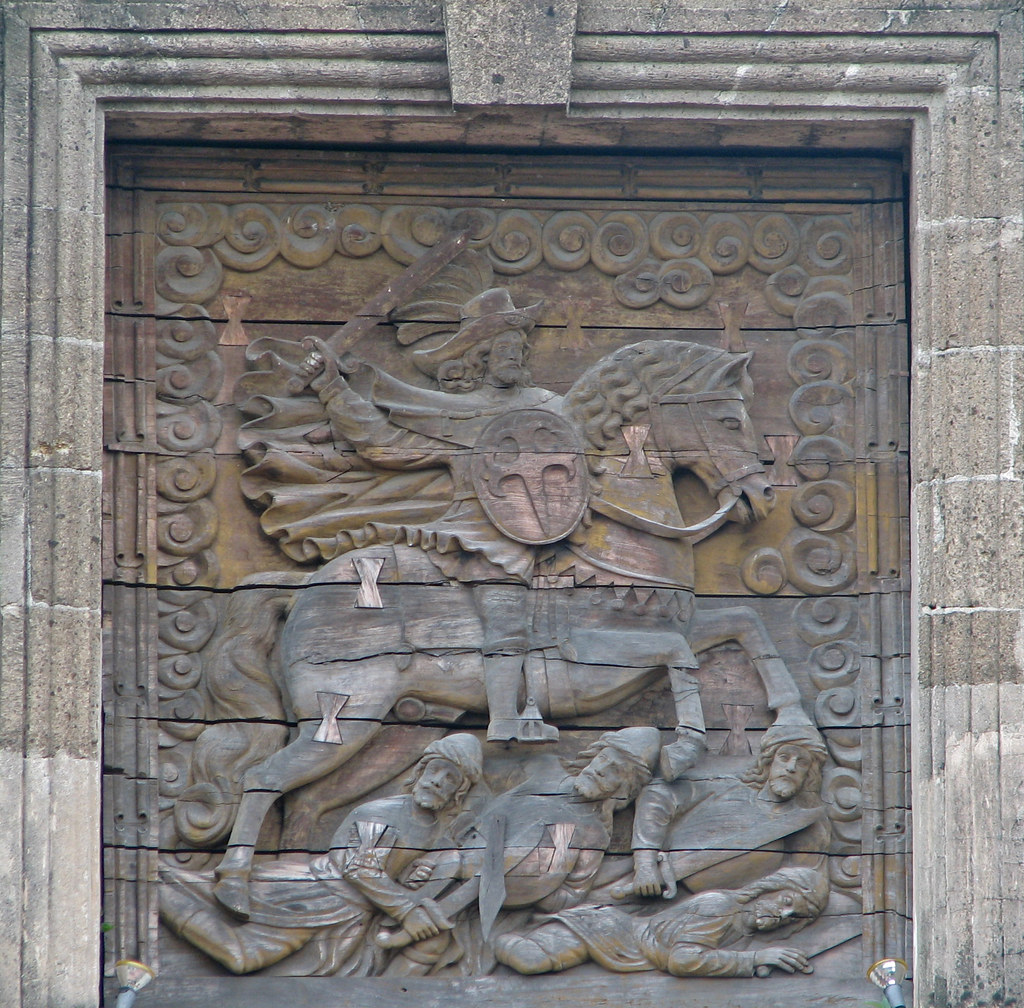
In Spain, the 25th of July is celebrated with great pomposity as the feast of St. James the Great-- or, as he is popularly known there, Santiago Matamoros. The epithet Matamoros literally means 'Moor-slayer', and was appellated to the saint by the Spaniards during the Reconquista. The story goes that, at the eve of the battle of Clavijo, the saint appeared to a soldier in a dream. The next day, on the battle itself, the Christian armies-- being vastly outnumbered-- were greeted by the sight of a knight astride a white horse. It was St. James himself, riding through the enemy hordes and slaying the Moors. To this day, many Spaniards shout 'Santiago y cierra Espana' (St. James and strike for Spain) as a battle cry.
The photo above is from Fort Santiago in the Philippines, taken from Fra Lawrence's ever excellent photostream.
"St James the Moorslayer, one of the most valiant saints and knights the world ever had ... has been given by God to Spain for its patron and protection."
- Cervantes, Don Quixote
I have been very busy these past few days. I've taken an interest in photography again after the longest time, so I enrolled myself at a basic photography class. Although I have to say, it was a bit difficult, because I am a masochist, and stuck to using my old, very old, nigh ancient, Canon EOS 500-- in film, of course. I was a bit disappointed because the pictures, when they were finally developed, seemed to be hazy, not so much as a result of poor skills but because there seems to be a leak in the camera that let light in. Very disappointing. Luckily, a place nearby is selling the new Canon 450D DSLR at a mere Php 42,950, complete with a basic wide-to-normal lens (18 to 55mm). That's less than a thousand US dollars, good enough, I guess.
I've also taken two of my old lenses to the cleaners. One is a Tamron 35mm to 105mm, the other is a Sigma, 28mm to 200mm. The latter is lacking a lenscap so I can only imagine how much that is going to freak out the shop's proprietors.
Also, I find it strange that I seem to be asked all the time whether I had a permit to take photographs in public. Yesterday morning, I was shooting at the uberchic Greenbelt Mall (and I use that term loosely, as it is really more a lifestyle center) when I was approached at least three times by two different guards if I had permission to take photos of the mall's public space. The same thing happened when I went to Manila Bay that afternoon. I wasn't aware the city officials owned the sunset. What's really irritating about the Greenbelt incident is that the patriarch of the family that owns it, Jaime Zobel de Ayala, is himself a photographer! The Zobel de Ayalas are quite possibly the wealthiest family in the Philippines; the immediate branch, based in Manila, is worth at least $2.6 billion; the Spanish based part of the clan (who own Sotogrande, the most exclusive, most expensive address in Spain), at least $1.7 billion. Another branch also based in Manila is worth almost $700 million (I think the Zobel side).
Slight Edit: I just came back from said mall after picking up something for my sister. I had to pass through it to get to the train, so I thought I might as well enjoy the experience... There was a Bang and Olufsen store there, which REALLY excited me, as I have admired their products for a long time-- but the prices are murder. I was looking at a pair of headphones which cost something like Php20,000 (around $400++). Wow, that is expensive. There were cheaper products to be sure, but the prices remain relatively high. If I only had the money... :(
Finally, after six long years of agonizing waiting, Terminal 3 of the Ninoy Aquino International Airport is open. The new airport is one of the more infamous white elephants of the Philippine government; its opening is good news, especially now that tourism here is booming (again). Although the 3 to 4 million visitors we have every year hardly compares to the tens of millions that visit Thailand and Malaysia. Ay, politicians can be so stressful. Would that they were buried in the Film Center instead of all those workers.
On a Starbucks, at 10:04 pm: Jeff Buckley's 'Hallelujah' starts to play. A man in his thirties cups his face in a corner; an elderly American couple sweet talk each other; a housewife, with a worried look on her face calls her son, only to be screamed at; a newly graduated employee, clad in an ill-fitting shirt, romances his girlfriend; a man sits alone in the far corner, his drink before him, untouched. He is carrying the weight of the world.
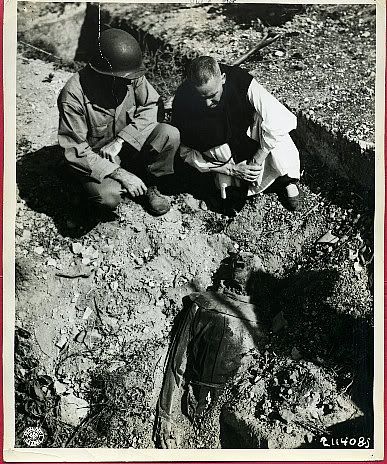
Found this on the Skyscraper City Forums.
The caption reads:
"Brother Jose Marjabacas and Col. Walsh look at the remains of the Father Superior of the Philippines. Trying to escape from a tomb in which a number of priests and sisters were held prisoner, the Japs shot him. 1945"
Link: Wartime Philippines
Growing up, I never really understood when my parents and grandparents would wax nostalgic, and reminisce about the 'good old days' of the Philippines before the Marcos era. Hearing them talk, you would sometimes get the idea that Manila might as well have been an American city back then. Sadly, the distance of time, memory, and shame, have all but rendered this vision a dream. So it is indeed chilling when I see videos like this-- made in 1955, back when my grandparents had the honor of living in the second most powerful economy in Asia, only next to Japan. It's haunting, really, how times have changed.
EDIT: I know it's a commercial for Coca Cola, but I still think it provides a valuable glimpse into the past.
I was at my friend Guada's home the other day along with some people I haven't seen in a long time. They lived in a rather affluent suburb south of Manila, in a large, spacious mansion filled with antique family heirlooms. You see, Guada and her family are what you and I would call 'old money'; in fact, she herself is descended from a long line of Spanish-Filipino mestizos, which, to this day, carries quite the social capital here.
Usually when one talks about mestizos, the overwhelming mental image that appears is that of a life of consummate ease and affluence. So, amidst the gleaming marble floors and priceless works of art, and beneath a giant crystal chandelier imported from Belgium in the late 1800s, our friend told us a story that was, frankly, iconoclastic.
When Guada's family moved into that suburb some 20 years ago, there weren't a lot of people who lived there yet. So they were able to build big, grand, and expensive. The house was truly gigantic, and was surrounded by an immaculate sea of green, and had numerous trees as well, creating the illusion of some secret garden or a pocket paradise. One the first people who moved there, according to her, was a Spanish couple, exceedingly wealthy, and 'tienen cara de Dios', meaning they were also very good-looking. The lady was tall, at least 5'10, and possessed a classic beauty at once timeless and relevant; the husband was also tall, dashing, a veritable conquistador in stature, apparently expensively educated in England and Switzerland, and whose aristocratic ways charmed all who met him.
It was an open secret that the lady kept a closet full of couture, from local designers and venerable European houses alike. It was likewise acknowledged that the dashing groom was an excellent sportsman, and whose collection of classic cars was the envy of many. Living next to such a charmed couple, Guada's family, usually very low-key, took pride in being seen with their new neighbors.
Everything went well until that fateful day...
Guada awoke one morning to find the dashing groom running scared from a seemingly supernatural foe. Her room had a view of the next door couple's spacious lanai, but it was only then that she exploited this fact. A shout, followed by the sound of something heavy crashing to the floor, followed. Out comes the lady, her hair still in her curlers, wearing a very matronly 'duster' (a 'house dress' popular with spinsters, usually very cheap and tackily designed), a cleaver in her hand. In crisp and crackling Tagalog, she shouted at her husband: 'P----g ina ka, ilang babae na ba ang binalahura mo? Tarantado!' (approximately 'You son of a b-tch, how many women have you perverted? Damn you!') which she then followed by a litany of curses in Spanish. The poor husband was quaking! The lady ordered her maids out and told them to pick up rocks with which to hit her philandering husband on sight. But it was the senora herself, wielding one of her husband's expensive golf clubs, who scoured the vast garden... While she wasn't able to bludgeon him, she did make mincemeat out of that golf club!
But that was not all, the Lady, incensed at the countless adulteries if her husband (all of which she seemed to have found out about in the same day), escorted herself to the garage, where, in a fit of rage worthy of Godzilla, she smashed the windows and windshields of many a classic Jaguar, BMW, and even a priceless Aston Martin!
The next day, however, it was as if nothing had happened at all-- the elegant lady appeared once more in public, ever charming, dressed in all her finery and jewelry. The Poor Husband, nowhere to be seen, had been 'grounded' by his wife for the rest of the week! LOL!
I've seen my fair share of strange cults, heck, we even have them in the suburbs of Manila, but the Suprema de la Iglesia del Ciudad Mystica de Dios in Mount Banahaw takes the cake. It's even named after the cult's leader! Mr. Sidney Snoeck has some fascinating photos and essays in his website, My Sari-Sari Store. I love the pics of the 'Mass' and their 'iconography'. Very creepy, if I do say so myself.
Of your charity please offer your prayers for the 229 dead and more than 700 missing in the aftermath of Typhoon Fengshen, locally, Frank. We did not have electricity for most of the day so I was only able to learn of the tragedy two hours ago. The 700 missing as a result of a ferry sinking into the sea is what worries me the most.
‘Frank’ leaves at least 229 dead, 700 missing
This is a very interesting episode in Philippine history.
Filomena Almarines was supposed to have been a saintly woman who lived in the town of Binan, Laguna, in the early twentieth century. A vendor, Filomena was the daughter of a poor tenant farmer. Not much is known of hear early life except that she died in 1938, her father following suit some seven years later. Since most people were poor back then, many had to share the same graves when they died. This is still a very common phenomenon today; I've heard of families so poor who were all interred in the same nicho (niche); probably a bit of a shock to our middle class sensibilities, but ultimately a pragmatic move (it also saves the remaining members from paying the priest extra for his stipend). Anyway, as they were preparing to clear Filomena's niche, lo and behold, she was discovered to be incorrupt!
A local man, wizened and much respected by the townsfolk, discovered that there was water inside the niche. Perhaps he read this is a supernatural omen, but something drove him to wash his eyes with it; soon enough, the blind man began to see once more. In popular religious fashion, Filomena's mortal remains were exhibited in a glass coffin; some cautioned that the 'holy water', if holy indeed it were, could be a breeding ground for many, untold diseases; but still people flocked to Filomena. There were even reports that new quantities of water began to form inside the locked, glass coffin.
Eventually it was decided that the body was to be re-interred in the ground, but the parish priest refused, because the chosen site was formerly a grazing ground for beasts. Thus, the people sought the help of the Aglipayan priests (officially, the Iglesia Filipina Independiente) for the required blessings. Today it is said that the body of Filomena Almarines is still under the custody of the sons of Aglipay; there are rumors too that the body, when it was exhumed in the 1970s, had finally corrupted; but her eyes, it was said, remained clear as ever.
EDIT: I found the link to where I originally found this. Mr. Alex Castro has one of the most unique photos in his Flickr account, many of them of a religious background. I highly recommend going there to check out his stuff-- you won't be disappointed!
We didn't really have access to the best hospitals growing up, so like any normal Filipino family, we sometimes resorted to 'peripherals'. As a child I remember going at least three to four times a year to the residence of Mang Isko, who was reputed to have been gifted with the power of healing in my father's province of Batangas. He lived on top of a hill, alone, with his small hut that could easily have been a quaint ermita to a traveling image of a saint, and his farm animals, which consisted of cows, chickens, goats, and a carabao.
But first, a background. As I have already said, the circumstances in which I grew up in were not exactly middle class. To save on bills, we would pay Mang Isko a visit. He was, you see, an 'albularyo', a traditional medicine man whose knowledge of herbs and other natural remedies were a cheaper alternative to hospitals. Well, at least I think he was an albularyo; he never claimed to be anything near it, but he played along with that honorific. Mang Isko looked like your stereotypical image of an Asian in the 1940s; think Fu Manchu, with more Japanese eyes, buck teeth, and the like. He even had paler skin than most Filipinos. Mang Isko was greatly respected by all those who knew him, not only because he could 'heal', but because, it was said, albularyos were privy to the secrets of the universe; rivals to priests, in their knowledge of incantations and prayers. It was also said that they chanted in Latin, thus giving credence to the notion that they were priests. There was even an old legend that held that the Jesuits, when they first came to the Philippines, compiled all the secrets and incantations of the albularyos into one black, leatherbound book, possession of which was said to give anyone power beyond his reckoning. To this day, there are still many who hold to this claim. Makes for a good Indiana Jones movie, if you ask me.
Anyway, the drive to Mang Isko's quaint house took about half an hour from my father's childhood home. From the highway one took a right turn to a hill fronted by an aging wooden billboard advertising an equally old and creaky hotel. The road wound up the hill, and to either side were small residences built by squatters. Finally the hill leveled somewhat, and the road led to Mang Isko's grotto of a house, which had a rather spacious veranda overlooking the small plot of land he farmed.
As a city kid, I hated going there. Especially at the age of 9 or 10, when I was just beginning to discover the wonders of the Internet; I felt Mang Isko's home was ancient at best and antediluvian, if not prehistoric, at worst. It was a small wood and stone affair, characteristic of homes built at the turn of the 20th century. The main house, which was of wood, stood on a base of stone, its foundation, and was reached by climbing a small stair. Inside, the house looked like a curio shop. It was literally stuffed with religious images, which contrasted, humorously and ironically enough, with the White Castle whisky calendars the old man had collected over the years (even healers have their needs too).
To one side was a wall, where an ancient, dark, wooden crucifix was affixed. It looked very expensive, with rayos of gold, and bolts of gold on the arms (there's a Spanish term for that which I have forgotten). The corpus had a wig of abaca, with finely worked potencias. The crucifix itself was framed by a gigantic wooden rosary; images of the Blessed Virgin, Saint Peter, and even a 'painting' of St. Michael ripped off a bottle of gin flanked the big cross (A popular brand of gin here is called Ginebra San Miguel). There was a small table which held a large number of candles before the images. There was a small, darkly lit room, with a single wooden bed with no mattress, where he performed his 'hilot' or traditional Philippine massage, his main method of 'healing'.
Mang Isko himself was a pleasant old man, whose hospitality was legendary. The last time we were there, 1998, my dad complained of a bad back, and my grandfather came along as well, as his arthritis was bothering him. So in we go, inside the small, quaint house, drinking small bottles of Coke which I then called the last point of civilization in the genteel, all too quiet surroundings of the farm. The only sound one could hear was the mooing of the cows and the clucking of the chickens. It added a decidedly mystical air to the whole environment, I thought.
Only once did I even dare to look at the procedure, and I was greatly disappointed. I ran into the room, feigning ignorance to mask my prideful curiosity, and discovered the old man rubbing a golden liquid onto my father's back. To my mind then, it looked like piss. I watched Mang Isko rub the liquid with his small, deft hands, which, even in the darkness, seemed to wander as if guided by truth itself into the invisible nooks and shadowy crevices of my dad's back. My grandfather awaited his turn, meanwhile, on a nearby chair, his pant leg rolled up to just above his knees. For an old man, Mang Isko moved with a graceful dexterity that seemed almost superhuman. I remember thinking that he must have loved exercise when he was a kid. That was the most sensible explanation for me.
Bored, I filed out of the house. I ran across the field with my brother, cursing the dumb beasts, throwing little stones at them or else flinging mud everywhere. Finally, after half an hour of doing so, I went back to the veranda, and sat myself on a small wooden chair. Finally, incensed at the constant mooing of the cows, I hurled a large rock at one of them, and screamed at the top of my lungs: 'Shut up you stupid cow!' But there was something about the silence that followed that simply wasn't right. I looked over to my side and saw Mang Isko's little figure, mouth agape, brows crunched, clearly puzzled, if not offended. 'Do you really think I am stupid?', he said. 'I just told your father what any sensible person would do. He needs a new mattress.'
It seemed that, just as I screamed at the cow, Mang Isko was simultaneously telling me that he knew the answer to my father's problems. It was incredibly hideous timing. Hearing the commotion, my dad headed outside, clearly angered at the commotion I caused. 'You ungrateful, disrespectful child! How dare you talk to your elders that way! Puneta!' My grandfather, ever the silent type, just shook his head in disapproval, but his eyes told me that he was greatly disappointed in my behavior.
I never got to apologize to Mang Isko. It was nearing dark, and he had gone to fetch a couple of things from the nearest house some 2 kilometers away; we thanked his housekeeper-slash-fac-totum, and told her to convey our sincerest apologies to Mang Isko. That was in the summer of 1998, and ten years hence, I have yet to apologize for that faux pas. I had never felt so humiliated before; I could not bear to look at his housekeeper, let alone Mang Isko.
The drive down the hill was eerily silent; only the croaking crickets accompanied us on the way down. Even the cows had seized mooing, and the chickens had clucked their last. Above, the full moon shone brightly-- and somewhere to the right, to the side of the road, I saw a small fire. The moonlight revealed Mang Isko's small figure-- hands outstretched in the orans, knees kneeling on dirt, a rosary hanging from either hand. The old albularyo knelt before a small, dilapidated grotto with an image of the Santo Cristo, and somewhere, in the distance, I heard a small voice, chanting words that could only have been Latin.
I found this little gem of an entry in Wikipedia. It is definitely one of the most unusual cults I have ever encountered.
"Saint Guinefort was a 13th century dog that received local veneration as a saint after miracles were reported at his grave.
His story is a variation on the well-travelled 'faithful hound' motif, perhaps better-known in Britain in the form of the dog Gelert. Guinefort the greyhound belonged to a knight who lived in a castle near Lyon. One day, the knight went hunting, leaving his infant son in the care of Guinefort. When he returned, he found the nursery in chaos - the cot was overturned, the child was nowhere to be seen and Guinefort greeted his master with bloody jaws. Believing Guinefort to have devoured his son, the knight slew the dog. He then heard a child crying; he turned over the cot and found his son lying there, safe and sound, along with the body of a viper. Guinefort had killed the snake and saved the child. On realising the mistake the family dropped the dog down a well, covered it with stones and planted trees around it, setting up a shrine for Guinefort. Guinefort became recognised by locals as a saint for the protection of infants. It was alleged by Catholic commentators, dismayed by the worship of a dog, that the locals sacrificed babies at the site.
The cult of this dog saint persisted for several centuries, until the 1930s, despite the repeated prohibitions of the Catholic Church."
So sorry for the lack of updates recently, I have been busy with several things. Also, I will be going to Hong Kong tomorrow and will be staying there for five days. The last time I was in Hong kong, in 1996, I cried in public, inside a bus, no less, so for the last decade or so I have always associated that place with crying. It should be a fun trip, although the school season has already started here in Manila (arrgh, no beach this year!). Also, keep an eye out for a somewhat historical (i.e., it is about history, not necessarily 'revolutionary' or anything)post in the coming days; the last post has made me think a lot about the character of Manila as a whole, and it is something, I think, which is worth exploring.

A picture of the Augustinian convent chapel at San Agustin church in Old Manila. Though the church itself still exists (the sole surviving great church in the destruction of Manila in WWII), the convent, where this chapel was located, did not. It is completely polychromed in gold, or so I have read.
The 80s. I'm glad I was born at the end of that ridiculous decade, hahahaha. 'Look around like a hound till you catch that fox!' LOL
Because I'm in love. Because we've been doing it for 500 years. Because she deserves it. Because she is the Mother of God. Because it is May. Because she is our Mother.
A curious footnote in Philippine history is the assassination of the governor general Fernando Manuel de Bustillo Bustamante y Rueda in 1719. The general, who came to Manila from Mexico on 9 August 1717, quickly proved to be an unpopular figure, which would later lead to his assassination, unique in the entirety of Philippine history for being instigated by priests and religious. On 17 October 1719, it was reported that all of Manila was at a standstill; church bells sang funeral dirges, and the citizenry lit candles, multitudes of them, as if it were Dia de Todos los Santos. Word reached the ears of the Governor that the religious were conspiring with many of the citizens to assassinate him. In response to this, he had the Archbishop of Manila, H.E. Antonio Cuesta, arrested and thrown in jail. This would prove to be his fatal mistake.
Two days later, just before the crack of dawn, the sons of St. Dominic, St, Francis, St. Ignatius, and St. Augustine poured out in droves into the streets of Manila, and processed to the Palacio del Gobernador..
"The Franciscans, Dominicans and Augustinians came out from their convents, each as a body, carrying in their hands crucifixes and shouting, ‘Long Live the Church! Long Live King Felipe V!’… they were joined by people of all classes and proceeded to the Church of San Agustin…
The governor who was roused from his sleep and informed of the arrival of the mob sprang up and ordered the guards to keep back the crowd… He dispatched an order to the fort to discharge artillery at the crowd; but he was so little obeyed that, although they applied a match to two cannons, these where aimed so low that the balls were buried in the middle of the esplanade of the fort.
Without opposition, this multitude arrived at the doors of the palace… As for the soldiers of the guard, some retreated in fear, and others in terror laid down their arms. The mob climbed up by ladders and entered the first hall, the halberdiers not firing the swivel-guns that had been provided, although the governor had commanded them to do so…
{Bustamante} attempted to discharge his gun at a citizen standing near and it missed fore; then the governor drew his saber and wounded the citizen; the latter, and with him all the rest at once attacked the governor. They broke him right arm, and a blow on his head from a saber caused him to fall like one dead."
In the aftermath of the assassination, it was said that the Te Deum was sung in the streets of Manila, and that the governor's body was yet made subject to a heap of other indignities too numerous to mention. Finally, his and his dead son's body, with their remaining relatives, were banished to the galleons to return to Mexico. It remains a controversial, albeit rarely discussed, footnote in Philippine history, with a number of historians defending the efficiency of Bustamante's reign. Prior to his arrival, Manila was governed by corrupt officials (hmm, this sounds familiar), and her treasury was in shambles. To be fair to the governor, he was able to raise Manila's coffers significantly, but his ruthlessness, it was said, also knew no bounds.
You may read some more of this incident in these following websites.
"A fatal religious procession"
Assassination of General Bustamante
Philippine History.net

Please pray for the repose of the soul of Jimmy Mizen, 16, murdered for refusing to pick a fight. As a teenager, I am deeply affected, not only because it was a life cut too short, but because from what I have read, Mr. Mizen was an exemplary character who brought love and joy to everyone who knew him. A devout Catholic and an altar server, Jimmy was killed, apparently by a fellow teenager, who smashed a dinner plate to his neck, and thus, bleeding to death. It is indeed sad that a gentle soul like him would have to die such a tragic death. Pray for justice, pray for his family. I've little doubt that he is with God now.

Can you believe this Church was just recently renovated? And yes-- those are the renovations! I was able to visit this church in April of last year; prior to this occasion I had last been in this church in April of 2005. Back then the murals still had not been painted and the retablo was still being finished. I'm particularly smitten with the chandeliers, I've seen them in person, and thought they were just absolutely fantastic. Nasugbu is a small town located in the province of Batangas, just two hours' drive south of Manila. It is famed for its beaches and multiple azucareras; many prominent residents of this town are of the old Spanish mestizo extraction. I have a couple of relatives in this town, and visiting them-- and no doubt, their church-- is always a pleasure.
The official website of St. Francis Xavier parish is here. Also, do check out their Flickr account; it has many beautiful pictures of the spectacular high altar, and more.

Sinigang na Baboy is arguably my favorite meal in the whole world. For those who don't know, sinigang na baboy means 'sour soup with pork', roughly the equivalent of the Thai tom yum, only less spicy. In fact, many Filipinos compete to make the sourest sinigang possible. In my opinion, it's best eaten on a cold, rainy day, as the hot soup is always refreshing in any circumstances. Here are the ingredients and steps to make sinigang.
First, you need the broth, and to make that, you need some tamarind first. Locally, it is called sampaloc, and half a kilogram usually suffices for making the broth. Clean the sampaloc, and place it in a pot with roughly 7 or 8 cups water. Heat for 20 to 30 minutes, depending on your tastes. I think the rule of thumb is the longer the sourer, though I think there's also a danger of draining away all the sourness. The best way to see if the broth is ready is when the tamarind pods are "mashable" or at least very soft. After boiling, discard the solid tamarinds, and strain. Don't worry if the broth looks cloudy, it's supposed to be that way, in fact, most people I know think that it's meant to be that way.
Ideally, while this is being done, you should have your pork ready by then. Typically, we use pork ribs for sinigang, although pork chops are also an acceptable substitute. Some cooks sear the pork first to add some zest to it, but typically, this is not required. Make sure to add a lot of bony parts, as these help to add flavor to the broth. Most Filipinos also opt to keep the fat in the pork, citing its velvety smooth texture as the pinnacle of all delights. Add a large quantity of water to the pork, together with some chopped tomatoes and spring onions (green onions if none of the former). Since sinigang is a typical Filipino dish which means the more ostentatious the better, many also add leeks, eggplant, sitaw (long beans), long green chili, and patis (fermented fish sauce); some also add black pepper to make it spicier. The quantity depends on the cook's liking, but usually these are in quantities that do not outnumber/outpower the pork. Let this simmer for at least 40 minutes.
After this is done, add the tamarind broth to the pork. Sprinkle generously with salt and pepper, and then add kangkong leaves (water spinach). These are a favorite of mine, and I like them in large doses in my sinigang. You can also add the water spinach earlier, with the rest of the pork, but this might turn them a rather unappetizing shade or brown. Thus, it's preferable to add them later so that they retain a somewhat vibrant green hue. I also like to add more onions at this point, just because they're awesome, LOL.
Finally, when all is done, sinigang na baboy is served! It is always eaten in the Philippines with magnificently hefty servings of steamed white rice. I like to put some of the broth in a cup and then just pour everything on top of the rice. The pork is tender and exudes a very sour, yet absolutely very tasty, uh, taste. You may also keep some more patis at hand, to make it even sourer; kalamansi (calamondin) is also another fine option. Kainan na!
*Note: The word sinigang is actually a method of cooking. Fish, prawns, and chicken siningang are all respectable dishes on their own. Typically, 'sinigang na manok' or chicken sinigang is not called thus, but given the moniker 'sinampalukang manok'; that is, literally, 'sampaloc-ed chicken'.
Dear Readers,
It has been a long time since I properly updated this blog. Over the course of the past few weeks, I have posted less and less frequently, occasionally popping in for prayer requests and some rants. Partly, this hiatus is my own fault; as I've mentioned, I've been battling severe depression lately, and it has really taken a toll on me. Just looking at the mirror confirms that I am now rather gaunt, if not a bit downcast. The good news is that I am not bi-polar, although I have been told that I am prone to depression. Apparently, I have many family members who are of similar situations, so I guess I am not alone in battling this. Thank you all so much for your kind thoughts and your prayers.
Also, I have added an option for Donations to this blog. The main reason I am doing this is because I've finally decided to be 'independent' to some degree, that is, I'm now going to pay more a third of my college tuition. Lately, I've felt like I've been in all your endeavocausing my parents undue stress with education, and I wanted to help them by alleviating some of the burden from their shoulders. I don't think I can go steady with a part time job yet, though, as I still have some personal issues to resolve. That said, your donations would be of tremendous help! Please understand, though, that I am NOT demanding anything from you; I will still continue blogging, donations or not.
Finally, I ask that you all be patient with me! Although this blog is not exactly a 'mega-blog', I am nevertheless DELIGHTED with all of the thoughtful and humorous comments you have left in my posts. They have seriously given me much to ponder, and I have to admit that they are often the inspiration for some of my posts. Once I again, I thank you all for reading my blog. May the Good Lord continue to bless you all in everything that you do!
Of your charity, please pray for the souls of the 22,000 dead and 41,000 missing as a result of the recent, devastating cyclone Nargis in Myanmar (aka Burma). There are bigger, more real news out there than the Indiana primaries or the latest celebrity scandals, and this is one such item that is sadly, outrageously, lacking attention.
De profundis clamavi ad te, Domine:
Domine, exaudi vocem meam.
Fiant aures tuae intendentes:
in vocem deprecationis meae.
Si iniquitates observaveris, Domine: qui sustinebit?
Quia apud te propitiatio est:
et propter legem tuam sustinuite, Domine.
Sustinuit anima mea in verbo ejus,
speravit anima mea in Domino,
a custodia matutina usque ad noctem.
Speret Israel in Domino.
Quia apud Dominum misericordia
et copiosa apud eum redemptio.
Et ipse redimet Israel ex omnibus iniquitatibus ejus.
God have mercy on us all.
I will post something more substantive about this tomorrow. Right now, though, I have an unbelievable headache and I seem to have caught the flu, too.
Young mother's fury as video of her gang-rape ordeal is posted on YouTube
Please excuse the somewhat pessimistic tone of this post.
I know this story is not exactly new, and I'm fairly certain it has been posted in other blogs before-- but the sheer disgust I feel for the perpetrators of this execrable act is simply too much. Has the West sunk so low that acts as barbarous as this are becoming more commonplace? What has happened, and what is happening to society? Sometimes, I feel utterly hopeless for the future of humanity, and this, I think, vindicates my feelings.
Frankly, whoever said that Europeans are more civilized than Americans has been fed a ton of bullshit. I'm sorry for being so pessimistic, but how can one possibly defend something of this nature? Granted, things like this are not exclusive to Europeans or Americans; I have known my fair share of truly outrageous a-holes in my life. One guy I went to school with blew up the school bathroom for fun, another tried to set the building on fire, and almost succeeded in burning it down. But at the end of the day, rape remains a personal transgression in the purest way. This video was done out of sheer malice against a person, in front of her own children, even. That is just WRONG. That is just INFURIATING. And it is utterly DAMNABLE.
Perhaps it is because Filipino culture places grave importance on the person of the Mother that I am so incensed. Where I come from, the strongest insults are always those that concern one's Mother-- but even if we say such things, violence against mothers is the ultimate sin once can commit. Murderers come and go, but patricides and matricides (and all those who commit violence against parents, whether one's own or those of others), I am convinced, have a special place reserved for them deep in the boiling recesses of the Devil's s--thole. I'm sorry for the strong language-- it is not customary for me to have such a salty tongue-- but I just feel so very strongly about this.
Let me end with a rather ominous comment from an Italian priest who visited a chapel I frequent; in America, sin loses its sinfulness because decadence is firmly grafted into society. But in Europe, sin loses its sinfulness because it becomes a philosophy. I did not understand what he meant until now. God be merciful to us all.
Dear Readers,
I'm afraid I haven't been entirely honest with you. Truth be told, the real (or at least, the most pertinent) reason I have taken a break from blogging is because I have felt nothing but complete and utter hatred for myself lately. To cut a long story short, I have very severe self-esteem problems, which have only worsened as of late. It does not help that I have rare, but extremely potent tendencies to slip into deep depression. I guess you could call me somewhat bi-polar, though that is not an official diagnosis (yet?). I can't help but blame God for all of my problems lately; and I can't help but feel like shit, too. Please pray for me and all my intentions, that I be able to overcome this period of darkness. Perhaps it would be best if I learn to accept myself for what I am or what I am not; I will probably never be the ideal me I've always pictured in my mind, and this is something I have to accept, however much it burdens me. Again, please pray for me; I really, really need it right now.

"So many adventures couldnt happen today,
So many songs we forgot to play
So many dreams are swinging out of the blue,
We let them come true."
It's been ages since I was last tagged, so I'm answering his one with great gusto! Thanks to Andrew for providing me with something to work with and killing my boredom.
The Rules:
a)The rules of the game are posted at the beginning
b)The blogger who gets tagged must answer the following questions about himself
c)After this has been accomplished, the blogger tags five more to answer the meme, and leaves a comment at their blog to answer it
1) What I was doing ten years ago:
8 April 1998 - Enjoying a trip to the beach in sunny Puerto Galera. I remember my little inflatable rubber boat got caught in a very powerful gust of wind, and I had to chase it for around 300 feet before I finally caught it. Then it got blown away again.
2) Five Things in My To-Do List
2.a) Get my grades from school (I got two B+'s! No A's, though :( )
2.b) Fetch my cousins
2.c) Clean my room, it's just an incredible mess
2.d) Read a book
2.e) Pray, and pray hard
3) Things I Would Do if I Were a Billionaire
3.a) Build the biggest church in the world, which I will personally furnish hahaha
3.b) Donate a significant sum to the Vatican
3.c) Build a resthouse near the Tubbataha Reef in Palawan
3.d) Build schools for the needy
3.e) Buy exceedingly rare books
4) Three of My Bad Habits
4.a) Pride (I can be a very arrogant person)
4.b) Lust/Impurity (Sadly, I can be very susceptible to the wiles of the flesh)
4.c) Backbiting (There was a time when all I could say about a person was gossip)
5) Five Places I Have Visited
5.a) The Grand Canyon, Arizona, USA (It was quite hot! I've never had bigger sweat stains in my life, LOL; but the view was incredible ['02])
5.b) Manhattan, New York, USA (We went to the Empire State building, FAO Schwarz, the Museum of Natural History, Liberty Island, and passed by the WTC [this was back in '00])
5.c) Panglao Island, Bohol, Philippines (some VERY beautiful beaches, great people, and I got to see Baclayon church, second oldest in the country ['07])
5.d) Victoria Peak, Hong Kong (I was with my siblings; we then proceeded to Ocean Park afterwards ['96])
5.e) Singapore (I've been to Singapore a lot of times, so much so that I've visited all the major sights there; also shopped at Orchard Road. I bought a pair of shoes ['05]).
I've been to a lot more places, but in the interest of time, I just listed the above off the top of my head.
6) Five Jobs I've Had
Hmm... This is difficult, since getting jobs while in HS here in the RP is an alien practice. But thankfully, I've had my fair share of experience.
6.a)Facilitator for a summer camp (entirely pro bono; '06)
6.b Assitant for my mom's business (an on-off thing; '04 to '05)
6.c)Part-time tutor (for some of the younger kids in school, but I saw this as voluntary work; '05)
7) Five Snacks I Enjoy
Though this category was not in Andrew's list, I've seen some versions of this meme that included this, so I might as well add it. Besides, snacks are awesome! Yum! (Be forewarned, though, that the things I'm about to list are unhealthy as fudge).
7.a) Chicharon (Fried, crispy pork rind, best enjoyed by dipping into spicy vinegar)
7.b) Toblerone (I really like it)
7.c) Smores ( A guilty pleasure)
7.d) Chocolate mousse cake (A favorite of mine since time immemorial!)
7.e) Mentos Spearmint (LOL)
I also want to try a snack called 'Filipinos', which are, apparently, a kind of biscuit in Spain. I hear they're terribly tasty. LOL.
8) Five Places I've Lived
I've lived in Quezon City, Manila, all my life. We have had three different houses, though, but always in the same city.
That's it. It took some time, but in the end, it was quite enjoyable, really. I tag the following people, should they choose to accept:
Arturo Vasquez of 'Reditus'
Jeffrey Smith of 'The Roving Medievalist'
Eegahinc of 'The B-Movie Catechism'
Ken of 'Hallowedground'
Mark Scott Abeln of 'Rome of the West'

Sunset at Manila Bay
Now that I have more time on my hands, I hope to be able to blog on things closer to home; there are so many things in Manila that deserve their own posts, including the city's many churches, its quirks, and of course, the horrible traffic jams. And yes, even that can have some spiritual meaning. I've also been meaning to post more about Intramuros, the 'Old Manila', and its famous churches: San Ignacio, San Agustin, Santo Domingo, and many more. Sadly, only the Augustinian (which is to say, the second, LOL) church survives to this very day-- the rest were destroyed in WWII, along with priceless other structures (did you know that Manila was the second most devastated city in WWII?). These should be interesting, to say the least.
It's summer already in my part of the world, and I'm enjoying every minute of it!
I'm sorry I haven't been around lately-- the last few weeks of school, followed almost immediately by the freedom that summer brings, can prove to be a very potent potion. I've visited museums, spent hours in bookstores, and numbed by butt to movie marathons of Godzilla and Hammer horror-- a very enjoyable thing, I assure you. Of course, all this couch potato slouching will take a toll on my body, hence I'm also doubling my time at the tennis court (it's great that I have my cousin over to indulge me, plus her cute friends are also a boon, LOL).
Posts soon; for now, I have to get back to watching 'Conan the Barbarian'.

'Why is this night different from every other night?'
Maundy Thursday has always been a day of great drama for me. From the time that I could walk, my parents would always take me 'church hopping' on this most holy of nights in the traditional 'visita iglesia' so dear to the Filipino people, the Tagalogs especially. I remember visiting provincial churches--grand, dusty, and tainted with the weight of history--and being awed by the whole experience. The sight of many veiled women, wailing and chanting prayers on their knees, and the heat of literally thousands of bodies packed into a small nave will forever haunt me for the rest of my life.
Oddly enough, Maundy Thursday is also a day of great setbacks and mistakes. There is always something happening during the day that makes it so mundane. Come evening, however, it is a different matter entirely, and this year was no different. One of the most spine-tingling sights for city dwellers in Manila is surely the sight of hundreds of tall buildings, utterly unlit, standing like silent sentinels in a sea of shadows. Every year, this scene is rehearsed again and again, but the potency is as strong as ever.
This year, we visited seven churches as usual-- a far cry from the fourteen churches that my father used to visit when he was my age, and barefoot, too. But just what is it about Maundy Thursday evening that is so different? This year, we followed almost exactly the same route as we did for Maundy Thursday last year. I will focus on the churches of Intramuros. When we reached the walled city--Old Manila, Spanish Manila-- it was probably the visual equivalent of being hit by a tidal wave. I had to suppress a sarcastic chuckle at the sight of so many cars trying to enter through the ancient stone walls, while guards dressed in guardia civil attire herded SUVs and sedans to safe, suitable parking spaces. But more than the cars was the sheer number of people, many of them poor, and almost all of them fulfilling a panata, trudging through the small (relatively speaking) portals of Old Manila. Again, there was a suppressed chuckle, as the a sizable portion of the milling crowd, especially the boys, seemed to be dressed like cholos, faux bling bling and oversized anime shirts and wifebeaters being an 'unofficial' dress code.
Many of them bore crucifixes, the kind that looked mass-produced but had its own unique quality, and almost all of them sporting a bloodied corpus of the Crucified. Many still were barefoot, mud and filth caking the soles of their feet. They numbered in the thousands, squeezing through the churches in undulating waves. The scene at the Manila Cathedral, for example, was too much for words to describe-- hundreds must have crammed through the small chapel where the Blessed Sacrament was reposed. Outside, in the body of the cathedral, bands of penitents knelt on the cold stone floor, praying the Via Crucis. The pews were filled to the brim with men and women, young and old, rich and poor alike. It was like a scene from the bible-- like the crowd before Moses as he parted the Red Sea, like the people of Jerusalem gathered at Golgotha to witness the death of the God-man.
Still in Intramuros, we proceeded next to San Agustin church, oldest of all the houses of God in the Philippines, the sole survivor of the great churches of Intramuros, the crowning glory of Old Manila. It was a five minute walk to this church from the Cathedral, but it lasted more than that, due to the sheer number of people trudging through the streets. I saw Spanish, Chinese, and Malay Filipino walking side by side that night. It was a sight to behold, and one to chill the blood of even the most hardened atheists. Entering San Agustin was an experience unto itself; the patio of the church was literally jam-packed with devotees, praying on their knees, and waiting for their loved ones to come. Inside, the church was lit very somberly; but the Baroque splendor of this ancient church still shone, and stood out amidst the shadowy darkness. I saw many a child looking with eyes-wide open at the sorrowful images of saints in their gilded niches. It was like being transported back in time, like 'seeing a glimpse of heaven from purgatory', as a lady next to me described it.
It was in Chinatown, though, that I grasped just what this day meant for me, and for many more out there. As we entered Binondo church, where the first Filipino canonized saint Lorenzo Ruiz once served as sacristan, I was struck immediately by the sight of a group of penitents, fifty at least, walking to the main altar of the church. They were poor people-- barefoot, dirty, and obviously tired. Ahead of them were four boys-- three bearing wooden crucifixes, and another holding a processional garden torch. Behind them knelt the rest of the group, holding rosaries and prayer books in their hands, many with eyes caught in a mystic rapture, and many more caught in a wave of emotion as to make them tear up. For five minutes at least, they recited their prayers, to the amazement and astonishment of the other pilgrims, including yours truly. Afterwards, when they had finished their prayers, they were gone as quickly as they had entered the church. It was truly one of the most amazing things I had ever seen.
The only other church we visited which we had not visited before was San Sebastian church in Quiapo, Manila. It is notable as the sole all-steel Gothic(!!!) church in all of Asia, and is one of the most intriguing churches in all of Manila (until 1975, it remained closed to the public for all but a few days in the year). San Sebastian loomed before us, its tall spires framing the bright moon above; even from a distance, and while seated inside the car, one could see the sea of people making their way inside the church. Inside, San Sebastian was packed to the brim; it took us practically five minutes to cross from the vestibule to the nave, so many were making their devotions, and so many were venerating the image of the Nazarene and the Senor de Paciencia at the nave. The confessionals were all robed in purple, and had large crowds swelling at every point. Again there were the penitents, still barefoot, making their pilgrimage to this house of God, while the number of devotees venerating the two images stationed near the entrance of the church still grew with every passing minute. We left the church, exhausted, hassled, and most importantly, awed to our wildest wits. 
Outside the church, it was a catastrophe. The already cramped streets were littered with refuse and garbage from the day (on mornings, this part of Quiapo becomes a wet market), a sight which contrasted sharply with the magnificence and splendor of the churches we visited. Yet in that hour, something within me understood something. Suddenly, everything made sense-- the garbage on the streets, the barefoot penitents, the bands of pilgrims, and the stripped altars. Suddenly, one could see: this night was, indeed, different from all other nights. The drama of the Passion had begun; the die has been cast, and the scenes which had been so familiar to us from the beginning repeat themselves, and we are transported back to the days of old, and I, at least, understood my place in the scheme of things; and that place is in the pews, grieving with the rest of humanity, and keeping vigil with Our Lord in the last hours before His execution. It would be better to say that I was bludgeoned with this truth than actually understanding it.
At 11pm, I finally got home, and with only a couple of minutes more, I once again hear, in my mind, these words: Why is this night different from every other night? And still, I cannot provide an answer, save a couple of ramblings and stories that try to approximate this single, supremely sublime piece wisdom: I kept watch with God at this night. That is why it is so different.

From Santo Domingo church, the Dominican mother church here in Manila. I had a very interesting Maundy Thursday, but right now, I am occupied by a lot of very time-consuming things. I'll post about it soon, probably on Easter Sunday.

(I censored the un-Christian word above, to use a line from Ned Flanders).
The Iglesia ni Cristo are a local pseudo-Christian group that denies the divinity of Christ, the Holy Trinity, and pretty much standard Christian doctrine. They claim they are the one, true, church, and that their founder, the late Felix Ysagun Manalo, was the last true prophet of God ('sugo ng Diyos'), sent to re-establish the true church on earth after virtually disappearing in the supposed 'Great Apostasy' that occurred in the early years of Christianity. They have been accused of extremely fraudulent exegesis by many scholars and even brainwashing tactics (one of the features of their services is that you are given an 'attendance card' which you have to get signed on on Sundays and their other holy days; failure to do this warrants a visit to your home by their leaders). They are one of the fastest growing religious cults here in the Philippines, incidentally.

One of the strangest superstitions I've read about happens every Good Friday in the island of Negros Occidental, here in the Philippines. It is said that Good Friday is the most auspicious day of the entire year to obtain power, blessings, and even strange abilities; it is a day when God Himself is seemingly 'dead', and the elements are at the behest of man to manipulate them to what he wills. To obtain a bountiful harvest, it is said that, on the precise moment when Our Lord is said to have died-- that is, 3pm, one must take a frog, and crucify it on a wooden board. The frog must imitate the position of Christ, with hands outstretched. This being done, a rain cloud will immediately form overhead, provided the ritual is done accordingly.
Another superstition native to the Philippines states that Good Friday is the day when new anting-antings-- amulets generally resembling sacramentals but which have strange, even occult symbols inscribed upon them-- are 'born'. To obtain one for yourself, stand under a banana tree, and again, wait for the magic hour; the 'heart' will eventually drop a fully-formed anting-anting, which is said to have numerous powers and effect many graces. Of course, grace, or grasya, as understood in the Philippine context usually meant a favor from the Divine.
Then there is also Mount Banahaw. Since the early part of the twentieth century, this so-called 'holy mountain' has been a pilgrimage site for legions and legions of believers, Catholic or otherwise. The story goes that an angel, or the Holy Ghost, appeared to a local hermit, and told him that the mountain just yonder will be the site of the New Jerusalem. Today, Mount Banahaw is home to numerous cults, too many and too fascinating for me to describe in one post. Some of these cults believe the Philippine national hero, Jose Rizal, to be God himself; others worship an Old Mother type of figue, dressed in immaculate white robes and a ridiculously large triangle behind her head. She is, believe it or not, supposed to "God the Mother" or one of the multiple titles of the Blessed Virgin; she also says the "mass", either in archaic Tagalog or pig latin, ad orientem.
Many pilgrims choose to climb Mount Banahaw on foot. The pilgrims visit places like the Balbas ng Ama (Beard of the Father) and the Buhok ng Ina (Hair of the Mother), sacred springs and fountains and curtains of lichen that curiously resemble growths of hair, hence their names.
Good Friday in the Philippines is, most curiously, not a very Christ-centered event in the usual sense. Aside from the procession of the Santo Entierro, the image of the dead Christ, which happens to be a major event in some provinces akin to how the Quiapo processions are in the city, Good Friday seems to be 'devoid' of Him altogether. This is the day when demons run loose on the face of the earth, since there is no Christ to cast them back to Hell, and conversely, a day of great power as well. Indeed, it would seem as if the whole order of things were inverted on this day: God is dead, hell is triumphant, heaven weeps. Even today, there are still many families who forbid laughing, dancing, jumping, and even bathing altogether on Good Friday, as these may disturb the sleep of Christ.
What are we to make of this? Should we be worried? I guess it all depends on the viewpoint with which we see these things. For the Catholic convert, such a display of enthusiastic despair will definitely leave a scandalous impression. But for many who grew up immersed in the strange, enchanted world of Catholicism, such events will appear quite 'commonplace'. The more I think about it, the more I am convinced that our modern preoccupation with liturgical purity is not very traditional at all. I say this, not to spite those who love our liturgy, but because for the better part of the last two thousand years, the liturgy was considered the domain of the clergy. The lay people thus had to contend themselves with something equally as magical, yet distinct from the official functions of the Church. Thus we have processions, and extra-liturgical acts such as the chanting of the Pasyon, brotherhoods of flagellants, men who have themselves crucified, and so on.
We have to remember that religion is primarily cultic, and only secondarily dogmatic. Worship, sacrifice, and ceremonies are, it can be argued, constitute a bigger part in our working definition of religion than creeds, beliefs, and polemics. In fact, one need not look too far to observe this phenomenon: visit any Mexican or Italian churches and note how the people behave. They stoop and cross before statues, kiss plaster feet, offer garlands of flowers, pin dollar bills onto a saint's breast, carry its bones on their shoulders, and kiss bloodstains, torn pieces of cloth, shards of scalp and bone and other such paraphernalia inside golden reliquaries. Suppose the iconoclasts had their way, and veneration eventually became consigned to the dust bin: would we then view these devotions as superstitions too?
Granted, the things I have mentioned above go beyond the mere realm of superstition, even crossing over into the realm of black magic. There is a reason why witches and ghouls and goblins are said to wander the world every Good Friday (as if Christ died every Passion Day; but that is something I'll tackle somewhere else). With the Great Hero down for the count, who is to stop the forces of darkness from doing their work? It is very striking that one of the most powerful ('literally' and symbolically) figures of Christ is the image of Him entombed in the sepulchre; it is the object of devotions of the populace during the Triduum, where thousands line up just to kiss its feet. Again, everything is reversed: the fallen become conquerors and the seemingly victorious are cast back into Hell, without them even knowing it. The folly of hell is revealed, and the Divine Wisdom reveals Itself, triumphant, a conquering hero Who has vanquished the night.
My point, basically, is that the things we believe are not just things to be read, as if the life of Christ were a purely textual event: it is not. Surprisingly, the naivete of the uneducated and the uncatechised show a fundamental rupture that we would otherwise not have seen: that the God-Man was, first and foremost, a God-Man. This is and was not a petty semantic formula, but a truth infinitely more profound than creation itself. It is, in a word, magical. I imagine this almost pagan notion does not sit very well with us today because we are too focused on OUR part of religion: the what and what not to do, the how to do, and so forth, that we forget God's part of the whole deal. Ultimately, crucifying frogs and anting-antings are just magnified superstitions; but whatever we make of it, let us ask ourselves if what we are following is actually a religion, or just a mystical book of etiquette.
Perhaps we're wondering, what's the difference? I think it is rather simple: a religion actually saves the sinner. An etiquette book merely gives one respectability. There is a world of a difference between the two.
 | My Peculiar Aristocratic Title is: Bishop Lord Miguel Carlo the Strange of Peevish St Victor Get your Peculiar Aristocratic Title |