Wednesday, April 24, 2013

Manuel L. Quezon Abjures Masonry

Manuel Luis Quezon y Molina was President of the Philippine Commonwealth from 1935 to 1944, and before that, the first Filipino elected to the office of Senate President, in which he served from 1916 to 1935. During the Revolution against Spain he joined the Masons, and became fiercely critical of the Church during his tenures. At one time he was said to have remarked that the Catholic Church is the sworn enemy of liberty. Following is an account of his abjuration of Freemasonry and reversion to the Catholicism of his youth, as accounted by Nick Joaquin, "Quijano de Manila."


Of his first trip to the United States, when he was about four, Nonong remembers only that it was the time he and his sisters had their tonsils out, one after the other: “I remember being taken to the hospital by Dad, then Baby being wheeled out, then myself being led in.” Dad, says Nonong, was a great ‘friolero’, very sensitive to the cold” which may explain why Nonong has no memories of his father showing him the sights of Washington, since Don Manuel, whose Spanish heritage did not include imperviousness to wintry winds, could not have relished exposing himself to the chilly weather of the American capital.
That particular trip to the United States, in 1930, was an important chapter in Quezon’s life. He had been a”fallen-away”Catholic since the Revolution and had joined the Masons. During that 1930 voyage to the U.S., right on the international date line, and on the eve of his 52nd birthday, Don Manuel returned to the Church. He had, says Nonong, long fallen away from Masonry too, but he made a formal retraction to Archbishop Michael O’Doherty, a co-passenger on the ship during that August voyage to America.
Quezon’s retraction (it’s Spanish and in his own hand) reads in part:
“It has been twenty-five years more or less since I left the communion of the Catholic Church, to which I belong by virtue of baptism, like my parents before me. This separation of mine from the religion which guided my boyhood, adolescence and the first years of my mature life was due not only to the fact that I had lost my faith but that I had joined Masonry”.
“During those twenty-five years, I did not embrace any other religion.
“I have to confess with shame that, in the course of such a long period of time, I forgot, in fact, my God and may even have ceased to believe in him.
“The day came when I felt a complete desolation in spite of the material goods I enjoyed, and I found that the cause was my want of faith in supernatural life, my lack of religion.
“Thus mentally disposed, I asked some ministers of the Catholic Church to aid me in winning anew the faith I professed in baptism and those ministers responded to the call. I wish to be a Catholic once more, to live ad die in the Faith.”
When Quezon returned from America, word of his conversion had spread but was widely doubtful until Don Manuel was seen publicly attending mass. Nonong says that his father’s conversion was an intellectual one and that he remained devout all the rest of his life, with a special devotion to our Lady of the Immaculate Concepcion and to St. Therese of the Child Jesus. An image of the Purisima that had been in the Quezon family for generations was kept by Don Manuel even during his non-Catholic years, enshrined in his bedroom.
Nonong remembers one twilight when he and his sisters were playing under the watchful eye of a maiden aunt who had nursed them since babyhood. Don Manuel happened to be in the same room, going through some papers. From some nearby parish belfry came the sound of the Angelus bell. Nonong and his sisters went on playing. Don Manuel had looked up from his papers; he said to the maiden aunt: “Mameng, don’t you teach this children to pray the Angelus?”
Sunday, March 31, 2013

Why seek ye the living among the dead?


Descensus Christi ad Inferos

From the Apocryphal Gospel of Nicodemus:

---

And while all the saints were rejoicing, behold Satan the prince and chief of death said unto Hell: Make thyself ready to receive Jesus who boasteth himself that he is the Son of God, whereas he is a man that feareth death, and sayeth: My soul is sorrowful even unto death. And he hath been much mine enemy, doing me great hurt, and many that I had made blind, lame, dumb, leprous, and possessed he hath healed with a word: and some whom I have brought unto thee dead, them hath he taken away from thee.

Hell answered and said unto Satan the prince: Who is he that is so mighty, if he be a man that feareth death? for all the mighty ones of the earth are held in subjection by my power, even they whom thou hast brought me subdued by thy power. If, then, thou art mighty, what manner of man is this Jesus who, though he fear death, resisteth thy power? If he be so mighty in his manhood, verily I say unto thee he is almighty in his god-head, and no man can withstand his power. And when he saith that he feareth death, he would ensnare thee, and woe shall be unto thee for everlasting ages. But Satan the prince of Tartarus said: Why doubtest thou and fearest to receive this Jesus which is thine adversary and mine? For I tempted him, and have stirred up mine ancient people of the Jews with envy and wrath against him. I have sharpened a spear to thrust him through, gall and vinegar have I mingled to give him to drink, and I have prepared a cross to crucify him and nails to pierce him: and his death is nigh at hand, that I may bring him unto thee to be subject unto thee and me.

Hell answered and said: Thou hast told me that it is he that hath taken away dead men from me. For there be many which while they lived on the earth have taken dead men from me, yet not by their own power but by prayer to God, and their almighty God hath taken them from me. Who is this Jesus which by his own word without prayer hath drawn dead men from me? Perchance it is he which by the word of his command did restore to life Lazarus which was four days dead and stank and was corrupt, whom I held here dead. Satan the prince of death answered and said: It is that same Jesus. When Hell heard that he said unto him: I adjure thee by thy strength and mine own that thou bring him not unto me. For at that time I, when I heard the command of his word, did quake and was overwhelmed with fear, and all my ministries with me were troubled. Neither could we keep Lazarus, but he like an eagle shaking himself leaped forth with all agility and swiftness, and departed from us, and the earth also which held the dead body of Lazarus straightway gave him up alive. Wherefore now I know that that man which was able to do these things is a God strong in command and mighty in manhood, and that he is the saviour of mankind. And if thou bring him unto me he will set free all that are here shut up in the hard prison and bound in the chains of their sins that cannot be broken, and will bring them unto the life of his god head for ever.

And as Satan the prince, and Hell, spoke this together, suddenly there came a voice as of thunder and a spiritual cry: Remove, O princes, your gates, and be ye lift up, ye everlasting doors, and the King of glory shall come in. When Hell heard that he said unto Satan the prince: Depart from me and go out of mine abode: if thou be a mighty man of war, fight thou against the King of glory. But what hast thou to do with him? And Hell cast Satan forth out of his dwelling. Then said Hell unto his wicked ministers: Shut ye the hard gates of brass and put on them the bars of iron and withstand stoutly, lest we that hold captivity be taken captive.
2 But when all the multitude of the saints heard it, they spake with a voice of rebuking unto Hell: Open thy gates, that the King of glory may come in. And David cried out, saying: Did I not when I was alive upon earth, foretell unto you: Let them give thanks unto the Lord, even his mercies and his wonders unto the children of men; who hath broken the gates of brass and smitten the bars of iron in sunder? he hath taken them out of the way of their iniquity. And thereafter in like manner Esaias said: Did not I when I was alive upon earth foretell unto you: The dead shall arise, and they that are in the tombs shall rise again, and they that are in the earth shall rejoice, for the dew which cometh of the Lord is their healing? And again I said: O death, where is thy sting? O Hell, where is thy victory?

When they heard that of Esaias, all the saints said unto Hell: Open thy gates: now shalt thou be overcome and weak and without strength. And there came a great voice as of thunder, saying: Remove, O princes, your gates, and be ye lift up ye doors of hell, and the King of glory shall come in. And when Hell saw that they so cried out twice, he said, as if he knew it not: Who is the King of glory? And David answered Hell and said: The words of this cry do I know, for by his spirit I prophesied the same; and now I say unto thee that which I said before: The Lord strong and mighty, the Lord mighty in battle, he is the King of glory. And: The Lord looked down from heaven that he might hear the groanings of them that are in fetters and deliver the children of them that have been slain. And now, O thou most foul and stinking Hell, open thy gates, that the King of glory may come in. And as David spake thus unto Hell, the Lord of majesty appeared in the form of a man and lightened the eternal darkness and brake the bonds that could not be loosed: and the succour of his everlasting might visited us that sat in the deep darkness of our transgressions and in the shadow of death of our sins.

When Hell and death and their wicked ministers saw that, they were stricken with fear, they and their cruel officers, at the sight of the brightness of so great light in their own realm, seeing Christ of a sudden in their abode, and they cried out, saying: We are overcome by thee. Who art thou that art sent by the Lord for our confusion? Who art thou that without all damage of corruption, and with the signs (?) of thy majesty unblemished, dost in wrath condemn our power? Who art thou that art so great and so small, both humble and exalted, both soldier and commander, a marvelous warrior in the shape of a bondsman, and a King of glory dead and living, whom the cross bare slain upon it? Thou that didst lie dead in the sepulchre hast come down unto us living and at thy death all creation quaked and all the stars were shaken and thou hast become free among the dead and dost rout our legions. 

Who art thou that settest free the prisoners that are held bound by original sin and restorest them into their former liberty? Who art thou that sheddest thy divine and bright light upon them that were blinded with the darkness of their sins? After the same manner all the legions of devils were stricken with like fear and cried out all together in the terror of their confusion, saying: Whence art thou, Jesus, a man so mighty and bright in majesty, so excellent without spot and clean from sin? For that world of earth which hath been always subject unto us until now, and did pay tribute to our profit, hath never sent unto us a dead man like thee, nor ever dispatched such a gift unto Hell. Who then art thou that so fearlessly enterest our borders, and not only fearest not our torments, but besides essayest to bear away all men out of our bonds? Peradventure thou art that Jesus, of whom Satan our prince said that by thy death of the cross thou shouldest receive the dominion of the whole world.

Then did the King of glory in his majesty trample upon death, and laid hold on Satan the prince and delivered him unto the power of Hell, and drew Adam to him unto his own brightness.

Gloria in excelsis Deo!

Monday, March 25, 2013

Libera Me


Libera Me, by the so-called Palestrina of the Philippines, Marcelo Adonay, as sung by the Philippine Madrigal Singers--appropriately at the very same church, San Agustin of venerable memory, in which the composer served as Kapellmeister. It is a pity that Adonay's works are all but forgotten in the Philippines today. I thought this setting of the Libera Me was incredible.

Friday, March 01, 2013

But this light is not for those men...


Oh my love
Look and see
The Sun rising from the river
Nature's miracle once more
Will light the world

But this light
Is not for those men
Still lost in
An old black shadow
Won't you help me to believe
That they will see

A day
A brighter day
When all the shadows
Will fade away
That day I'll cry
That I believe
That I believe

Oh my love
High above us
The Sun now
Embraces Nature
And from Nature we should learn
That all can start again
As the stars must fade away
To give a bright new day


Friday, January 25, 2013

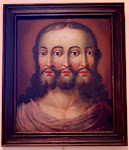
Three Persons, One God


A painting of the Most Blessed Trinity, here shown as three identical Christ figures seated side by side. On the foreground are shown the figures of Saint Joseph (bottom left) and Saint Ignatius (bottom right). A definite product of the Cuzco School-- though as to the name of the painter, that has already been lost to time. This type of depiction of the Trinity was banned in Europe following the Reformation; however, it found new life in a Latin America for which the Reformation never happened, and art was sacred art was free to pursue its own, vastly imaginative course.

Monday, December 31, 2012

RIP Fr. James Reuter

In your charity, please say a prayer for the eternal repose of Father James Reuter, a priest of the Society of Jesus, who died today at the age of 96. A Jesuit of the old school, Father Reuter's fastidiousness and zeal with which he propagated the Catholic faith, have served as inspiration for countless Filipinos who have had the honor of knowing him.

Monday, October 15, 2012

The Mass of St. Sylvestre

(This short story, by the great Filipino writer Nicomedes Marquez Joaquin, is one of my favorites. I have written about this story before, back in 2007, having posted a detailed summary of the events in the story. I am posting it here in full, for the enjoyment of my writers, a number of whom, I'm sure, have long wanted to see this short story online.)

The Mass of St. Sylvestre
To open their doors to the New Year, the Romans invoked the god Janus, patron of doors and beginnings, whose two faces (one staring forward, the other backward) caricature man’s ability to dwell in the past while speeding into the future.
In Christianity, the post of Janus has been taken over by another Roman: St Sylvestre, pope and confessor, whose feast falls on the last day of the year. At midnight of that day, the papal saint appears on earth and, with the Keys of his Office, opens the gates of all the principal archiepiscopal cities and celebrates the first Mass of the year in their cathedrals.
Manila has been a cathedral city almost from its foundation; for centuries it was one of only two cities in the orient (Goa being the other) to whose gates the New Year’s key-bearer made his annual visitation. For this purpose, St. Sylvestre always used the Puerta Postigo, which is—of the seven gates of our city—the one reserved for the private use of the viceroys and the archbishops. There he is met by the great St. Andrew, principal patron of Manila, accompanied by St. Potenciana, who is our minor patroness, and by St. Francis and St. Dominic, the guardians of our walls.
St. Sylvestre comes arrayed in cloth-of-gold and crowned with the tiara. Holy knights suspend a pallium above him; archangels swing censers and wave peacock fans; the book, the Mitre, the Staff and the Keys are borne before him by a company of seraphim; and cherubs flock ahead, blowing on trumpets. Below them swarm the Hours on fast wings. After them come the more sober Days—cryptic figures clad in silver above,  in sable below—playing softly on viols. But behind the Pontiff himself, walking three by three, are the twelve splendid angels of the Christian Year.
The first three of these angels are clothed in evergreen and are crowned with pearls, and in their hands they bear incense, gold and myrrh—for these are the angels of the Christmas Season. And the next three angels are clothed in April violets and are crowned with rubies, and they bear the implements of the Passion—for these are the angels of the holy time of Lent. And the next three angels are clothed in lilies and crowned with gold, and they bear triumphal banners—for these are the angels of Eastertide. But the last three angels are clothed in pure flame and crowned with emeralds, and they bear the seven gifts of the Holy Ghost—Wisdom, Understanding, Knowledge, Counsel, Perseverance, Piety, and the Fear of God—for these are the angels of Pentecost.
At the Puerta Postigo the heavenly multitude kneels down as St. Sylvestre advances with the Keys to open the noble and ever loyal city of Manila to the New Year. The city’s bells ring out as the gate opens and St. Andrew and his companions come forth to greet the heavenly embassy. The two bishops embrace and exchange the kiss of peace, and proceed to the cathedral, where the Pontiff celebrates the Mass of the Circumcision. The bells continue pealing throughout the enchanted hour and break into a really glorious uproar as St. Sylvestre rises to bestow the final benediction. But when the clocks strike one o’clock, the heavenly companies vanish—and in the cathedral, so lately glorious with lights and banners and solemn ceremonies, there is suddenly only silence, only the chilly darkness of the empty naves; and at the altar, the single light burning before the Body of God.
Those who have been favoured with glimpses of these ceremonies report that St. Sylvestre (like Janus) seems to have two faces—but these reports are too vague, too confused, and conflicting to be given credence. More respectable is the ancient belief that whoever sees and hears, in its entirety, this Mass of St. Sylvestre will see a thousand more New Years; and it is whispered that Messer Nostradamus succeeded (through black magic) in witnessing one such Mass, while most of Roger Bacon’s last experiments (according to Fray Albertus Magnus) were on a prism that should make visible to mortal eyes this Mass of Time’s kry-bearer. They also speak of a certain magus of Manila, who, like Nostradamus, intruded with black magic upon the sacred scene—and was punished for it.
This magus, who was known was Mateo the Maestro, lived in Manila during the early part of the 18th century and was feared by many as a sorcerer. He was equally famed as a musician, artist, doctor, philosopher, chemist, and scholar; and in his bodega on the street of the Recollects a crowd of apprentices laboured day and night at various arts—carving wood or chiselling stone, or narrating lives of the saints on canvas, or conjugating Latin, or choiring together in rehearsals of a solemn Mass or chanted Rosary. The Maestro—a small, very shrivelled ancient with white hair flowing down to his shoulders and a thin white beard—might look as frail as a mummy, but his eyes—and his temper—were still as sharp as a child’s. Because no one could remember him young he was believed to be hundreds of years old, surviving (some said) from the days before Conquista, when, being a priest of the ancient cults, he wielded great power, wearing his hair long and affecting the clothes and ways of women, but had hidden away from the Castilians in various animal disguises to plot a restoration of the old gods—those fierce and fearful old gods now living in exile on the mountaintops, and in dense forests, and out among the haunted islands of the south, but who steal abroad when the moon dies or when typhoons rage in the night, at which times you may invoke their presence by roasting a man’s liver, and by other unspeakable devices.
The truth, however, was that Mateo the Maestro was not yet eighty years old and could not be remembered as a young man because he had spent his youth in incessant wanderings all over the country, thus acquiring his mastery of the arts, his command of a dozen tongues, and his profound knowledge of herb-healing and witchcraft. Like all magians, he was obsessed by a fear of death and the idea of immortality; but all the lore he had accumulated he found powerless to wrest the secret from life, though he had laboured over countless experiments involving molten gold and pearls, the guts of turtles, the organs of monkeys, and the blood of owls. And after each vain experiment he would bitterly gaze out the window and reflect how, a few steps down the street, in the cathedral, there was yearly said a Mass which—had he but the power to behold it—could increase his life by a thousand years.
He had consulted the dark deities in exile but was informed that the holy mysteries (except by divine dispensation) could be observed only by the eyes of the dead. Whereupon a monstrous idea had grown; the grave of a holy man was profaned; the dead eyes plucked out—and one New Year’s eve Mateo the Maestro hid himself in the cathedral, having grafted into his eye-sockets a pair of eyeballs ravished from the dead.
Just before midnight, he saw the dark naves suddenly light up and a procession forming at the high altar. Garlanded boys bore torches; flower-crowned girls carried lamps; acolytes pressed forward with the cross, the standards, and the censers; and a glittering angel lifted the Flag of the City, its Lions and Castles embroidered in jewels. Behind a company of heralds appeared the mighty St. Andrew, attired in apostolic red and wreathed with laurel. Beside him walked the virgin St. Potenciana, robed in bridal white and crowned with roses. Behind them came St. Francis and St. Dominic and a great crowd of Holy Souls who had been, in life, illustrious citizens and faithful lovers of Manila. Down the aisle advanced the concourse, the cathedral doors swung open, and the Maestro followed the procession down the street to the Puerta Postigo. There the crowd paused in its chanting, and, in a moment of silence so infinite you could hear the clocks all over the world intoning twelve, a key clicked audibly in the lock and (as in Jerusalem and Rome and Antioch and Salamanca and Byzantium and Paris and Alexandria and Canterbury and all the great Sees of Christendom) the gates opened and St. Sylvestre entered the city as the wild bells greeted the New Year, the two processions merging and flowing together to the cathedral.
Now, there was a fine retablo in our cathedral, carved in stone and representing the Adoration of the Shepherds, which at Christmas time was lugged out of its side-chapel and placed upon the high altar. In this retablo, Mateo the Maestro now hid himself, since from behind the kneeling shepherds he commanded a superb view of the ceremonies commencing below. Having been warned that the Mass of St. Sylvestre cannot but prove unbearable to human senses, inducing (like the atmosphere of great heights) a coma in the mortal beholder, he had brought along a knife and a bag of limes, wounding his arms and steeping the wounds with limes each time he felt sleep threatening to overcome him. But as the Mass progressed, it became more and more difficult, it became sheer agony to stay awake. His head swelled and swayed, the purloined eyes fought to squeeze loose from the sockets, slumber pressed down on him like an iron weight around his neck though he stabbed and stabbed till both his arms were bloody blobs of chopped flesh.
But at last the Mass drew to a close; the Pontiff rose for the final benediction. Writhing and sweating, bleeding and smarting, Mateo strained forward, leaning over the kneeling shepherds and forcing his agonized eyes open. St. Sylvestre was standing with his back to the altar—but had he turned his face or was that a second face that stared back at Mateo? Mateo retreated slowly but could not wrench his eyes away from those magnetic eyes below.. he dropped down slowly, irresistibly, to his knees—still staring, still fascinated, his mouth agape. Then he ceased to move: his bones stiffened, his flesh froze. There he knelt moveless00one more kneeling and fascinated figure in a tableau of kneeling and fascinated figures.
Mateo the Maestro had turned into stone.
And there he has remained all these years—and, for generations, bad boys who drowse at Mass have had his crouching form pointed out as a warning. But every New Year’s eve, at midnight, he returns to life. His flesh unfreezes, his blood liquefies, his bones unlock, and he descends from the retablo to join the procession to the Puerta Postigo; sees the New Year come in; hears the Mass of St. Sylvestre; and at the stroke of one o’clock turns into stone again. And so it will be with him until he has seen a thousand New Years.
Or has the spell broken for him at last? For his retablo is broken, the cathedral is broken, and the city he knew has been wiped out by magic more practical and effective than any he ever dreamt of.
…And just as soon as the Liberation Forces opened the Walled City to the public, I went to see what the war had left us of our heritage from four centuries. Nothing had been left—except the oldest and most priceless jewel of all: St. Augustine’s. The Puerta Postigo still stands, but most of the city walls have been levelled to the gorund and the cathedral is a field of rubble. Into what city (I wondered) would St. Sylvestre now make his annual entry? In what cathedral would he say his Mass? The retablo of the Pastoral Adoration has been smashed and dispersed into dust. Does that release Mateo the Maestro from his enchantment—or must he still, on New Year’s eve, reassemble a living body from stone fragments to fulfil his penance of a thousand year?
Later, I told this story to some GI friends, who straightway clamoured that a buddy of theirs, while stationed in the Walled City, had actually witnessed this entry and Mass of St. Sylvestre on New Year’s eve, 1945. Unfortunately, the buddy had gone home to the States; but I took down his address and immediately wrote him, begging for a full account. His name is Francis Xavier Zhdolajczyk and he lives in Barnum Street in Brooklyn.
Here is the letter he sent me:
“… I didn’t know all that about living a thousand years or I might have acted otherwise. If that stuff is true—what a chance I missed! We were camped just outside the walls-on the grassland between the walls and the Port Companies. That night—it was New Year’s eve—I’d come back to the camp early because I was feeling homesick. I was all alone in our tent, the other boys were still downtown celebrating. I lay awake a long time thinking of the war and the folks back home and when I was going to see them. Around midnight I woke up from a doze and heard music. So I stuck my head out and saw a kind of parade coming up the road. I wasn’t surprised then and I wasn’t surprised at anything afterwards. I just told myself that you people must be having one of your New Year’s celebrations and wasn’t it too bad your churches were all smashed up. But I turned my head just then—and there was the Walled City, and it wasn’t smashed up at all. The walls were whole all the way and I could even see some kind of knights in armour moving on top of them. Behind the walls I could clearly see a lot of rooftops and church towers and they were none of them smashed up at all.
I told you about not being surprised—I wasn’t. I simply felt I should go and take a look. So I dressed fast and ran out. The parade had stopped at a gate in the wall and a bishop was opening the gate and bells began ringing. There was another crowd waiting inside and they had a bishop too and the two bishops kissed and then they all went through the gate and I followed. Nobody took any notice of me. Inside, it was a real city, an old city, and hundreds of bells were ringing and they had a park with fountains all around abd beside the park was a cathedral. Everybody was going in there, so I did too.
You never saw such a sight! The bishops were saying Mass and it was all lighted up and the air swelled good like high mountain air and the music was so pretty you wanted to cry. Then I said to myself: what a picture you could make of this, to send home. But I hadn’t brought my camera and I decided to get it. So I ran out and down the street and past the open gate and into our camp. Nobody was around. I got my camera and raced back. When I reached the cathedral I could see that the Mass was ending. I aimed for a nice view—but right when I was going to snap the shutter the bells stopped ringing—and just like that—it all disappeared. The bright lights was only moonlight and the music was only the winf. There was no crowd and no bishops and no altar and no cathedral. I was standing on a stack of ruins and there was nothing but ruins around. Just blocks and blocks of ruins stretching all around me in the silent moonlight…”