Thursday, April 23, 2009

What Is A Christan Nation?


If, like me, you spent an inordinate amount of time researching how Holy Week was celebrated throughout the world two weeks ago, then you would know that the andas used for the processions in Guatemala are some of the largest in the world; that Franciscan priests use the Greek Orthodox altar in the Shrine of the Holy Sepulcher for the rite of the deposition; that Nazarenos are the ones with the pointed hoods, and costaleros are the ones with the sacks over their heads carrying the paso in procession. You would know that Taranto, Italy, has excellent marches to accompany the processions of Good Friday, and that an Australian comic was crucified in Pampanga here in the Philippines, who planned to use the footage of him in agony for a TV show (he should not have been let down that cross).

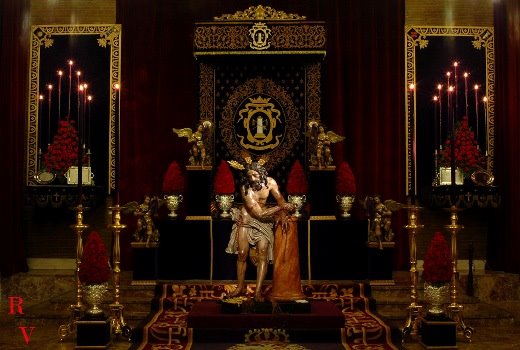
In Seville, capital of Andalusia in Spain, they hold what is, quite possibly, the grandest Good Friday procession in the world. Starting at the crack of midnight, La Madruga, as this procession is called, typically lasts 14 hours, with a minimum of a million people joining. The high point of the procession is the image of Nuestra Senora de Esperanza de Macarena-- a three hundred year old image of the Blessed Mother, which Sevillanos believe to have been carved by angels. The face of La Macarena is haunting; it is the face of one trying to comprehend the agony and grief of a loved one. It is at once restrained and gut-wretching. La Macarena is borne on a huge paso (processional platform), a giant, velvet palio above her announcing that she is the Queen of all Andalusia. Before her burn several tall candles, to shield her eyes from the sight of her Son in agony.

The video above shows the much revered image of La Macarena exiting the church where she and her confraternity 'reside'. Amidst much fanfare and cheers from the crowd, and the piercing trills and passion of haunting saetas sung in honor of the Virgin, the image makes its way through the crowded streets of Seville. Grown men and women cry upon seeing their beloved Queen in her grief; words of admiration, as if whispered to a lover, are dedicated to the Virgin, accompanied by thousands of kisses and rose petals blown at her by many a devout member of the crowd. Women in long, flowing mantillas accompany La Macarena, as the carefully choreographed procession relives the passion and drama of Spain's much revered Semana Santa.

All of these scenes seem to paint an image of militantly Catholic Spain, fiercely proud of her Christian traditions. But the reality is far different. Spain today is a vastly secularized nation with a growing population of atheists and agnostics. Three decades ago, it would have been unthinkable to equate Spain with secularism; even today in the Philippines, the contrite prefer to confess to Spanish priests, because they are perceived to be guardians of tradition, and many still equate that country with glorious, triumphant Catholicism. If Wikipedia is to be believed, then the downward spiral of the Church in Spain poses a serious problem, if Europe is to preserve its Christian identity. How did it happen that the land of the Dominicans, the Jesuits, Opus Dei, which traversed the whole world for glory of God and country become so secular?

The answer is not easy to pinpoint. One can perhaps trace it to the La Gloriosa Revolucion in 1869, when Masonry began to visibly flex its muscle against the Church. More recent is the Civil War of 1936, and its Red Terror, which claimed the lives of thousands of priests, bishops, and religious. But popular sentiment simply does not change overnight; less than 40 years before the Civil War, Spain was still an Empire (technically, a collection of kingdoms), but the loss of Cuba and the Philippines, as well as its defeat at the hands of America (then the new kid on the block trying to assert its place among the old powers of Europe)is sure to have played a role in secularization as well. But the bottom line is that the country's Catholic identity had been under attack for a long time. As easly as the mid-19th century, missionaries in the Philippines were already decrying the lax attitude of Spaniards when it came to the reception of the Sacraments.

Today, while the Church still retains a measure of esteem in Spain, its voice has been growing weaker by the decade. We need not look further than the legalization of same-sex marriage in that country, the pitiful church attendance (20%), and the fact that Spain has one of the lowest birth rates in all of Europe. In the face of all these numbers, one is tempted to think that all is lost for Europe. The former champions of Christendom are gone, and with it, a sense of tradition. We ask ourselves, 'Is there still a Christian nation left in Europe?'

For many, there has been a shift in thought in what constitutes a Christian nation. Many of us see the United States, for example, as the pre-eminent Christian nation on earth today, and proof of this are its great wealth and dominance in world affairs. But the United States has never received the Cross, received its pain and its love. It has received its fruits and its commerce, but not its humility, and its glory. Sometimes it can get depressing to think of the rapidly declining voice of Christianity in the world. But then along come these veritable scenes of splendor from the past, and for a brief moment, all the fears brought about by 'supercategorical thinking' cease to exist. We are alone before the Virgin of Hope once again, crying our eyes and our hearts out like children. Streets fill with the thunder of a million footsteps simultaneously pounding the pavement, and the roar of trumpets heralding the passing of the Queen.

The more I think about it, the more I see the Church like an immovable rock wall, or a majestic mountain undaunted by the tricks and artifice of man. You can butt heads with a wall all you want, but the wall always wins, leaving you with a cracked skull and perhaps more than a few broken bones. In Spain, as in Italy, Portugal, and especially France, the Church has so embedded itself in the culture that it is practically impossible to think outside of its framework. The Church has influenced food, culture, music, even the way we talk, or bid someone goodbye (e.g., Adios - to God)-- even the way we hate has been influenced somewhat by the Church. Even Luis Bunuel, who was rabidly anti-clerical, who toasted the death of bishops and priests in the Civil War, and who threw an image of the Virgin into the sea, would recall the God-haunted days when he yet had faith, citing how the rituals of Viernes Santo always brought a chill to his spine, and not a few tears.

Perhaps it is a new phenomenon to Americans and other people of non-Catholic countries, but Church attendance is never really an excellent gauge of one's faith or religiosity. To be sure, it helps a lot, but at the end of the day, it is not a direct correlate to something that is unquantifiable in the first place. In Italy and Spain, for example, one can be non-religious but still feel insulted by Communist politicians disobeying the Church. Similarly, people who are not regular church-goers can still be moved to tears by the sight of the Virgin in her grief. They cry out to her, their Mother and Queen, and wish that it was them suffering instead. Again, there is that image of the Church as an immovable brick wall; ultimately, it still deserves our respect, whether given grudgingly or not.

Admittedly, the diminishing influence of the Church is something to be lamented. But at the same time we should not expect an overnight 'reversion' to Christian truth. One thing which I fervently believe in is that being a Christian is to be incorporated into the Body of Christ, in all its wounds, bruises, and brokenness. It is not for naught that the defining symbol of Christianity is the crucifix. It is no accident that He died, and it is certainly not a mere trifle that we celebrate His sacrifice. And while a Catholic culture is not the be-all-end-all of our woes, it is certainly a good place to start. A nation is built on ideas; we cherish them with great affection, and in so doing, form our consciousness as a people. I believe that Spain's identity as a Christian nation is crucial for the Church, not only for the sake of its history, but ultimately for the sake of its survival. If indeed culture is the expression of the ideas upon which our nation (or other imagined communities) is built, then the tradition behind it must be preserved as well. You can only have too many glass houses and diamond-studded skulls to last a lifetime before obscurity or the next big fad swallow them into oblivion.

It is said that a drunk man once hurled insults at the image of La Macarena, punctuating it by following his sacrilege with a beer bottle that hit the right cheek of the Virgin. Later, upon reaching sobriety and realizing what he had done, the man was overcome with great grief and resolved to walk in the procession of La Macarena with his ankles bound in chains, and a heavy cross on his shoulders. Even when the man had died, his descendants continued the tradition, and even today, it is said that the tradition continues. Those who wish to purge Spain and indeed the rest of Catholic Europe of every last vestige of their Christian heritage seeth in hatred at the processions of Sevilla's Semana Santa, but the great multitudes who participate seem to defy the desired effect of their opinion-makers. They hate this relic of the superstitious past, because they see that it is alive, despite the onslaught of years and ideologies. They hate it, because ultimately, they are the ones in most need of the light and peace of Christ.

Semana Santa is over, and most of Spain has returned to its former habits. But the Church remains, undaunted-- though perhaps diminished and more than battle-weary-- waiting for that day when it may start to rebuild itself in Europe. And while that day seems far off, one should never underestimate the power of the Church. It is a pledge of hope and a sign of future victory that we can cling to, and ironically, but not accidentally, its herald is the image of the Crucified Lord and His Sorrowful Mother, who is nevertheless ready to forgive and forget all our offenses. That is why she is called Esperanza---Hope--, after all.

Wednesday, April 15, 2009

The Arcade Fire - Wake Up

Roadside Shrine, Quiapo, Manila


I just thought it was an incredibly whimsical photo. Found on Flickr.

Monday, April 13, 2009

Vere Surrexit!


"Et resurrexit tertia die, secundum Scripturas"
-the Nicene Creed

May the peace and joy of the Risen Christ be with you and yours. May the glory and splendor of this day radiate within you and inflame you with the ineffable love of the human God. For truly, Christ the Lord is risen from the dead, and has trampled it beneath His mighty heel. The angelic hosts rejoice, the whole universe rejoices and stands in awe before this most awesome mystery-- how the Uncreated took on dust and ash became as one like the created, and how the Invincible and the Almighty succumbed to mortal sleep-- and rose, a victorious conqueror, bringing desolation to desolation itself. Christ the Lord draws all the world to Himself; let us heed His call and worship Him. Christ has risen from the dead; nothing else matters. But had He not, then truly, nothing else matters.

Santissimo Cristo de Buena Muerte de Malaga


(Link if video does not show)

I realize this is a bit late, but I think it's still worth posting. On the morning of Maundy Thursday members of the Spanish foreign legion arrive in Malaga to participate in the rites of Holy Week. In particular, they lift the larger-than-life image of the Santo Cristo from the cathedral and place it on its processional 'trono', a 4-tonne veritable moving altarpiece. They subsequently carry the image to the cofradia in charge of carrying it in the actual procession at night. I really like the marcha in this video; I did some research behind it but cannot find the name of the tune nor its composer now. Any help would be appreciated.

EDIT: The name of the song is El Novio de la Muerte. Link.

Tuesday, April 07, 2009

Saint James the Great Church, Ibaan, Batangas


I really liked the way this photo turned out. On our way home from our mini-vacation, we stopped by the sleepy town of Ibaan in the Batangas province to visit their church. We got there around 3pm; outside, a group of people were doing the Via Crucis, while inside, small families gathered to pray. From the looks of it, a Mass was probably going to start in a few minutes-- a lot of the people inside were all properly dressed and some were praying the rosary. We spent a total of fifteen minutes there, as we had to be on our way; Holy Week traffic in the Philippines can literally be a Calvary of a time. Curiously, the images weren't veiled, despite it already being Palm Sunday. I was told by my father that the custom there was to cover the images after the Palm Sunday Mass-- but which, he didn't know. Despite the 'abuse', I was thankful to have been able to see the retablo in all its glory.

Monday, April 06, 2009

Benedictus Qui Venit In Nomine Domini


I took this photo outside the church of St. James in Ibaan, Batangas, where a group of women and their children were selling these palms for Php 10 a piece. For us Catholics, the waving of palms ushers in the most sacred week of the year, when we commemorate the Passion, Death, and Resurrection of the Son of God. I came back from the beach on Palm Sunday, and the 5-hour traffic, as well as the multitudes of people crowding the streets, were an instant reminder of the solemnity of this week. I'll be honest and admit that I'm not exactly a paragon of virtue, but if anything, this week should remind us that there is nothing too great for God to forgive. May God grant all of us the grace to repent of our sins.

Hosanna, Hosanna filio David.
Benedictus qui venit in nomine Domini.
Hosanna, Hosanna in excelsis.
Amen.

Thursday, April 02, 2009

Cebu Cathedral Altar Update


Found on Flickr (see link), here is an image of the new retablo of the Cebu Cathedral. It's not yet finished; there are still some adjustments and polishing to be made, according to the craftsmen who built it. Here is a message from Robert Cruz, also found on Flickr, whose group was responsible for its construction.

We were supposed to install on the 3rd week of April yet. But the pastors requested to have them for the Chrism Mass. It took us six days to put up the structure. So many Masses celebrated daily, we could only work at night. Minutes before the Chrism Mass, we were still working on it. [I'm guessing by Chrism Mass he meant its blessing and dedication]

Thus, up-close you'll still see a lot of finishing work and adjustments yet to be done. The statues, relleve, and many of the carvings didn't make it for this shipment. We still have to clad the post-WWII marble canopy jutting out of the center. Expect the retablos to be ready for the Apr. 28 anniversary.

All components were pre-fabricated in our Laguna workshop. The main body is made of Philippine Mahogany with gold leaf appliques (carvings), internally supported by a steel structure.

The left retablo niches will have St. Valeria (top), the twins Sts. Gervasio and Protacio (left, right), bas relief of the Martyrdom of San Vitale (center).

For the right retablo: St. Joseph (top), St. Anthony (left), St. Vincent Ferrer (right), La Inmaculada (center).

The IHS logo was re-used, while the old Crucifix was decorated with rays.

Harvey, thanks for the compliment. We're also working on a proposal for four stained glass windows at the facade (choir and chapel windows).

By the 3rd week, we will start installing the twelve-bell carillon in the belfry.

Robert Cruz
Vitreartus Liturgical Arts

Tuesday, March 31, 2009

Never Been Known To Fail

Growing up, I have to say that my mental image of the Church has always been defined by the 'landscape' in which I lived. It was, for me, experienced primarily through a series of images: women in veils, Sacred Heart scapulars, walking on one's knees, sampaguita-clad statues of the saints, golden retablos, and the graphic depiction of the sufferings of the Crucified. These for me served as a background of sorts, a tapestry on which I somehow based my idea of what the Church was. One of the most ubiquitous components of that tapestry is the novena to St. Jude.

I'm sure you've seen them everywhere. They are usually hidden in some back pew of a grand church, photocopied or printed individually. I've collected a lot of these 'pamphlets' over the years; when I was a student in the sixth grade, I recall plundering our parish for copies of the novena, intrigued by its audacious claim of 'it has never been known to fail'. In 2002, I had the chance to visit Mission San Juan Capistrano in California; St. Jude was there, too, only it was a pamphlet-slash-booklet, containing nine copies of the prayer within. When I started college, I began to collect more and more of these novenas. They range in size from A4 bifolds to 3in by 3in laminated squares small enough to fit in your wallet.

I've never prayed the novena, though. Despite always being intrigued by it, I guess I was never desperate enough to give it a try. But with the worsening economic crisis and other factors, there seems to be an influx in the saint's devotees. I think it's quite fitting (and bitingly ironic) that the shrine of St. Jude in Manila is proximate to Malacanang Palace, the seat of the national government.

Perhaps one reason why I'm so reluctant to give the St. Jude novena a try is because it always seemed like folk magic to me. I have blogged before about the somewhat neurotic religious environment in which I grew up, where evangelical Protestantism seemed to mesh with traditional Roman Catholic piety. While I learned to cross myself, say the Our Father and the Hail Mary, I was also being told about the end of the world, the rapture, and all of that. I took this all in, as any child is wont to do, never really distinguishing one from another. Thus, I would kiss the foot of a saint while believing, simultaneously, that one should not commit idolatry (that is, bow before a graven image, as most prottys define it).

For some reason, whenever I would feel myself in a lull in my spiritual life, I am always buoyed up by St. Jude novena, even if I have never prayed it before. Maybe it was the sheer audacity-- and consequently, hope-- that it promises, but I end up telling myself 'Your life isn't too bad, you know.' One time, I saw an old man, who could not have stood more than 4'10, and whose skin looked as if it had been parched and burned by years walking under the sun, walk his way toward the altar of the church, carrying several pieces of paper with the novena prayers printed on them. The church was practically empty, as it was only 7 in the morning (or perhaps they had already left since the first mass there was at 5.30), and with the exception of the man, most of the people there were preparing to leave. It was such a nice little scene to observe, so peaceful and so hopeful. You would never know that he was beset my so many problems.

I don't think anyone could really determine in an empirical way whether the St. Jude novena delivers on its promise. In the end, one really has to have faith. But that's just the problem with us nowadays: we don't really believe anymore. It's all a matter of convenience and pleasure. Perhaps, one day, God will make me desperate enough to try something so audacious and so comforting as the St. Jude novena. Lord, that I may see.

Saturday, March 21, 2009

Sagada Mountain Province - All Souls' Day


Just an incredibly haunting photograph, found online, and whose source I am trying desperately to find. The people of the Sagada, instead of lighting candles to remember their dead on All Souls' Day, light small bonfires instead. First is the practical consideration-- one simply cannot expect wimpy candles to last long in the battering winds of the mountains. The more mystical side of this ritual centers on the belief that, the brighter the flame one lights, so too is the intensity of the deceased's suffering alleviated. It is especially interesting, too, since Sagada is not exactly a region where Catholicism is that entrenched-- the Anglican communion is stronger there, having been brought by American missionaries to the Philippines at the dawn of the twentieth century.

Wednesday, March 18, 2009

Radio Melodrama

I took a cab home today.

I don't usually commute and from school; I'm lucky enough to have my own car (an old Honda :/ )but for some reason, I thought it would be fun to go it like an ordinary college student. Jeepneys, on general, tend to make me feel queasy, mainly from the dust and heat (I am very prone to migraines) and cabs, well, let's just say taxis in Manila tend to make even the worst NYC cabbie look like a kitten. It was easy enough, but I did have to lug my big bag all the way, which had almost 30 lbs of stuff inside (it is 'hell week' already for students in the city).

It was the return home, however, that was quite... entertaining. I live around 30 to 40 minutes away from school, depending on the traffic, and many cabs usually take me in without much trouble. I flagged down this badly bruised Toyota, which screeched to halt around five feet from me. I got inside, and luckily, the taxi driver was a pleasant man, quite talkative, really. I told him my destination, and judging from the way he spoke, he seemed pretty familiar with where I lived.

Five minutes in, mister taxi driver asks me in a somewhat sheepish tone if he could switch the radio station so he could catch his favorite radio drama. It wasn't a problem, I told him; so he switches from FM to AM, and lo, I start hearing the most over the top, overwrought, hyper-melodramatic dialogue ever.

The first involved an evil grandmother (who sounded like she had smoked her peace pipe for too long) berating and harshly treating her granddaughter, who was literally crying her heart out. It was difficult to make out what she was saying, but here I've tried to transcribe it to the best of my memory:

'Pero... (sob) Mahal.. (sniff) Mahal ko siya!!! (cries heart out) Hu hu hu! Ma...(sob)sama.. kang.. tao!! (sob)' (sniffsobsobsniff auugh guhuhu raaah, unintelligible noises)

[English: But...(x)I love...(x) I love him!!!(x) Hu hu hu! You...(x) are..(x)An evil woman!(xxx)]

For 15 minutes, there was not one sentence that was not punctuated by a sob, a sigh, a sniff, or an invective against the evil grandmother. I personally did not know whether to laugh or cry, but I found myself gritting my teeth in some instances, especially when the grandmother spoke, that shrill, cackling, vulture-ish voice inciting my inner sap to join in the drama. The driver must have seen me making faces through the rear view mirror (not a very good sight), and offered to explain the whole plot line-- plot ribbons and knots, more likely-- and it went by so fast I had to ask him repeatedly about it.

'Ah kasi, 'yung lola, ayaw siyang ipakasal kay (didn't catch name), kasi, mahirap. Gusto ng matanda, si ganito na lang daw, dahil may utang pa siya dito. So 'yung babae na lang daw pambayad utang niya. Pero itong si apo, ayaw, kaya nag-iiiyak sa lola, pero rinig mo naman na malupit siya, diba. Si lola, malupit sa lahat, pati sa sarili niyang anak. Lalong lalo na sa mga mahirap. Proud ba siya! Hahaha!'

[It's like this, the grandmother, she doesn't want her to be married to that guy (didn't catch name), because he's poor. The old lady wants her to marry so and so instead, because he's rich, and she still owes him. But the girl, she doesn't it (the fact that grandma is intruding into her personal life), that's why she's crying her heart out before her grandma, but as you've heard, she's downright mean. The grandmother, she's cruel to everyone, even on her own children. And she's even proud of it! Hahaha!]

I listened to him narrate the rest of the story, from its unfolding to the present. As I said, there was not a full minute that passed without hearing a sob, a sigh, or a sniff from the radio. Sometimes I ask myself, What's the point of all this obsession over suffering? Haven't we, as a people, suffered enough? You'd think a housemaid would be the last person on earth to listen to her radio counterpart scream and sob from her latest beating; but no, she listens to it, even giggles at it. I don't understand it, really. Maybe it's because of our 'bahala na' (lit. 'It's in God's hands) attitude, or the fact that we tend to be most serious when we are laughing. He definitely seemed to be enjoying himself.The driver eventually stopped talking, allowing me to hear the rest of the glorious melodrama.

I guess, with all the poverty in the world today, it's sometimes good to take a pause and laugh it all off. After all, your life can't be that bad; just be happy you don't have an evil bitch of a grandmother giving you off to be married in order to pay a debt, or an evil stepfather who likes the beat the s4it out of poor people. Yes, it's grossly exaggerated stuff, and I can't help but think that this is also the reason why it is so true.

'Ayan na si Bernardo! Ha, sige, lagot ka ngayon!'[There, it's Bernardo! Ha, wait till her hears of what you did!'], he says to no one in particular. Maybe it was cathartic, or it was just that entertaining. The radio drama eventually ended, but not before advertising cheap brandy, an online classified ads website, and a bad jingle for an even worse cola. Finally, the familiar, booming voice of the announcer announces the name of the cast members, reminding us all that it was (thankfully) just make believe. The show closed with a bad techno remix of Ennio Morricone's theme from 'The Good, The Bad, and The Ugly.'

Tuesday, March 17, 2009

Altar of Cebu Cathedral, circa 1930s


The altar of the Cathedral of Cebu, as it appeared in the 1930s. Interestingly enough, this altar would be demolished in 1934, when Cebu was elevated to an archdiocese in the 1930s. Supposedly, Bishop Gabriel Reyes was responsible for the brand-spanking new, but vastly pared down, American style altar (that is to say, wedding cake Gothic) that replaced this one. The new altar was made of carrara marble, and if I remember correctly, had three stained glass windows above it. Currently, however, the Cebu cathedral is once again under renovation, and the present altar (long since changed from the Gothic one)will be replaced by a new, more classically-designed altar (reredos, actually-- in the Philippines they're interchangeable). The new reredos will come from Pampanga, a province known for producing classical and baroque inspired altarpieces.

Friday, March 13, 2009

Psychic Surgery

Here is something I have meaning to post for a few days now but have always forgotten to do so, mostly due to stress. One of my guilty pleasures is reading travelogues of people from all over the world, and this one, written by a Briton who has been in the Philippines for five months now, is especially interesting. Here is the link; but I have also pasted his whole account here for the benefit of the readers. Check out his other posts as well.

Psychic Surgery and Healing With A Double-Edged Sword
by Edward Adrian Vallance


I screamed with pain as the healer swung his double-edged, razor-sharp sword full force into my belly. It was agonizing but somehow felt more like being hit by a metal rod than a sword.

"Stop, stop," I cried, "I don't want any more!" But I had begun now, and other people held me back. I received two more blows to the stomach and three on my leg, all equally excruciating and producing cries at a similar volume. Afterwards I looked at the areas of flesh he had struck and sure enough there were three long thin red marks where the blade had hit me but somehow not penetrated my skin. Two weeks later, as I write this, huge black bruises still cover the area.

The room in which we found ourselves and the people we were with looked, outwardly, highly Americanised. The healer was no shaven-headed Tibetan monk in long red shawl, no wild-haired, pencil-thin Indian Yogi - he was a fat, simple-faced, warm-hearted Filipino in jeans, a T-Shirt and a baseball cap. We were in no Himalayan temple or Buddhist shrine, but on the twenty first floor of the Herrera Tower in downtown Makati, surrounded by the vast shopping malls and reflective glass windows of Manila's flashiest area and answer to Singapore. Yet this bizarre ritual took place amid all this seeming hyper-modernity. The other "patients" were highly-educated working people yet they must have believed in the efficacity of the ritual otherwise why would they have been there? Relaxed and trusting, they did not scream while being hit. My own agony upon having the blade unleashed upon me was apparently due to my skepticism; fearing the worst, I had unwittingly tensed all my muscles in useless preparation for the blow.


"Where are you from?" I asked the healer when the ordeal was over.

"The island of Leyte, Sir," he replied.

"And what did you do before you became a healer?"

"I was just a farmer, Sir."

"How did you realise you had this gift?"

"One day God just told me, Sir. I left home and lived in the wild for a year, fasting during the day and never once washing. Then I came back and started to help people." He seemed straightforward, down to earth, and without a cunning bone in his body.


The owner of the clinic in which the ritual had taken place quoted a couple of verses from the Bible which mentioned metal rods and double-edged swords representing the Word of God which could protect people from death.

"Perhaps it felt more like a rod than a sword when he hit you?" he asked, looking from face to face. He went on to show us some photos of the ritual on his computer where a bright shining light inexplicably appeared near the sword, or where the sword became transparent. We checked our own photos and, sure enough, in one of them the sword was transparent. In another one Lizz had captured the sword just as it hit my leg; it was definitely the blade, not the flat, that was striking me and, what is more, the blade appeared to be partly buried in my flesh.

"Anyway," the owner went on, "this should build up your protective aura enormously and prevent you from getting hurt." He went on to site a list of examples of policemen and soldiers who had taken the same treatment then survived without a scratch after being shot at point blank. Another young man at the clinic told us that after having the treatment one day he had had an sudden urge to change buses then had watched as the bus he had left blew up in a terrorist attack.

"The clothes you are in now, you can't wear them for a year," the owner said, "unless you are going into a particularly dangerous situation, then they will protect you. For the next three days you cannot shower, eat pork or have sex. For the rest of your life you cannot shower, eat pork or have sex on Tuesdays or Fridays. Whenever you eat meat, you must never skewer it with your fork. And, most importantly, you must say these prayers every day at 6am and 6pm." He handed out several pages of Tagalog and Latin prayers that would take at least twenty minutes to recite.

"We have to say them all twice every day?" I asked with a sinking heart, knowing full well that I would not be able to keep it up.

"Indeed, otherwise you will lose your protection."


We had decided to undergo the treatment by alternative healers because for us it summed up a number of aspects of the Filipino culture, above all the deep, almost fanatical spirituality which scratched below the surface of the Americanised exterior. The sword healer was apparently a one-off, just a man who had been given a gift by God not to be found in anyone else. Our next experience was to be of one of the most controversial healing practices to be found anywhere in the world: that of psychic surgery. This practice, revered for its successes by the spiritualists and denounced by conventional doctors as giving false hope to people who would be much better off putting their faith in Western medecine, is extremely popular in the Philippines.

I had seen a documentary on TV in the West in which psychic surgery had been proven to be a hoax. When I mentioned this to the owner of the clinic where I had received the sword treatment, he replied that in the whole world there were only about forty genuine psychic surgeons but plenty of people out to make money by faking it.

We were in a tricycle taxi bumping along a small winding street in a poverty stricken part of the Pasay area. The power-dressed, briefcase-clutching businesspeople of Makati were gone, replaced by street vendors, karaoke bars and crowds of children playing in the street. The cries of "hey Joe!" and "Where you going, man?" that had greeted us everywhere in the provinces but had disappeared upon our arrival in Manila were once again all around us. Fifteen minutes after leaving Makati we were already in a different world, one that reminded us of any number of small provincial towns in Palawan, Panay, Negros, Mindanao, Romblon or Mindoro.

The tricycle drew up outside a small church whose wide doors opened onto a street that was buzzing with life. It made me reminiscent of the provinces. Here people knew everyone around them, laughed and joked with one another, watched the newcomers with excited curiosity; in Makati, as in any big, developed place, the huge numbers of people concentrated in one area silenced each other and shut themselves off from anyone they did not already know.

We entered the Church, a modern little affair whose walls were hung end to end with tapestries depicting different saints, and were greeted by a group of spiritual healers who worked there giving free treatment to the poor of the neighbourhood.

"What we do first is a sort of spiritual x-ray on you to find out what you need doing," a woman told us, "then we operate. The healer will collect all the toxins and bad energy in your body together and materialise it into one piece of blood or flesh or something then draw it out of your body."

Lizz went first. It began by an injection from one of the tapestries. A tassel was somehow attached to her arm and prayers said over it by several mumbling voices. Next came the spiritual x-ray; a man stood over her, hands just above her head, muttering prayers for several minutes. He then plucked a hair, put it in a spoon and boiled it over a candle.

At a desk at the front of the church a woman began scribbling down her diagnosis. Behind her stood another, stroking the tassel of another tapestry and making motions with her hands as if to sprinkle the power of the tapestry onto the head and breasts of the one making the diagnosis. When it was finished the woman finished her writing and slumped back in her chair for a moment, seemingly unconscious, before reawakening with a distinctly disorientated look in her eyes. I had the impression that she might be sick at any moment.

Lizz lay down on a table and after a quick massage the surgery began. Several hands were placed on Lizz's stomach and the surgeon himself began shaking and went into trance before he began his work. Then I saw his hands begin to move and blood bubbled up all around. A couple of other people had their hands on her stomach and the skeptic in me felt sure this was to block my line of vision so that I could not see whatever trick it was that they were pulling off. I came in closer, bent down right next to the action and sure enough, as far as I could see, the surgeon's finger was actually inside Lizz's stomach, blood coming up all around it. This went on for a couple of minutes until eventually some evil-looking black material was pulled out along with something that reminded me of the tail of a radioactive worm that had featured in one episode of the X-Files. The operation was finished, blood wiped off her stomach and no scars left to show for it all.

Next it was my turn. Being a smoker, the operation was concentrated more on my lungs than stomach. I lay on the table, received the massage and closed my eyes like I was told. Suddenly there was a burning unlike any sensation I had known before coming from right inside my chest and I could feel the surgeon's fingers inside me. They moved gradually down to my stomach and despite the intensity of the burning that followed them I felt no urge to cry out. It took only a few seconds this time before I felt the fingers squelch out of my belly accompanied by the feeling of something being sucked out from inside me. The surgeon told me to open my eyes; he was holding a tiny, tangled mess of flesh and blood which he quickly placed to one side in a metal bowl.


Could the sword healer somehow have swapped the razor sharp blade we both felt for a blunter weapon just before the ritual? Unlikely but possible. Could it, or what I saw happen to Lizz, have been optical illusions? Most probably they could. Was there some potion they could have rubbed on my skin that made me feel the burning and somehow made it seem like the movement of the surgeon's fingers were inside me while in reality they were on my skin? Possibly. But none of these rational, scientific explanations answer the question of why the healers, who work helping poor people at no profit to themselves, would want to deceive their patients.

"How did you find out about your powers?" I asked the surgeon.

"Everyone has them, but God only tells a very few how to use them," he replied. "It's a gift, not something you can learn."

I, a devout skeptic, left the church confused and unsure what to believe - my own senses or my logical Western mind.


It should be noted that the 'church' here in question is, in all probability, not a Catholic Church, despite what its outward resemblances to one. In many rural areas, especially where deep catechesis has never really penetrated, Catholicism is lived out in the 'samahans'-- brotherhoods or fellowships centered around a particular individual who often claims to have a divine mandate to perform a specific mission for the betterment of the community. These leaders can be male or female; the more radical among them may claim to be an 'incarnation' of Our Lord Himself (if he be a man), or the Blessed Virgin (if the leader be a woman). As is evidenced by the photos in Mr. Vallance's post, the Catholicism of these groups often remain on a very superficial level. However, this does not usually stop even devout Catholics from availing of the 'miracles' peddled by these men and women, especially when desperation sets in.

Tuesday, March 03, 2009

Rizal's Poltergesit

(I heard this story from a Jesuit professor of mine. I will resume blogging 'regularly' sometime toward the end of Lent; right now, though, school requirements are killing me. I take solace in quirky, curious little anecdotes like this one.)

One of the more curious apocryphal anecdotes about the life of Dr. Jose Rizal, the Philippines' national hero, held that he was tormented by a poltergeist for three days and three nights. The story goes that, upon his exile to the quaint island of Dapitan in Mindanao, Rizal immediately set about to work as an ophthalmologist. There, he shacked up with his Hong Kong raised Irish paramour, the lovely Josephine Bracken. Now, Rizal, like a lot of his fellow illustrados in the Philippine Revolution against Spain, was a Mason. This meant that he could not contract an ecclesiastical marriage with his beloved; but during his entire stay in Dapitan, he considered Josephine as his lawfully wedded wife.

One night, the two awoke to strange noises in the house. Pots and pans were banging, strange whistling sounds howling through the dead of night. Josephine was alarmed, and even Rizal himself was left wondering as to the source of the previous night's strange events. This went on for two more nights, the attacks getting noisier with each passing night. On the fourth day, Rizal resolved to contact the local priest, a Jesuit, indeed, one of his former teachers at the Ateneo. The priest addressed the first question to Josephine: 'Are you an espiritista?'The woman answered in the negative, stating that she had been raised a strict Catholic and had been one all her life; to believe in such things would be superstition. The priest blessed the house, and told Josephine to say some special prayers. This she did, and on the fourth night, they were left in peace.

Somehow, Josephine got wind of the news that her stepfather had died in Hong Kong. This she reported to Rizal; whereupon he, amazed, immediately wrote the local parish priest, thanking him profusely, and ending his letter with the statement: 'Truly there is no greater proof of the immortality of the soul.'

This may seem like a trivial episode in the life of Rizal, but if it were true, then it would have planted the seeds of Rizal's rejection of Masonry at the end of his life. This remains a particularly thorny issue today, with nationalistic and anti-clerical historians claiming that he never recanted. The Jesuits of his alma mater, on the other hand, are certain that he rejected Masonry, and that he had confessed three times and received Holy Communion most devoutly on the eve of his execution. I believe that he rejected Masonry, if only because he never seemed to doubt the existence and providence of a personal God, even in his time as a Mason. Fr. Javier de Pedro argues very eloquently for the retraction of Rizal in his excellent book 'Rizal Through the Glass Darkly'; do check it out if you can.

Thursday, February 26, 2009

Prayers for Amiel Alcantara

I couldn't sleep last night.

Julian Carlo Miguel 'Amiel' Alcantara was a ten year old student in the fourth grade at the Ateneo de Manila grade school. On Tuesday, as he was crossing the street to get to his car, he was bit by a van and crushed between two cars. The impact was so strong that the can further collided with three vehicles before coming to a stop. Little Amiel was hit and run over, his head pinned beneath the wheel. His 65 year old nanny also suffered serious injuries. She tried to push the boy away from the careening car but they were too far from each other. The really heartbreaking part was that it was his 13 year old brother and his driver who had to extricate his body from underneath the car. He was rushed to the hospital, but died in his brother's arms an hour after the accident.

Read the full story here and here.

I am really shocked and distraught. Reports are saying that the driver of the van, herself a mother, might have stepped on the wrong pedal. I can't help but feel for her, too, since it is her children who will undoubtedly carry the shame of having a mother for a killer for the rest of their lives, accident or not. And pray, pray, pray for Amiel's family, that they will have the strength to bear this cross.

According to a statement from his father, Amiel Alcantara was a very studious son, who liked to swim (he had apparently swam in the lake in Taal Volcano)and was a member of the Boy Scouts. Let us pray that such a senseless tragedy may never happen again. What a sad, sad event.

Oh. Em. Gee.


Mortify yourselves with this.

Wednesday, February 25, 2009

The Descent from the Cross


I found these two pictures on the Life archives on Google. They depict a paraliturgical rite of taking the effigy of Our Lord from the Cross. I remember reading about this in a book-- at the 12th station of the Via Crucis, the Franciscans process into the Greek Orthodox chapel bearing the Cross, and vested as if for Mass. Gradually they remove the vestments and the ritual climaxes in the image of the dead Christ being wrapped in an altar cloth (I think) and taken into repose. I'm not really a liturgics geek so I would welcome any and all corrections about what I have posted.

Sunday, February 22, 2009

Worshipping in Style at the Old Sto. Domingo Church

This account came from an American tourist to the Philippines, a certain George A. Miller, in the country's American colonial heyday. The book he wrote, 'Interesting Manila', chronicled the life and times of the City as it was before the traumatic destruction of World War II. Here he describes a scene from the pre-war, Neo-Gothic masterpiece that was the Santo Domingo church, home of the beloved and revered image of Our Lady of the Most Holy Rosary, and often cited as one of the grandest-- if not the grandest-- church in all of Manila.

The Church:

One of the most impressive and interesting of all the Manila churches is old Santo Domingo. The exterior with its embattled towers and climbing buttresses is stately and massive. The view from the Ayuntamiento is striking, and the old Gothic windows of the semicircular apsis have a strong ecclesiastical flavor.

If there were nothing of Santo Domingo but its doors it would still be worth going to see. The interior is Gothic, being the only example of the kind in the city, and with its beautiful marble bases and altar steps, its choir and altar railings of worked brass, its colored glass and curved pulpit(said to have cost four thousand pesos), it readily weaves a spell of magic over the beholder. Its sacristy contains many objects of beauty and interest and the mellow tinge of time lends a halo to the whole pile.

My first experience in a Manila church was at High Mass in Santo Domingo at the early hour. There were sixteen hundred candles shining in the gloom of the old sanctuary, and a thousand worshipers were kneeling on the polished floor. Among the high arches gathered the smoke of the incense, and way up in the dome the morning sun streamed red and gold through the colored glass.

The chanting of the priest reverberated through the aisle like the noise of a cataract, and the answer of the prostrate people was like the murmur of many waters upon the sand. Then the great organ with its thundering reeds made the old pile ring and shout like some strong giant in sport, and in the succeeding silence the people waited in awe for what might follow. What did follow was the chanting of the boy's choir without accompaniment, and the effect from the high gallery was as if the voices came from everywhere, the very stones had suddenly become vocal and joined in the acclamation.

At last it was over, and the multitude filed slowly out past the great marble basons, and there remained only the flickering candles, the fragrant incense, the glittering altar and the slanting sun-beams of orange and purple. What a place for reverie, what a spot for romance! What shades of the forgotten past knelt behind the "dusty" images, and hovered among the pointed arches!

With all its painted pillars and glaring colors the old church has a fascination about its rich tone and its gothic lines that holds one, Whatever it may be, it is a church, and it weaves over the visitor the spell of the old gothic motive, that insistent pointing upward that lifts men's heart to the sky.


The Pipe Organ:

The guardian of each church are liberal in their praises of of their particular organ, as is natural. Perhaps the best organ in the city is the one in Santo Domingo. It contains a fine "double open diapason" on the pedals with the longest pipe reaching up eighteen feet above the floor. Like all the old organs it is rich in reeds and the full organ is something terrifying in the empty church. The European plan of placing the heavy reeds in a horizontal row just above the player's head has the advantage of getting the most noise out of a given number of pipes, but it must be a boiler-factory experience for the organist. The organ referred to contains some dozen stops on each manual and has three or four "mixtures." Rough as the effect may be, when the full organ is used as support for forte passages with full choir, the result is impressive and has a tonal dignity that can not be disregarded. What such effects must be upon the native worshiper, with his susceptibility to impressions alike of sights and sound, may be better imagined than discribed.


The Bells:

A good story might be found in almost any of these places if the bells could speak that which they have seen, and therefore should know, but while bells are talkative enough, they have discreet tongues and tell no tales exept those they are hidden by their lords and masters. Now bells are doubtful members of the family of music makers, and Manila bells, as they are hung and rung, have little claim to anything except discord and crashing noise. Cowper sang of the soft music of village bells that fell at intervals on the ear in cadence sweet, but evidently he had never been in Manila at six o'clock p.m. There are half a dozen really fine bells in the city but they are never heard to advantage, because of the impertinent raps and clatter of the small fry that clang simultaneously and incessantly whenever their elders essay to speak. The largest bell is in the tower of Santo Domingo, and, being too big to swing, is rang with a hammer. If properly struck its tone is rich and full, but is rarely heard.

The destruction of Intramuros eradicated a large part of Manila's Catholic patrimony. An anecdote about the post-war Dominicans, who were discussing plans to build a new Shrine out of the confines of Old Manila, said that they wanted absolutely no reminder of the past, save for the image of the Virgin. The present day Santo Domingo church in Quezon City, while beautiful, simply cannot hold a candle next to its much lamented predecessor.

Tuesday, February 10, 2009

Ruins of the Franciscan Church, Intramuros


One of the greatest losses brought about by the War was the destruction of Intramuros and its seven great churches. Today, only San Agustin, the oldest, survives-- the neo-classical San Ignacio, and the neo-Gothic Santo Domingo, among others, are now no more than memories. Up until the American colonial rule, Intramuros retained an air of mystique that was nothing short of medieval, with purple and black clad penitent women wandering about at any given time, the sonorous tolling of bells announcing the time, the multitude of lights and flowers that flooded the streets in any major procession. I would have loved to have spent even a day in it.

Tuesday, February 03, 2009

Akira Ifukube - Prayer for Peace


Ifukube wrote this piece for the first Godzilla movie, 'Gojira', in 1954. Whoeever said that monster movies are all bad should definitely see this movie-- there is stark poetry and somber grit in it that rival even Kurosawa's work (Ishiro Honda, who directed the film, was Kurosawa's best friend in real life). In the movie, this haunting tune was instrumental in Dr. Serizawa's decision to use the Oxygen Destroyer against Godzilla, and his ultimate, tragic death by his own hands to seal the secrets of his most terrible invention. The movie has definitely lef its mark on me.