Monday, December 31, 2007

Thoughts for the Year's End

It's 7pm here in Manila, and already a good portion of the city folk are going crazy over the coming year. Kids as young as 3 or 4 years old are running along the streets with lighted fireworks in their hand, their parents idly watching by, and everyone who's anyone who wants to be someone is somewhere, anywhere, for the party of the year (end?).

As I look back at 2007, however short it was, I guess it would be healthy to remind myself of my faults as well. When this year began, I resolved to be more truthful and even brutally honest with myself; instead I still find myself, on occasion, living in a dream world that even Don Quixote would find absurd. I resolved to be a better person, but became grumpier, perhaps even less friendly. I resolved to finally take a stand about certain things in my life that have burdened me ever since I could remember, but only wound up more scared, more evasive, than I was before. Yes, 2007 was a great year for me, but simultaneously very trying as well. My dream to get into the Dean's List once more, sadly, fell short, a good portion of my study time being allotted instead to partying and an assortment of other miscellanies that don't always mesh well with academics.

I guess I should be angry at myself. My parents had always told me that I was too hard to please, and it is true that I am, and always have been, my biggest critic. But if there is one thing I learned in 2007 that is sure to stick with me is the thought that I am never alone. For all my gripes, my failures, my shortcomings and personal defects, I've found that God always sends His graces in the most 'crooked' way possible. If I didn't see it, it is probably because I wasn't really looking anyways. Life is simple, it's just that we sometimes have too many concerns to see this fact.

In the end, I have a lot of things to be thankful for. I am especially grateful that this blog, though admittedly still not part of the 'big league', has its own niche (finally!) in cyberspace. To all the readers of this blog, I humbly offer my deepest thanks. Blogging has decidedly played a far more important role in my life than I originally thought it would, and this is something that is very important, even touching, for me.

It is exactly four hours and twenty five minutes before we bid farewell to 2007. The New Year is practically just around the corner, so close that some of my neighbors are going crazy with their fireworks already. May our blessed Lord remind all of us that it is never too late to change, or to be forgiven.

HAPPY NEW YEAR TO ALL!!!

Tuesday, December 25, 2007

Merry Christmas!


It is such a strange thing that the ineffable, the boundless, the Almighty, would choose to take on the veil of flesh, and trod the earth with His feet-- that the transcendent, the Uncreated would deign to walk amongst His own creation and live among them. What was once but dust and ashes has been hallowed beyond all belief, what was once fallen was restored to the high places, the humble are exalted and the proud cast upon their faces to pray unto the winds. The birth of Christ-- God emptying Himself of the vestiges of power-- becoming as one like us. It is an event to make the earth tremble and heaven itself to sway in its firmament, an event to shatter the halls of pandemonium and all of creation to quake. We can never truly know the mind of God, but He comes to us now in the form of a babe-- so tender, so fragile, so undeniably human. It boggles the mind just thinking about it.

Christ is born today for us, and He lies in a manger, wrapped in swaddling clothes. Glory to God in the high heavens! Let it resound from the lowest depths to the highest firmaments! Glory to Thee, O God, for Thou hast shown us Thy great mercy!

Thursday, December 20, 2007

Mass of St. Josemaria Escriva


"You saw me celebrate the holy Mass on a plain altar— table and stone, without a reredos. Both Crucifix and candlesticks were large and solid, with wax-candles of graded height, sloping up towards the Cross. The frontal, of the liturgical colour of the day. A sweeping chasuble. The chalice, rich, simple in line, with a broad cup. No electric light, nor did we miss it.

And you found it difficult to leave the oratory: you felt at home there. — Do you see how we are led to God, brought closer to him, by the rigour of the liturgy?"

-The Way, Point 543

Saturday, December 15, 2007

Help Needed

I need a little help here.

This will be very, very short.

I need some Christmas carols, in Portuguese, to, uh, 'sing' (caterwaul, rather) at a Christmas party in our place about a week from now. A good friend of our family is coming home after almost a decade of living in Portugal. Can anyone suggest some good ones? Mi madre wanted something upbeat from us. Thanks in advance :) .

Thursday, December 13, 2007

Vichnaya Pamyat!


Alfons Maria Cardinal Stickler
1910 - 2007


Please pray for the repose of the soul of His Eminence Alphonse Maria Cardinal Stickler, who passed away Wednesday. Here is the link to the news story, in German.He was a hero among men; let us pray that the saints of God may escort this holy man into the heavenly courts.

Monday, December 10, 2007

Christ is Passing By

Sunday, December 09, 2007

The Slavery of Liberation


There's hardly a question that liberation theology has been one of the most controversial theologies to have arisen in the wake of the Second Vatican Council. Vilified by some, and yet vindicated equally by others, I think both sides can agree that the controversy generated by this world view stems from the fact that it is a theology greatly unhappy and discontented with the way things are-- so much so, that it is willing to provoke the change itself, regardless of means, and sometimes even of its consequences.

Influential theologians (you have to admit it) like Jesuit Fathers Jon Sobrino and Ernesto Cardenal, among others, speak of the so-called 'preferential option for the poor' almost as if it were prayer. On the converse side, its opponents speak of it like the plague. What is the average Catholic to think then of liberation theology? Should he shun it and avoid all contact with it, or should he embrace it, in order to be on 'the right side'? And for that matter, who is on the right side?

I don't subscribe to liberation theology, but let me offer a few points in the semester that I was acquainted with it. First: yes, it is true, the primary lens with which these theologians see liberation is Marxist-- that is, liberation from primarily sociological and economic malcontents. Second: liberation theology and its theologians seem to envision a world that is the 'Kingdom of God'; however, what is ironic is that this kingdom is one without a King, in the sense that they see a classless, absolutely-equal utopia as the icon of the heavenly kingdom. Apocalyptic would be a suitable word here. Corollary here would be the obligation binding on all the faithful to work for this utopia, even if it means a revolution (insert what context you may, here).

At least, that is their party line, political ideology. In retrospect, I guess I can see why liberation theology is becoming increasingly popular in the Third World. Latin America is home to a cornucopia of Catholic nations, but paradoxically, not all of these nations necessarily have Catholic societies. A socialist nation could literally be next door to a totalitarian state-- both are just not feasible options for me. Here in the Philippines, the gap between rich and poor is rapidly becoming more and more unbridgeable. I have been to streets where literally one end could lead to an upper crust suburban environment, while the other end is home to families poor as dirt, living in squalor and squatting by the streets as the SUVs of their suburban co-streeters gaily ride down the road. I have seen entire families, sometimes with up to ten members, eking out a living and barely surviving in makeshift shanty towns under bridges and garbage dumps. These are sights to wrench the soul of even the most hardened among us-- I've lived here all my life, yet I still cannot fathom the extent of the poverty of these people.

For all my bourgeoisie, I sometimes have to remind myself that I am but a part of a minority in this country which is increasingly suffering from the stratifications of language, wealth, and education. The only reason I can write, speak, and think in English like this is because my parents were hardworking enough to send me to the right places; the only reason I am not part of them is because I was lucky enough to escape. But in a population of at least 90 million, where only a handful can afford a semblance of 'life' (as used in the Western context), one simply cannot remain locked in his environment.

We can blame the government, our politicians, and even ourselves all we want, but that does not change the fact that we have too often neglected our charity to our fellow man. There seems to be a disturbing trend among many Catholics today to make an idol out of poverty-- we admire the poor for their simple faith, but the great irony is that there is absolutely nothing simple about this faith. This is a faith born out of many sleepless nights of hunger, of rummaging through waste bins and trying to find even the smallest scraps of junk food to last a family of ten for the next week; this is a very visceral faith. And let us not kid ourselves: we who grew up living in comfort would probably lose the faith sooner than touch a discarded piece of fruit covered in germs and all that 'good' stuff.

This is why I can never fully give my support to these liberation theologians, because the poor at least know one thing: poverty is a curse. Poverty is hell on earth. Imposed poverty can in no way ever be a blessing, because to do so would be practically the same as acknowledging a god that does not know how to love. But we have learned men in their polo shirts and Gucci loafers strutting around town proclaiming the good news of being penniless. It is indeed a great irony that even poverty is fast becoming a luxury of the rich, and that this egalitarianism is the sole oligarchy of a few.

However, this is not to say that sociological and economic liberation are entirely wrong. This would be swinging form one extremism to another, and as we know, this is precisely the rhythm in which heresy is born. There are Catholics out there who live as if one only needed the sacraments to enter heaven-- of course, from a theological perspective, this is true. But there is a marked difference between a true, proper sacramental life and a legalistic, juridical understanding of it (i.e., reducing the sacraments to transactions). There is a reason why there are clergy and laymen in the Church-- have we forgotten that our place is in the world, and not the altar? Many traditionalists today sadly believe that locking themselves in church would be the answer to all of life's problems; yet, from the lives of the saints, we know that demons are present even at Mass. I think it was Padre Pio who said that the church building is crowded with all the powers of Hell during Mass, only being vanquished at the Consecration.

Perhaps one of the greatest deficiencies in religious praxis today is the divorce between the mind and heart. To be properly called religious, one must shun all the things of this world and live as if time and life had not changed since five or so decades ago; let us make no mistake here-- this is nostalgia, plain and simple. At best, it could be a genuine desire to return to the simplicity of bygone days, but this will never completely solve all of our problems, mainly since the one pervading quality of life-- that is, its ability to lapse into sinfulness-- has not changed since the days of our distant ancestors. Similarly, while there is great virtue in living a life of service, it must always be grounded in Truth, and that is Jesus Christ. What makes joining the Red Cross so different from Christianity, then?

I think it's a great shame that things that were formerly expected of every good Christian now have to be lumped together under specific, but ultimately chaotic, theologies. How did it come about that love for fellow man got filed under liberal modernism? And how did it come about that sticking to the rules got filed under blind obedience? One has to wonder if we honestly believe in religion at all, given this mindset; for what it's worth, we are becoming more and more like dilettantes. Here, the paradox: the Christian must achieve absolute selflessness through maximum self-consciousness. The problem with liberation theology is that it imposes selflessness, not so much through honest assessment, but through imposition as well. And, as anyone can see, there has to be something to do the imposition. In that sense, it is really a luxury.

Christ said, ‘The poor you will have with you always’. What are you going to do about it?

Saturday, December 08, 2007

Weird Emails

I don't know why, but I've been receiving strange emails from three individuals named 'God', 'Satan', and 'Teh Raptorzzz' for the past three days. The subject of the emails is almost always a variation or a play on a quote from Scripture (and really bad ones, too); for instance, the other day, one email's subject read: 'REPENT!!! The TYNE is at hand!!! WOOSH!'. Yes, the 'WOOSH!' part is real. The emails themselves are all blank, but contain a link to some site (I can't reproduce it here, since A) I have no idea what it is, and B) I have no control as to its content).

Has anyone else been troubled by similar occurrences? It's really getting quite annoying-- my Gmail, Yahoo and MSN accounts have all received these emails. Ah well. Time to get a new email address, mine's already getting old, anyway.

Friday, December 07, 2007

Prayers Requested

Please say a prayer for the repose of the soul of Jose Roberto 'Joey' Carlos, a freshman here at the university. He died in a car accident over the weekend. He was only 18. I never knew Joey; in fact I can probably say with all certainty that I would never have heard of him had it not been for this accident. But we went to the same school; he was my fellow student, and it pains me whenever something bad happens to a member of my community. I don't know what he looks like, but we probably passed each other more than once when moving from one classroom to another. I don't know how he sounds like, but I probably heard his laughter-- so full of mirth and life-- in passing the cafeteria. I don't know the guy, but I feel like I've lost someone I know.

He is to be interred tomorrow, the feast of the Immaculate Conception. Again, I urge you all to pray for his eternal repose, especially at this time which is so near Christmas. Please also offer your prayers for his parents, that they may have the strength to weather this tragic loss.

Wednesday, December 05, 2007

St. James the Great


OK, I lied. This is the last short post. Sorry, I just couldn't let the day pass without posting this.

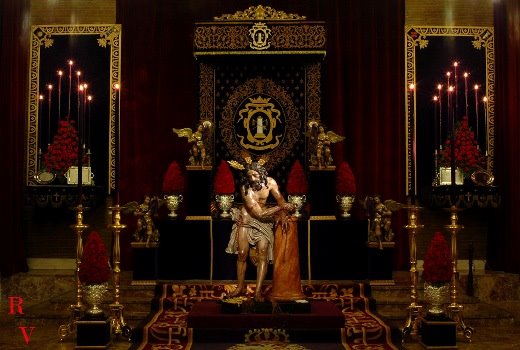
Above, a picture of the posh St. James the Great parish church's high altar in swanky Alabang, one of the wealthiest districts in Manila. The particular suburb in which this church is located is home to some of the oldest, most venerable families of the country. It is a veritable playground of the Spanish mestizeria, the relatively few of them still remaining in the country. What's interesting is that this church was built only within the last decade, having been completed, to the best of my memory, in 1995, blessed by no less than Jaime Cardinal Sin himself. I estimate this retablo to be at the very least 25 to 30 feet high. It is certainly one of the most beautiful built in recent memory.

The usus antiquor was celebrated here on November 14. What a sight it must have been to see the ancient rite celebrated on such a slice of heaven as this.

Tuesday, December 04, 2007

Jesuitry

This will be the last short post in a long while, I promise :D .

So I was talking to my mate Kyle today. Back in high school he had a rather nasty reputation as a playboy slash bad/inattentive student, as well as a bit of the more naughty kids in class (he just didn't like listening to the lectures and amused himself with childish pranks). We didn't go to the same high school; he studied under the Jesuits, and although he wasn't the most religious person out there, Kyle still had the fear of God instilled in him. He was the type of person who would suddenly grow tense whenever the topic of Hell or death would be brought up, though he did not like to admit it. Anyway, Kyle came down with a very bad case of the flu last week. It was one of the worst illnesses he had ever gotten, which caused him to miss five school days.

In an effort to alleviate his fears, he contacted a Jesuit priest to give him anointing of the sick. Unfortunately, he was one of those students who preferred cutting classes and causing trouble more than listening and taking down notes, a fact which this Jesuit priest (who came from a socialite family) apparently never forgot. At his house, he surprised the priest by suddenly asking for the last rites (he apparently tricked the Jesuit, proferring another reason for his visit). Then the surprise came.

The Jesuit, clearly annoyed, suddenly blurted out, 'Tangina mo naman pala, eh', which in English is loosely translated as 'Your b*tch of a mother'. Said Jesuit relayed this without batting an eyelash, in crisp and accented Tagalog. Not knowing what to do, Kyle just laughed, and rather loudly at that, which the Jesuit clearly enjoyed. After giving him last rites, the Jesuit departed, but not without giving my friend a solid smack on the back first.

Ah, Jesuits. Sometimes I don't know if I should still be shocked by their antics. And worse, I don't know whether to laugh or cry at the incident.

Monday, December 03, 2007

Thank God for Nick Names

I was talking to a friend of mine earlier. This friend hails from a very old, very hidden family of Spanish descent. Unlike other mestizos, though, he was what we would call in modern parlance 'jologs', a term which has come to mean kitschy or down to earth or in bad taste or cheap (all of these things and yet none of them-- it's hard to explain. I think nouveau riche isn't accurate at all, but it somehow connotes a misplaced ability to prioritize... or something). The conversation gradually drifted into the subject of names, but somehow he didn't like talking about it.

'What's wrong? Don't you like your name?'

'I do. I have enough saints in my name that they're probably fighting in heaven as to who should be my patron.'

'But don't you think it's good to have many patrons?'

'Sometimes I think I'd rather have just a few'.

'So just what the hell is your whole name?'

'Jose Miguel Alessandro Sebastian Carlo Maria de Aranzazu Felipe Francisco Javier Alfonso Martin Ignacio del Santisima Trinidad, Alzogaray y Acuna.'

'Oh.'

His nickname: Zazu, after the Virgin of Aranzazu.

Wednesday, November 28, 2007

San Martin de Porres


Can I sing you, Brother Martin,
saint whose hands know work, like mine?
Would that we could sit together,
tell our cuentos, sip some wine.

Soon I'll close the church till morning.
Please guide me walking home alone.
Not a safe place for a woman.
Justice this old world postpones.

Speaking to our sweeping rhythms,
let us plot for those in need.
Can't you scare these stubborn faithful,
with your powers intercede?

Bread you gave to those in hunger,
kindness to the child alone,
held the trembling hand that suffered,
kindness from a man disowned.

Is it true when you were sweeping,
cats and dogs would come to chat,
telepathically you'd answer,
query disbelieving rats?

Brother Broom, with just a handshake,
you could cure a soul in pain.
Oh, I wish that you could touch me,
make these old joints fresh again.

Would that you had time to teach me
bilocation, such a trick,
not that I deserve the honor
and pleading seems impolitic.

You liked flying and liked gardens,
so practice aerial delights.
Come see roses, tulips, daisies.
Can't I whet your appetite?

Ay, that I had seen the shining,
from your oratorio,
in your habit, man so prayerful,
that your very self would glow.

How we come, the dark-skinned faithful,
comforted to see you here,
able to confide our sorrows
to a black man's willing ear.

Your corrido I must finish
for priests frown at such casual songs,
frowning is their special talent,
but still, protect them all night long.

Help me listen to my garden,
cease wrinkled judgments based on skin,
our colored sacks like bulbs or seeds
that hold our fragrant selves within.


From the excellent book, 'Aunt Carmen's Book of Practical Saints', by Pat Mora. This was an instant favorite of mine-- get this book as soon as possible! It is well worth the read.


Sunday, November 25, 2007

Papal Mass of the Proclamation of the Assumption


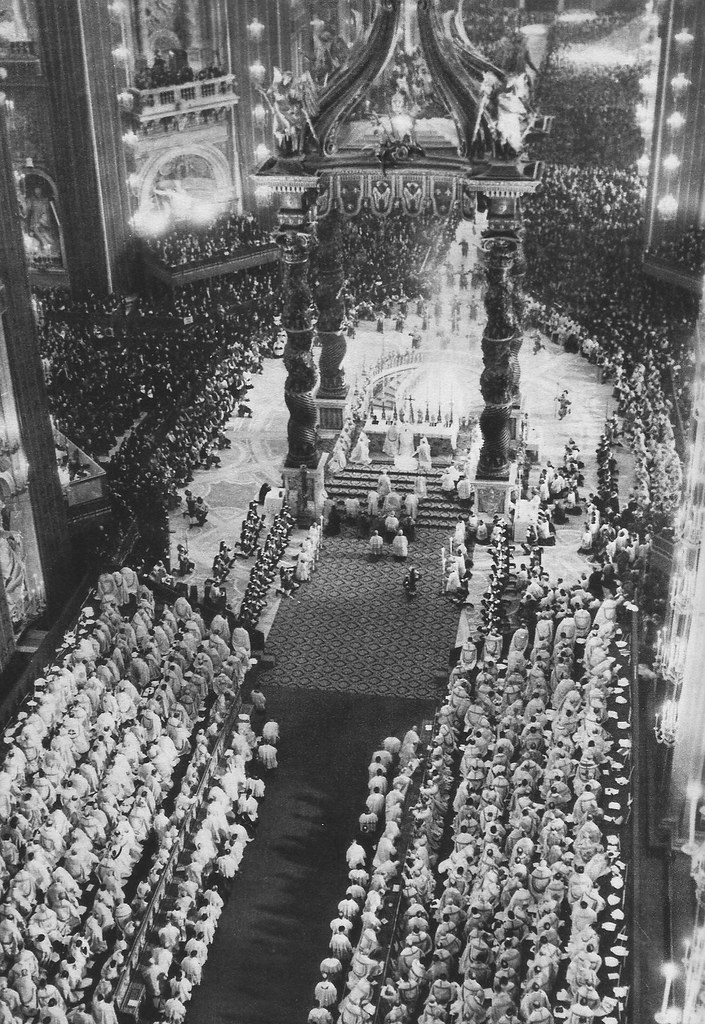
I really like this picture. There are certain truths that only images can capture-- words can only do so much, and are limited to the scope of truthfulness they possess. The icon, the image, however, reveals this truth as it has always been. If we want to know what it means to be Catholic, the life of the Church-- Her ceremonies, liturgies, and mystery-- should be our starting point. From Msgr. Pierre Pfister, the French canon at the Lateran Basilica:

"On this morning of the extraordinary All Saints' Day of 1950, it was quite impossible to move in the crowd of more than half a million. The majority chose to watch the rite of the definition of the dogma outside the basilica. Those who filled the interior were able to hear the Pope's voice through loud-speakers, and, in this setting, as thrilling as it was awe-inspiring, they could watch his processional entry and the Mass in which the new text was followed for the first time. It is the supreme moment of the Consecration. All are kneeling, and the Noble and Swiss Guards are giving a military salute."

Friday, November 23, 2007

Come apart into a desert place, and rest a little


Sometimes we can be too restless, even in the practice of religion, that we end up not doing anything at all. We are too busy theologizing, arguing, apologizing, party lining, bitching, whining and even thinking about too much that there can be a real danger of adapting--nay, conforming-- our religious lives to our secular lives. Of course, ultimately, one has only one life to live, and it is understandable when these two spheres occasionally collide with each other.

The problem I see with this is that religion basically becomes a hobby. We argue it, fight for it, debate it, bitch about it, but hardly practice it. I guess, with the arrival of the internet, this tendency has been more especially pronounced than before. Nowadays it is so easy to come across religious polemics, both pro and against it, that I sometimes have to wonder if being religious today is just another fad. We have many Catholics who know the minutiae of papal ceremonial, for example, but can't stand a simple roadside shrine Mass. We have so-called traditionalists who seem to exist for the sole purpose of criticizing everything that the Pope says or does, and we have even worse progressives who think they are the only people in the Church who constitute a valid voice, and who are seemingly more concerned with the cosmetic facets of the Mystical Body (actually, I think both sides are guilty of this) than its preservation.

There is a very real danger here of arrogating the Church-- and ultimate Its Head, Jesus Himself-- exclusively to oneself. Somehow, there seems to be a growing, if cryptic, trend that is slowly equating religiosity with being a busy-body. Nowadays, to be a 'true' Catholic, one must have a certain set of politics and ideal world view, all wrapped up and packaged with a shiny, red bow; or you can just as easily swing to the other side, and claim that being a 'true' Catholic means an almost exclusive devotion to issues of social justice and diversity and acceptance. Both speak of the arrogance of our age; we are all too busy of thinking of ourselves as the evolutionary apex of Catholicism that we too often forgot our own humanity-- and consequently, that we, too, are sinners.

For all it's worth, the picture above is, quite simply, sublime. In prayer, in bended knees and folded hands, the world rests; a fragile world, resting on fragile hands, taking in the whispered breaths and voiceless sighs of equally fragile men and women. Prayer gives peace to the soul. Prayer reveals the sweet face of Christ. If there is anything we need to pay more attention to, it is prayer-- and to learn how to pray, we must first shut up.

Thursday, November 22, 2007

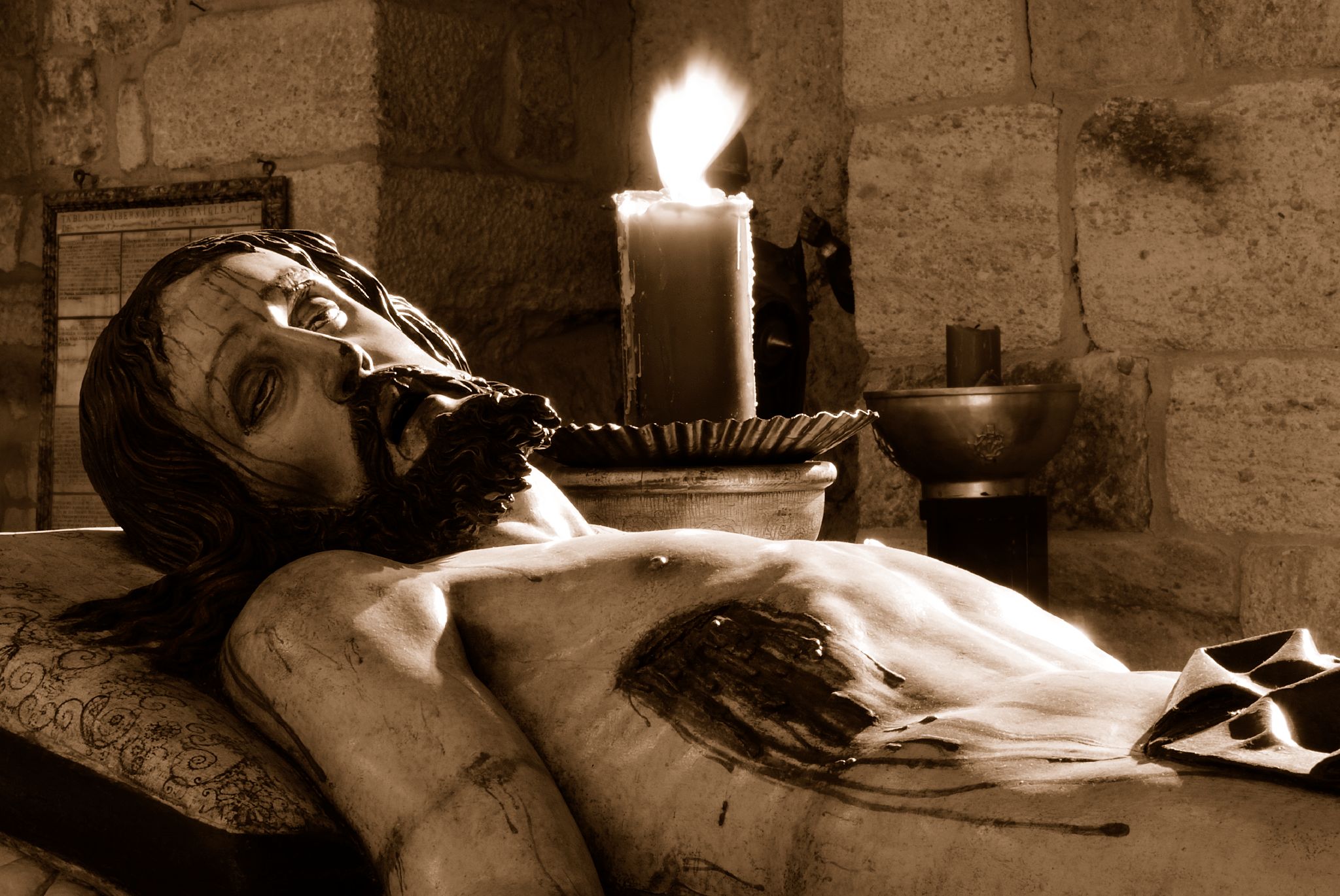
Cristo Yacente


From the taller of the sculptor Gregorio Fernandez, a fine example of 16th century Spanish Baroque. This image is kept in the church of Santa Maria de la Nueva in Valladolid.

Monday, November 19, 2007

Prayers for My Grandmother

Today, 19th November, marks the third death anniversary of my paternal grandmother (1923-2004). She was a devout Catholic in life, and prayed the holy rosary morning, noon, and night, and read Scripture at every moment she can. In life she was a brilliant teacher, having founded a Catholic school in their neck of the woods, which remains, to this day, a bright light in their area. Your prayers would be especially appreciated-- of the holy souls in purgatory, it is written that they shall plead for us before the Divine Tribunal in the hour of despair. It is a good and wholesome thing to pray for the dead.

Friday, November 16, 2007

On Love and Devotion


European visitors to the Philippines in the twilight of the Spanish colonization often noted the exotic, often 'excessive' devotion of the native people to the saints-- they bowed and knelt before statues, wiping its face, hand, feet, and sides with handkerchiefs in broad, sweeping motions, and often placed wreaths and garlands of flowers upon the saint's image. The devotion to the Santo Entierro-- the dead Christ-- often reached feverish heights in some places, such that pulling the ropes of the image's carriage was often seen as a fountain of innumerable graces. Even today, many processions still retain a certain awe to inspire even the most brazen of non-believers. I've blogged enough about the Black Nazarene, the Lord of Quiapo, whose procession every January 9th attracts, in some cases, up to a million people, rich and poor alike. They go about their panatas solemnly and yet at the same time with a sense of merriment that could only be called medieval.

The educated Spaniards and their mestizo illustrado counterparts called this show of excessive piety 'una devocion horrorosa', decrying the superstitious facade of many of these celebrations. Looking at the image above, the children are grasping the arms and hands of the Lord; some are taking pictures, some are blessing themselves, some are content just to be able to witness the scene. Christianity is a religion, first and foremost, of a Person; a Person can love, can be angry, can be merciful, is. Logically, of course, a Person can be the recipient of love and devotion, because only another Person is able to comprehend and return these things. You can't have a devotion to a Book, however lovely and beautiful it is, because it does not understand things like love, beauty, and truth. At best, they are just repositories of it.

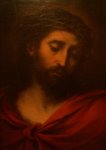
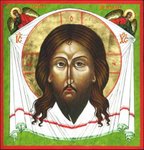
Those people above have had their lives shaped by the face of Christ, that sweet, melancholy face fraught with all the bitterness and hatred of the world, and yet still manages to be a refuge to even the most desperate. They kiss and wipe and touch His cheek every Good Friday and kiss and wipe and touch His cheek as a newborn babe on Christmas day. These are people who grew up with the haunting image of the God-Man's face etched in the deepest recesses of their hearts and guts. As someone wise once said, the Bible is perhaps the most beautiful book in all of creation-- it is God's personal love letter to us-- but remains a letter nevertheless. To love another person necessarily transcends the boundaries of the spoken and the written, its communication distilled to its purest in the silences and sighs that span the space between seconds, and cover the whole of eternity. To love is its own reward, and there could be no more greater one than it.

At the end of the day, whom would you rather trust: the one who knows the love letter by heart, or the one who has actually loved? These are things that we have largely forgotten, and desperately need to remember.

Tuesday, November 13, 2007

Bastards!!!

Blast hits Philippine congress, 1 killed.

This occurred roughly five to ten minutes away from where I live. At around 8pm this evening, Manila time, there was a loud, booming sound that jolted me from my dinner. I didn't pay much attention to it. It was only after half an hour that I found out about the terrible news. I drive through this area every day; there is a public school just in front of the House of Congress, which, up until last year, had classes all the way till ten in the evening to accommodate its large number of students. To think what might have happened had the school continued that policy. To think I was planning on going out tonight.

They are reporting that a Muslim congressman is the latest to die in the explosion; the first casualty was a driver for one of the congressmen. Please pray for the souls of the injured and the departed. Please pray that whoever son of a bitch did this will fall.

Monday, November 12, 2007

Towards a Catholic Democracy


For you are all the children of God by faith, in Christ Jesus. For as many of you as have been baptized in Christ, have put on Christ. There is neither Jew nor Greek: there is neither bond nor free: there is neither male nor female. For you are all one in Christ Jesus.

-Galatians 3:28

The following post deals with a very messy topic: politics.I am not an expert on political science, but government is a subject that has always intrigued me. It has taken me a lot of days to write this, partly because I am so very busy, and partly because I haven't had the right 'moment' to start it.

Some of my readers may recall a certain post which I blogged way back in December of last year, wherein I expressed my main gripes with democracy. It shouldn't be too hard too find, as it is the only post for that month. Back then, I was still very much a self-confessed 'radical traditionalist'; my concerns were still very much political, and most of the time I wanted to turn this blog into a little corner where all my rants and gripes could be expressed. The only thing that stopped me from doing so was that I didn't really like controversy.

Today, I am a very different person-- I am a lot more sober and realistic in dealing with things, and I am a lot more 'level-headed', compared to my overly-impassioned self eleven months ago (not that this is entirely bad, mind you). Part of this change involves my own political views, which have, interestingly enough, been more 'leftist', in that what some of us might call 'Catholofascism' started to lose its appeal to me. Perhaps it is because I am currently in the university that this has happened; perhaps this change is due to myself alone, the external factors helping only slightly. Needless to say, I have beens saying a lot of things lately which would have made my blood pressure climb through the roof just over a year ago. What a difference a year makes!

To tell the truth, I am still sort of suspicious of democracy, at least the version of it that we are all familiar with. I stand by my earlier convictions that it is a system which can be heavily prone to abuse, from both far-leftists and far-rightists. It is a thing of incredible, indelible irony, indeed, that many governments could justify their totalitarianism under the guise of the people's will; it has been so abused that democracy has practically been stripped of any political significance. Be that as it may, I have begun to rethink my earlier position, namely, that democracy is an inherently flawed, and evil political system.

The seeds of this process began some moons ago, when my parents, out of the blue, began to reminisce on the Martial Law days of the Philippines from the 1970s to the mid-1980s. Adding to the growing bonfire was the spate of high-profile murders of journalists and leftists, which reached a feverish peak in May of this year, when the senatorial elections took place. I guess what really prodded me to be suspicious of far-rightists was the pregnant silence of the Philippine government on the matter of these killings. It was the kind of silence that one would expect from a cabal, or an anti-clerical entity like the Freemasons. I won't go into details here, but I seem to have lost much of my trust in the government.

Romanticism can be a very dangerous thing: what the freedom fighter is to one group could very well be an anarcho-terrorist extraordinaire for another. An excess of the romantic spirit could just as well be dangerous as a deplorable lack of it. It all comes full circle, as the adage goes. That is why legislation can be a very dangerous thing: it reduces problems into a set of propositions, and by the might of a majority, proclaims it as gospel truth. In fact, I think the gravest problem of democracy is its ability to provide too many answers for a single question.

But then again, to say that democracy is in itself an inherently evil thing would be just as wrong as saying that it is God's best gift to mankind after silly string. As is well known to all, democracy comes to us form the Greeks, a term which means 'the rule of the people'. Going back to the Greeks, we have Plato and his student Aristotle, both intellectual titans of the ancient world. Plato, of course, is more idealistic and poetic, while Aristotle's though focuses on the pragmatic and the scientific. To cut a long story short, Aristotle disagreed with his master's positions. Plato mentions in his Politeia that there are roughly three types of government: tyranny, oligarchy, and democracy. Aristotle differs from his master in that he classes these different systems in a somewhat hierarchical manner: first, monarchy, then the aristocracy, and lastly, polity. He cites these three systems for their pragmatism and efficiency.

Given the intelligence of the Greeks, one would expect the kind of liberal socialistic-democracy we have today to be the same rule of law as back then. But, as it turns out, this is not the case. Aristotle still endorsed slavery and reserved education to the ruling class; Plato believed in a totalianarian absolutism, where all power rested in the reigning, 'enlightened' monarch. This democracy, then, is just as elitist as the aristocracy. Mob rule would be a more fitting term.

The arrival of Christianity brought about an unprecedented change in European civilization, a very radical one, indeed. We see how it was necessary for the arrival of the Christian religion to develop democracy as we know it today: without Galatians 3:28, Europe could still very well be composed of barbarians, reavers and slavers. Without that verse, we would not have the concept of human rights, fair trial, dignity, freedom or a transcendent happiness. The concept of a People of God was not yet established; but with its establishment came the sense of entitlement we have today. Thus we can demand our rights to free speech and a fair trial because of the radical notions of Christianity, which liberated entire peoples from slavery to the pagan gods. We can shout for our dignity at the behest of others because Christianity taught that all peoples were equal in the eyes of God: kings and bandits alike were of the same substance, and would one day be subject to the same judgment. But whither each shall go, remains to be seen.

Would we really want to live in a world without free speech or thought? Would we really want to live in a world where a commoner can never question the infallible words of a monarch? Would we really want to worship in a Church where the word of a corrupt bishop are heard as the voice of God? None of us would like to do so. The danger in idealizing monarchy as an infallible ideal is that we run the risk of associating God with a certain politics, effectively confining Him under the limits of a few zip codes. This is in marked contrast to what the Church has always taught about God: that He is everywhere, being confined by neither time nor space. He is not a provincial, back water deity, but the God of the Nations, the Lord of Hosts.

The problem with today's praxis of democracy is the overwhelming lack of responsibility on our part. Consequently, legislation loses all its meaning and morphs into a whimpering paper tiger, which can be freely challenged at anytime. We patent laws and statutes which have no meaning at all other than to serve as witnesses to our own decadence and sin. In due course, we arrive at the democracy envisioned, or at least taught, by Aristotle: a veritable anarchy, where the rule of the mob is law. We thus arrive at the old elitisms and cease to progress.

The danger of assuming that God has certain politics is that we eventually make that god contingent to our own politics; it is a god that ceases to exist outside the confines of Republican or Democratic territory. This god, then, is an elitist god, that hogs all power unto itself. We lose the light, and are slaves to the darkness once more.


"Their gods were sadder than the sea,
Gods of a wandering will,
Who cried for blood like beasts at night
Sadly, from hill to hill."

-Chesterton